Juan Genovés
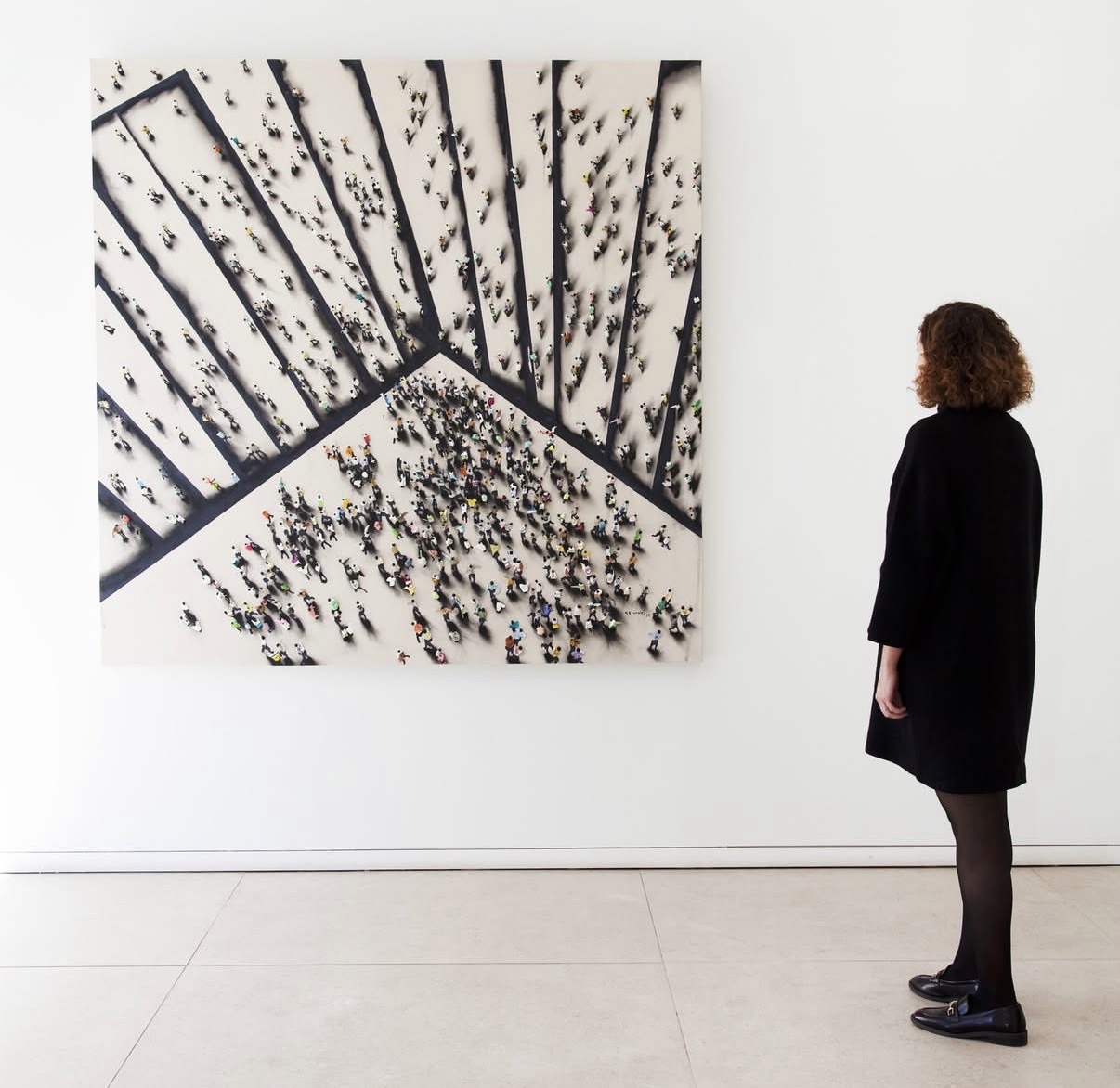
Juan Genovés: The Poet of Human Solidarity
Artist Spotlight · The Collection Editorial
In 2016, Spain's Museo Reina Sofía in Madrid staged a landmark retrospective of Juan Genovés, bringing together decades of work that had quietly shaped the conscience of Spanish art. The exhibition drew visitors who stood transfixed before his iconic aerial crowds, those small urgent figures rendered in cool photographic tones, frozen in the act of running, gathering, or scattering as if caught by a surveillance camera trained on history itself. It was a reminder that Genovés was not simply a painter of pictures but a chronicler of the human condition under pressure, a witness whose art never lost its sense of tenderness even at its most politically charged. By the time of his death in Valencia in 2020, at the age of ninety, he had earned a place among the most significant figurative painters to emerge from twentieth century Spain.
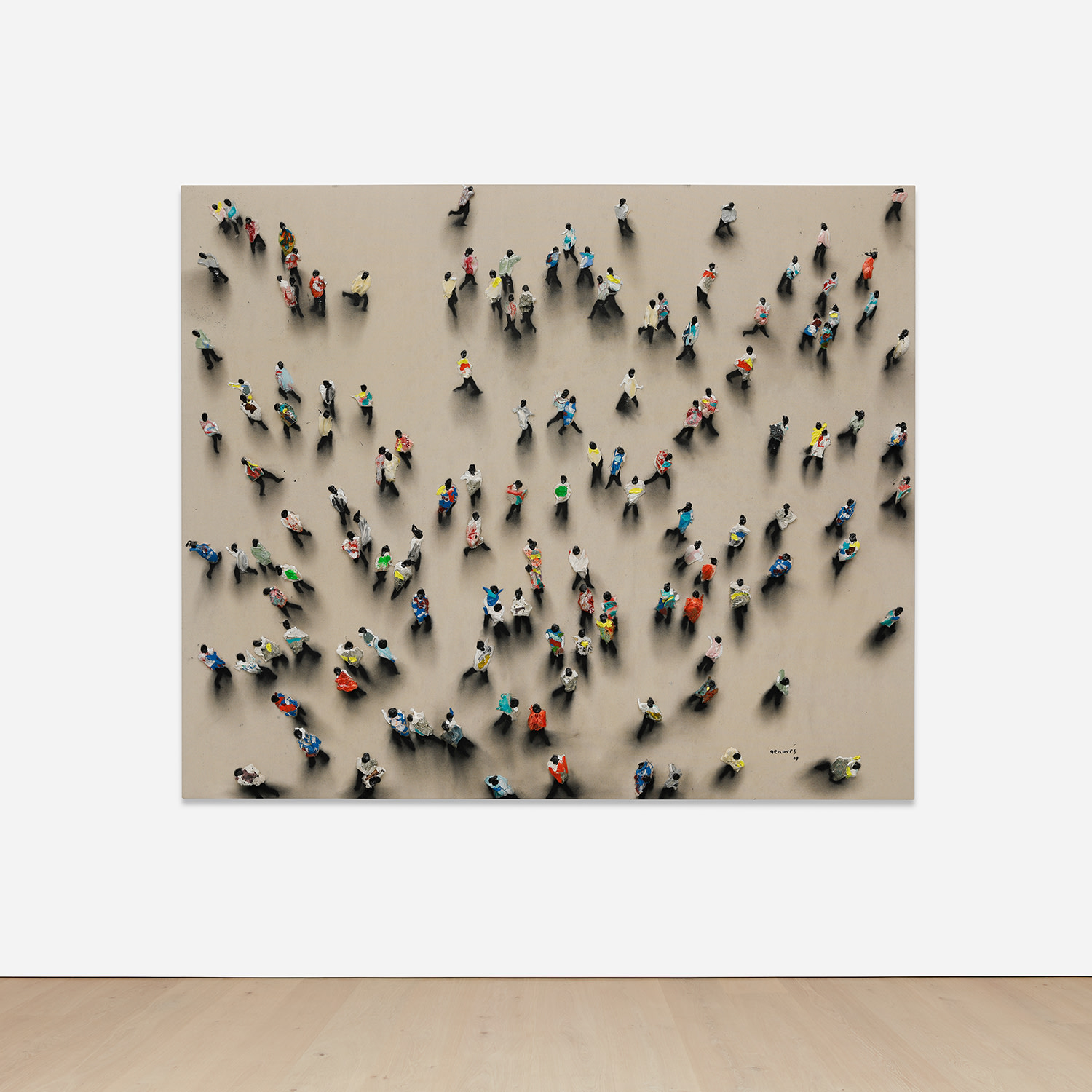
Juan Genovés
Mirada al horizonte, 2008
Juan Genovés was born in Valencia in 1930, into a country that would soon be convulsed by civil war and then locked into the long authoritarian stillness of the Franco regime. Growing up in Valencia, a city with a rich tradition of painting and a strong popular culture, he developed an early sensitivity to the visual world. He trained at the Real Academia de Bellas Artes de San Carlos in Valencia, absorbing the classical foundations that would later make his departures from convention all the more deliberate and powerful. The contrast between academic formation and the political reality pressing in from outside gave Genovés a creative tension he would spend a lifetime resolving on canvas.
In the late 1950s and early 1960s, Genovés aligned himself with the Estampa Popular movement, a loose collective of Spanish artists committed to social realism and printmaking as tools of resistance against Francoism. This was a decisive turn, moving him away from purely formal concerns toward an art that carried weight and responsibility. By the mid 1960s, however, he had begun to develop the aerial perspective that would become his signature, a God's eye view of anonymous crowds that transformed political subject matter into something more philosophically expansive. His participation in the 1966 Venice Biennale, where he received an award, brought him to international attention and confirmed that his visual language had a reach far beyond the specific circumstances of Spanish politics.
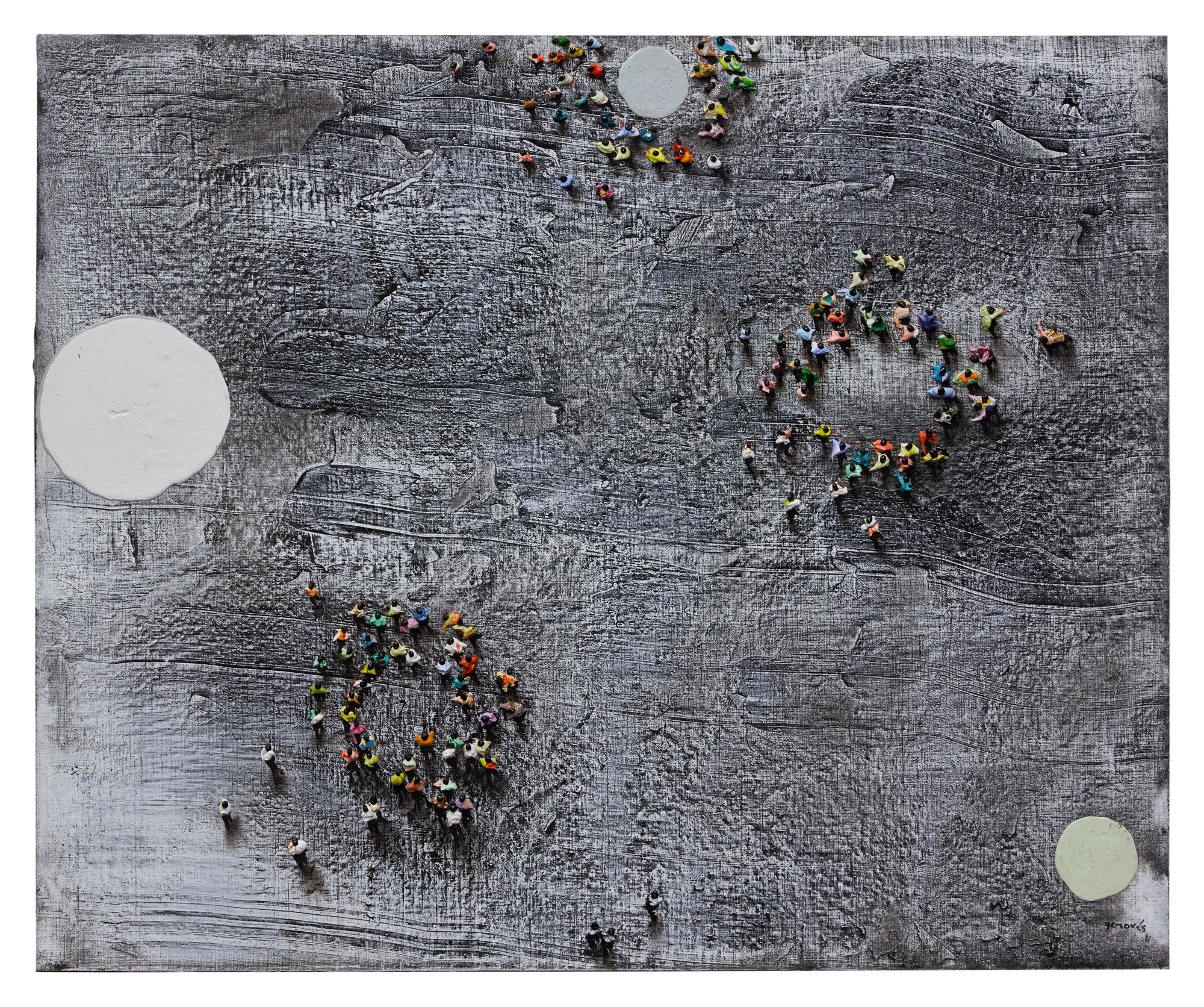
Juan Genovés
Tres, 2011
The works from the late 1960s and early 1970s represent perhaps the most concentrated period of his artistic achievement. Paintings like "Rebasando el Limite" from 1966, available through The Collection, show the full force of his approach: figures viewed from above, compressed into a frame that suggests both surveillance and vulnerability, painted in a restricted palette that evokes documentary photography without ever fully surrendering to it. These are images that feel simultaneously specific and universal, rooted in the Franco era but speaking directly to any moment when individuals find themselves overwhelmed by power or circumstance. The monoprints he made around 1970 extend this sensibility into the graphic medium he had explored since his Estampa Popular days, demonstrating a fluency across materials that collectors continue to find compelling.
What is remarkable about Genovés is how his practice evolved over the following decades without losing its essential humanity. Works from the 2000s and 2010s, including "Mirada al horizonte" from 2008, "Trasiego" from 2006, and "Columna I" from 2009, show him working with acrylic, plaster, fabric collage, and resin in ways that bring new textural richness to his compositions. The figures remain, still moving, still anonymous, still poised between togetherness and dispersal, but the surfaces have acquired a material presence that gives them an almost archaeological quality, as if these scenes of human movement had been excavated rather than painted. "Tres" from 2011 and "Cumbre" from 2014 continue this dialogue between the photographic and the painterly, between the documentary impulse and the lyrical.
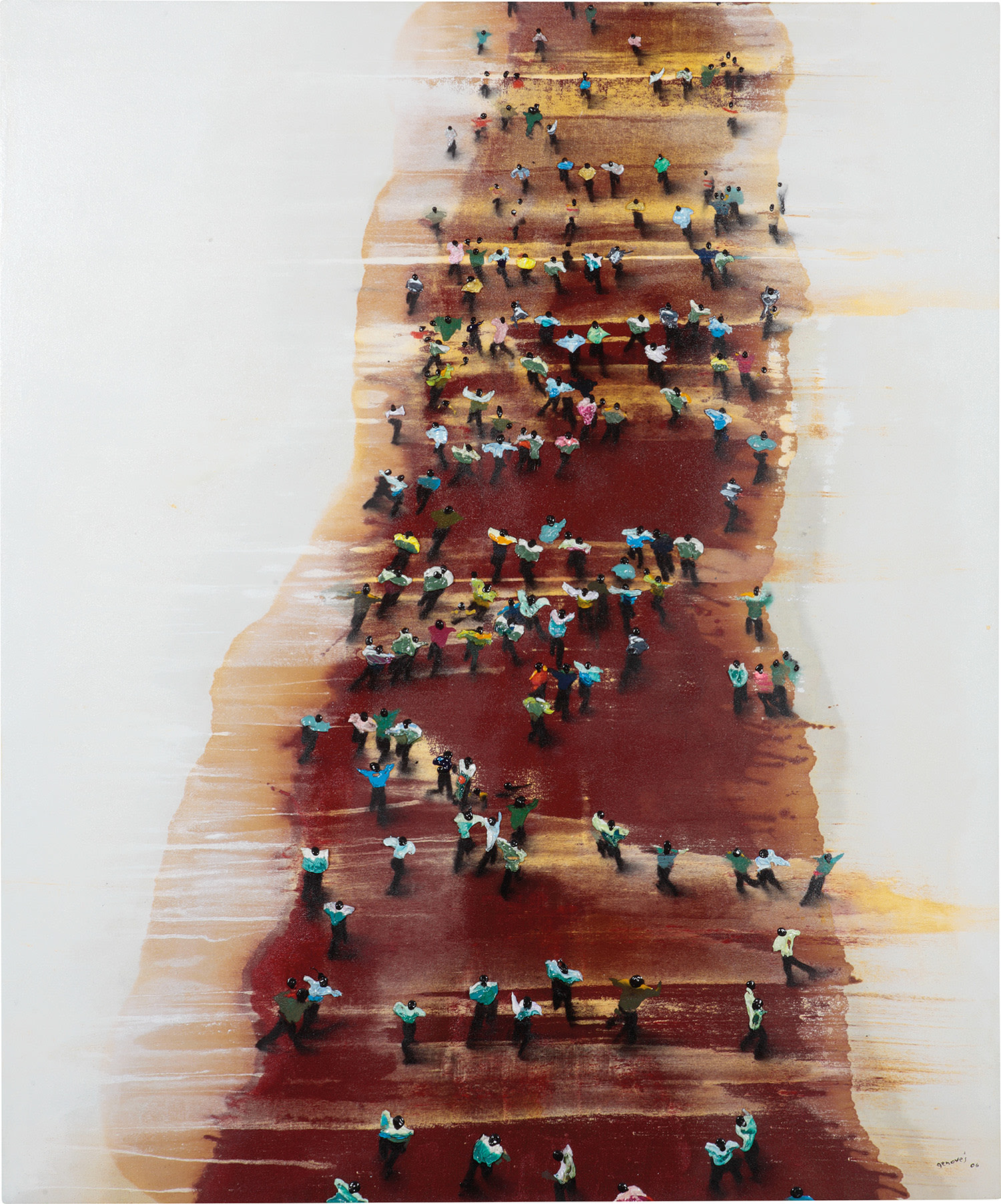
Juan Genovés
Trasiego, 2006
"Tosco" from 2019, made just a year before his death, stands as evidence of an artist who never stopped asking questions of his own medium. For collectors, the appeal of Genovés rests on several foundations that have only strengthened with time. His work occupies a unique position at the intersection of European political art, Spanish modernism, and the broader international conversation about figuration and photography that defined the postwar decades. He is genuinely admired within Spain and collected internationally, with works held in major institutional collections including the Museo Reina Sofía and the Museo de Bellas Artes de Valencia.
His range of media, from oil on canvas to mixed media works incorporating collage and resin, means that collectors at different points of entry can find works that reward close looking. The earlier oil paintings command serious attention at auction as historical documents as much as aesthetic objects, while the later acrylic and mixed media works offer a softer accessibility without any sacrifice of intellectual depth. In the broader sweep of art history, Genovés sits in illuminating proximity to artists who similarly used the human figure as a vehicle for exploring collective experience and political power. His aerial crowds invite comparison with the German artist Gerhard Richter, whose photo paintings probe the tension between the documentary and the painted image.
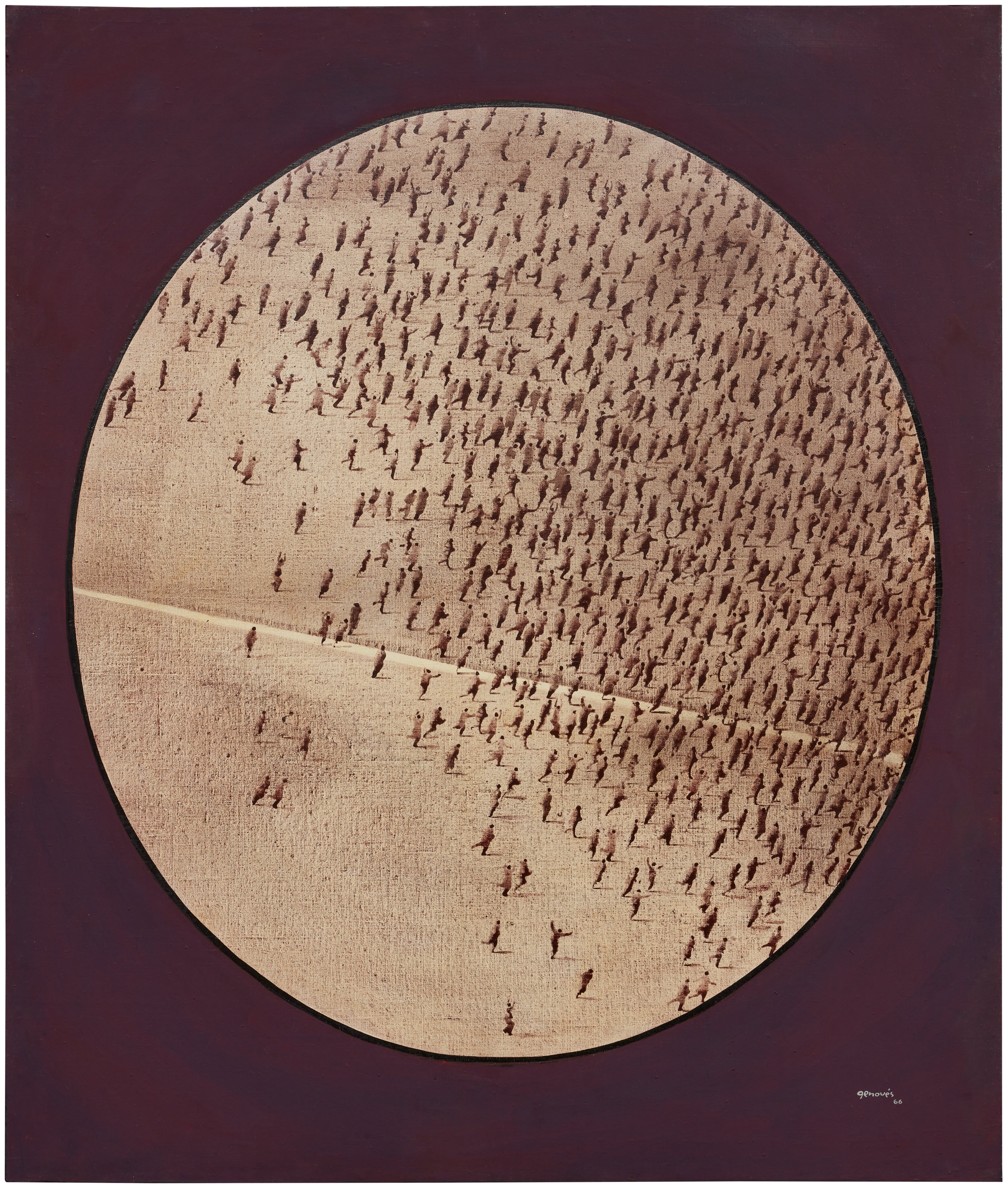
Juan Genovés
Rebasando el Limite, 1966
There are affinities too with the American artist Leon Golub, who also bore witness to state violence through figurative painting, and with the Spanish sculptor Eduardo Chillida, whose abstract forms carry a comparable moral seriousness. Within Spain, Genovés belongs to a generation that includes Antonio Saura and the members of the El Paso group, though his figurative commitment always set him apart from the dominant informal abstraction of that moment. The legacy of Juan Genovés is one of rare coherence and purpose. He spent sixty years asking the same essential questions: what does it mean to be a body among other bodies, to move through public space, to be seen from above or to disappear into a crowd?
Those questions feel no less urgent today than they did when he first posed them under the shadow of Francoism. In an era of mass surveillance, political polarization, and the daily spectacle of collective movement captured on screens, his imagery reads as almost prophetic. To live with a Genovés is to keep a conversation alive about what it means to be human in the face of forces larger than any individual. That is a rare and precious thing to have on a wall.