Josef Hoffmann

Josef Hoffmann: Where Beauty Meets Brilliant Function
Artist Spotlight · The Collection Editorial
There is a particular kind of object that stops you in a room. Not because it shouts, but because it hums with a quiet, earned authority. A silver plated tray, its surface hammered into a gentle texture that catches light like water. A mirror whose frame seems to have been thought about rather than merely made.
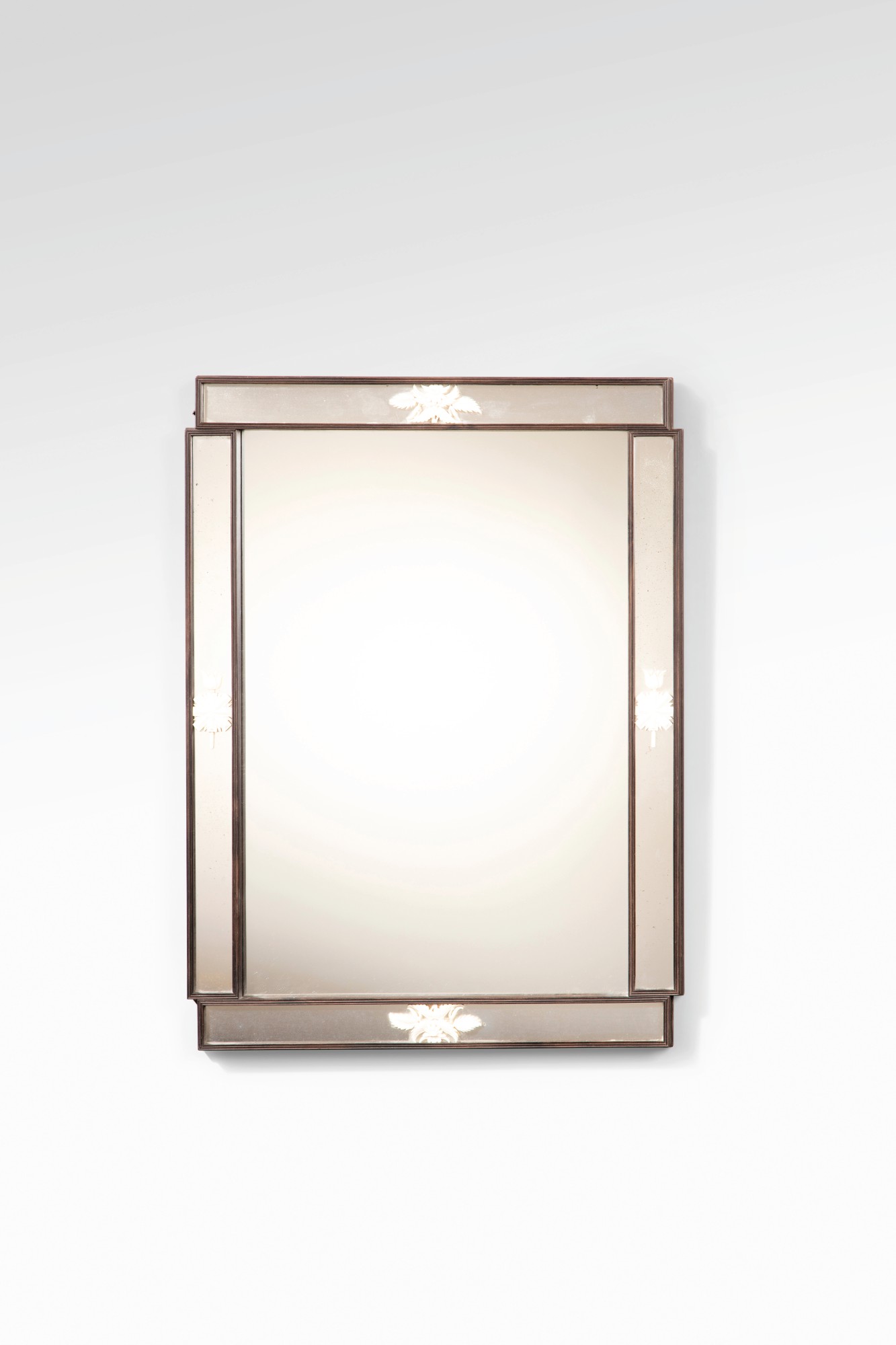
Josef Hoffmann
Miroir
These are the kinds of objects Josef Hoffmann gave to the world, and they continue to arrest collectors and curators more than a century after they first left his hands. The Vienna Museum of Applied Arts, the MAK, has long served as a cathedral to Hoffmann's legacy, and recent years have seen renewed scholarly and market attention devoted to the Wiener Werkstätte circle he helped found, with major institutional loans and traveling exhibitions reminding global audiences just how radical and enduring his vision truly was. Josef Hoffmann was born in 1870 in Pirnitz, a small town in Moravia, which was then part of the Austro Hungarian Empire and is today in the Czech Republic. He grew up surrounded by the robust craft traditions of Central Europe, and this early immersion in the made object never left him.
He studied architecture in Vienna under Otto Wagner, one of the defining figures of the Viennese Secession, and it was in that electric intellectual environment that Hoffmann began to understand the designed world not as decoration applied over structure, but as a unified, total proposition. Wagner's insistence that modern life demanded a modern visual language lodged itself permanently in Hoffmann's sensibility. In 1897, Hoffmann was among the founding members of the Vienna Secession, the breakaway artists' movement that sought to dissolve the barriers between fine art, architecture, and the decorative arts. This was not a minor institutional gesture.
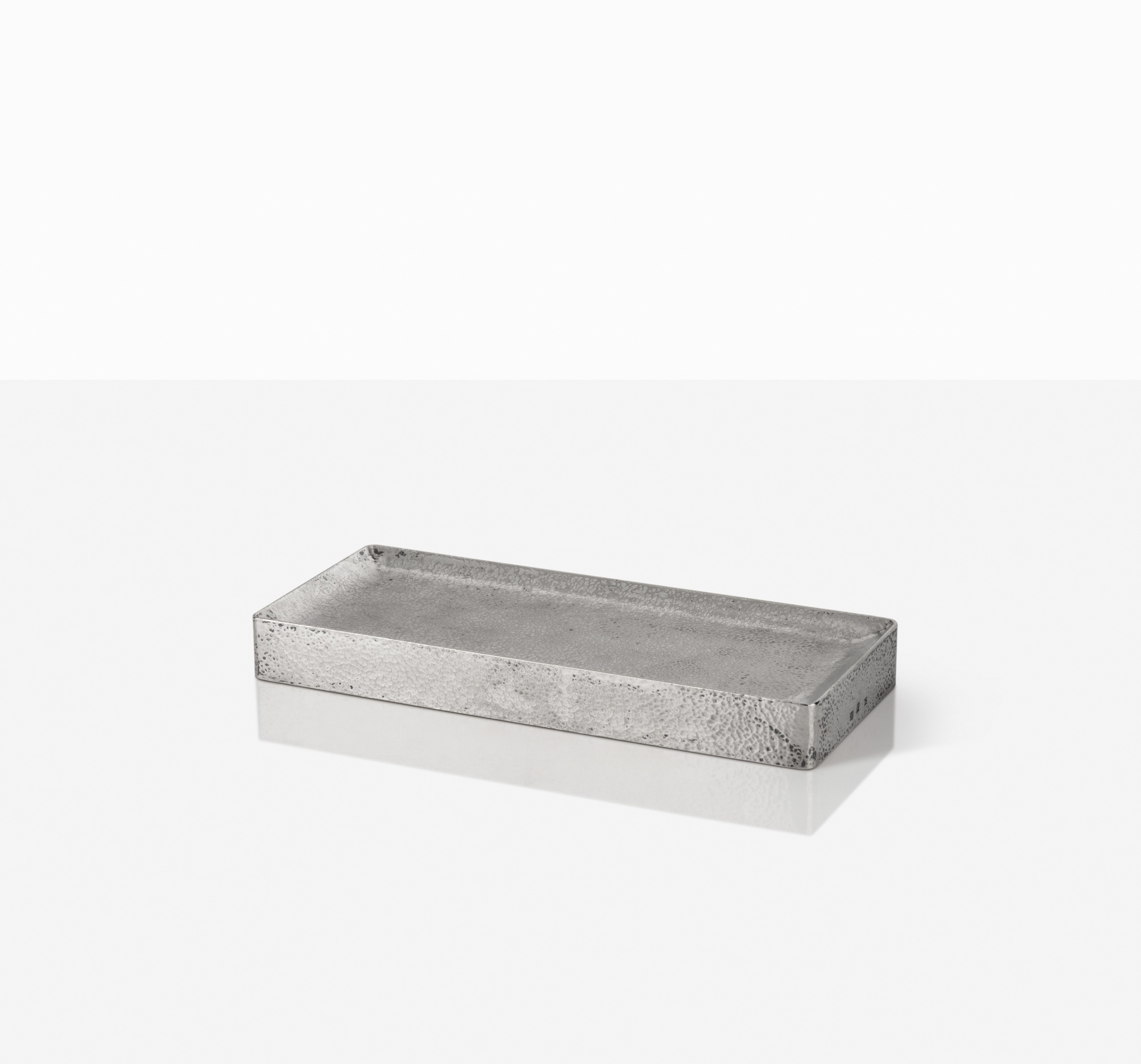
Josef Hoffmann
Plateau, modèle M1195
It was a declaration that beauty had no hierarchy, that a perfectly designed teaspoon was as worthy of serious attention as a painted canvas. The Secession's early exhibitions, held in the now iconic building designed by Joseph Maria Olbrich on the Friedrichstrasse, drew enormous public interest and connected the Viennese avant garde to currents running through Glasgow, Brussels, and Munich. Hoffmann was at the center of this exchange, absorbing and contributing in equal measure. The founding of the Wiener Werkstätte in 1903, alongside Koloman Moser and with the financial support of the industrialist Fritz Waerndorfer, was the moment Hoffmann's ambitions took permanent, tangible form.
The Werkstätte, meaning workshop in German, was a collective of craftspeople and designers dedicated to producing objects of the highest quality for domestic and civic life. Hoffmann's architectural masterwork, the Palais Stoclet in Brussels, commissioned by the Belgian financier Adolphe Stoclet and completed around 1911, stands as perhaps the greatest monument of the Gesamtkunstwerk ideal, a total work of art in which every surface, every fitting, and every piece of furniture was conceived as part of a single, coherent visual argument. The building is now a UNESCO World Heritage Site, a designation that speaks to its continuing power to astonish. The works that collectors most ardently pursue today reflect the Hoffmann sensibility at its most distilled.
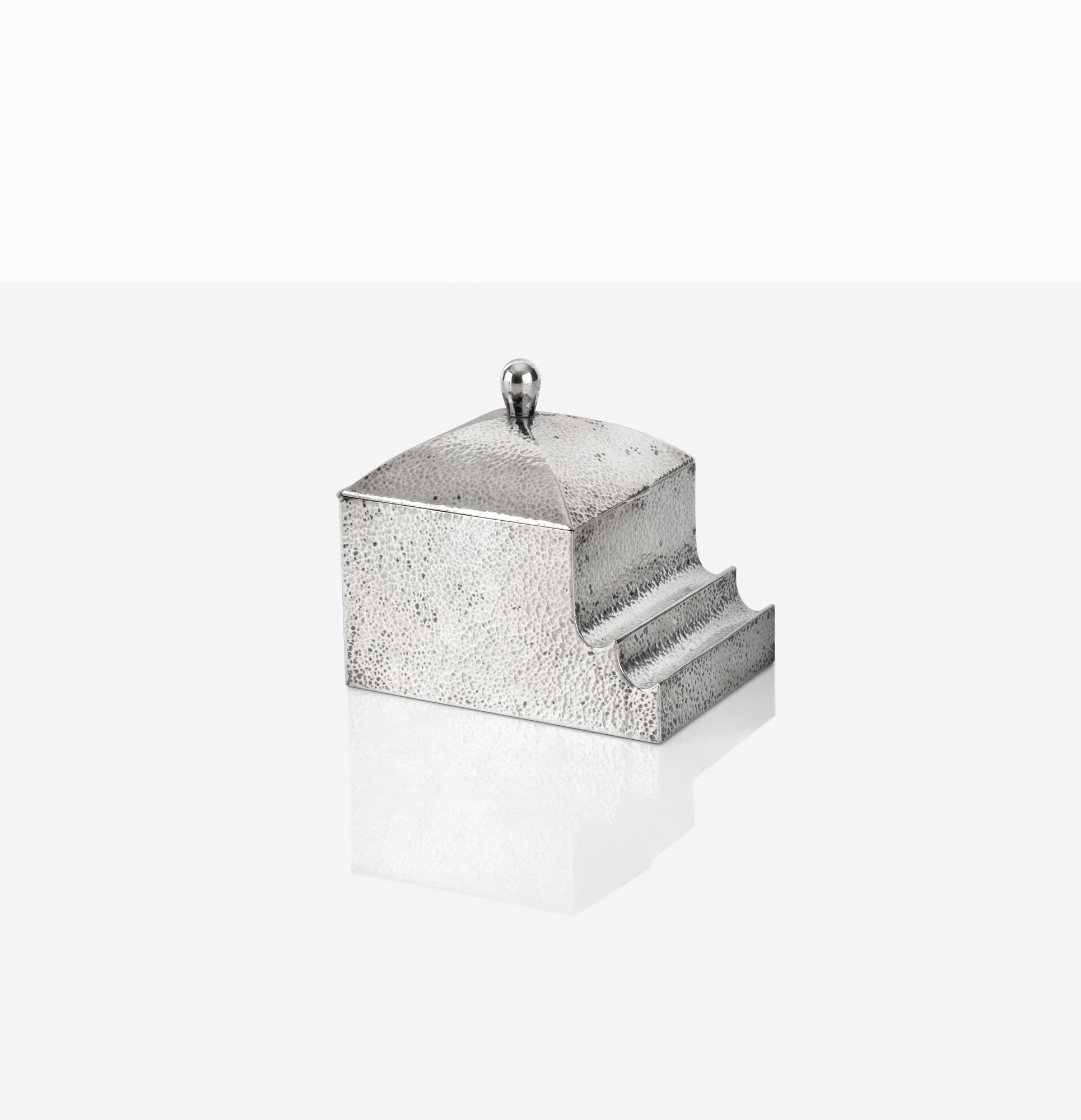
Josef Hoffmann
Encrier, modèle M2079
His silver plated and hammered alpaca pieces, including trays, inkwells, and ashtrays produced through the Wiener Werkstätte, demonstrate his extraordinary command of surface and proportion. The hammering technique he favored was not merely decorative. It was structural thinking made visible, a way of stiffening a thin metal form while simultaneously animating its surface so that it seemed alive to changing light. The Plateau modèle M1195, the Encrier modèle M2079, and the Cendrier modèle M0555 are exemplary in this regard.
Each object exists in a state of complete resolution, as though no further adjustment were possible or desirable. A mirror attributed to Hoffmann carries the same quality of settled confidence, a frame that does not compete with what it holds but completes it. In the auction market, Wiener Werkstätte metalwork and objects designed by Hoffmann have commanded serious prices at Christie's, Sotheby's, and Dorotheum, the Viennese house that is perhaps most attuned to this material. Collectors drawn to Hoffmann are typically those who appreciate the point where Modernism and craft intersect, where the rigorous geometry of the early twentieth century avant garde is expressed not through painting or sculpture alone but through the objects of daily life.
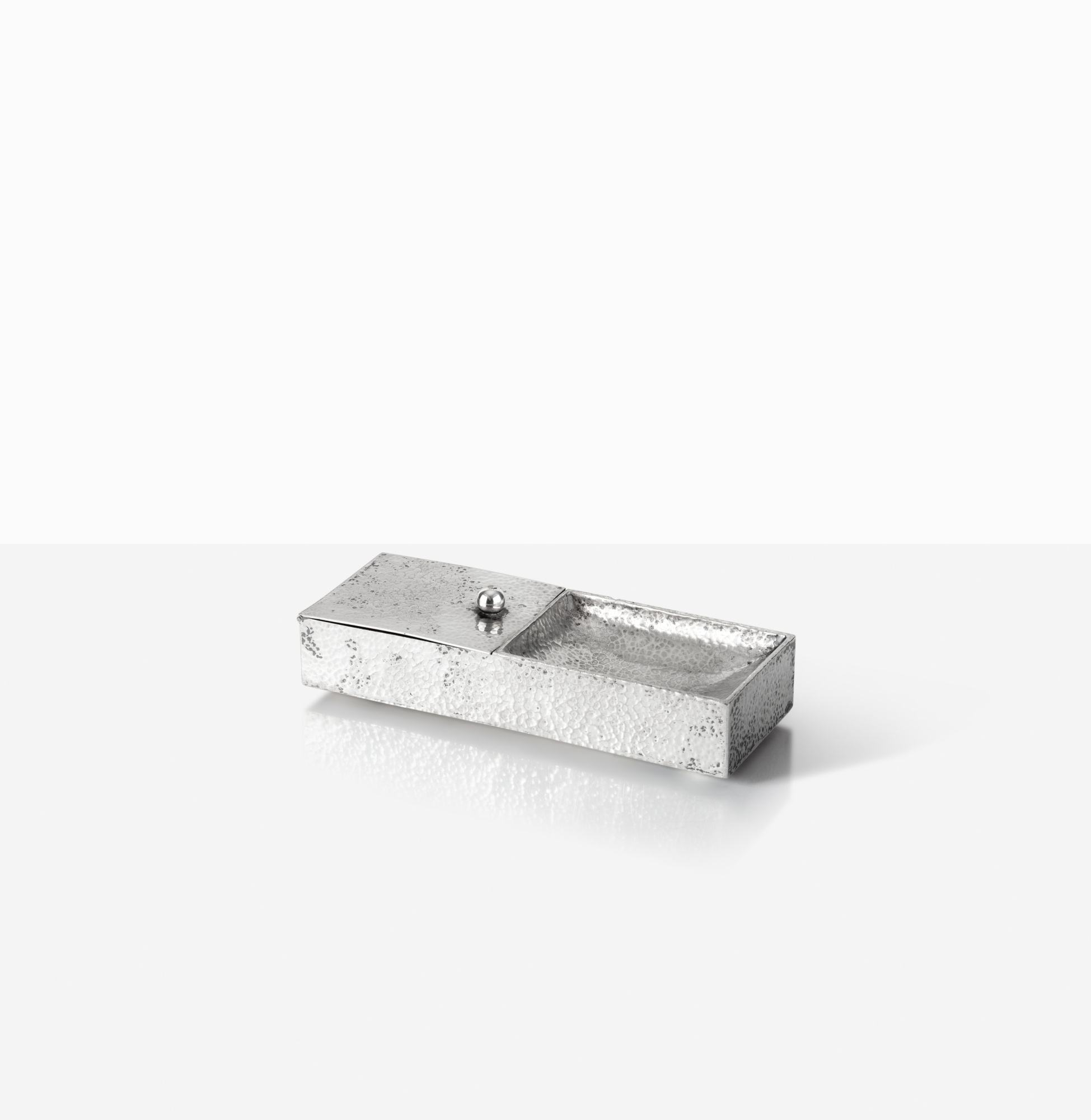
Josef Hoffmann
Cendrier, modèle M0555
The condition and provenance of Hoffmann pieces matter enormously. Works with clear Werkstätte marks, clean surfaces, and documented histories consistently outperform at auction. Given the breadth of his output, from large architectural commissions to intimate tabletop objects, there is meaningful entry into this collecting area at a range of price points, making Hoffmann unusually accessible for a figure of his historical stature. To place Hoffmann properly in art history, one must think of him alongside figures such as Charles Rennie Mackintosh, whose geometric severity and commitment to the integrated interior paralleled Hoffmann's own.
The Glasgow architect's influence on the Vienna Secession was direct and acknowledged. One must also think of Peter Behrens, the German architect and designer who brought similar ideals to an industrial context, and of course of Koloman Moser, Hoffmann's closest Werkstätte collaborator, whose graphic and decorative work shares the same elevated economy of means. Later, the Bauhaus would take many of the ideas Hoffmann and his contemporaries had pioneered and press them toward mass production. Hoffmann himself lived long enough to see this happen, dying in Vienna in 1956 at the age of eighty six, having witnessed the full arc from Secession to postwar reconstruction.
What makes Hoffmann matter today, urgently and genuinely, is the argument his work continues to make about how we should live with things. In an era of disposable design and accelerating obsolescence, his objects insist on permanence, on the idea that a well made thing repays attention over time and becomes more rather than less interesting as the years pass. For collectors, owning a Hoffmann piece is not simply a matter of acquiring art historical cachet, though that is certainly present. It is an invitation to think about the designed environment as an expression of values, as a form of daily philosophy.
His vision of beauty as something functional and of function as something beautiful remains one of the most coherent and compelling propositions the twentieth century produced.
Explore books about Josef Hoffmann
Josef Hoffmann 1870-1956
Peter Vergo
Josef Hoffmann: Complete Works
Eduard F. Sekler
Hoffmann
Günther Feuerstein
Josef Hoffmann and the Wiener Werkstätte
Alessandra Ponte
The Vienna Secession and Its Creator Josef Hoffmann
Werner J. Schweiger
Josef Hoffmann: 1870-1956, Ornament Between Hope and Crime
Peter Noever
Josef Hoffmann: Interiors 1899-1910
Christian Witt-Dörring
Hoffmann: Architecture and Design
Eduard F. Sekler and Gerhard Feuerstein