Jonathan Borofsky
Jonathan Borofsky: Counting Toward Our Common Humanity
Artist Spotlight · The Collection Editorial
“I count to stay grounded. It reminds me that I am a human being, not just an artist.”
Jonathan Borofsky, interview with the Philadelphia Museum of Art, 1984
In the spring of 2024, visitors to the grounds of the Grounds for Sculpture in Hamilton, New Jersey encountered something that stopped them in their tracks: the monumental, striding silhouette of a figure so familiar it felt like a memory. Jonathan Borofsky has spent more than five decades installing his towering sculptures in public squares, museum atriums, and open fields across the world, and yet each encounter feels intimate, even confessional. At 82, he remains one of the most quietly radical figures in contemporary American art, a man who turned the act of counting into a spiritual practice and the anonymous working figure into an icon of modern longing. Borofsky was born in Boston in 1942 and came of age in an America charged with postwar optimism and political tension.
Jonathan Borofsky
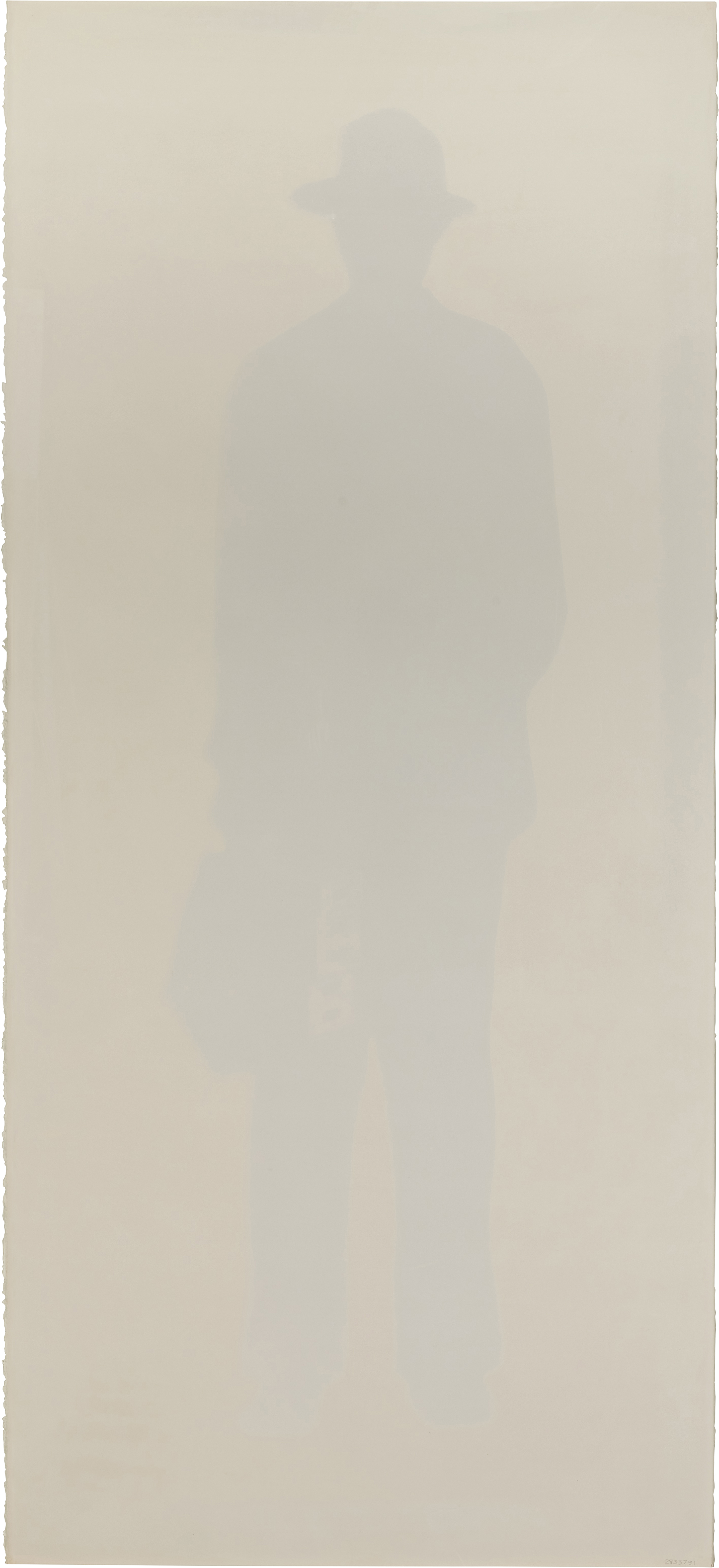
Man with a Briefcase at 2,833,791, 1982
He studied at Carnegie Mellon University before earning his MFA from the Yale School of Art and Architecture in 1966, entering the art world at precisely the moment when painting's dominance was being questioned by Minimalism, Conceptualism, and performance. Rather than choosing a single camp, Borofsky absorbed everything around him and did something deeply personal with it. He began counting. Starting in 1969, he sat at his kitchen table and wrote numbers, sequentially, on sheets of paper.
This act, which he continued for years, became the philosophical engine of everything that followed. The counting practice gave Borofsky a radical organizational principle. Every artwork he made was assigned a number corresponding to wherever he was in the count at the time of its creation. A large painting might be labeled 2,545,678.
Jonathan Borofsky
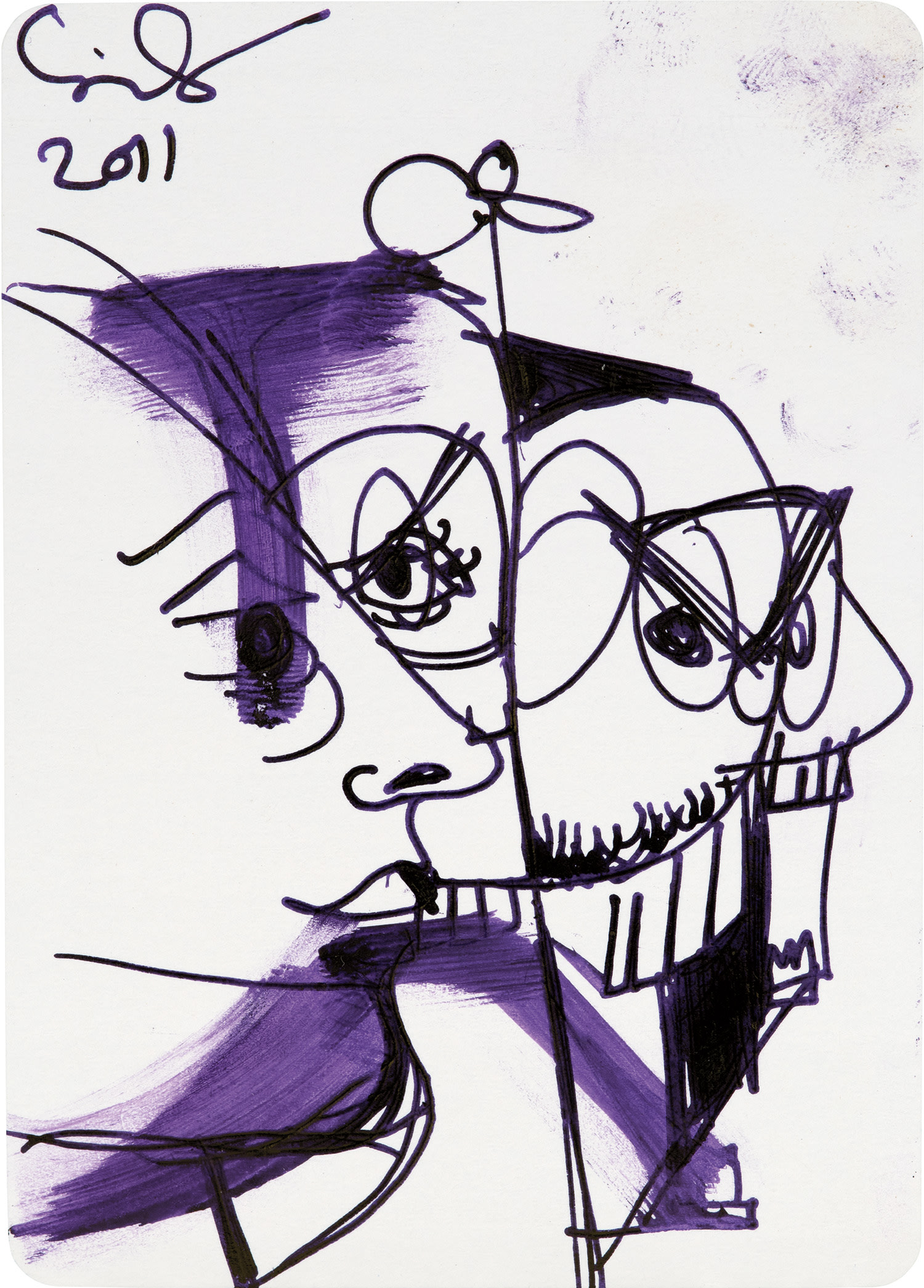
Man With a Briefcase (A) (G. 1482)
A small drawing might carry a number in the millions. This system dissolved hierarchies between works, insisting that a monumental installation and a modest sketch on graph paper were equally valid expressions of a continuous human consciousness. It was Conceptualism with a heartbeat, rigor married to vulnerability. By the time Paula Cooper Gallery began showing his work in New York in the late 1970s, the art world took notice.
His 1984 retrospective organized by the Philadelphia Museum of Art and subsequently traveling to major institutions confirmed his place among the defining artists of his generation. No image in Borofsky's vocabulary has proven more enduring than the Man with a Briefcase. The figure, rendered as a flat silhouette, strides forward with a kind of relentless purpose that is somehow both universal and poignant. He is everyman and no man, a vessel for the anxieties and aspirations of modern working life.
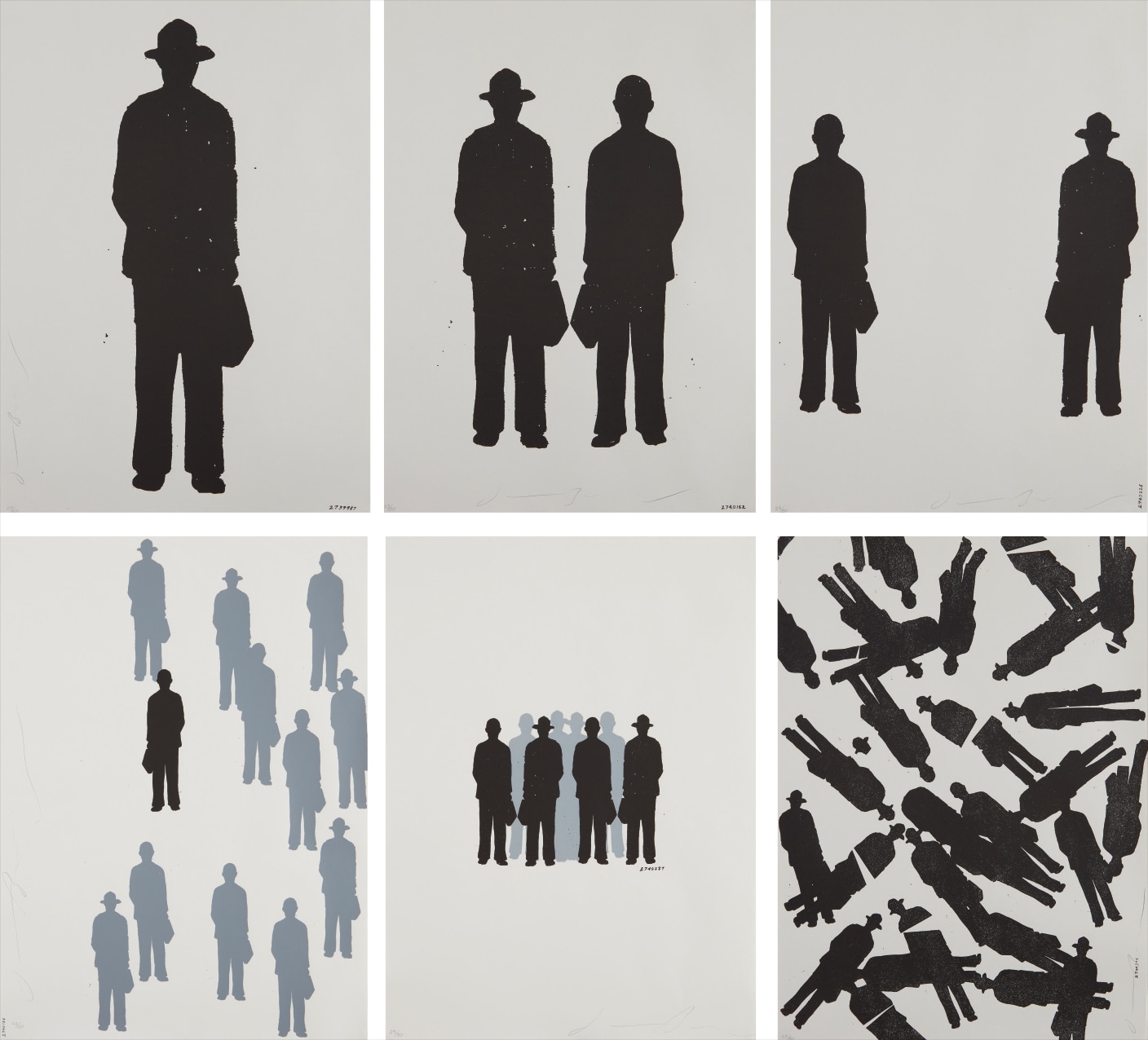
Jonathan Borofsky
2740475
The 1982 airbrush on paper work titled Man with a Briefcase at 2,833,791 distills this vision with particular economy, the numbered title reminding us that this anonymous commuter is one moment in an infinite count, neither more nor less significant than any other. The monumental woodcuts from the same series, printed on La Paloma handmade paper with collage elements and contained in steel frames the artist himself specified, show Borofsky pushing printmaking into the realm of sculpture and installation. These are not editions in the conventional sense but singular objects, each one a physical argument about scale, labor, and presence. Across his career, Borofsky worked fluidly between media: painting, drawing, printmaking, sculpture, sound installation, and large scale public work.
The Sun at 3,214,887, an acrylic on canvas mounted on a concave welded aluminum theater light, exemplifies his willingness to combine industrial materials with painterly mark making. Works on paper such as Drawing, 2766760, ink on graph paper, carry the intimacy of a private journal alongside the conceptual clarity of a system. His screenprints, including Workers on Planet Earth at 2941455 and the Pied Piper series, extend his humanist imagery into rich color fields that reward close attention. The Pied Piper figure, like the briefcase man, is simultaneously a cultural archetype and a Borofsky original, a borrowing transformed by the obsessive logic of the count.
Jonathan Borofsky
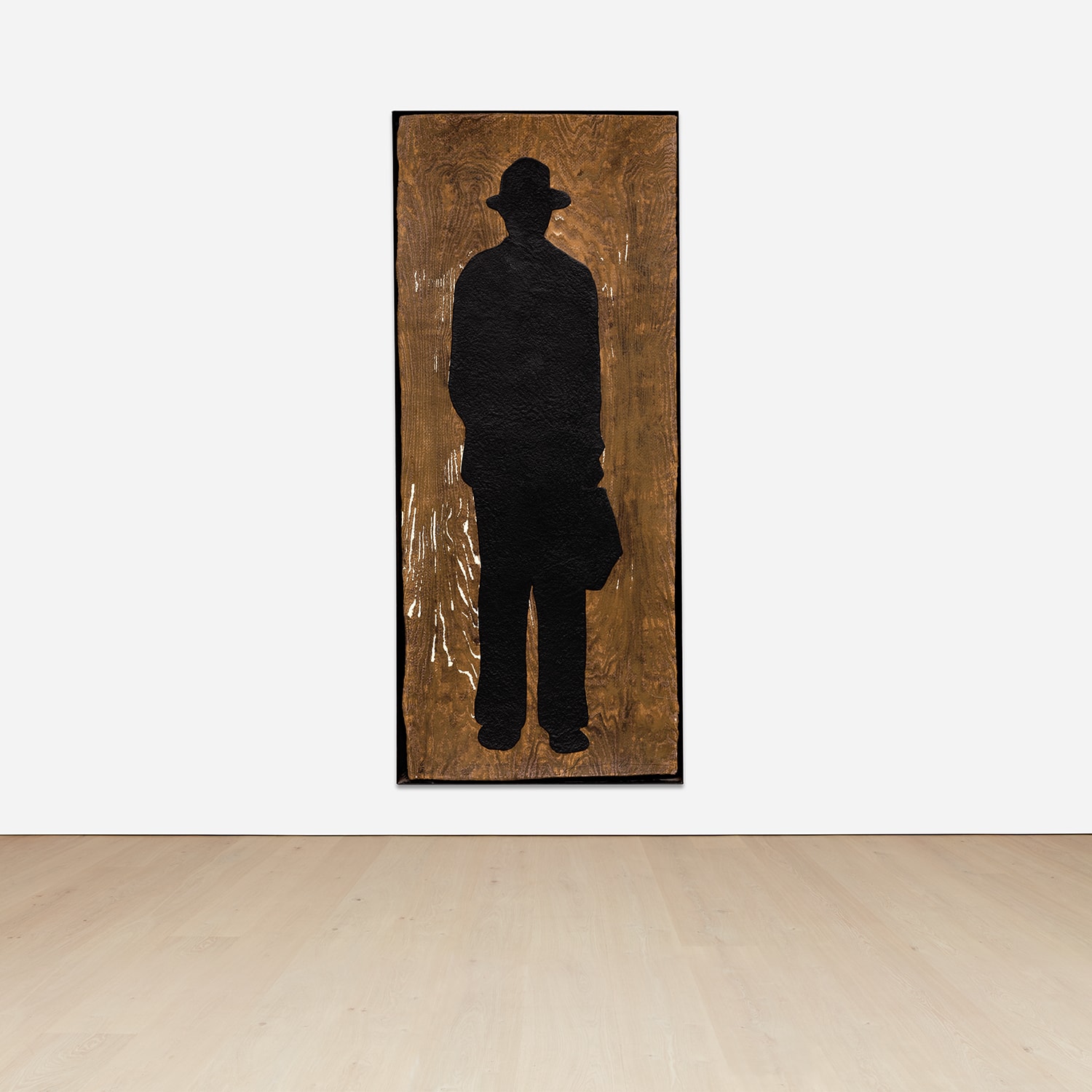
Man With a Briefcase (C) (G. 1484)
For collectors, Borofsky's work offers something increasingly rare in the contemporary market: depth of meaning at every price point. His multiples and prints were produced with exceptional care, often in collaboration with distinguished publishers including Peter Blum Edition in New York, and many carry the artist's signature numbering system in pencil. The unique woodcuts from the Man with a Briefcase series represent the apex of his print practice and are among the most sought after works on the secondary market. Collectors drawn to Arte Povera, to Bruce Nauman's conceptual restlessness, or to the social consciousness of artists like Leon Golub will find in Borofsky a kindred spirit.
His work also resonates with admirers of Jasper Johns and the tradition of image as idea, and with those who appreciate the democratic spirit of artists like Claes Oldenburg, who similarly made the everyday monumental. What places Borofsky in the longer arc of art history is his insistence that art must account for every human being, not just the exceptional or the powerful. His counting practice is, at its core, a refusal to leave anyone out. The numbered titles are not bureaucratic labels but acts of inclusion, a reminder that the artist was present, alive, and counting at this moment, and that the viewer standing before the work is also a number in the great ongoing sequence of human experience.
This philosophy animates even his most modest works and makes his most ambitious public sculptures, like the iconic Hammering Man installed in cities from Frankfurt to Seattle, feel less like monuments than like companions. Borofsky's legacy is secure, but his work is also genuinely alive in the present moment. Public institutions continue to display his sculptures, and a new generation of collectors is discovering that his prints and works on paper offer an accessible entry point into one of the most coherent and humane bodies of work produced in postwar America. The simplicity of his imagery belies the sophistication of his thinking, and that combination, populist surface, rigorous depth, is what ensures his work will continue to matter.
To collect Borofsky is to participate in something larger than the market, a count that has no end and excludes no one.
Explore books about Jonathan Borofsky
Jonathan Borofsky
Germano Celant
Jonathan Borofsky: A Retrospective
Mark Rosenthal
Jonathan Borofsky: Paintings, Drawings, Prints
Thomas Krens
Jonathan Borofsky: Counting and Dreaming
Linda Cathcart
Jonathan Borofsky: Whispered Secrets
Robert Pincus-Witten