John Hoyland
John Hoyland: Britain's Master of Radiant Colour
Artist Spotlight · The Collection Editorial
“I want the paintings to hit you like a wave. I want them to be overwhelming.”
John Hoyland, interview with the Royal Academy of Arts
There is a particular kind of electricity that fills a room when a large John Hoyland canvas is properly seen. It is not the quiet contemplation that some abstract painting invites, but something closer to a physical encounter, a full body reckoning with colour at its most unapologetic and alive. When the Royal Academy staged its major retrospective of Hoyland's work in 1999, visitors found themselves standing before paintings that seemed to generate their own light, vast fields of saturated pigment organised into compositions that felt both rigorously considered and gloriously free. That exhibition confirmed what a generation of artists, dealers, and collectors already knew: Hoyland was not merely a significant British painter, he was one of the most important colourists the country had ever produced.
John Hoyland
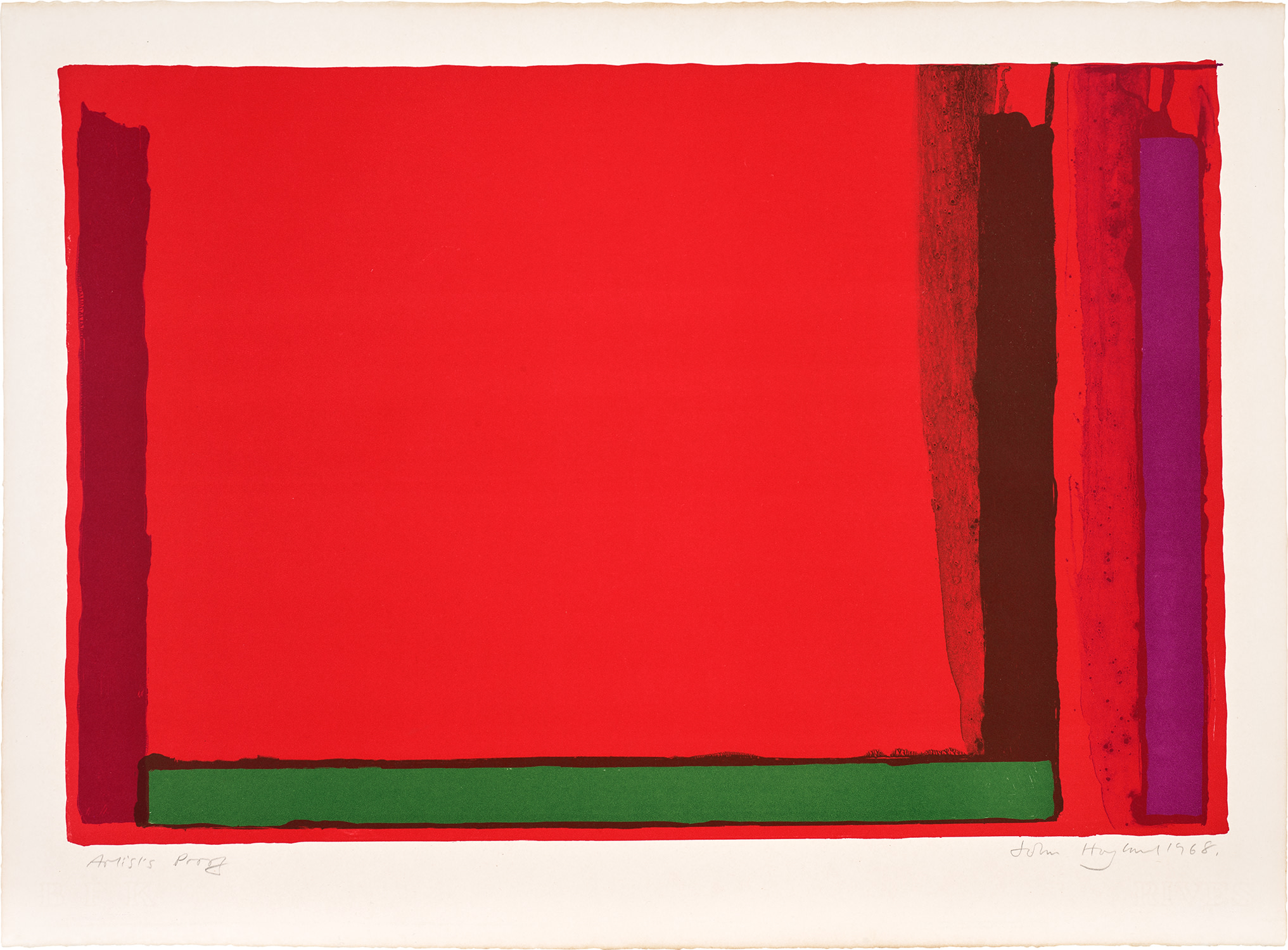
Small Red
John Hoyland was born in Sheffield in 1934, and his formation as an artist carried the particular ambition of someone who understood that the centre of gravity in modern art lay elsewhere and was determined to find it. He studied at Sheffield College of Art and later at the Royal Academy Schools in London, absorbing the traditions of European painting while scanning the horizon for something that felt more urgent and alive. London in the late 1950s and early 1960s was a city beginning to wake up to abstraction, and Hoyland found himself at the centre of a generation of British painters who were asking serious questions about what painting could do when it was freed from representation entirely. The pivotal transformation in Hoyland's practice came through his visits to New York in the 1960s, where he encountered the American Abstract Expressionists and the Color Field painters who had reimagined what a painted surface could be.
Meeting artists including Mark Rothko, Barnett Newman, and Hans Hofmann, and spending time in the company of their work, reshaped Hoyland's understanding of scale, colour, and the relationship between a painting and its viewer. He absorbed their lessons without becoming a follower. What he brought back to Britain was not imitation but a deeper permission, a conviction that colour could carry the full weight of human feeling without any illustrative support whatsoever. Through the later 1960s and into the 1970s, Hoyland developed the singular visual language that would define his reputation.
John Hoyland
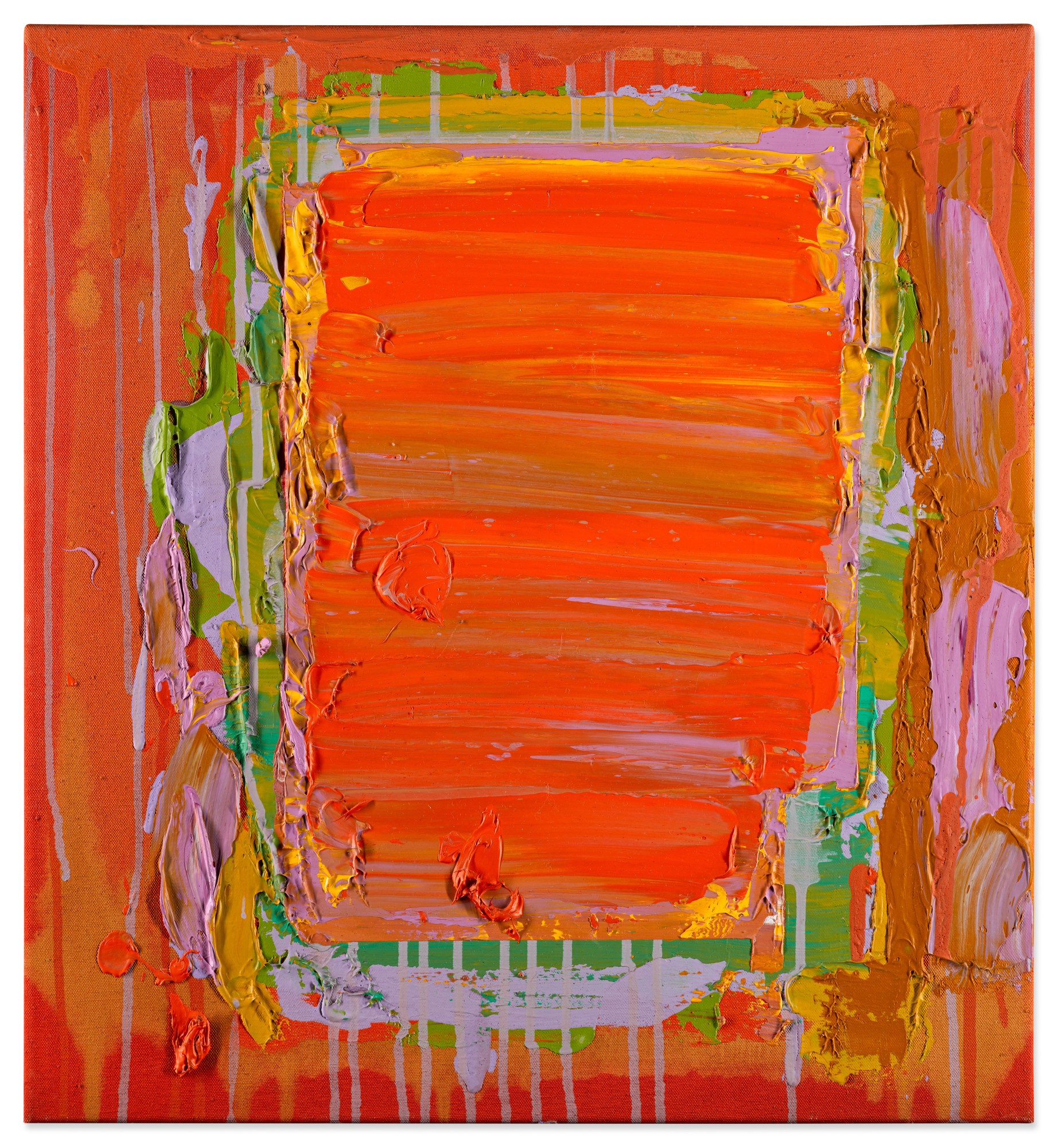
Shotfield 23.4.74, 1974
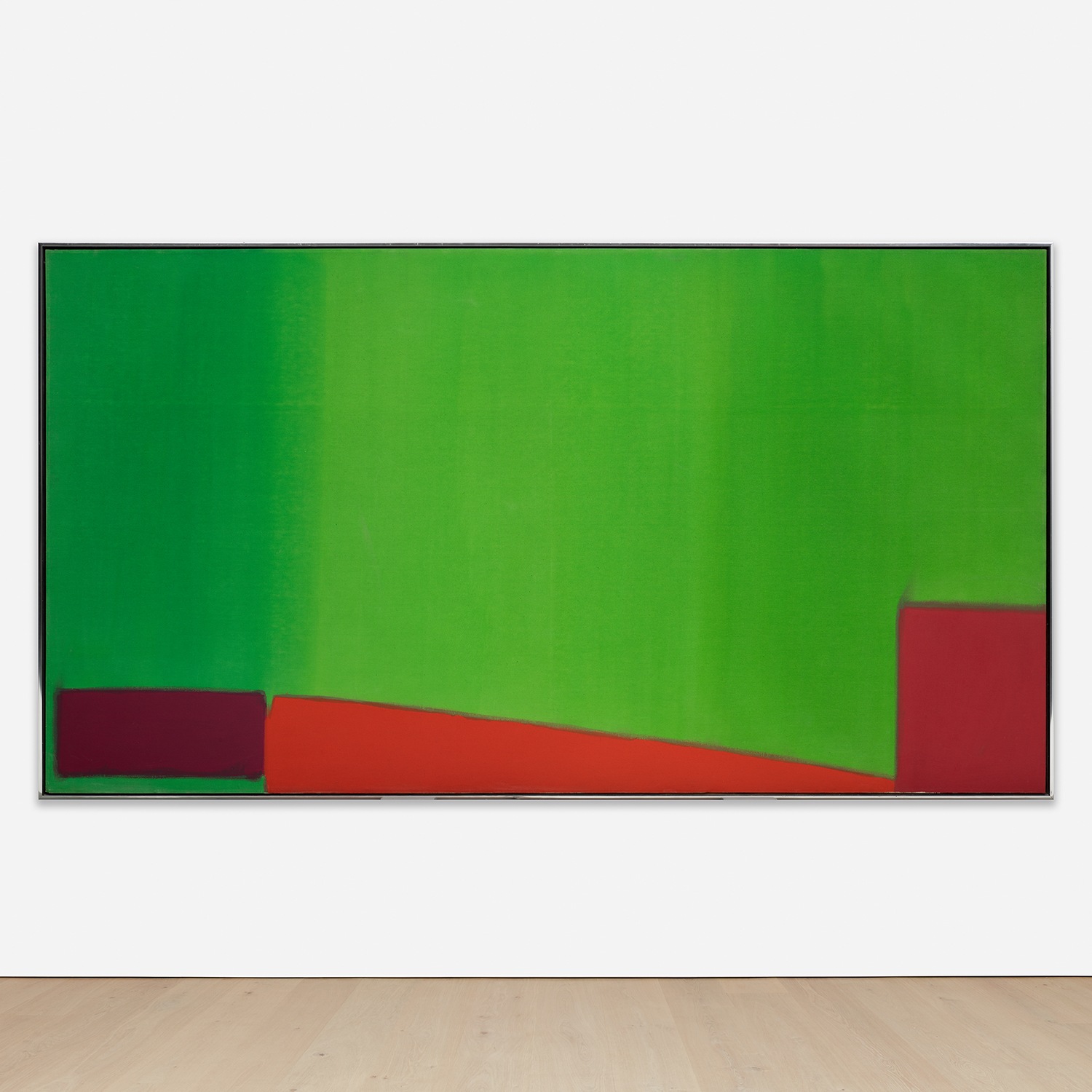
Works such as "29.12.65" from 1965 and "11.10.
68" from 1968, both executed in acrylic on canvas, show the painter moving with increasing confidence toward a mode of working in which blocks and fields of intense colour are brought into dynamic, sometimes precarious relationship with one another. The dates he used as titles were not merely administrative notations but a kind of honest record keeping, a painter marking time and process. "Shotfield 23.4.
John Hoyland
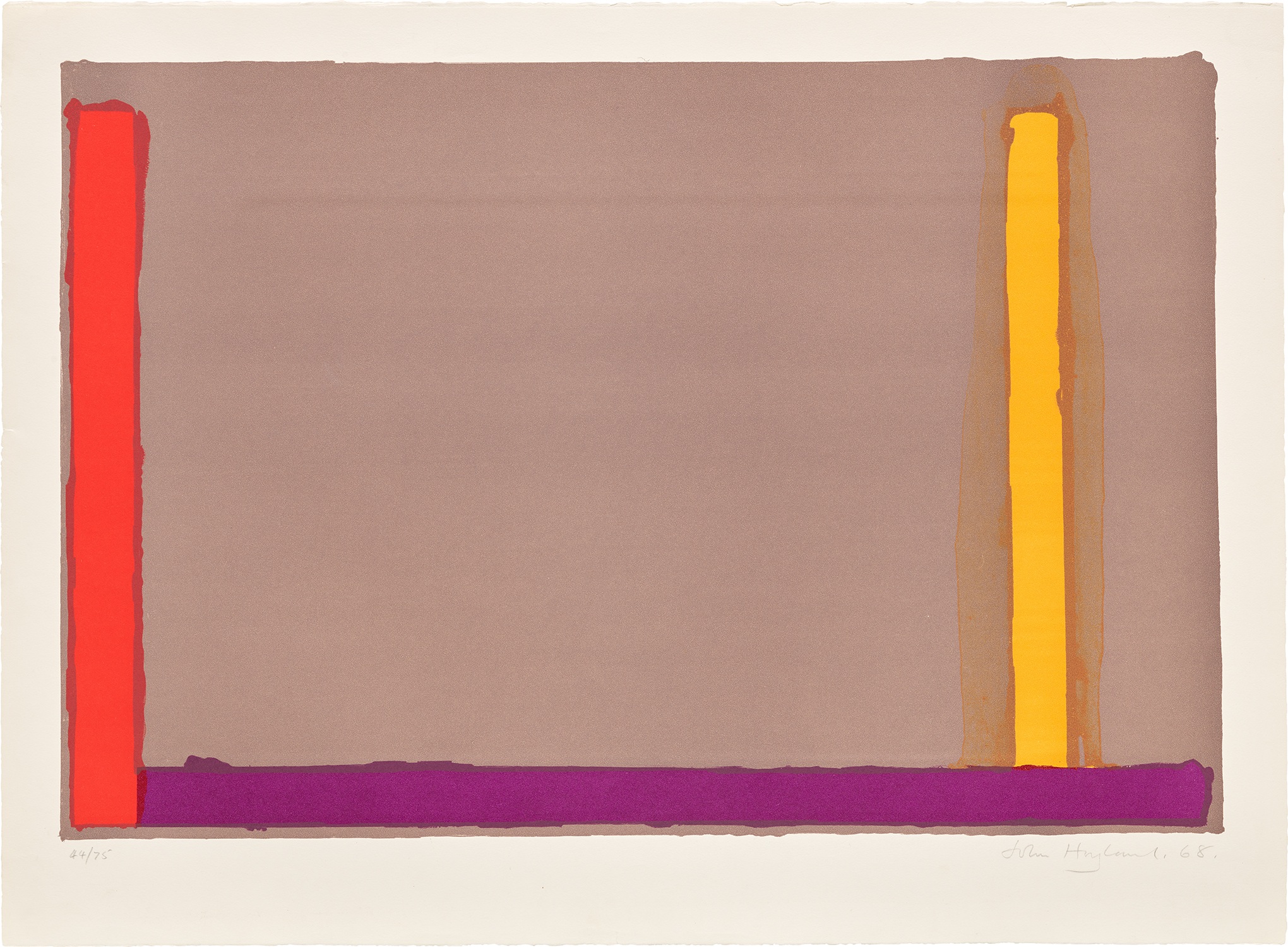
Small Grey Swiss
74" from 1974 exemplifies the maturity of this period, the oil paint applied with a directness and sensuous weight that distinguished his work from the cooler, more theoretical approaches of some of his contemporaries. Hoyland was also a committed and gifted printmaker, and this dimension of his practice deserves serious attention from collectors. His lithographs, including works such as "Small Red" and "Small Grey Swiss", printed on BFK Rives paper with the kind of care that reflects a genuine investment in the medium, and his etchings and aquatints, demonstrate that his command of colour and composition translated fully into the demands of works on paper and the print studio. The "Italian Etchings", published by Alan Cristea Gallery in London and produced in carefully controlled editions, represent some of the finest examples of British printmaking of their era.
Works such as "Fly Away", an etching and aquatint with carborundum in colours, show Hoyland exploiting the particular textural possibilities of intaglio processes to create surfaces of extraordinary richness. For collectors, Hoyland offers a range of entry points that is genuinely rare among artists of his stature. The prints and works on paper, including the 1969 acrylic and watercolour "Untitled" which passed through the collection of Jack Shirreff and descended through his family, provide access to his visual intelligence at a scale and price point that makes serious collecting possible for those who are not in a position to pursue the major canvases. The larger oils and acrylics, when they do appear at auction or through specialist dealers, tend to attract competition from both institutional buyers and serious private collectors who understand that works of this quality and historical significance do not circulate frequently.
John Hoyland
29.12.65, 1965
Collectors are advised to look for paintings from the late 1960s and the 1970s, widely regarded as the period in which Hoyland's ambitions and his technical command were most completely aligned. Hoyland's place in the broader story of twentieth century abstract painting is secure and deserves to be understood in its proper international context. He belongs to a generation that includes fellow British painters such as Patrick Heron, Howard Hodgkin, and Bridget Riley, all of whom were engaged in a sustained and serious dialogue with both European modernism and the energies coming from New York. Like Heron in particular, Hoyland insisted that British painting could participate fully in that international conversation without losing its own character.
He was elected a Royal Academician, a recognition that placed him within the longest tradition of British artistic life while doing nothing to diminish his credentials as a genuine radical in the history of abstraction. Hoyland died in 2011, but the vitality of his work ensures that his presence in the rooms where it hangs remains fully alive. There is a quality to the best of his canvases that resists the passage of time in the way that only the most resolved and genuinely felt painting can. He was an artist who believed, with complete conviction, that colour was not decoration or surface but the primary substance of meaning, and he spent a long and productive career demonstrating exactly that.
For collectors who care about the full story of postwar painting, and who want to live with work that continues to reward sustained attention, John Hoyland represents one of the most compelling and still undervalued propositions in the British market. His work does not merely hang on a wall. It changes the room.
Explore books about John Hoyland