John Henry Twachtman
The Quiet Visionary Who Reimagined American Light
Artist Spotlight · The Collection Editorial
There are artists whose reputations arrive fully formed and artists whose greatness seeps slowly into the consciousness of collectors and curators alike, demanding patience and a certain quality of attention. John Henry Twachtman belongs emphatically to the second category. In recent years, major American museums including the Metropolitan Museum of Art and the Smithsonian American Art Museum have devoted renewed scholarly energy to the American Impressionist circle, and Twachtman consistently emerges at the center of those conversations, recognized at last as not merely a participant in a movement but one of its most daring and original voices. His paintings and works on paper reward the kind of sustained looking that the current collecting moment, with its appetite for intimacy and subtlety, is uniquely prepared to offer.
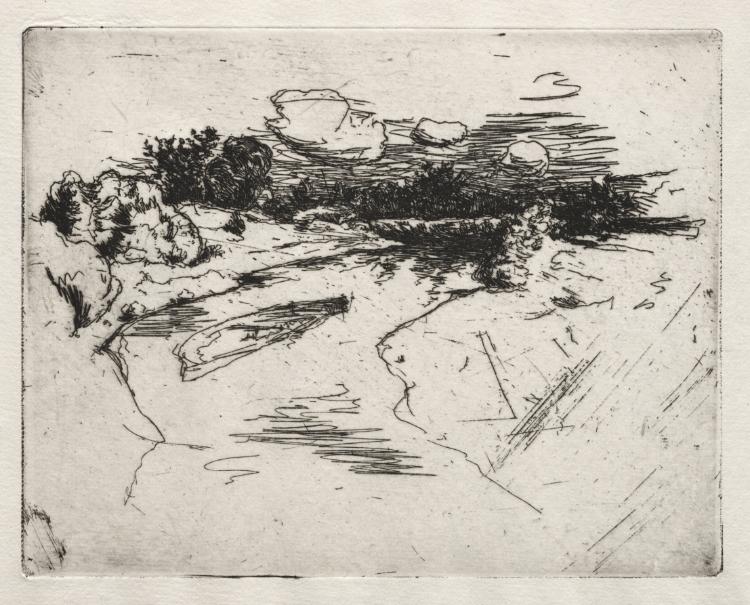
John Henry Twachtman
Miami River, near Cincinnati, Ohio, 1879
Twachtman was born in Cincinnati, Ohio in 1853, the son of a window shade painter, a modest origin that gave him both a practical grounding in craft and an early familiarity with the expressive possibilities of color and surface. Cincinnati in the mid nineteenth century was a genuine artistic hub, home to a community of painters and craftspeople who took their vocation seriously, and Twachtman absorbed that atmosphere from his earliest years. His decisive early encounter came through Frank Duveneck, the Cincinnati born master whose bravura brushwork and commitment to European training galvanized an entire generation of American students. Under Duveneck's influence, Twachtman traveled to Munich in the mid 1870s, where he trained at the Royal Academy of Fine Arts and absorbed the dark, richly tonal manner that dominated German academic painting at the time.
What followed was a remarkably purposeful artistic evolution. The Munich period gave Twachtman technical confidence and a painter's understanding of tonal relationships, but it was his subsequent travels that truly liberated his eye. He spent time in Florence alongside Duveneck and his circle, and then made his way to Paris, where he enrolled at the Académie Julian in the early 1880s. Paris proved transformative.
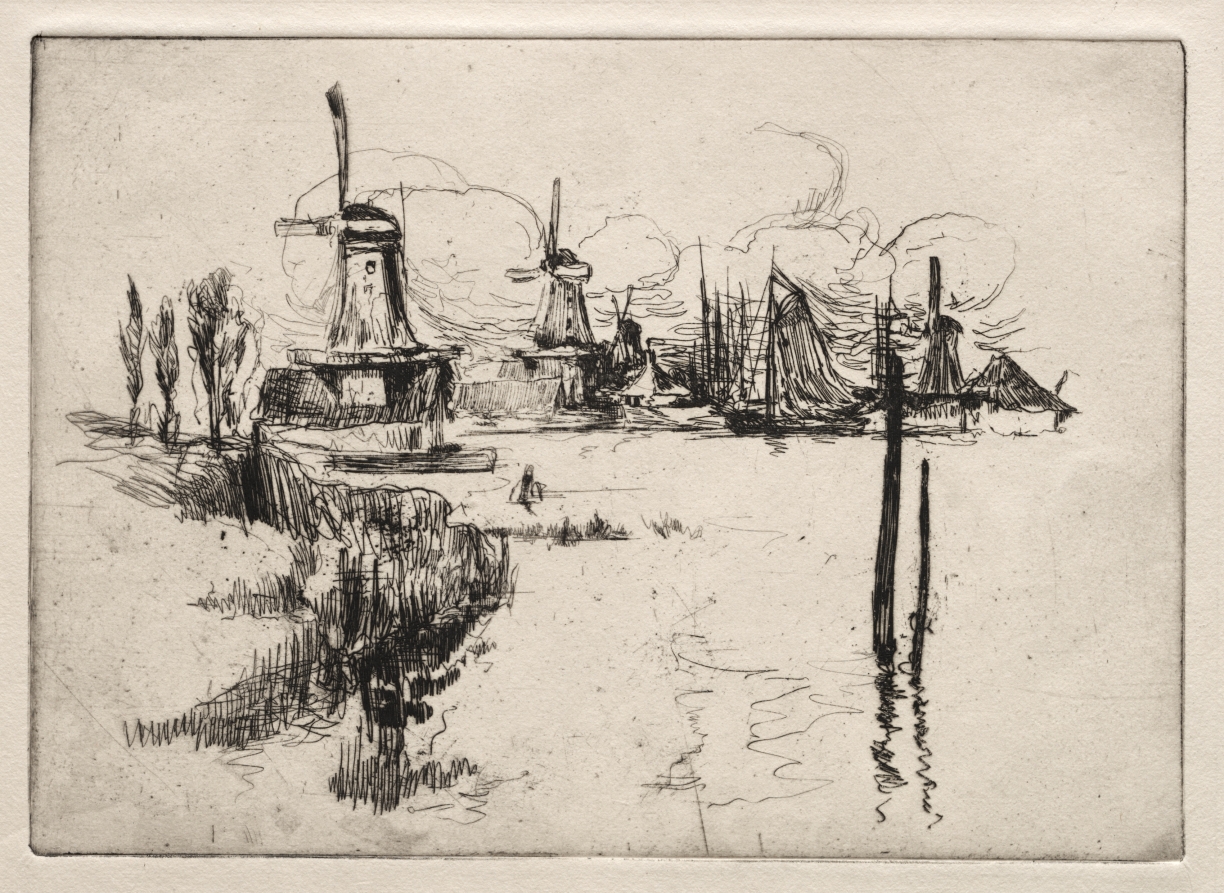
John Henry Twachtman
Dordrecht, 1885
Exposure to the work of the French Impressionists and to the quieter, more atmospheric Whistlerian aesthetics shifted Twachtman's entire sensibility. He began working with lighter, more restrained palettes, building compositions of extraordinary refinement and psychological stillness. The canvases and works on paper from his years in France and the Low Countries, including his haunting etchings made in Dordrecht and along the Dutch and French coasts, show an artist in the process of becoming entirely himself. Twachtman's etchings deserve particular recognition, and for collectors approaching his work they represent one of the most compelling entry points into his vision.
Works such as his Dordrecht etching of 1885 and his Holland Dykes from the same year demonstrate his mastery of the medium, using the finest network of marks to evoke atmosphere and the particular weight of northern European light falling across water and low land. His Woman on Quay at Honfleur, made in 1883, has the directness of a memory fixed precisely at the moment before it dissolves. These are not preparatory studies or secondary works. They are finished artistic statements, and they reveal that Twachtman thought in line with the same sensitivity and conviction he brought to paint.
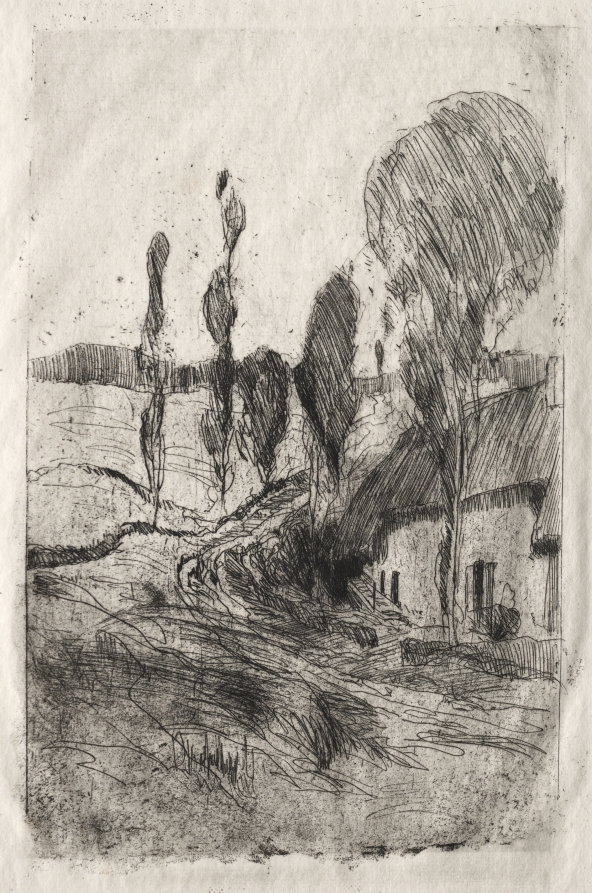
John Henry Twachtman
French Landscape, 1884
His early American etchings, including the Miami River near Cincinnati from 1879 and Landscape near Cincinnati from the same year, show a young artist already alert to the poetry of the familiar and the local. When Twachtman returned to America and settled in Connecticut, first in Branchville and then at his beloved farm in Greenwich, his mature style fully emerged. Working en plein air in the landscape of southern New England, he developed a manner of painting that stands apart from virtually all of his contemporaries. His canvases from this period favor high key palettes, broken surfaces, and compositions that seem to dissolve at their edges, as if the scene is being recalled rather than directly observed.
His Deserted Wharf, sometimes known as The Old Mill at Cos Cob, painted around 1890, is a masterful example of his Connecticut manner, a study in silvery atmosphere where structure and light seem to negotiate a delicate and constantly shifting equilibrium. Pastures, Branchville, Connecticut, executed in pastel on composition board in 1888, captures the open meadow country of that part of New England with a freshness and economy that feel startlingly modern. Twachtman was a founding member of Ten American Painters, the group that broke from the Society of American Artists in 1897 to exhibit together under a shared commitment to Impressionist values. His colleagues included Childe Hassam, J.
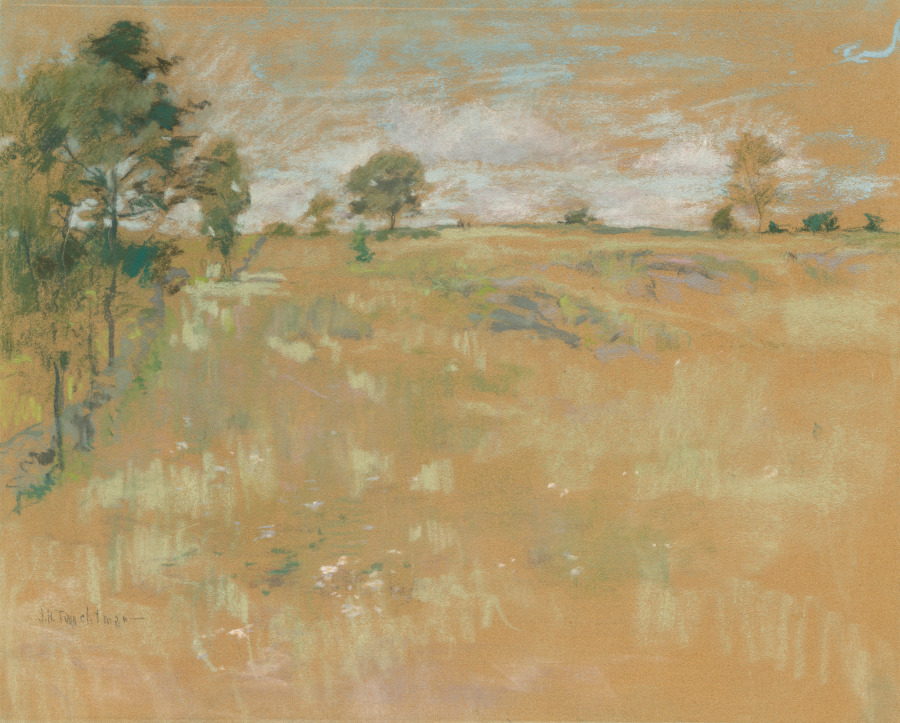
John Henry Twachtman
Pastures, Branchville, Connecticut, 1888
Alden Weir, and Edmund Tarbell, painters of genuine accomplishment, yet Twachtman's work within that group consistently occupies its own register. Where Hassam favored strong color and urban vitality, Twachtman sought something more elusive: the condition of landscape at the edge of perception, the hour before full light, the field under thin winter snow. His affinities across American painting align him with Weir above all, and across the Atlantic with Whistler, whose tonal precision and belief in painting as distilled sensation Twachtman shared at a deep level. For collectors, Twachtman's market presents a picture of genuine quality and, relative to his art historical importance, remarkable accessibility.
His works appear at major American auction houses including Christie's and Sotheby's, where his paintings have drawn serious attention from institutions and private collectors who appreciate the combination of technical refinement and emotional depth his work offers. His etchings, in particular, represent an area where the attentive collector can acquire works of museum quality from one of American Impressionism's true originals. What to look for is a consistent quality of attention in the mark or stroke, the sense that every decision on the surface was made with both confidence and feeling, and that particular quality of quietness that distinguishes his best work from mere competence. Twachtman died in 1902 at the age of forty eight, in Gloucester, Massachusetts, where he had spent his last summers teaching and painting.
The brevity of his life only deepens the achievement contained within it. His legacy is one of sustained artistic integrity, a career spent refusing easy effects in favor of something harder to achieve and more lasting in its impact. In an era when American painting is being reassessed with fresh eyes and genuine intellectual seriousness, Twachtman stands as a figure whose time, in the fullest sense, has arrived.
Explore books about John Henry Twachtman
John Henry Twachtman
Eliot Clark
John Henry Twachtman: An American Impressionist
Lisa N. Peters
Twachtman: His Life and Paintings
John Douglas Hale
John Henry Twachtman: Connecticut Landscapes
Lisa N. Peters
American Impressionism: Paintings of Light and Atmosphere
William H. Gerdts