John Beasley Greene
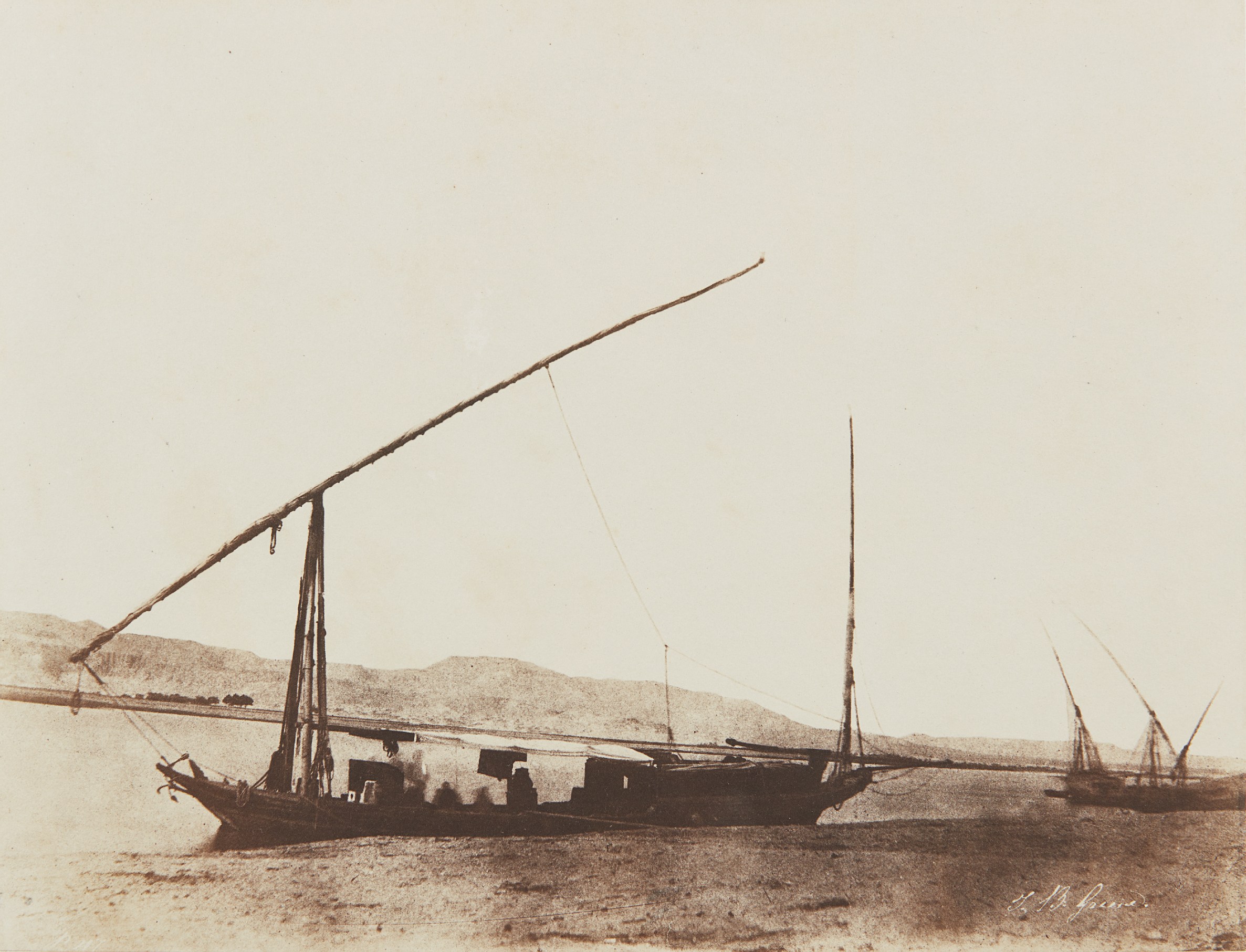
Light, Sand, and Ancient Stone
Artist Spotlight · The Collection Editorial
There is a particular kind of silence that settles over the great monuments of Egypt at dawn, when the stone holds the night's cold and the sky has not yet committed to full brightness. It was into exactly this quality of stillness that John Beasley Greene carried his camera in the winters of 1853 and 1854, producing images so luminous and so precisely felt that they continue to astonish curators, historians, and collectors more than 170 years after they were made. A new generation of photography enthusiasts and institutional collectors has returned to Greene's work with fresh urgency, recognizing in his salted paper prints and waxed paper negatives a sensibility that feels startlingly contemporary, a mind that understood the photograph not merely as a record but as an interpretation, an act of seeing shaped by intellectual passion. John Beasley Greene was born in 1824 in France to American parents, a circumstance that placed him from the very beginning between cultures and gave him, perhaps, an outsider's sharpened attention to the visible world.
John Beasley Greene
John Beasley Greene
He grew up steeped in both French intellectual life and the traditions of American curiosity and pragmatism, a combination that would serve him exceptionally well. By the time he reached his early twenties, he had become deeply involved with the Société Française de Photographie, one of the most important early forums for the new art of photography in France, and had developed serious scholarly interests in Egyptology at a moment when European fascination with ancient Egypt was reaching one of its great peaks. Greene was not a tourist or a dilettante. He was a trained and committed archaeologist who happened to understand, with rare intuition, that photography was the most powerful tool his generation possessed for the study and communication of the ancient world.
His first major expedition to Egypt took place in 1853 and 1854, and the work he produced during those months is nothing short of foundational. Greene worked with the calotype process, specifically using waxed paper negatives, a technique pioneered by Gustave Le Gray that allowed for greater sensitivity and portability in the field. This was not an easy medium to master in the heat and dust of the Nile Valley, and the fact that Greene achieved such tonal richness and compositional control under those conditions speaks to both his technical command and his extraordinary patience. He photographed the temples at Luxor, the great funerary complex at Medinet Habu, the colonnades at the Island of Philae, and the sphinx at Giza, among many other sites.
John Beasley Greene
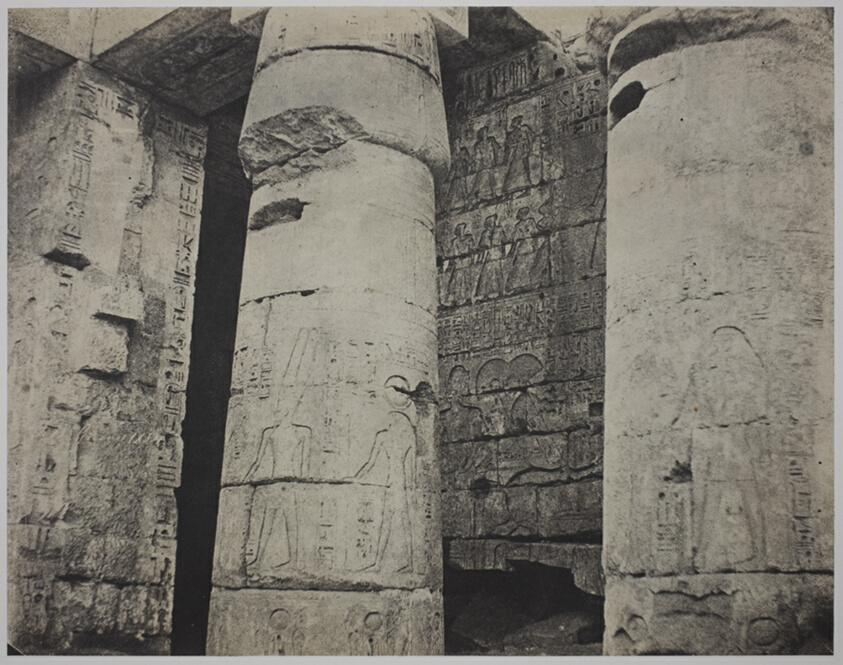
Medinet Habu, Mortuary Temple of Ramses III, Left Wall (Médinet-Habou, Temple funéraire de Ramsès III, paroi gauche, 1854
He also undertook systematic excavations and documented them photographically, making him one of the first practitioners anywhere in the world to integrate photography directly into archaeological fieldwork. The works themselves reward sustained looking. In his 1854 salted paper print of the mortuary temple of Ramses III at Medinet Habu, Greene frames the hieroglyph covered wall with a gravity that feels almost architectural in itself. The tonal gradations from deep shadow to pale, chalky light are handled with a restraint that modern photographers might envy.
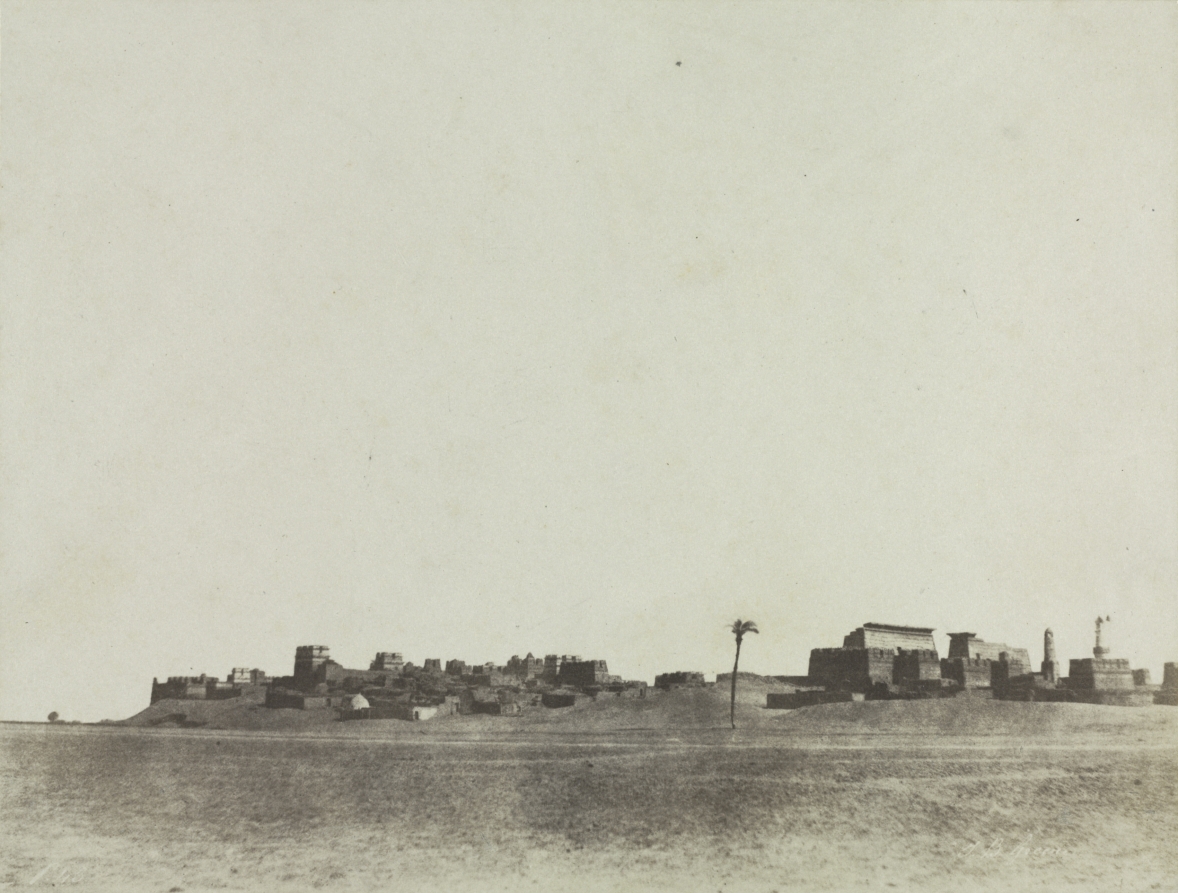
His 1854 view of Luxor has the quality of a held breath, the reflections in the Nile soft and almost dissolved, the temple rising from the image with a weight that seems to belong to time itself rather than stone. His 1853 salted paper print of the Sphinx, made from a waxed paper negative, places the great monument in a landscape so spare and elemental that it reads almost as abstraction. These are not photographs made to illustrate a text. They are independent works of art, shaped by a vision that was already, in the early 1850s, thinking about what photography could be rather than simply what it could show.
John Beasley Greene
View of Luxor, 1854
Greene also turned his lens to Algeria, producing a significant body of work documenting ancient Roman and Berber sites, including a remarkable 1855 albumen print of the Tomb of the Christian Woman, a monumental royal mausoleum near Tipasa. His 1856 salted paper prints from the Cherchell Museum, depicting Roman sculptures, show a photographer moving fluidly between civilizations and centuries, finding in each a similar formal intelligence. These Algerian works are less well known than the Egyptian photographs and represent a genuine area of discovery for collectors who want to engage with a less thoroughly charted part of his practice. Greene also made a small number of still life images, including a waxed paper negative from 1852 depicting a statuette of the Venus de Milo, a work that shows him thinking carefully about sculptural form and the relationship between photography and classical tradition even before his expeditions began.
For collectors, Greene's work occupies a position of genuine rarity and historical significance. His prints appear at auction infrequently, and when they do, they attract serious institutional and private interest. Major museums including the Getty Museum, the Metropolitan Museum of Art, and the Bibliothèque nationale de France hold examples of his work, and these institutional holdings both validate and partly explain the scarcity of prints available to the private market. Collectors drawn to the history of photography, to archaeological and orientalist imagery, or to the broader context of nineteenth century paper print processes will find in Greene a figure whose importance is fully established and whose market has historically been supported by that importance.
![John Beasley Greene — Untitled [Roman sculptures, Cherchell Museum]](https://rtwaymdozgnhgluydsys.supabase.co/storage/v1/object/public/artwork-images/aic/202884/81060c28-1b84-814e-c245-7180cf889ad7.jpg)
John Beasley Greene
Untitled [Roman sculptures, Cherchell Museum], 1856
Works on paper from this period require careful attention to condition, particularly to tonal stability and fading, and buyers are well advised to seek pieces with good provenance and ideally with documentation connecting them to early collections or scholarly sources. In the context of art history, Greene belongs to a remarkable cohort of French and Franco American photographers who transformed the medium in its earliest decades. His closest peers include Maxime Du Camp, who also photographed Egypt in the early 1850s, and Félix Teynard, whose monumental documentation of Nubian monuments appeared in 1858. Like Greene, both Du Camp and Teynard understood that photography in the service of archaeology was also photography in the service of beauty.
But Greene's eye was arguably the most purely aesthetic of the three, the most willing to let the formal qualities of a composition carry meaning independent of its documentary function. He also shares something with the great landscape photographers of the same period, including Charles Nègre and Henri Le Secq, in his attentiveness to light as a structural element rather than merely an illuminating condition. Greene died in 1856, at just 32 years old, cutting short a career that had already produced more than most photographers achieve in a full lifetime. The brevity of his life has sometimes cast a melancholy shadow over discussions of his work, but the more generous and more accurate way to understand it is as a testament to the remarkable concentration and ambition he brought to every year he had.
He worked at the intersection of science and art before those categories were understood as distinct, and he produced images that belong equally to the history of archaeology, the history of photography, and the history of visual culture more broadly. To collect John Beasley Greene is to participate in one of the great early stories of what it means to see the world through a lens with both rigorous intelligence and genuine feeling.