John Adams Whipple
Light Captured, Time Made Permanent
Artist Spotlight · The Collection Editorial
In the summer of 1851, a telescope at the Harvard College Observatory pointed toward the moon, and a young photographer from Massachusetts pressed his daguerreotype plate against the eyepiece. The resulting image, among the first detailed photographs of the lunar surface ever made, stunned the scientific community and the art world alike. That photographer was John Adams Whipple, and in that singular moment he announced himself as one of the most daring and technically gifted image makers of the nineteenth century. Whipple was born in 1822 in Grafton, Massachusetts, into an era when the very idea of fixing light onto a surface was still regarded as something between miracle and magic.
John Adams Whipple
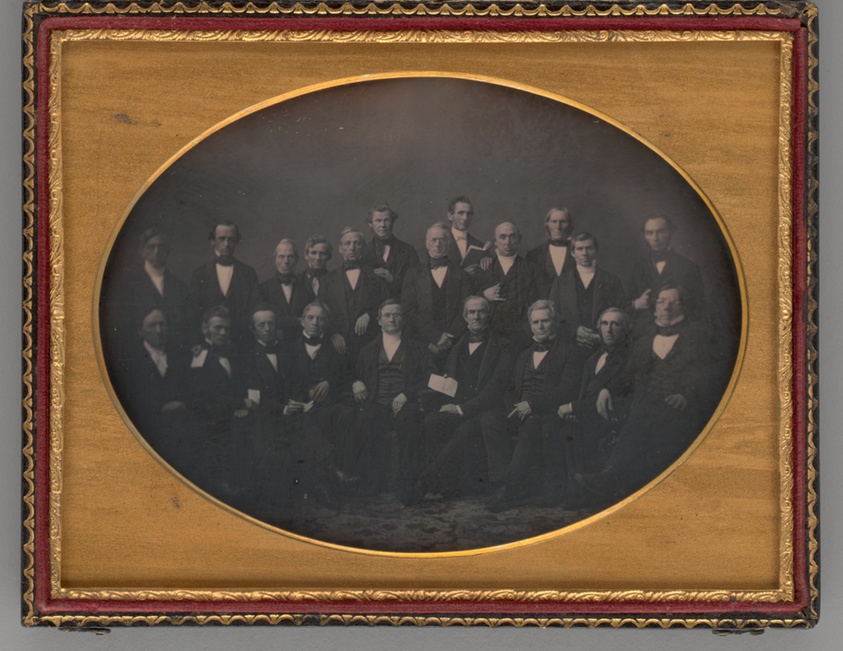
Untitled (Group Portrait of Men), 1852
He came of age as the daguerreotype swept through American cities, transforming how ordinary people understood portraiture, memory, and the preservation of a human face. By his early twenties, Whipple had established himself in Boston, opening a studio on Washington Street that would become one of the most celebrated photographic enterprises in New England. He possessed an almost scientific restlessness, an appetite for experimentation that set him apart from contemporaries content to simply replicate what had already been achieved. His training was rooted in chemistry as much as in aesthetics.
Whipple approached the daguerreotype not merely as a commercial tool but as a medium worthy of genuine artistic investigation. He developed and refined the crystallotype process, an early method for producing paper prints from glass negatives, which he patented in 1850. This innovation positioned him at the vanguard of photographic technology at precisely the moment when the medium was beginning to define itself as something more than a curiosity. Collectors and historians alike regard this period, roughly 1848 through the late 1850s, as the peak of his creative and technical powers.
John Adams Whipple
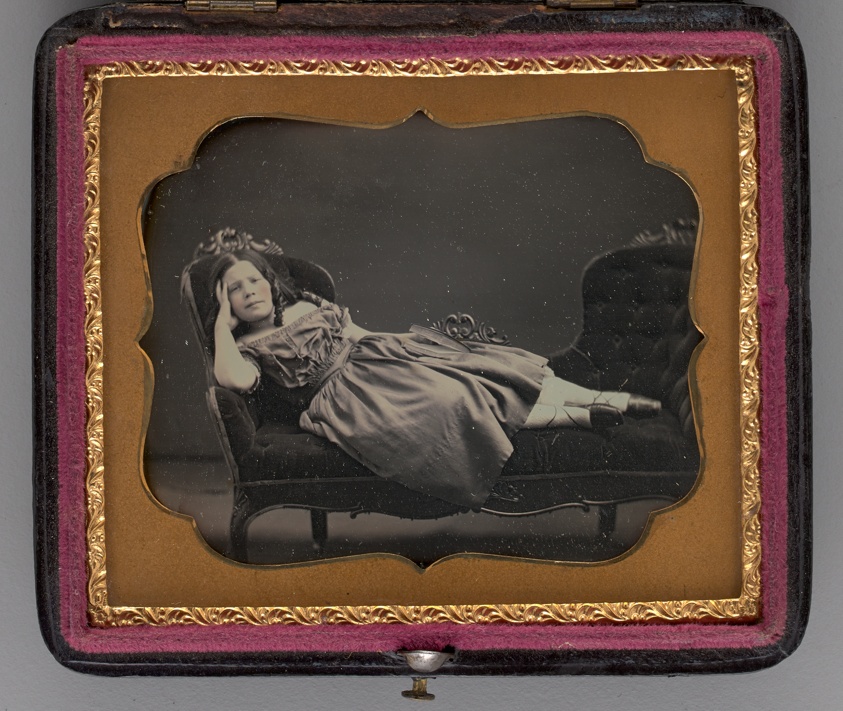
Untitled (Portrait of a Reclined Woman), 1855
The works that survive from this era are extraordinary documents of American life and Whipple's compositional intelligence. His group portraits, such as the luminous daguerreotype of men gathered together made in 1852, reveal an instinct for staging that goes well beyond the conventions of the period. He understood light as a sculptor understands clay, coaxing it to define the planes of a face, the drape of a collar, the quiet dignity of an individual seated before his lens. His 1855 portrait of a reclined woman is among the most tender and psychologically present images produced in American photography before the Civil War.
There is a stillness in that image that feels earned rather than imposed, the result of a photographer who had learned to make his subjects feel genuinely at ease within a process that, in the early 1850s, still required considerable patience and physical cooperation. The Stone Sisters daguerreotype from 1850, depicting a natural rock formation in Lincoln, Massachusetts, is something of a revelation within Whipple's catalog. It signals an awareness of landscape and place that was not typical among portrait photographers of his generation. The image carries a mood that connects Whipple, however unexpectedly, to the broader currents of American Romanticism coursing through painters of the Hudson River School during the same decade.
John Adams Whipple
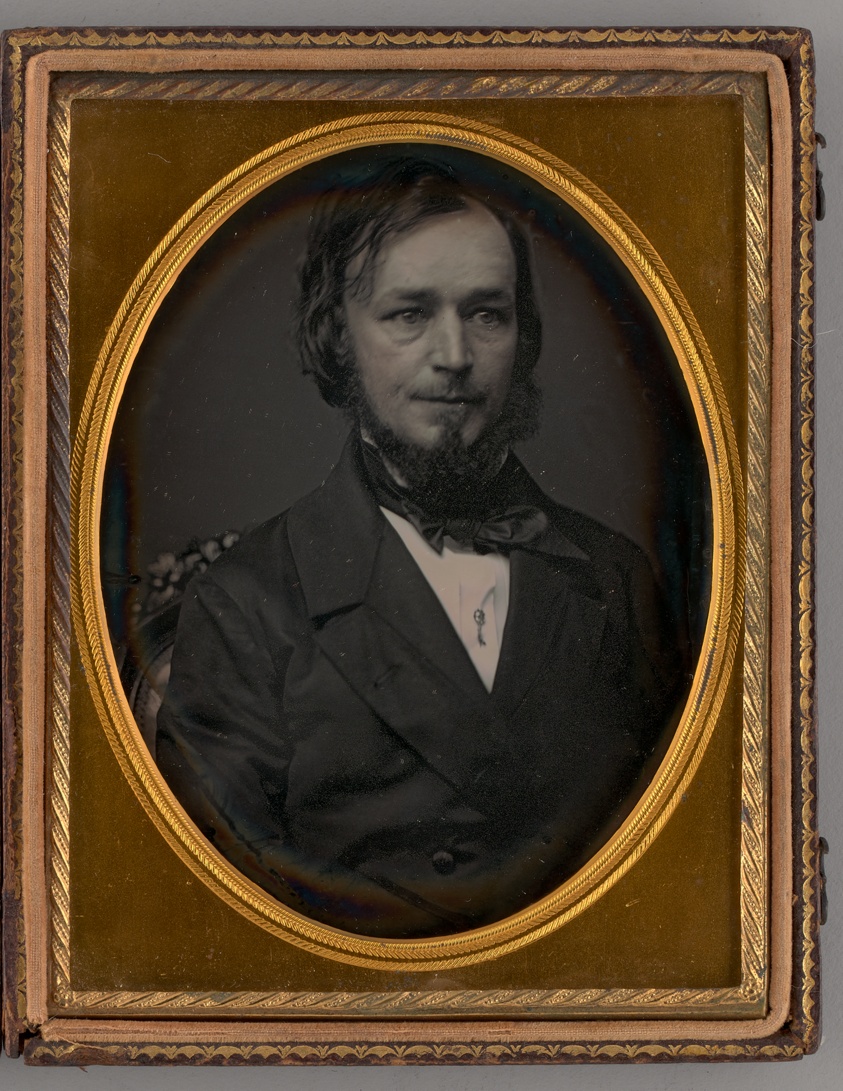
Untitled (Portrait of Man), 1854
He was thinking, it seems, about more than documentation. He was thinking about atmosphere, about the way light and geology conspire to produce something that feels sacred. His astronomical work earned him a medal at the Great Exhibition in London in 1851, one of the first American photographers to receive such recognition on an international stage. This achievement drew the attention of scientists, collectors, and cultural figures across the Atlantic world.
It also confirmed what his Boston clients already knew: that Whipple's studio was producing images of a quality that demanded serious attention. He worked alongside James Wallace Black, another important Boston photographer, for a period in the late 1850s, and their collaboration produced a body of aerial and documentary work, most famously photographs taken from a hot air balloon over Boston in 1860, that pushed the boundaries of what photography was understood to be capable of. For collectors, Whipple daguerreotypes represent a singular opportunity to own objects that sit at the intersection of art history, scientific history, and the social history of nineteenth century America. The daguerreotype as a form carries an inherent intimacy.
John Adams Whipple
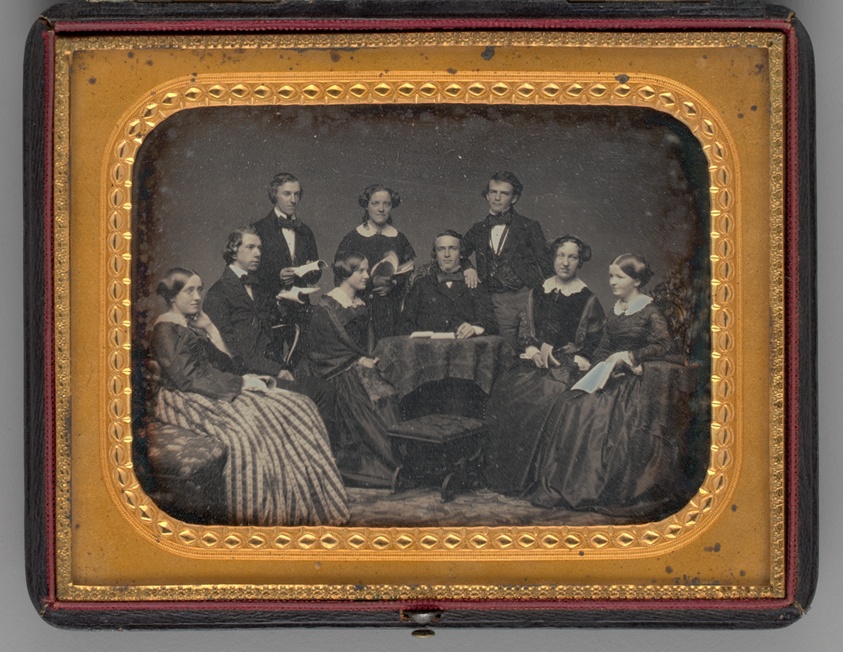
Untitled (Group Portrait of Men and Women), 1855
Each plate is a unique object, unreproducible in the way a print is reproducible, which gives each surviving Whipple a singular status. Collectors drawn to early photography, to American material culture, or to the history of portraiture will find in Whipple's work a depth of craft that rewards close looking. His portrait subjects, whether seated women, domestic groups, or individual men caught in moments of quiet self presentation, convey a humanity that transcends the period. When considering Whipple's work alongside contemporaries such as Mathew Brady, Albert Sands Southworth, and Josiah Johnson Hawes, his particular sensitivity to light and his willingness to push the technical envelope become even more apparent.
Brady may have the wider historical fame, and Southworth and Hawes the greater critical reputation in certain scholarly circles, but Whipple occupies an essential place in that constellation. What makes Whipple matter now, in an era saturated with images produced at a scale and speed he could not have imagined, is precisely the slowness and intention embedded in each plate he made. Every daguerreotype required deliberate setup, chemical preparation, and a shared moment of stillness between photographer and subject. There is no accident in a Whipple.
His legacy speaks to a generation of collectors and viewers who are increasingly drawn to work that demands presence and patience in return. Museums including the Metropolitan Museum of Art and the George Eastman Museum hold examples of his work in their permanent collections, testament to the scholarly consensus that Whipple was not merely a talented craftsman of his era but a genuine pioneer whose contributions to photography as both art and science remain foundational. To encounter a Whipple daguerreotype is to hold a piece of light that has been waiting, perfectly preserved, for more than 170 years.
Explore books about John Adams Whipple
John Adams Whipple: America's First Master of Photography
Rachel Moore
The Life and Work of John Adams Whipple
William B. Becker
John Adams Whipple and His Daguerreotypes
Peter E. Palmquist