Joan Miró
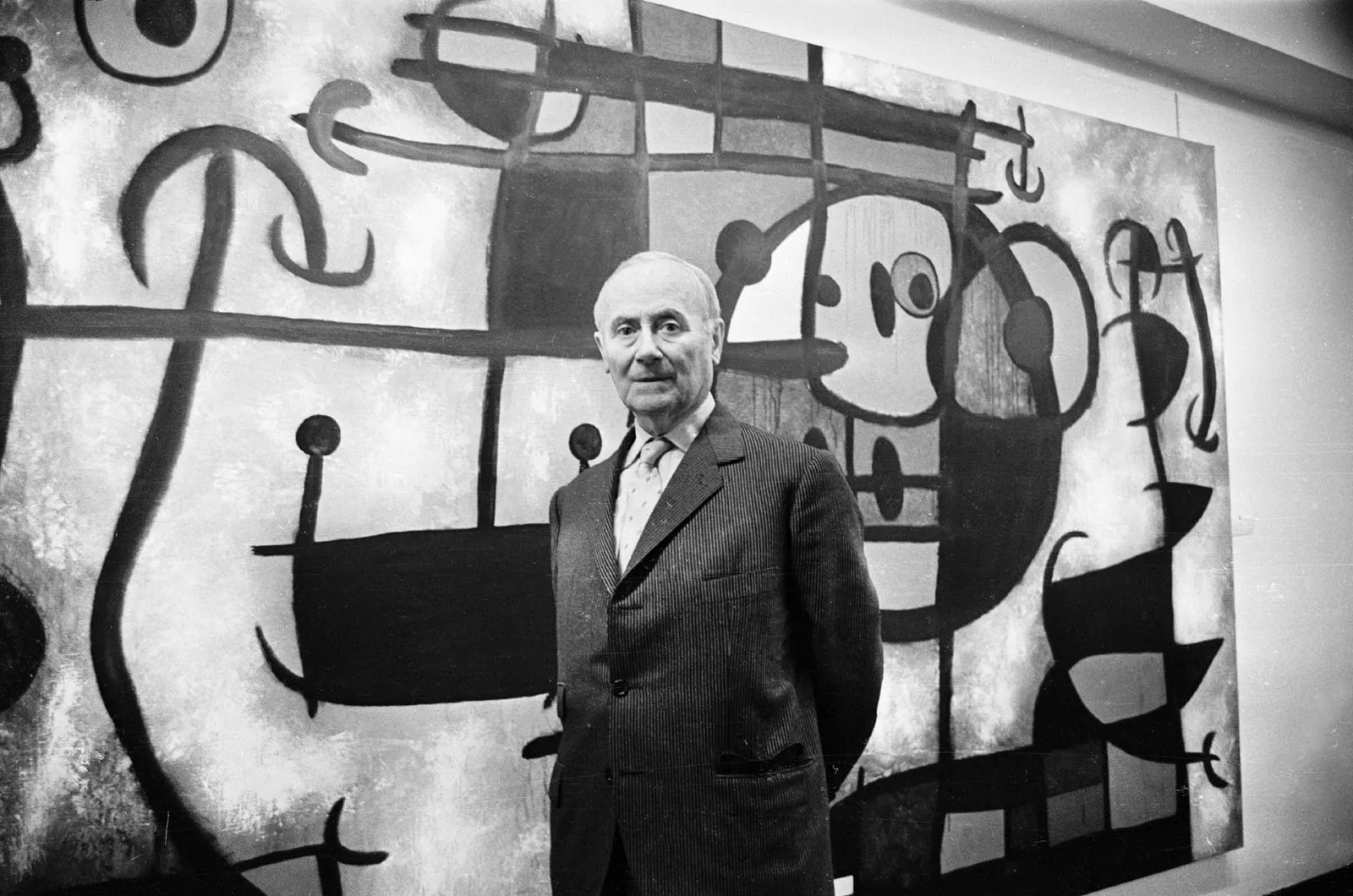
Joan Miró, The Universe's Most Joyful Dreamer
Artist Spotlight · The Collection Editorial
“I try to apply colors like words that shape poems, like notes that shape music.”
Joan Miró
In the spring of 2023, the Fundació Joan Miró in Barcelona mounted a landmark exhibition drawing visitors from across the globe to stand before works that feel as alive today as when they were first made. The occasion was a reminder of something collectors and curators have long understood: Miró does not age. His canvases pulse with an energy that seems to renew itself with every generation, every pair of fresh eyes that encounters his constellations of floating forms and burning color. Few artists in the history of modern art have achieved what Miró achieved, which is the rare and almost impossible feat of making the complex feel effortless, and the personal feel universal.
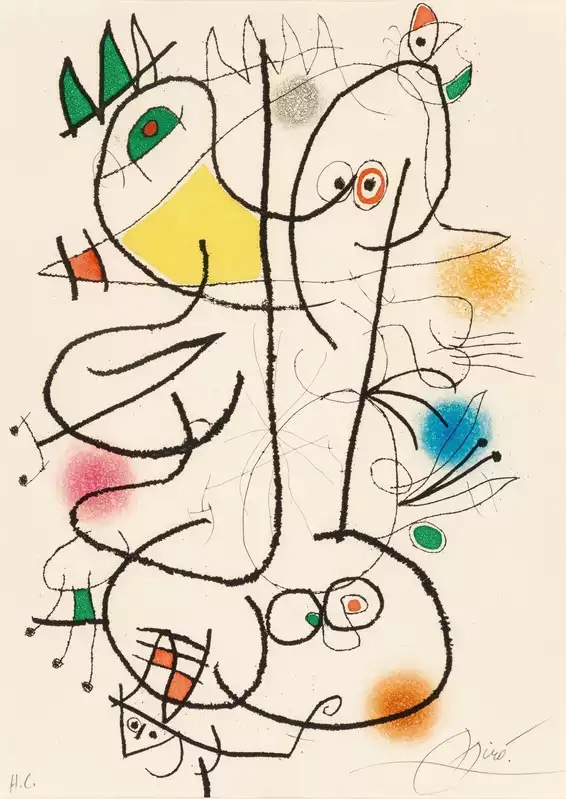
Joan Miró
Le Miroir de L'Homme par les Bêtes, 1972
Joan Miró i Ferrà was born in Barcelona on April 20, 1893, into a family of artisans. His father was a goldsmith and watchmaker, his grandfather a blacksmith, and this inheritance of craft and making with the hands would never leave him. He spent formative summers in the countryside of Montroig del Camp in Tarragona, a sun drenched landscape of red earth, olive trees, and an enormous Mediterranean sky that would become one of the most persistent visual libraries of his life. The Catalan landscape was not merely a backdrop for Miró; it was a living source code, and his attachment to Catalan culture and identity gave his work an emotional rootedness that distinguished it from the more cerebral experiments of his Parisian contemporaries.
In 1920, Miró made his first trip to Paris, where he encountered Pablo Picasso, who became a generous early supporter, as well as the emerging Dadaist and Surrealist circles that were reshaping what art could be and do. He would spend years dividing his time between Paris and Catalonia, and this duality proved enormously productive. By 1924 he had formally aligned himself with André Breton's Surrealist movement, though Miró always occupied his own distinct corner of it. Where other Surrealists pursued the uncanny and the unsettling, Miró pursued joy, humor, and a kind of cosmic playfulness.
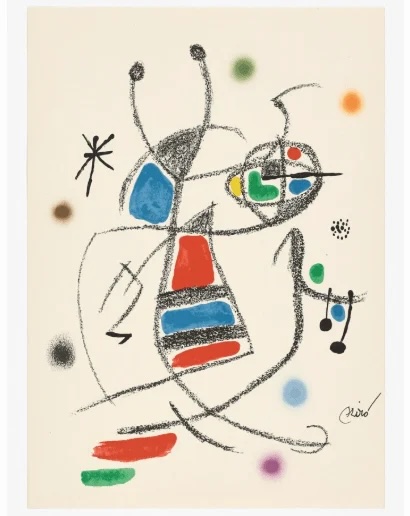
Joan Miró
Maravillas con Variaciones Acrósticasa en el Jardin de Miró, 1975
His 1925 painting known as The Harlequin's Carnival, dense with dancing creatures and floating symbols, announced a visual language entirely his own. The late 1930s and 1940s brought darker pressures. The Spanish Civil War and the rise of Franco drove Miró into a painful exile from his homeland, and the trauma of that rupture found its way into the extraordinary Constellation series, painted between 1940 and 1941 while he was in Normandy and then Majorca. These small, jewel like works, shown famously at the Pierre Matisse Gallery in New York in 1945, marked a turning point not only in Miró's career but in the broader story of modern art.
“The painting rises from the brushstrokes as a poem rises from the words. The meaning comes later.”
Joan Miró
American painters including Mark Rothko and Arshile Gorky looked at those constellations and saw a way forward. The influence on the Abstract Expressionists who would define the following decade was profound and direct. What makes Miró so enduring as a collecting proposition is the extraordinary range and consistency of his output. He worked in paint, sculpture, ceramics, tapestry, and print, and in each medium he brought the same generosity of imagination.
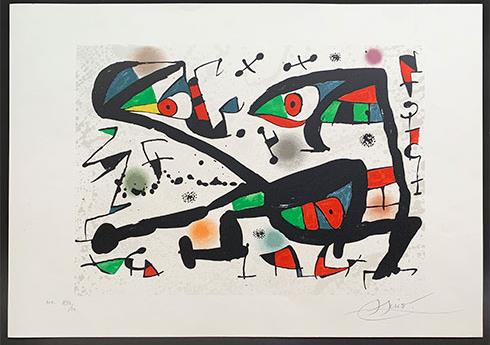
Joan Miró
Fondation de la Fédération Internationale des Jeunesses Musicales Marcel Cuvelier - René Nicoly, 1976
His printmaking practice in particular produced some of the most sought after works on the secondary market today. Works such as Préparatifs d'Oiseaux III from 1963, an aquatint of thrilling chromatic intensity, and the Homenatge a Joan Prats lithograph from 1971, demonstrate how seriously Miró approached the graphic arts. These were not reproductions or afterthoughts; they were fully realized statements in their own right, made in close collaboration with master printers and editions that Miró supervised with meticulous care. His prints from the 1960s and 1970s, including series such as Maravillas con Variaciones Acrósticas en el Jardín de Miró from 1975, offer collectors a genuine and meaningful point of entry into one of the twentieth century's most important practices.
“I feel the need of attaining the maximum of intensity with the minimum of means.”
Joan Miró, Cahiers d'Art, 1934
At auction, Miró's blue chip status has been confirmed repeatedly over decades. His paintings have achieved prices well into the tens of millions at Christie's, Sotheby's, and Phillips, with major works such as Peinture from 1927 setting records that reflect both the rarity of prime material and the depth of institutional and private demand. The print market remains robust and, relative to the paintings, accessible. Works on paper and limited edition prints carry strong price floors and have shown consistent appreciation, making them attractive to collectors at a range of entry points.
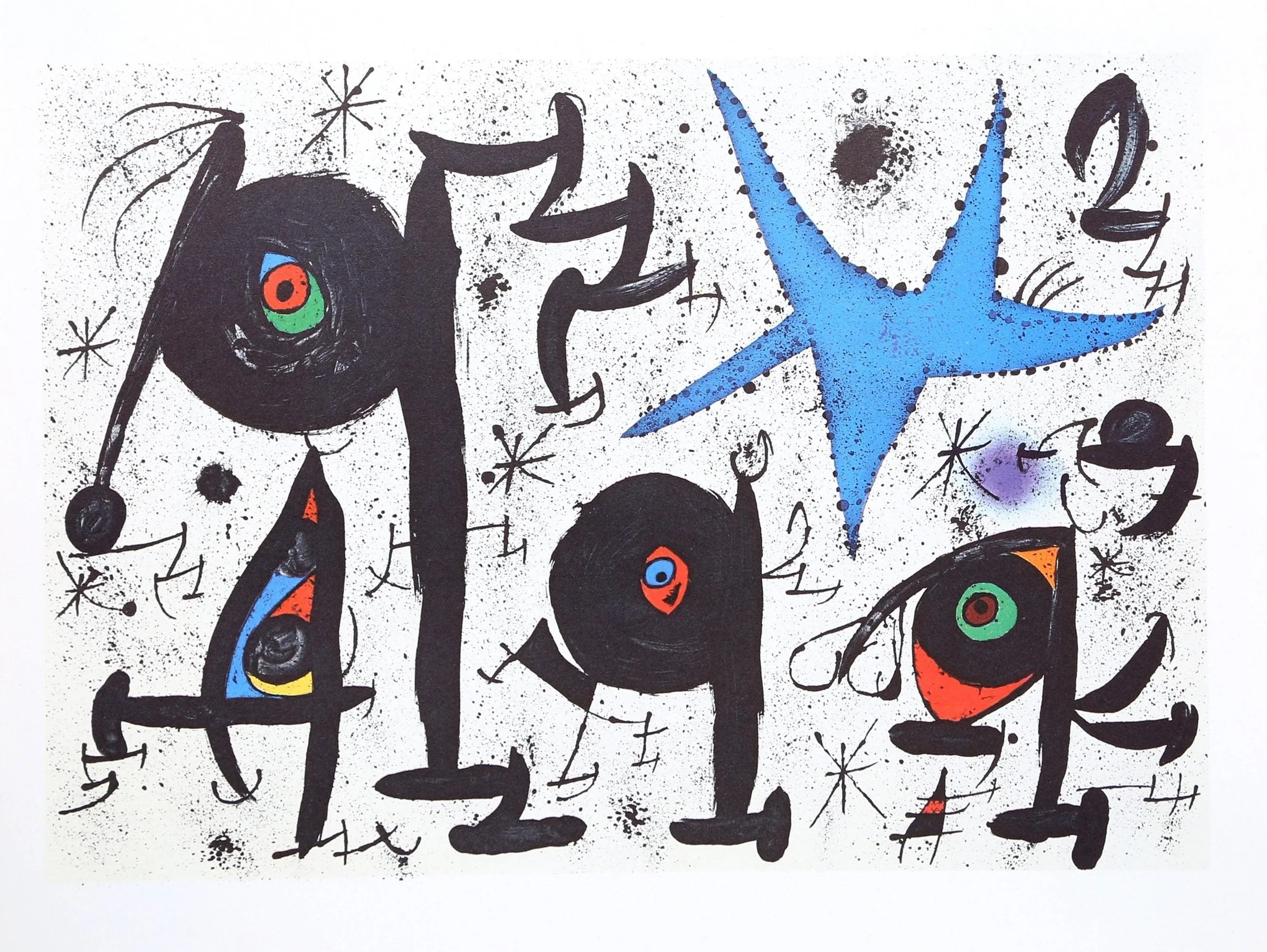
Joan Miró
Homenatge a Joan Prats (M.721), 1971
Curators and advisors frequently point to Miró's prints as among the most rewarding in terms of the relationship between quality, authenticity, and value within the broader modern master category. Miró invites comparison with a constellation of his own contemporaries and inheritors. The biomorphic abstraction he pioneered runs parallel to the work of Alexander Calder, his close friend, whose mobiles share something of Miró's sense of weightless, playful form in motion. Jean Arp explored similar territory in sculpture.
Among painters, Paul Klee is a natural companion, another artist who found in simplicity a profound philosophical depth. In terms of influence, the lines run forward to artists as varied as Keith Haring, whose graphic boldness and love of symbol owes a clear debt, and to generations of artists working in abstraction who continue to find in Miró's example both permission and inspiration. Joan Miró died in Palma, Majorca, on December 25, 1983, at the age of ninety. He had worked almost to the very end, the last decades of his life marked by increasing ambition in scale and medium, including monumental public sculptures and ceramics made in collaboration with his friend Josep Llorens Artigas.
The Fundació Joan Miró, which he established in Barcelona in 1975 with the architect Josep Lluís Sert, stands as one of the most architecturally beautiful and intellectually coherent artist foundations in Europe, a testament to a man who gave his entire life to the idea that art should be free, generous, and available to all. To collect Miró is to bring something irreducibly alive into your life, a fragment of a cosmos that one man spent ninety years building, star by painted star.
Explore books about Joan Miró
Miró: A Retrospective
Museum of Modern Art
Joan Miró: 1893-1983
Jacques Dupin
Miró: Life and Work
Caroline Lanchner
The Birth of Modern Art: Miró
Pierre Daix
Joan Miró: Selected Writings and Interviews
Joan Miró and Margit Rowell
Miró: An Introduction
William Rubin
Joan Miró: A Life
Roland Penrose
Miró: The Birth of the World
Henri Godelier