Jean Dubuffet
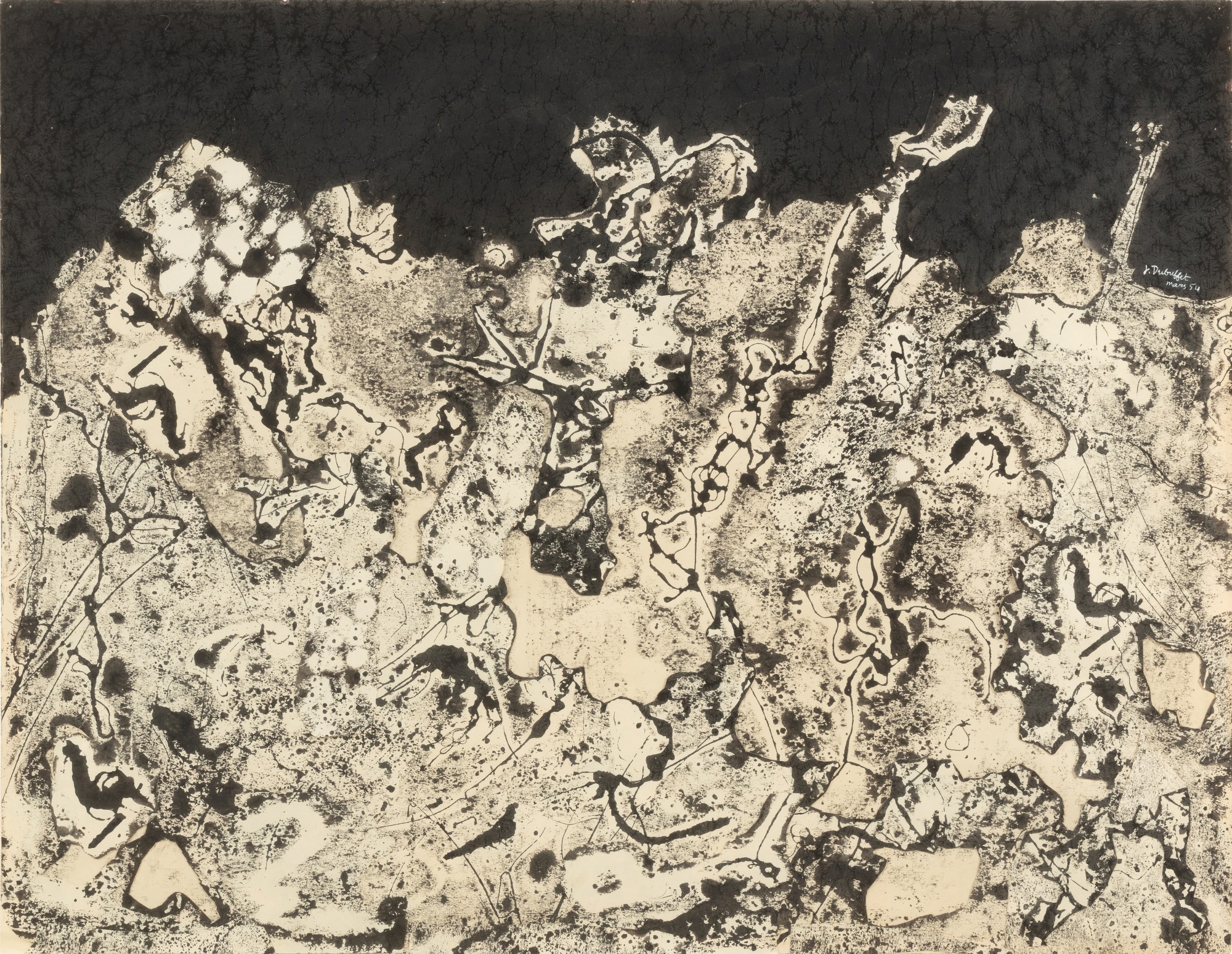
Jean Dubuffet, Forever Wild and Free
Artist Spotlight · The Collection Editorial
“Art does not sleep in the same bed as meaning and intention.”
Jean Dubuffet, writings collected in Prospectus et tous écrits suivants
In the spring of 2024, the Fondation Dubuffet in Paris mounted a focused exhibition drawing renewed attention to one of the twentieth century's most stubbornly original voices. Scholars and collectors gathered in the city's sixth arrondissement, where the foundation maintains an intimate archive of the artist's work, to reconsider a body of art that refuses, even now, to sit quietly within any established canon. That restlessness is precisely the point. Jean Dubuffet spent his entire career insisting that the most vital creative energy existed outside the museums, academies, and galleries that defined respectable art, and the art world has spent decades discovering he was right.
Jean Dubuffet
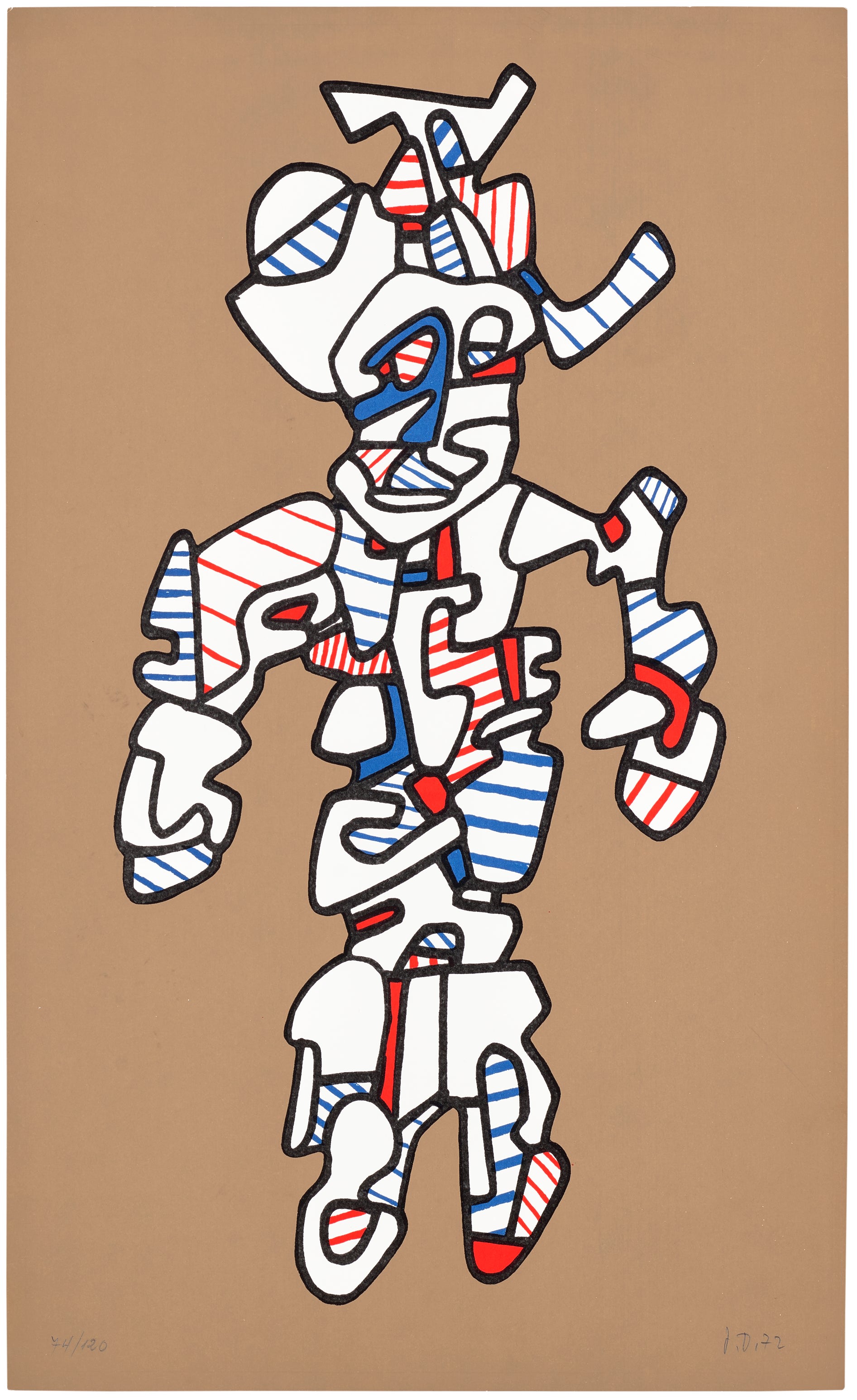
Le surintendant (The Superintendent) (W. 1098)
Dubuffet was born in Le Havre in 1901, the son of a prosperous wine merchant, and the tension between bourgeois comfort and radical instinct would animate his work for the rest of his life. He arrived in Paris in 1918 to study at the École des Beaux Arts but found its instruction hollow and left after only six months. He moved through circles that included Fernand Léger and Raoul Dufy, absorbing modernism without submitting to it. For years he retreated from art entirely, returning to run the family wine business, and it was not until 1942, at the age of forty one, that he committed fully to painting.
That late start gave him a freedom that younger artists rarely possess: he had nothing to prove to the establishment because he had already decided the establishment was not worth proving anything to. The breakthrough years came quickly. In 1944 and 1945, Dubuffet held his first major Paris exhibitions, showing work that immediately divided opinion. His surfaces were thick with sand, gravel, tar, coal dust, and plaster, built up into dense, churning fields that looked more like excavated earth than painted canvas.
Jean Dubuffet
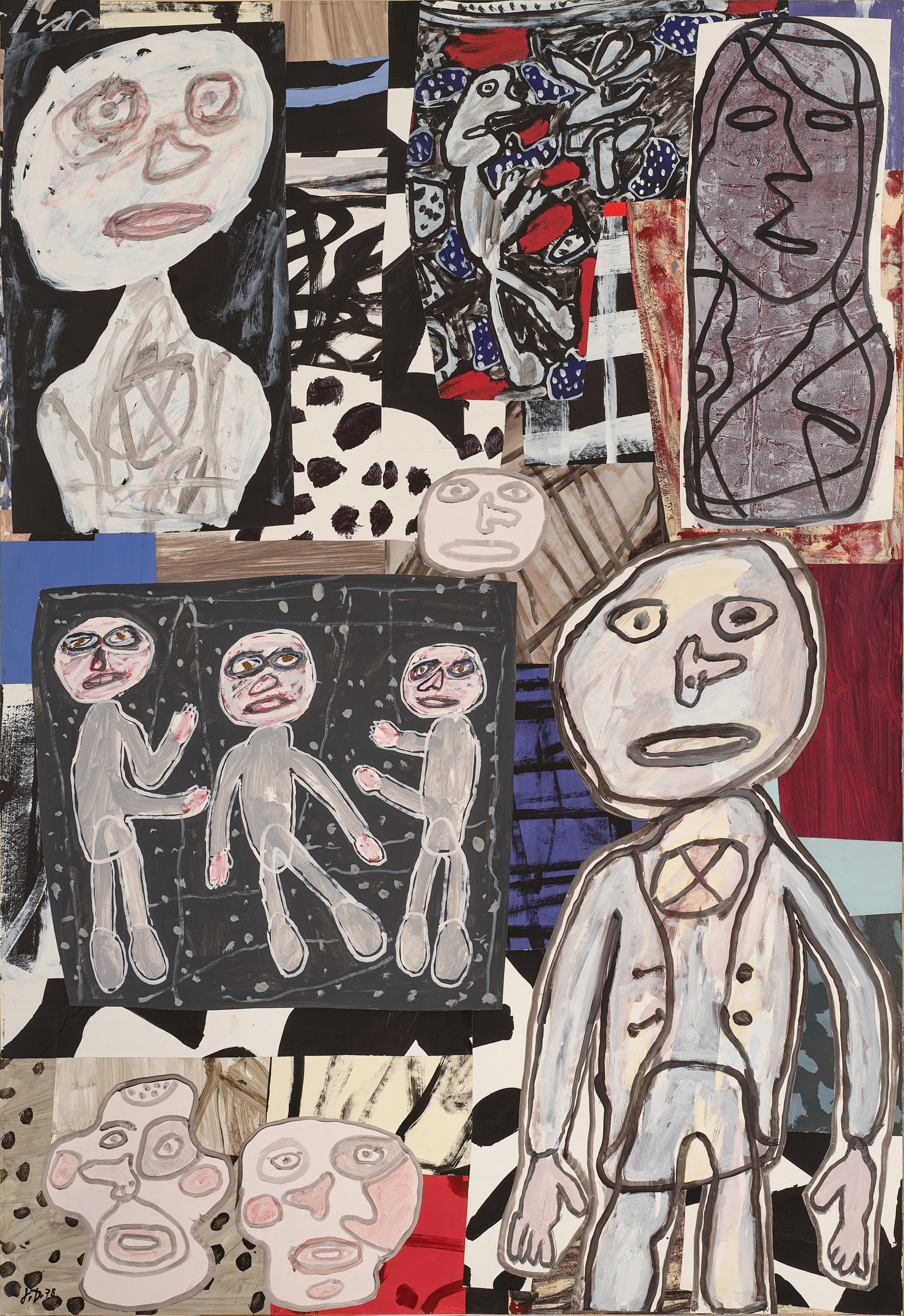
L'Après-midi chômé
His figures were grotesque in the most generous sense, lumpen and grinning, carved into the matter of the picture plane rather than painted onto it. Critics recoiled. Collectors with genuine curiosity leaned in. By the late 1940s, Dubuffet had articulated a philosophy he called Art Brut, which he understood as art made outside all cultural conditioning, by psychiatric patients, prisoners, mystics, and untrained visionaries whose work carried a rawness that academic training systematically destroys.
“For me, insanity is super sanity. The normal is psychotic. Normal means lack of imagination, lack of creativity.”
Jean Dubuffet
In 1948 he founded the Compagnie de l'Art Brut with André Breton and others, and began assembling the extraordinary collection that would eventually become the Collection de l'Art Brut in Lausanne, Switzerland, opened in 1976. Dubuffet's own practice evolved with remarkable restlessness across several distinct periods. His Corps de Dames series of the early 1950s presented female figures as landscape, flesh merging with terrain in images that were simultaneously tender and transgressive. The Texturologies and Matériologies of the late 1950s pushed toward near abstraction, the canvas becoming a meditation on raw material and surface rather than representation.
Jean Dubuffet
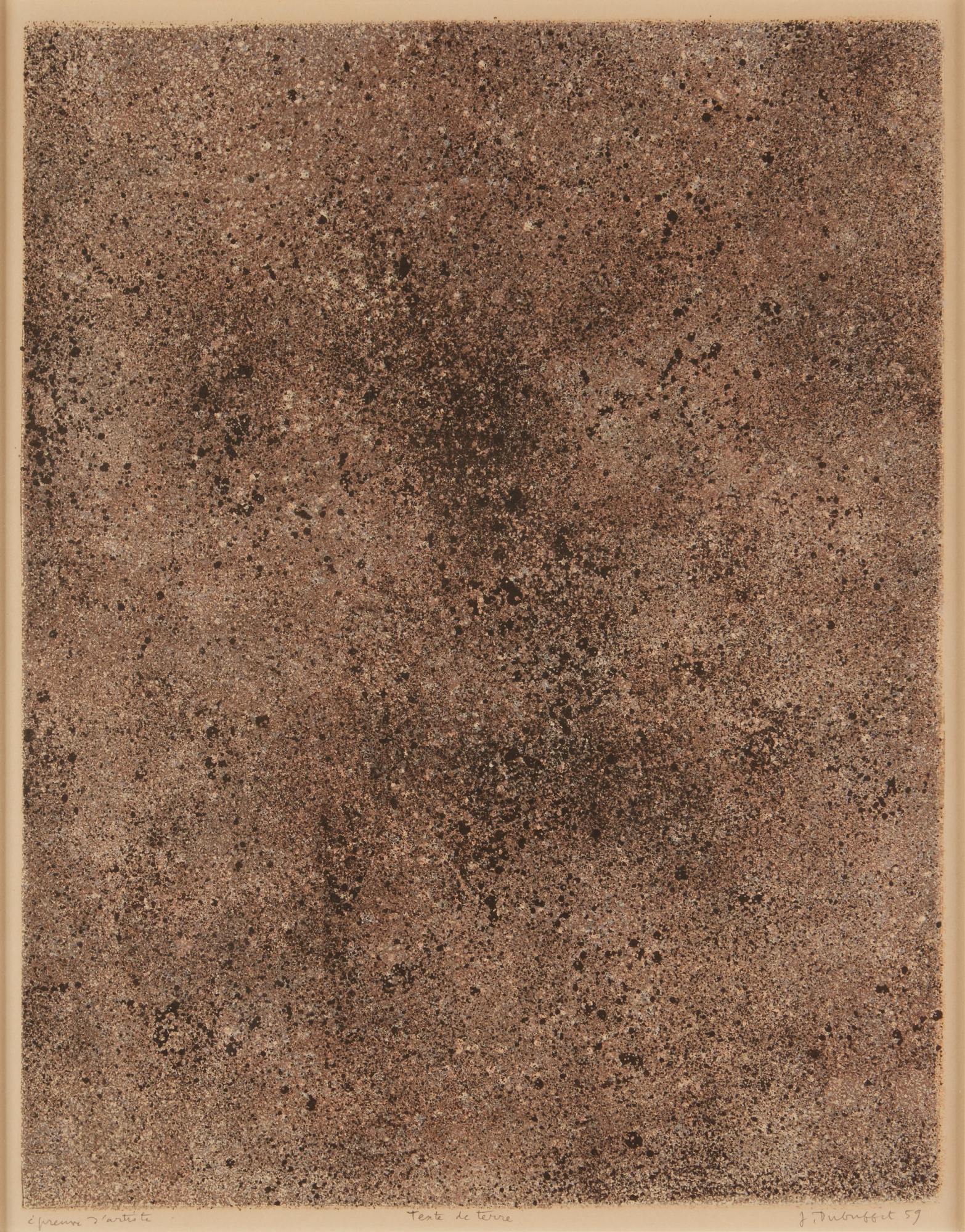
Texte de terre, from Champs de Silence, 1959
Then came the Hourloupe cycle, which he began in 1962 and pursued for over a decade. The Hourloupe works, built from interlocking amoebic cells filled with red, blue, and white, and outlined in black, were unlike anything else being made. They eventually expanded from paintings into sculptures, architectural environments, and monumental public structures, including the remarkable Closerie Falbala completed in 1973 near Paris, a walkable sculptural environment at Périgny sur Yerres. The lithographs of this period, including the vivid Texte de terre from the Champs de Silence portfolio of 1959, reveal how deeply he thought about the printed mark as a carrier of the same disruptive energy as his painted surfaces.
The works available through The Collection offer a privileged window across the full arc of Dubuffet's practice. The acrylic and paper collage L'Après midi chômé demonstrates his mastery of the collage form, where fragments of painted paper are assembled into figures that pulse with compressed energy. The screenprints, among them Le surintendant and the Parade nuptiale from his later career, show how fluidly he translated his visual language across media, with the flat graphic clarity of screenprint somehow amplifying rather than diminishing the anarchic charge of his imagery. The Site aléatoire works from 1982, made when he was in his eighties, confirm what his admirers had always sensed: that his invention never calcified into mannerism.
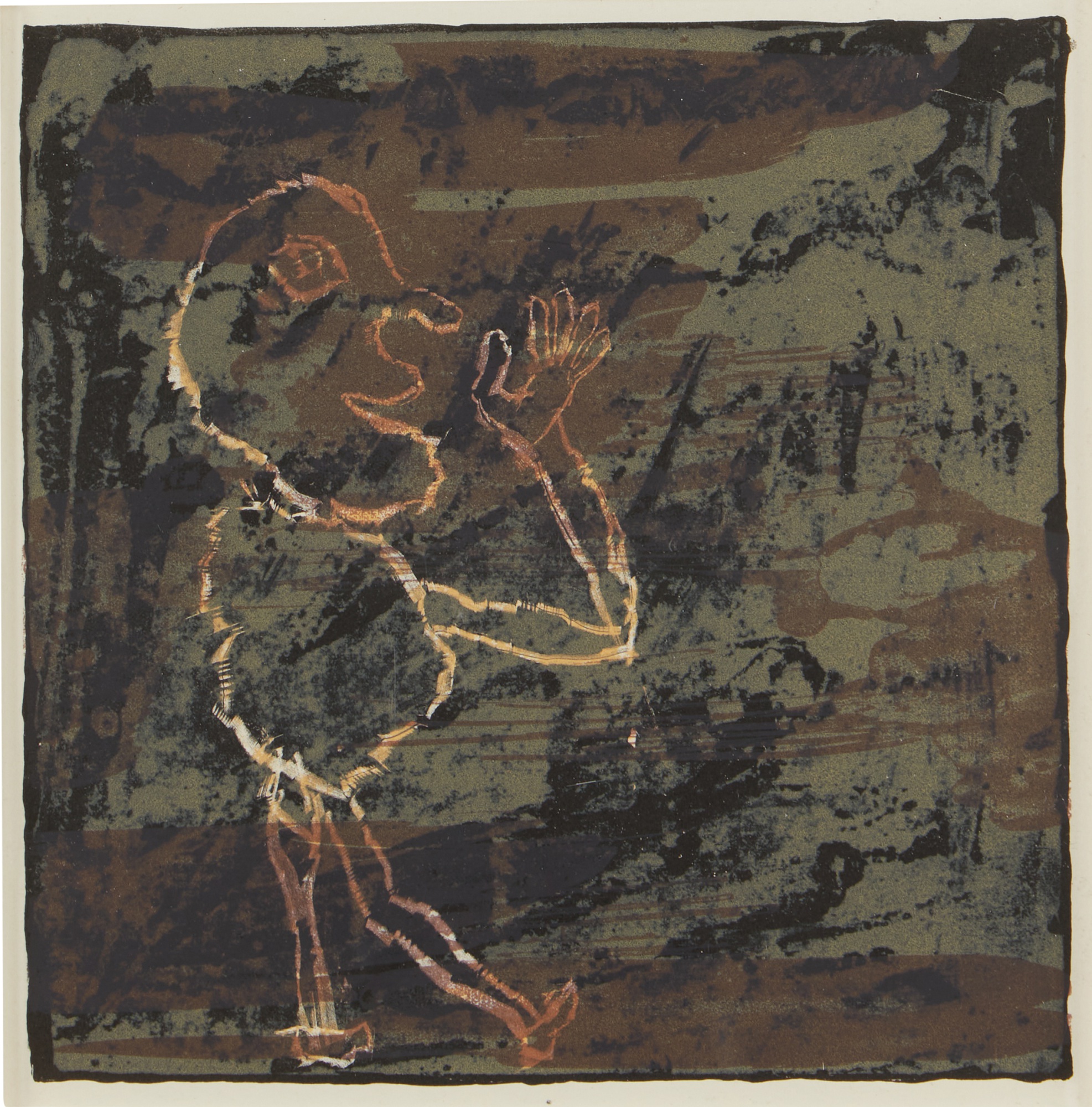
Jean Dubuffet
Voyageur au site obscur, from Anvouaiaje par in ninbesil avec de zimaje, 1949
The figures in these late acrylics still feel newly discovered, still strange, still alive. The sculptural Encrier, a painted earthenware inkwell, is a small and perfect object, the kind of work that reminds you how much wit ran through everything he made. For collectors, Dubuffet presents a compelling case. His market has been consistently strong for decades, with major works appearing regularly at Sotheby's, Christie's, and Phillips.
Prices for significant paintings from the Corps de Dames or Hourloupe periods have reached into the millions at auction, but his works on paper and prints remain genuinely accessible entry points for collectors at multiple levels. The lithographs he made in collaboration with Mourlot in Paris, and the screenprints produced through Pace Editions in New York, were created with care and in limited numbers, and they carry the full conceptual weight of his larger practice. Collectors drawn to artists like Karel Appel, Asger Jorn, or Jean Fautrier will find in Dubuffet a figure who shares their appetite for material intensity and anti rational form, but who went further in theorizing and embodying that position. His relationship to American artists is also instructive: Cy Twombly acknowledged a debt to the scratched and scrawled surfaces Dubuffet pioneered, and the Neo Expressionist generation of the 1980s, figures like Jean Michel Basquiat and A.
R. Penck, owed more to his example than is always acknowledged. What makes Dubuffet matter in the present moment is not nostalgia but provocation. At a time when conversations about whose creativity counts, about the relationship between trained and untrained making, about cultural gatekeeping and institutional authority, sit at the center of the art world's self examination, Dubuffet's entire project reads as startlingly prescient.
He did not romanticize outsider artists from a comfortable distance; he built an institution to preserve their work and structured his own practice around the uncomfortable question of what art loses when it becomes polished and assured. His answer, delivered across thousands of paintings, prints, sculptures, drawings, and writings, was that it loses everything that matters. Walking alongside a Dubuffet, you feel the truth of that. The surface resists you and then pulls you in, and you emerge slightly unsure of where the picture ends and the world begins.
That is a rare and lasting gift.
Explore books about Jean Dubuffet
Jean Dubuffet: Art Brut and the Other
Kristine Stiles

Dubuffet: A Retrospective
Peter Selz
Jean Dubuffet 1901-1985
Michel Tapié
Dubuffet: Texturologies
François Marquet
Jean Dubuffet and Art Brut
Corinne Diserens

Dubuffet: Catalogue Raisonné of Paintings
Max Loreau
Jean Dubuffet: Writings and Interviews
Peter Reed
Dubuffet: A Life
Laurie Wilson