Isidore Pils
Isidore Pils: Humanity Rendered in Monumental Scale
Artist Spotlight · The Collection Editorial
Imagine standing before a vast canvas in the Salon of 1852, jostled by the crowds of Paris, watching as they fall quiet in front of a scene of soldiers pressing bread into the hands of the destitute. No theatrical heroism, no gilded allegory, just the plain and aching weight of one human being offering something to another. That painting, rooted in the same tender impulse visible in the surviving preparatory study now held in private collections, captures everything that made Isidore Pils one of the most morally serious painters of nineteenth century France. His work did not merely decorate the walls of the Salon; it asked something of the people who stood before it.
Isidore Pils
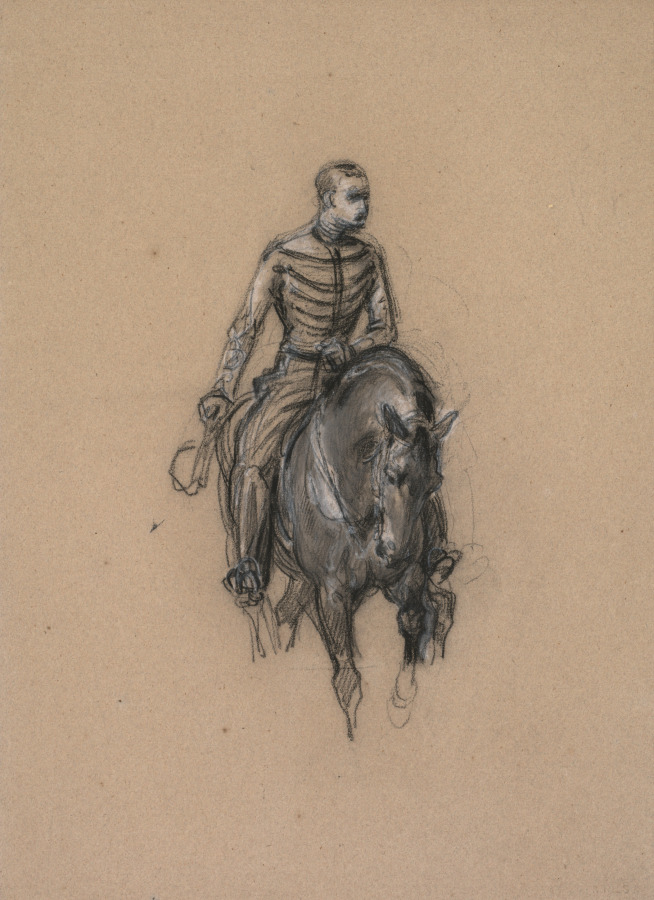
Militaire a cheval (Soldier on Horseback), 1855
Pils was born in Paris in 1813, entering the world at a moment when French painting was still charged with the legacy of David and the epic ambitions of the Napoleonic era. He came of age artistically under the tutelage of François Édouard Picot, one of the great transmitters of the French academic tradition, a painter whose studio produced an extraordinary number of Prix de Rome laureates. Under Picot, Pils absorbed the rigorous discipline of figure drawing, compositional architecture, and the mastery of paint handling that would underpin everything he made. The training was exacting, and Pils proved equal to it, winning the Prix de Rome in 1838 and securing his passage to the Villa Medici in Rome, that storied institution where French painters had been sent to study antiquity and the Renaissance masters for generations.
The years in Rome were formative in ways that went beyond technical refinement. Pils encountered the devotional grandeur of Italian fresco painting and absorbed the lessons of Raphael and the great religious decorators of the Counter Reformation. He also encountered poverty, the street life of Rome, the faces of people living without comfort or certainty, and these encounters left a permanent mark on his imagination. When he returned to Paris and began exhibiting at the Salon in the 1840s, his religious subjects carried an unusual emotional directness.
Isidore Pils
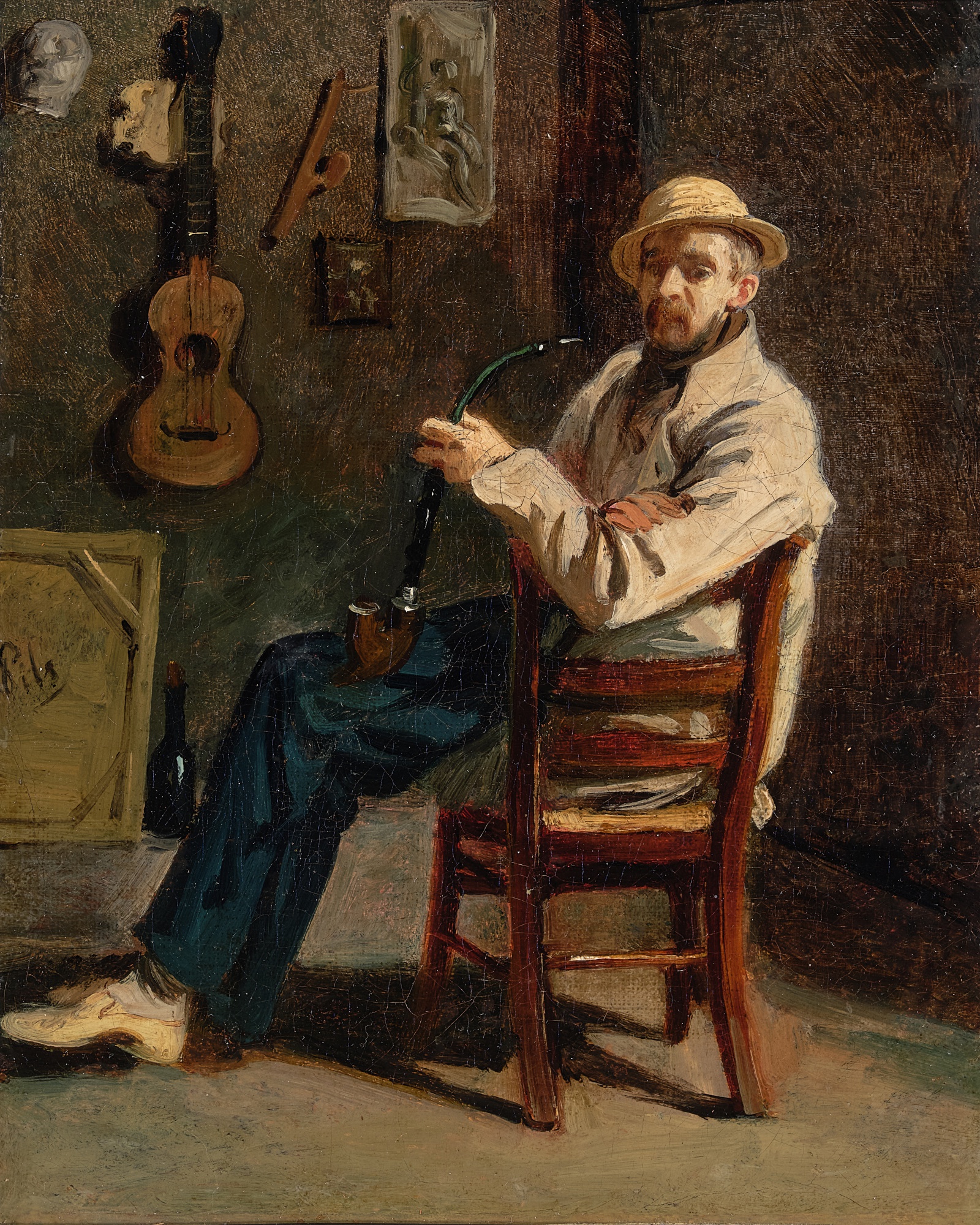
Self-Portrait
His figures were not idealized beyond recognition; they bore the weight of actual bodies and actual feeling. The decade of the 1850s was perhaps the most creatively charged of his career. His military subjects attracted enormous public attention and brought him into alignment with the taste of the Second Empire, which had its own appetite for images of French martial life. Yet Pils resisted the temptation of pure triumphalism.
His soldiers are tired, tender, sometimes broken. The chalk study known as Militaire a cheval, dated to 1855, exemplifies his draughtsmanship at its finest, a single figure rendered with economy and authority in black and white chalk on beige laid paper, the horse and rider caught in a moment of composed readiness rather than theatrical charge. It is a work that rewards close looking, revealing the confidence of a hand that has drawn thousands of figures from life and distilled that knowledge into something effortless in appearance and demanding in execution. The Study of a Reclining Nude from 1841, painted in oil on fabric during or shortly after his Roman years, belongs to a different register entirely.
Isidore Pils
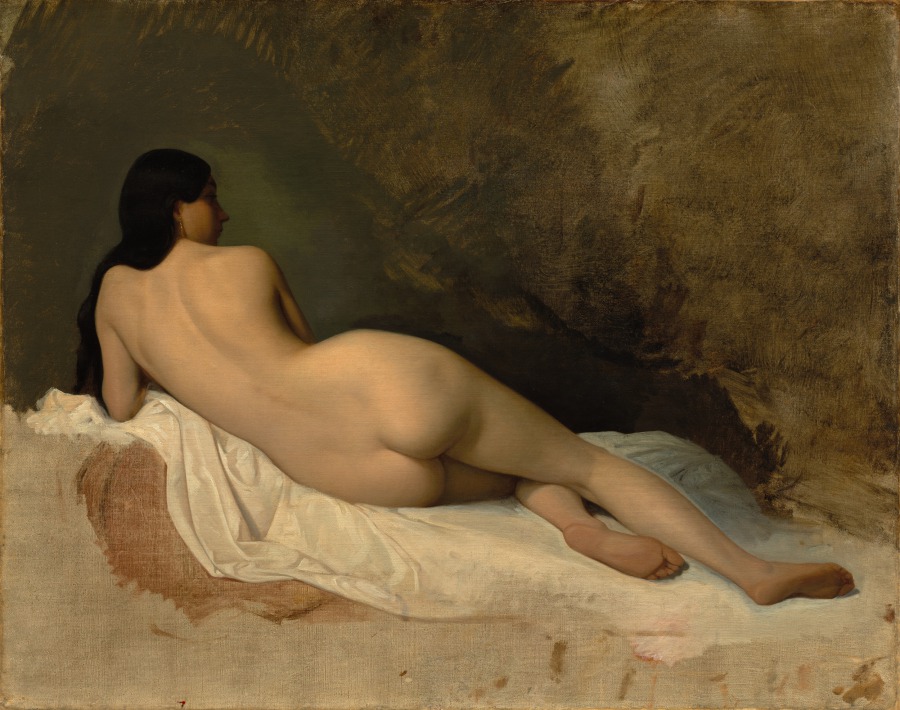
Study of a Reclining Nude, 1841
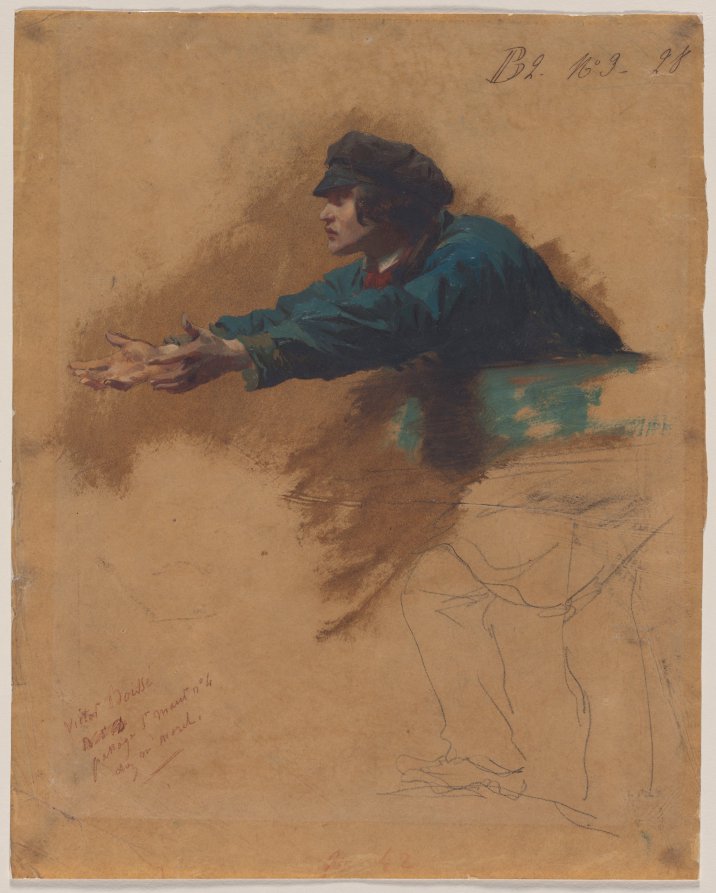
It is an academic exercise that transcends its origins as a study, demonstrating Pils's sensitivity to the fall of light on skin and his ability to render the human body with warmth rather than clinical detachment. The Young Man Leaning Forward with Outstretched Arms, a preparatory study for his celebrated composition of soldiers distributing bread to the poor dated to 1851, is equally revealing. Executed in oil, brown wash, and black crayon, it captures the gesture of giving as a physical and moral act, the arms extended not in triumph but in offering. These preparatory works illuminate the seriousness of his process and the depth of thought he brought to even the smallest component of a large composition.
Beyond the Salon and the easel, Pils was entrusted with one of the grandest decorative commissions of Second Empire Paris: the ceiling paintings for the Paris Opéra, the Palais Garnier, begun under Charles Garnier's direction. To be asked to contribute to that building was to occupy a position at the very pinnacle of official French art, and Pils met the challenge with the same combination of technical mastery and human feeling that characterized all his work. Monumental decorative painting demands a different set of skills than easel painting, requiring an understanding of how imagery reads from a distance and how color must be calibrated to hold its force across vast architectural spaces. Pils navigated these demands with the sureness of a painter who had spent decades thinking about how images move people.
Isidore Pils
Young Man Leaning Forward with Outstretched Arms (Study for Soldiers Distributing Bread to the Poor), 1851
For collectors, the works of Pils represent a compelling intersection of historical significance and genuine artistic quality. French academic painting of the nineteenth century has undergone substantial critical reassessment over the past several decades, with institutions and private collectors alike recognizing that the movement produced work of remarkable sophistication alongside its more formulaic productions. Pils occupies a distinguished position within that reassessment because his work was never merely decorative or politically convenient. His preparatory studies and drawings are particularly prized, as they offer an intimate view into a working method of considerable intelligence.
Works on paper from this period by Prix de Rome laureates of Pils's stature have performed well at auction when they come to market, and the rarity of his finished oil studies makes them genuinely desirable objects for collectors focused on the French academic tradition. Within the broader context of nineteenth century French painting, Pils stands in productive relationship with artists such as Théodore Géricault, whose Raft of the Medusa established a template for depicting suffering without sentimentality, and with Gustave Courbet, who shared Pils's interest in the working body and the lives of ordinary people, though from a very different ideological position. His military subjects also invite comparison with Édouard Detaille and Alphonse de Neuville, painters of the following generation who would carry the genre of military painting into the era of the Franco Prussian War with comparable seriousness of purpose. Pils was in many respects a bridge between the grand tradition and the emerging impulse toward social realism.
The legacy of Isidore Pils is ultimately the legacy of a painter who believed that large ambitions and genuine compassion were not in conflict. He worked within the system of the French Academy and the Salon without allowing that system to flatten the human particularity of his subjects. His soldiers are people, his saints are people, and the unnamed poor man reaching for bread in his great composition is as fully realized as any figure in the French painting of his time. In an era when questions about how art should represent suffering and dignity feel more urgent than ever, the example of Pils rewards renewed attention.
His work does not shout; it insists, quietly and with great assurance, that the people it depicts deserve to be seen.