Ingo Swann
Ingo Swann, Painter of Inner Worlds
Artist Spotlight · The Collection Editorial
“The universe is not only queerer than we suppose, but queerer than we can suppose.”
Ingo Swann, writings on consciousness
There is a particular kind of artist whose inner life is so vivid, so relentlessly expansive, that the canvas becomes less a surface and more a portal. Ingo Swann was precisely that kind of artist. Born on September 14, 1933, in Telluride, Colorado, a mountain town of extraordinary altitude and startling beauty, Swann spent the better part of eight decades producing paintings of surrealistic intensity and symbolic richness that deserve far greater attention from the contemporary art world. As collectors and institutions increasingly turn toward figures who operated at the fringes of mainstream art history, Swann is emerging as one of the most genuinely singular voices of his generation.
Ingo Swann
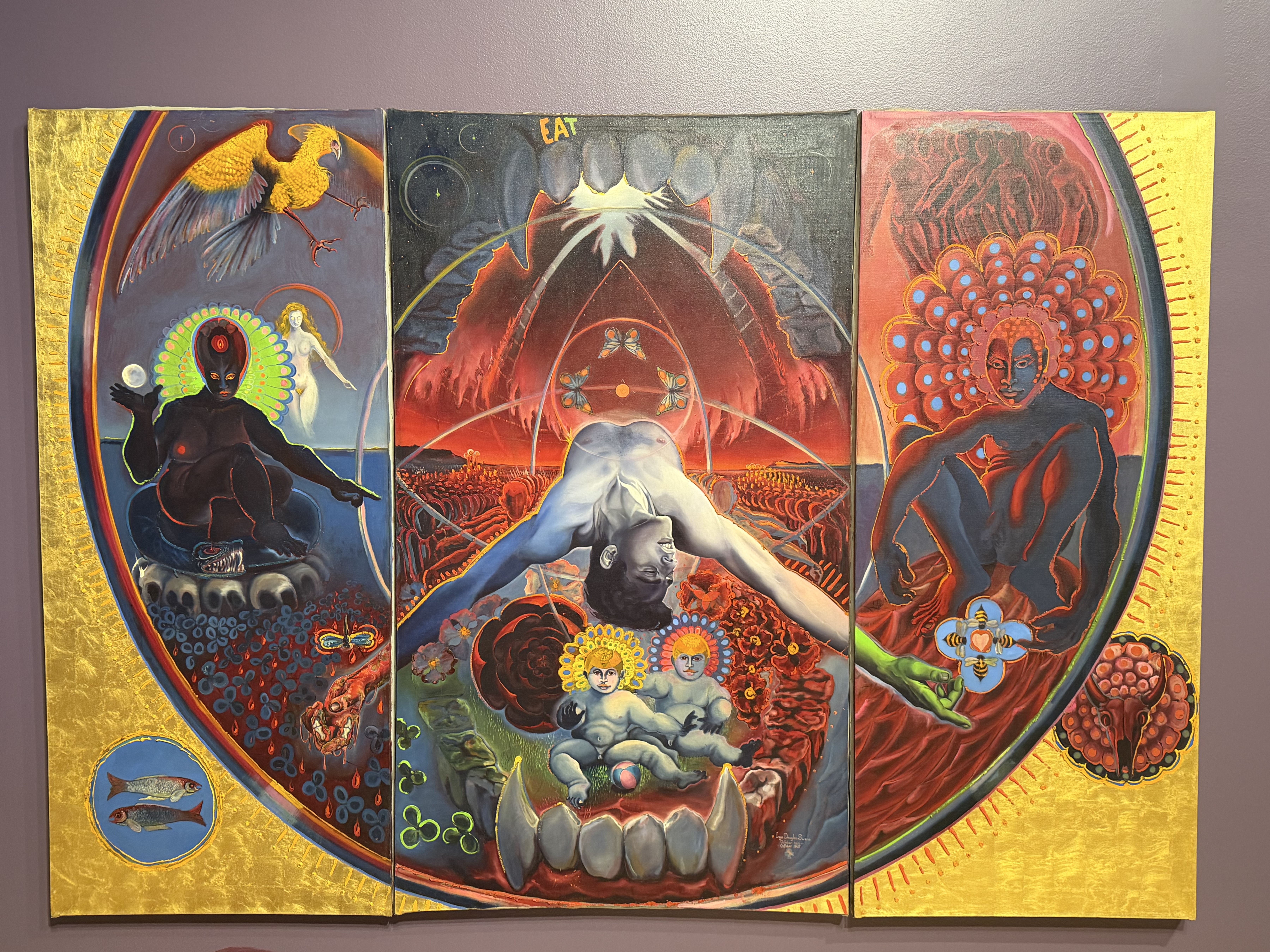
Rebirth Requiem, 1964
Telluride in the 1930s and 1940s was a world unto itself, a former mining boomtown ringed by the San Juan Mountains, its Victorian architecture slowly weathering into something mythic. Growing up in that landscape, Swann absorbed the drama of extreme terrain and extreme light at an impressionable age. He later moved to New York City, where he immersed himself in the ferment of the postwar art scene, absorbing the energy of Abstract Expressionism while clearly charting his own course. New York in the 1960s was an extraordinary proving ground, and Swann engaged with it seriously, developing a practice that was figurative yet dreamlike, grounded in personal symbolism while remaining visually arresting to any viewer willing to slow down and look.
Swann studied at Westminster College in Salt Lake City and later served in the United States Army before settling in New York, where he would spend the most productive decades of his artistic life. His formation as a painter was shaped not only by the dominant movements around him but by his profound and lifelong interest in consciousness, perception, and the nature of subjective experience. These were not peripheral concerns for Swann. They were the very engine of his art.
Where other painters of his era were working through the formal problems of flatness or gesture, Swann was asking what the mind actually sees when it turns inward, and what visual language might be adequate to that seeing. The 1960s represent a particularly rich period in Swann's artistic output. His 1964 painting "Rebirth Requiem," executed in acrylic on canvas, stands as one of the most compelling works of that decade. The title alone signals his ambitions: grief and renewal held in the same breath, the cycle of dissolution and emergence rendered in the vivid, almost hallucinatory palette that would become his signature.
Acrylic paint, still a relatively new medium in 1964, suited Swann's purposes well. It allowed for the kind of saturated color and layered transparency that oil might have muddied, and its fast drying time encouraged a directness of mark that keeps his surfaces alive and urgent. "Rebirth Requiem" rewards sustained looking, its compositional logic unfolding slowly, like a dream recalled in stages. Of course, Swann became widely known outside art circles for his involvement in parapsychological research, particularly the remote viewing program developed at the Stanford Research Institute in the 1970s, where he worked alongside researchers including Russell Targ and Hal Puthoff.
This dimension of his life has sometimes overshadowed serious engagement with his painting, which is a genuine loss for art history. The two aspects of his work were not contradictory but deeply continuous. His belief in the expansive capacities of human consciousness informed every compositional choice he made. His canvases are, in a very real sense, maps of attention, records of what becomes visible when perception is pushed past its ordinary limits.
For collectors approaching Swann's work, there is a quality of genuine rarity and intellectual depth that distinguishes his paintings from the more easily categorized work of his contemporaries. He does not fit neatly into Abstract Expressionism, nor into Pop, nor into any of the movements that have generated the most institutional and market attention over the past half century. That independence is now a strength. Artists who resisted easy classification tend to look more interesting over time, not less, and Swann's visionary surrealism places him in stimulating conversation with figures such as Pavel Tchelitchew, whose obsessive inner landscapes share something of Swann's symbolic intensity, and with the broader current of American visionary art that includes painters like Morris Graves and Yves Tanguy's American inheritors.
His work also resonates with the psychedelic and consciousness expanding currents that would define so much of late 1960s and 1970s culture, yet predates and in many ways anticipates them. The market for Swann's paintings remains at an early stage of full recognition, which is precisely the moment that serious collectors know to pay attention. Works from the 1960s in particular, executed during a period of exceptional creative focus, carry the dual distinction of historical significance and visual power. "Rebirth Requiem" is a strong example of what to seek: a work with a clear date, a title that articulates the artist's thematic concerns, and a visual presence substantial enough to hold a wall and a conversation for decades.
Condition and provenance matter, as they always do, but the relatively contained market means that exceptional works can still be acquired at prices that will seem startlingly modest in retrospect. Swann passed away on February 1, 2013, in New York, the city that had been his home and creative base for so many years. He left behind not only a body of paintings but a series of published books, a trove of writings on consciousness and perception, and a legacy that spans disciplines in ways that remain genuinely unusual. In an era when the art world is reckoning seriously with figures who were marginalized or overlooked during their lifetimes, Swann stands as a compelling case for reappraisal.
His paintings are not curiosities attached to a famous name in parapsychology. They are the work of a serious, dedicated, visually sophisticated artist who spent his life trying to render the invisible visible. That project feels more relevant today than ever.
Explore books about Ingo Swann
Everybody's Guide to Natural ESP
Ingo Swann

To Kiss Earth Goodbye
Ingo Swann
Penetration: The Question of Extraterrestrial and Human Telepathy
Ingo Swann

Remote Viewing: The Story of the American Laboratories That Uncovered Espionage Secrets
Joseph McMoneagle
Mind Trek: Exploring Consciousness, Time, and Space Through Remote Viewing
Joseph McMoneagle