Honda Takeshi
Honda Takeshi Draws Mountains Into Being
Artist Spotlight · The Collection Editorial
There is a particular quality of stillness that settles over a room when a work by Honda Takeshi is present. It is not the stillness of absence, but rather the stillness of absolute attention, of a world that has been listened to so carefully that it surrenders its deepest nature onto paper. Honda, the Japanese artist whose charcoal drawings of mountain landscapes have earned quiet but devoted admiration among collectors of postwar Japanese art, represents one of the most singular and sustained visions in contemporary Japanese works on paper. His practice, rooted in direct experience of the mountain environments of Japan, produces images that feel less like representations than like memories the earth itself has agreed to share.
Honda Takeshi
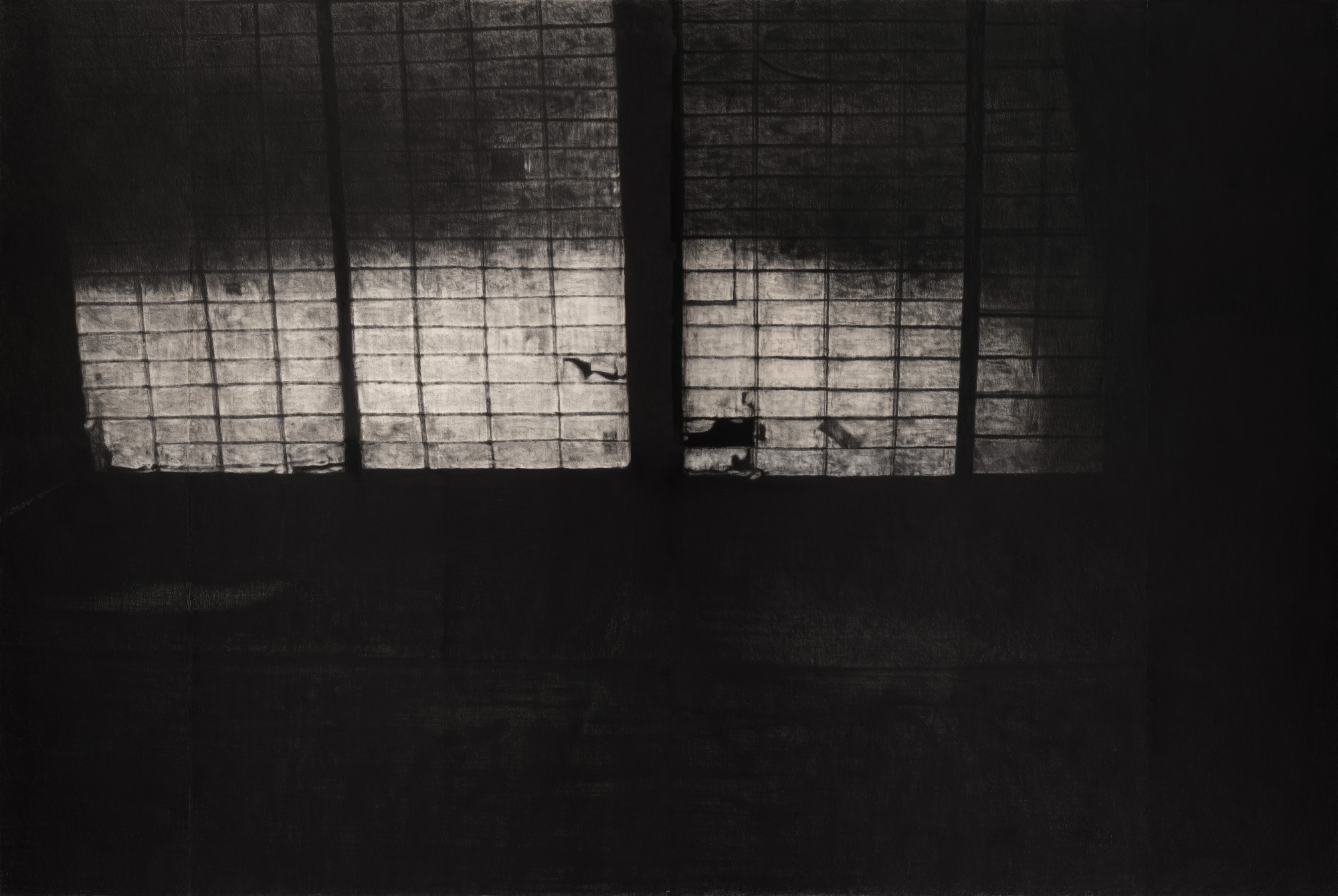
Mountain Life – Shoji (Yama no kurashi – shoji)
Honda Takeshi was formed by landscape in the most literal sense. Growing up in Japan during the postwar decades, he came of age during a period when Japanese artists were negotiating between the weight of traditional ink painting and the insistent pull of Western modernism. Honda charted a path that acknowledged both without being consumed by either. His early training gave him a command of compositional discipline and tonal sensitivity, and he gravitated toward the mountains not as picturesque backdrop but as subject matter with philosophical weight, a terrain in which human presence is measured, humble, and renewed through the act of walking.
The charcoal medium became central to Honda's practice in ways that feel entirely inevitable in retrospect. Charcoal is a material with deep affinities to the natural world: it is, after all, burned wood, a substance that has passed through fire and emerged transformed into something capable of marking, describing, and evoking. Honda's command of charcoal on paper allows him to build tonal ranges of extraordinary subtlety, moving from the palest silvered gray of mist above a ridgeline to the dense, weighted black of a tree silhouetted against an October sky. The medium suits his subject because it is never garish, never insistent, always willing to yield to the paper beneath it in a way that mirrors how light yields to mountain shadow.
Honda Takeshi
1993
Among the works that best illuminate Honda's achievement is 'Mountain Life, Shoji, Yama no kurashi, shoji,' executed in charcoal on paper in 1991. The work invites the viewer into an interior moment defined by the translucent screen of a shoji panel, that quintessential Japanese mediator between inside and out, between the domestic and the wild. The mountain world presses gently against the paper screen, and Honda captures that pressure with a restraint that is itself an argument about how we might dwell in landscape rather than simply observe it. It is a work about thresholds, about the way Japanese architectural and spiritual traditions teach us to understand nature not as something beyond the walls but as something that permeates them.
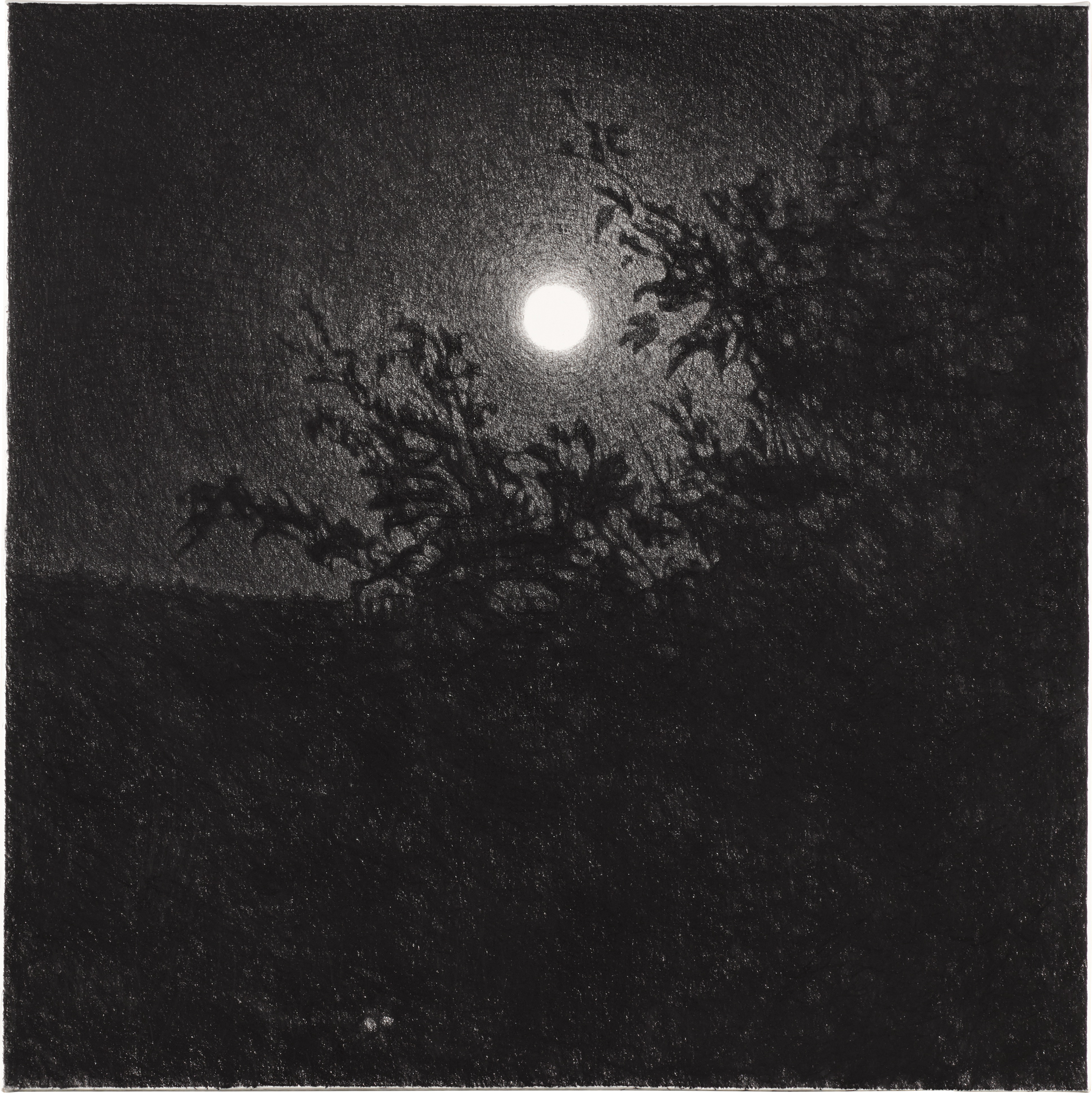
'Walking in the Mountains, October, The Moon with Mulberry Trees, Yama aruki, jugatsu, kuwa no ki no tsuki,' created in 2014, demonstrates the continuity and deepening of this vision across more than two decades. The mulberry trees, unglamorous and workaday in Japanese agricultural life, are elevated here by their proximity to moonlight and mountain air. Honda finds in the ordinary tree a collaborator for the extraordinary sky, and the result is an image of companionship between human cultivation and wild nature that feels genuinely moving. For collectors, Honda Takeshi offers something increasingly rare in the contemporary art market: a practice of unbroken integrity, pursued across decades with the discipline of someone for whom art is not a career strategy but a form of devoted attention to the world.
Honda Takeshi
Walking in the Mountains – October (The Moon with Mulberry Trees) (Yama aruki – jugatsu, kuwa no ki no tsuki) | 2014
Works on paper of this quality and this sustained vision occupy a meaningful position in any serious collection of Japanese postwar and contemporary art. The intimacy of the charcoal drawing means that these are works that reward close and repeated living with: they open slowly, offering new tonal passages and compositional decisions each time one returns to them. Collectors drawn to artists such as Hiroshi Senju, whose waterfall paintings similarly navigate the space between Japanese tradition and contemporary sensibility, or to the ink work of artists working in the Nihonga adjacent traditions, will find in Honda a figure whose work holds its own with genuine authority. The market for Honda's drawings has been concentrated among knowledgeable private collectors with a particular feeling for Japanese works on paper, and this concentration speaks to the work's character: it does not announce itself loudly but it does not need to.
In the broader context of Japanese art history, Honda Takeshi belongs to a lineage that stretches from the great landscape traditions of Edo period painting through the Meiji era artists who grappled with Western influence, and into the postwar generation who sought to reclaim a Japanese relationship with nature on their own terms. His work resonates with the ethos of the Mono no Aware tradition, the Japanese aesthetic sense of the pathos of things, of beauty apprehended in its transience. The mountains he returns to season after season are not symbols of permanence so much as ongoing presences, entities with their own seasonal and daily lives that the artist is privileged to witness and record. In this respect Honda is a genuine heir to Basho as much as to any visual art tradition, a wanderer who brings the experience of the path back into the studio and finds ways to transmit it.
What Honda Takeshi offers the contemporary moment is, in the end, a form of counterweight. At a time when the art world calibrates attention in units of spectacle and velocity, his charcoal mountains propose a different economy: one of slowness, of return, of the knowledge that accumulates only through sustained looking. The moon over mulberry trees in October is not a dramatic subject by conventional measures, and yet Honda makes it one of the most compelling images a collector of Japanese art might encounter. That is the mark of an artist whose vision is not borrowed from the world around him but grown from something deeply personal and deeply considered.
His work belongs in collections where it will be seen often, in rooms where there is time to sit with it, and it will reward that attention every single time.
Explore books about Honda Takeshi