Hernan Bas
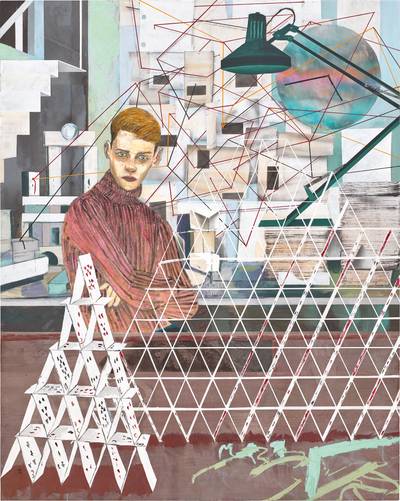
Hernan Bas and the Beauty of Becoming
Artist Spotlight · The Collection Editorial
In recent years, Hernan Bas has ascended to a position of rare cultural authority, his lush figurative paintings arriving precisely when the art world finds itself hungry for work that is simultaneously beautiful, intellectually rigorous, and deeply personal. His solo exhibitions at Lehmann Maupin, the gallery that has long championed his vision across its New York, Hong Kong, and Seoul spaces, have drawn sustained critical attention and enthusiastic collecting from institutions and private hands alike. The Brooklyn Museum counts his work among its holdings, a recognition that places him firmly within the canon of significant American painters working today. At a moment when figuration has reasserted itself at the center of contemporary discourse, Bas stands as one of its most distinctive and literate voices.
Hernan Bas
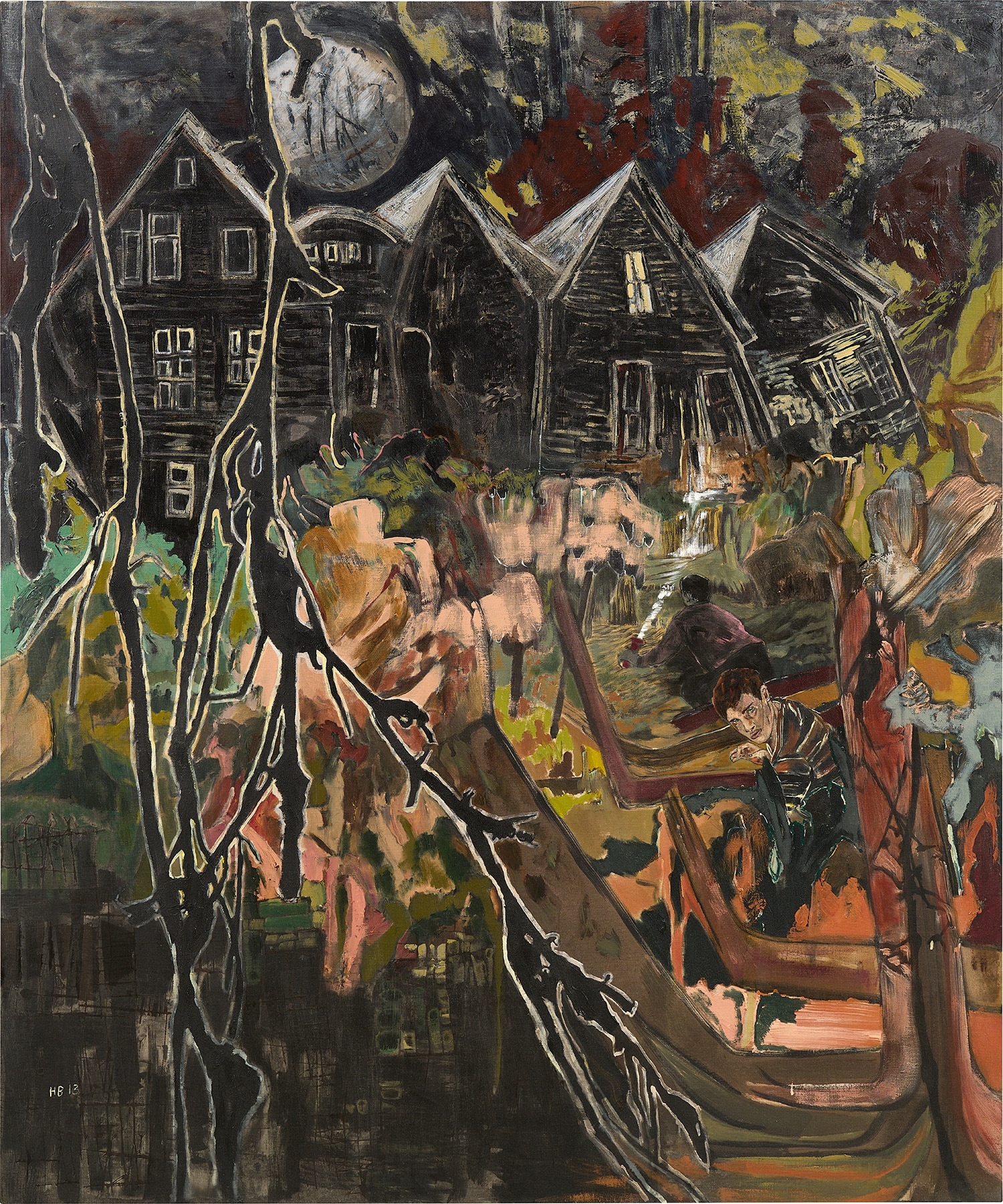
Who Told Them We Were Coming?, 2013
Bas was born in Miami in 1978, and the city's subtropical atmosphere, its sense of lush overgrowth pressing against the edges of civilization, never entirely left his canvases. Miami in the 1980s and 1990s was a place of vivid contradictions, a setting where decadence and danger coexisted with beauty, and where queer culture developed its own clandestine languages and rituals. Bas came of age absorbing this atmosphere alongside a voracious literary appetite, drawn early to the decadent writers of the nineteenth century, the Gothic tradition, and the particular world conjured by Oscar Wilde, where aestheticism becomes a form of survival and self invention becomes an art form in its own right. These twin inheritances, the sensory richness of South Florida and the intellectual glamour of decadent literature, would prove foundational.
His artistic development accelerated through the early 2000s, a period when he established the visual grammar that would define his practice. Working initially on paper with gouache, acrylic, and mixed media, he populated his compositions with solitary young men, dandyish figures who seem caught between worlds, belonging neither entirely to the natural settings they inhabit nor to any legible social category. A work like The Last Song from 2005, rendered in a remarkable mixture of gouache, acrylic, metallic acrylic, charcoal, pastel, graphite, ink, and neon paint on paper, demonstrates the ambition of his material thinking even in this early moment. The surface practically hums with competing energies, the neon paint introducing something almost spectral into what might otherwise read as a romantic scene.
Hernan Bas
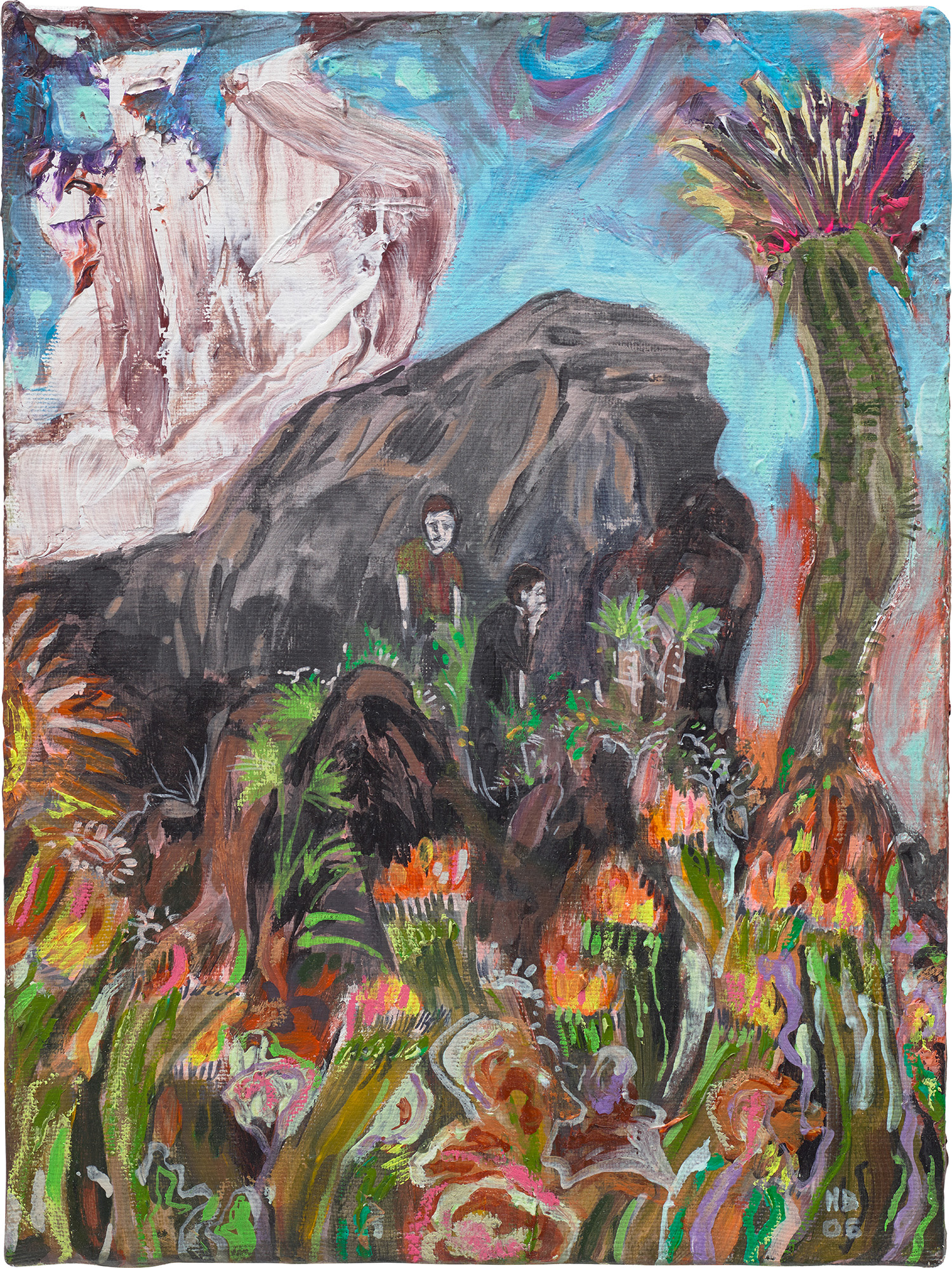
The Lost and Soon Forgotten Explorers, 2006
By the mid 2000s, works on paper had given way increasingly to painting on linen and canvas, and the scale and complexity of his compositions expanded accordingly. The paintings that secured his reputation are among the most tonally precise works produced by any painter of his generation. The Lost and Soon Forgotten Explorers from 2006 captures the essential quality of a Bas protagonist, a young man adrift in landscape that feels both inviting and faintly threatening, where the romance of exploration is shadowed by its costs. Barthélemy Enfantin from 2007, a mixed media work on linen referencing the utopian Saint Simonian commune and their extraordinary quasi monastic dress, shows how deftly Bas weaves historical research into aesthetic experience, transforming archival curiosity into something painterly and alive.
The 2010 work Decorative Panel for the Foyer of a Homosexual's Home, executed in acrylic, airbrush, household gloss, and block print on linen, announces itself with a title of cool, defiant wit, and the surface rewards close looking, the household gloss lending a domestic intimacy that complicates any reading of the work as merely decorative. These are paintings that hold their meanings lightly, offering pleasure first and demanding thought only as a consequence of sustained attention. More recently, Bas has expanded his formal vocabulary while deepening his engagement with literary and art historical source material. Conceptual Artist Number 6, a 2022 work combining acrylic and silkscreen on linen, introduces a wry self awareness about artistic identity and legacy, its long subtitle describing an invented practice of combining grave rubbings to fabricate lives that never existed.
Hernan Bas
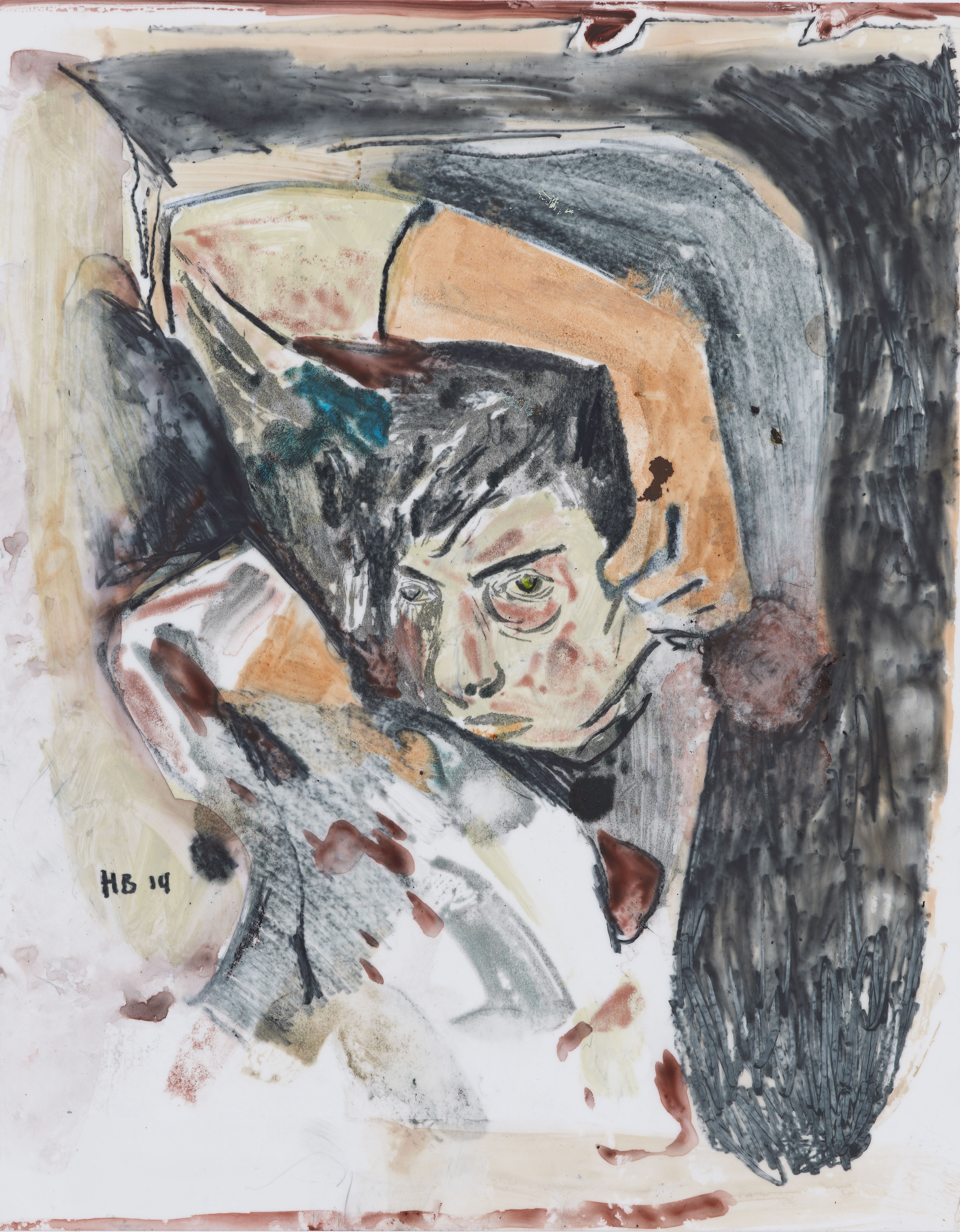
Manipulating the self (#2), 2014
The gesture feels characteristic of Bas at his most playful and most serious simultaneously: the work reflects on how identity is constructed through accumulated fragments, how the self is always partly a fiction assembled from available materials. The Ash Tree, with its bilingual title carrying its John Keats reference into Chinese, demonstrates a consistently expansive reach, a refusal to treat any tradition as the sole origin point for meaning. For collectors, the appeal of Bas is inseparable from the coherence of his vision. His work holds together across media and across time in a way that rewards the formation of a body of works rather than a single acquisition.
Watercolor and graphite works on vellum, such as the intimate Manipulating the Self series from 2014, offer a different register of engagement with his themes, more fragile and confessional in surface quality, while the large linen paintings command a room with the authority of the best contemporary figurative work anywhere. Collectors who have followed him across two decades report that later acquisitions deepen the resonance of earlier ones, the works entering into quiet conversation with each other. His presence in institutional collections internationally, alongside strong private collecting in Europe, Asia, and North America, has established a stable and growing market for his output. Within the broader history of art, Bas occupies a thoughtfully articulated position.
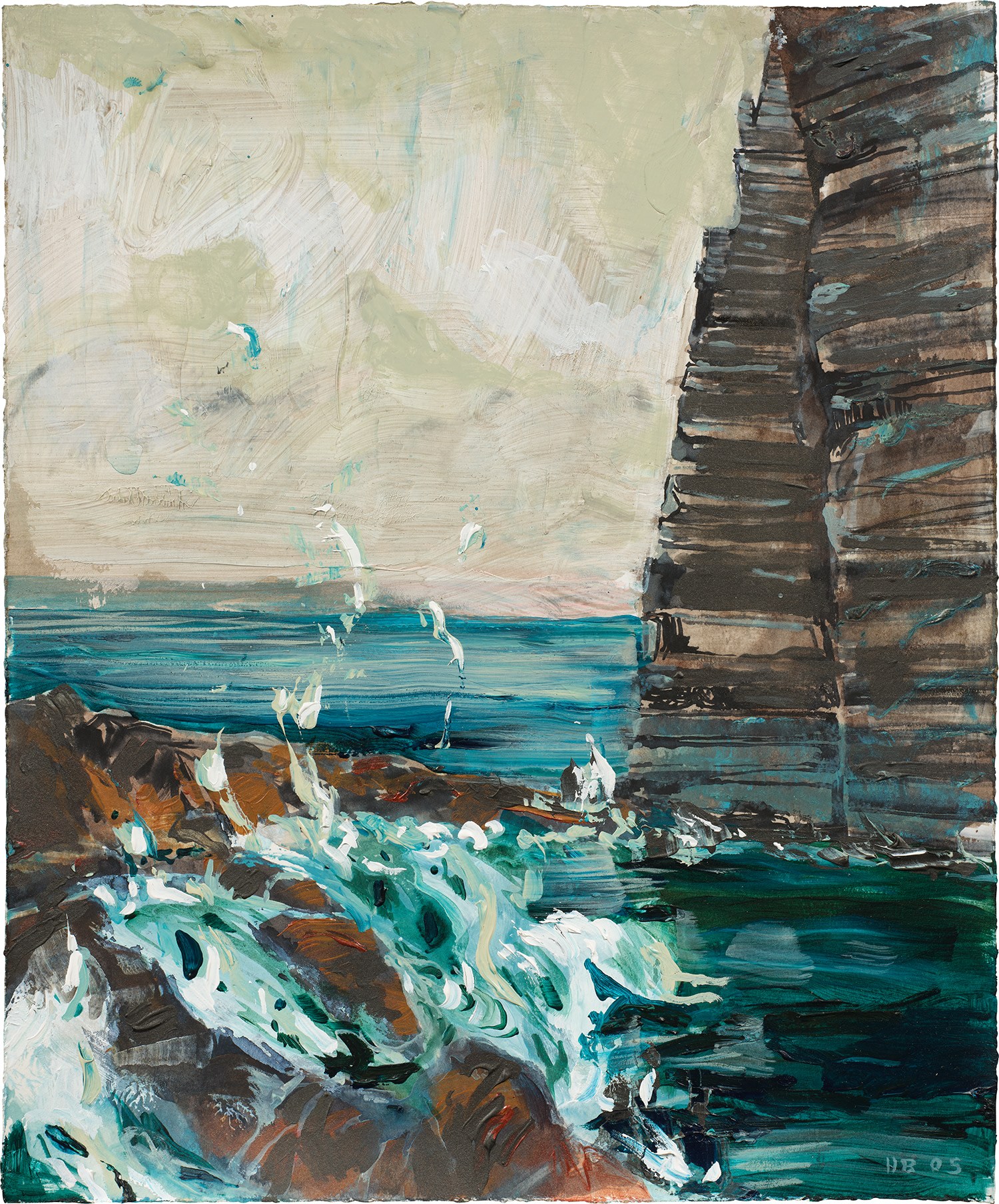
Hernan Bas
L'etrate, 2005
He is in genuine dialogue with the tradition of Symbolist painting, with the atmospheric figure studies of Fernand Khnopff and the narrative ambiguity of Gustav Moreau, while his American sensibility connects him to the magic realist strand of mid twentieth century painting. Among his contemporaries, he shares with painters like John Currin and Neo Rauch a commitment to figuration that refuses easy categorization, though his particular fusion of queer theory, Gothic literature, and precise painterly observation is entirely his own. The art historical conversation his work participates in is long and serious, and he enriches it. What ultimately makes Bas essential is his fidelity to the proposition that painting can be a place of genuine freedom, a space where identities that have been marginalized or romanticized or simply overlooked can be seen fully and without apology.
His young men, adrift in their beautiful and melancholy landscapes, are not victims of their strangeness but its aristocrats. There is dignity in every canvas, and something that functions like love. At a moment when the question of whose stories painting tells feels more urgent than ever, Hernan Bas offers an answer that is as aesthetically ravishing as it is morally clear.