Henry Peach Robinson
Henry Peach Robinson, Photography's Poetic Visionary
Artist Spotlight · The Collection Editorial
“A photographer must be an artist, and must use photography to express his artistic feelings.”
Pictorial Effect in Photography, 1869
There is a particular kind of quiet that settles over a Victorian parlour scene rendered in albumen print, the silver tones pooling into something that feels less like a photograph and more like a painting remembered from a dream. That quality, simultaneously precise and ethereal, is the hallmark of Henry Peach Robinson, and it is why his work continues to command serious attention from scholars, curators, and collectors more than a century after his death. In recent years, institutions including the Victoria and Albert Museum in London and the George Eastman Museum in Rochester, New York have maintained significant holdings of his work, and the broader conversation around Pictorialism as a founding movement of photographic fine art has only deepened appreciation for what Robinson achieved. He was, in the most substantive sense, the photographer who argued most forcefully and most publicly that the camera could be an instrument of genuine artistic ambition.
Henry Peach Robinson
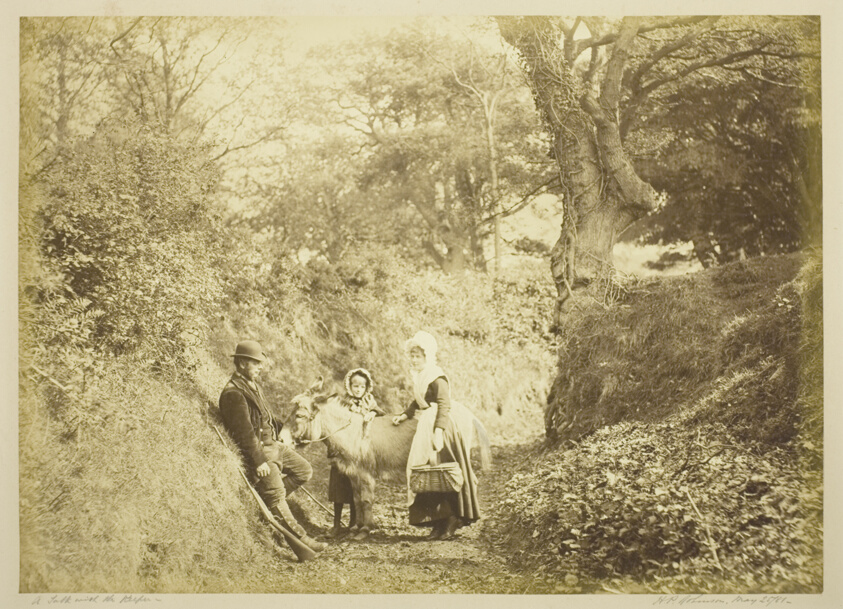
A Talk with the Keeper, 1881
Robinson was born in Ludlow, Shropshire, in 1830, a market town of considerable picturesque character nestled along the Welsh Marches. His early formation was artistic rather than technical: he trained as a painter and worked as a bookseller, absorbing the visual culture of mid Victorian England with its deep appetite for narrative imagery, literary sentiment, and Pre Raphaelite idealism. When he encountered photography in the early 1850s, he did not see it as a mechanical curiosity but as a medium capable of the same emotional and compositional range as painting. He opened a photographic studio in Leamington Spa in 1857, and within a year he had produced the work that would make his name.
That work was Fading Away, created in 1858 and composed from five separate wet collodion negatives combined into a single seamless print. It depicted a young woman dying of consumption, her family gathered around her in attitudes of grief and resignation, the whole scene bathed in a soft, poignant light. The image caused immediate controversy. Some critics found it morbid and indecorous; others recognised it as proof that photography could achieve the narrative and emotional weight of history painting.
Henry Peach Robinson
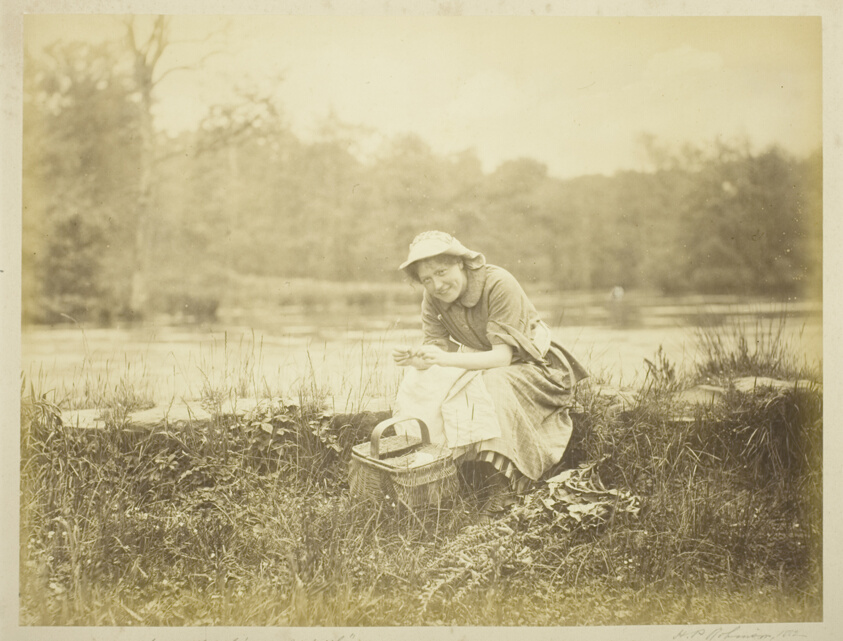
I think on the Laddie that lo'es me so well, 1882
What no one could deny was that Robinson had done something technically and aesthetically unprecedented. The combination printing method he pioneered, assembling a final image from multiple negatives to achieve compositions that a single exposure could never produce, would become his signature contribution to the medium. She Runs Home and Tells Her Mother All about It, from 1858 and held in albumen print, gives a sense of how naturally he translated this approach into lighter domestic narrative, the image carrying a warmth and storytelling ease that speaks directly to the literary culture of his moment. Through the 1860s and 1870s Robinson refined his practice, producing images that drew openly on the conventions of genre painting, particularly the rural and pastoral tradition that celebrated English country life.
“Any dodge, trick, and conjuration of any kind is open to the photographer's use.”
Pictorial Effect in Photography, 1869
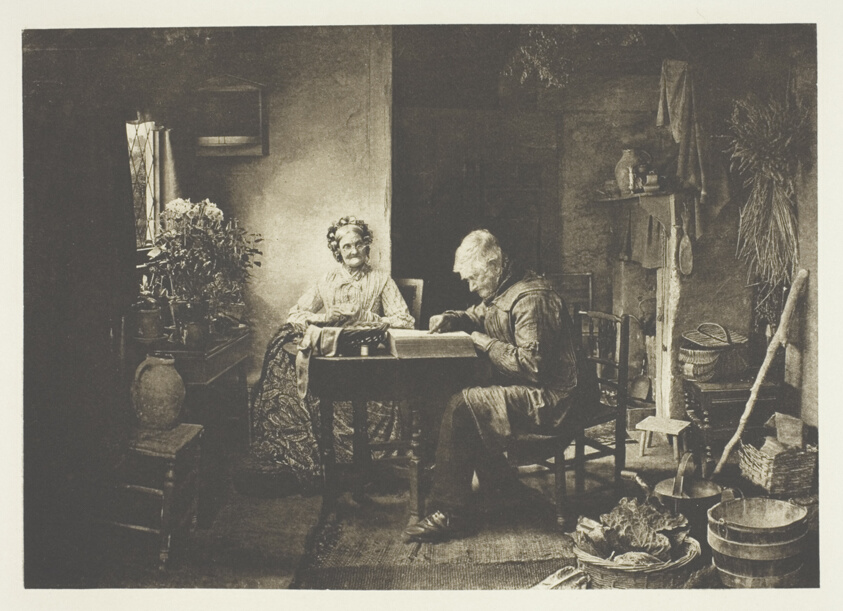
When the Day's Work is Done, from 1877 and later reproduced as a photogravure in the celebrated Sun Artists series of 1890, exemplifies his mature sensibility: figures posed with evident care in landscape settings that feel genuinely inhabited rather than staged, the light handled with a painter's instinct for mood and atmosphere. The Sun Artists publication itself, which reproduced work by Robinson alongside that of Frank Sutcliffe and John Gale among others, was an important moment for photography's self presentation as a serious art form, and Robinson's inclusion confirmed his status as one of the medium's defining voices. Dawn and Sunset from 1885, rendered in platinum print, shows him working with the tonal richness that the platinum process allowed, the image achieving a depth and permanence that spoke directly to his convictions about photographic permanence and aesthetic ambition. Robinson was also a writer and theorist of considerable influence.
Henry Peach Robinson
When the Day's Work is Done, 1877
His 1869 book Pictorial Effect in Photography laid out a systematic argument for photography as a fine art, drawing on the principles of composition, tone, and narrative that governed academic painting. The book was widely read and translated, shaping the approach of a generation of photographers on both sides of the Atlantic. Later works including The Studio and What to Do in It and Picture Making by Photography continued to develop his thinking, making him not only a practitioner but an educator and advocate whose influence extended far beyond his own output. Works like A Talk with the Keeper from 1881 and Rook Shooting from the same year, both in albumen print, reflect this theoretical grounding: they are images built with compositional deliberateness, figures placed in the frame with the considered attention to balance and storytelling that his writing prescribed.
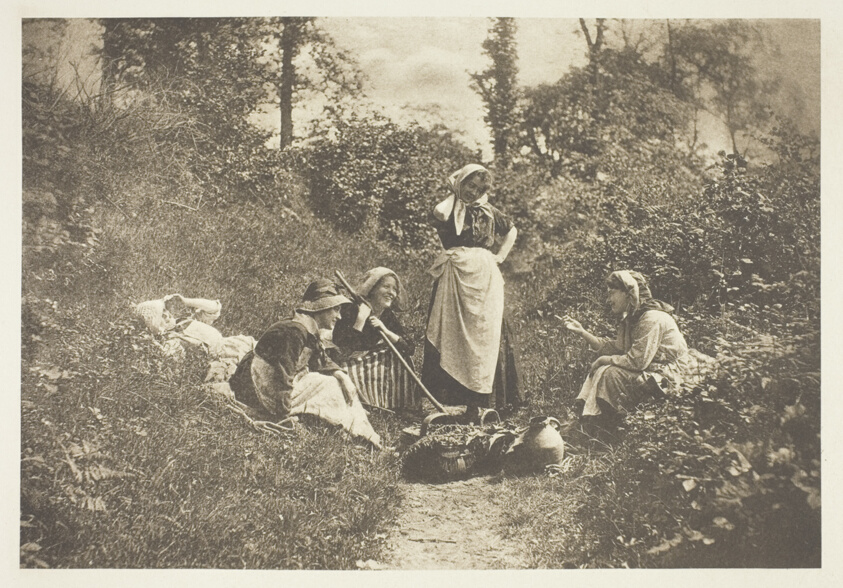
For collectors, Robinson offers a genuinely compelling combination of historical importance and aesthetic pleasure. His albumen prints, when well preserved, carry a warmth and luminosity that reproduces poorly in reproduction and rewards close attention in person. The photogravures from the Sun Artists series represent an important secondary strand of his legacy, demonstrating how his images were understood and disseminated in his own time and offering collectors an entry point into the broader world of late Victorian photographic publishing. Works like A Merry Tale from 1882 and Carolling from 1887, both as Sun Artists photogravures, speak to the range of mood he could achieve within his pastoral and domestic register, from gentle humour to lyrical tenderness.
Henry Peach Robinson
A Merry Tale, 1882
On the Slopes of Cader Idris, The Last Load of Hay from 1883 reveals his feeling for the Welsh landscape and his ability to integrate figures and environment into a unified pictorial whole. Collectors drawn to the Pre Raphaelite aesthetic, to Victorian narrative painting, or to the early history of photography as a fine art medium will find in Robinson a figure who sits at the confluence of all three traditions. Robinson's place in art history is secure but in some ways still being fully appreciated. He was a founding member of the Linked Ring, the photographic society established in 1892 as a deliberate assertion of photography's independence from purely scientific or commercial purposes, and his involvement in that organisation placed him at the centre of the movement that would eventually give rise to Alfred Stieglitz's Photo Secession in New York.
The line from Robinson's combination prints and Pictorialist philosophy to the Camera Notes and Camera Work publications, and from there to photography's full acceptance as a fine art medium in the twentieth century, is direct and traceable. He is not a footnote in that history; he is one of its founding chapters. To collect Robinson is to hold a piece of the argument that photography first made for itself, rendered in silver and light with uncommon skill and genuine feeling.
Explore books about Henry Peach Robinson
Pictorial Effect in Photography
Henry Peach Robinson
The Studio and What to Do in It
Henry Peach Robinson
Elements of a Pictorial Photograph
Henry Peach Robinson
Henry Peach Robinson: Master of Photographic Art
Graham Ovenden
Henry Peach Robinson and the Pictorialist Movement
Mike Weaver