Hans Fredrik Gude
Norway's Mountains, Rendered in Light
Artist Spotlight · The Collection Editorial
Stand before a Hans Fredrik Gude landscape and the sensation is immediate: the cold breath of a Nordic fjord, the particular silver of Norwegian coastal light just before the clouds break. Though Gude completed his major works in the nineteenth century, his paintings feel urgently present in today's collecting world. Institutions from the Nasjonalmuseet in Oslo to the Nationalgalerie in Berlin hold his canvases as cornerstones of their Northern European collections, and recent scholarly attention to the Düsseldorf school has brought a new generation of collectors to his work with genuine enthusiasm. Hans Fredrik Gude was born in Christiania, now Oslo, in 1825, the son of a lawyer in a city that was still finding its cultural footing as a young nation.
Hans Fredrik Gude
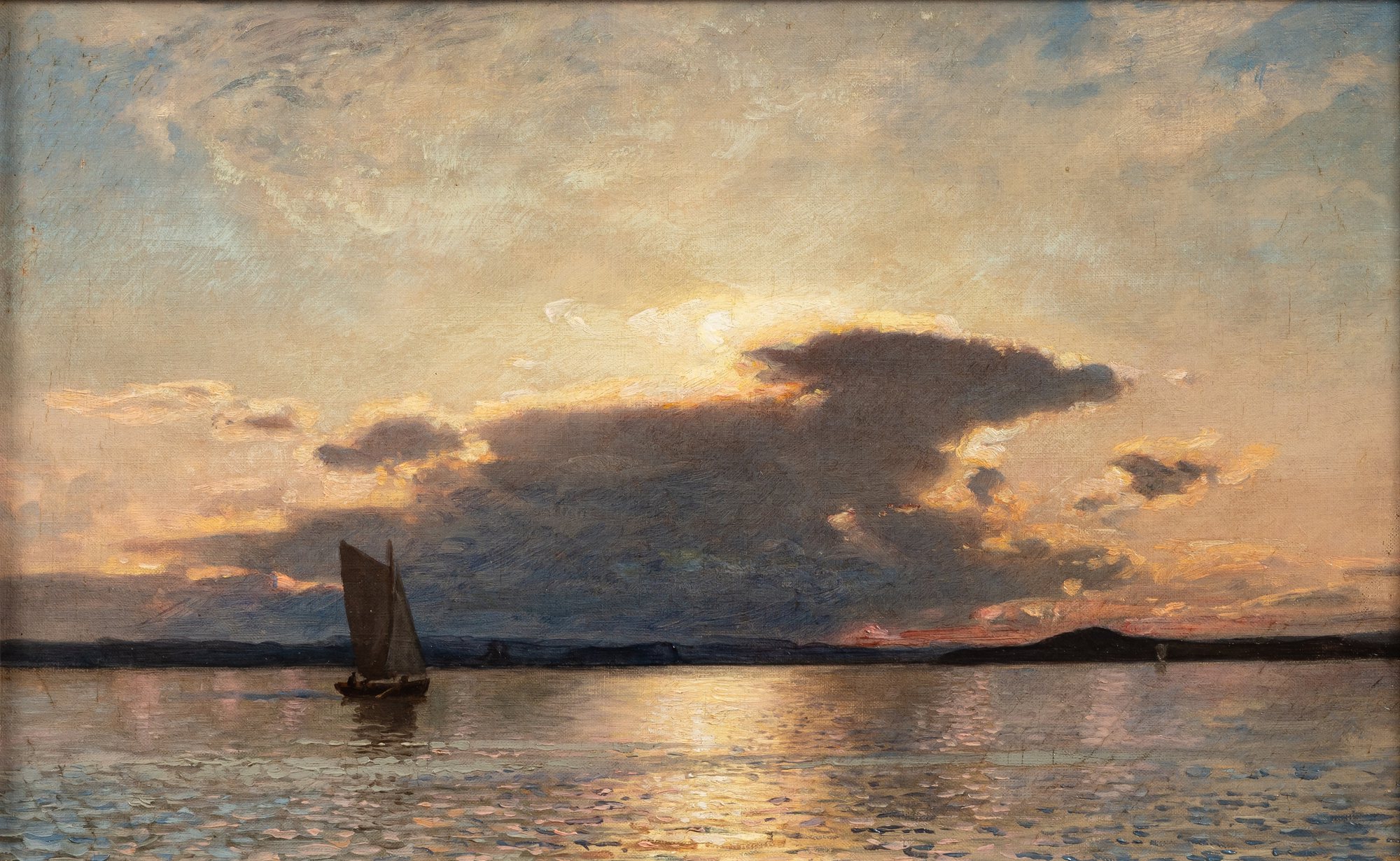
Nuages du soir
Norway had only dissolved its union with Denmark in 1814, and the question of what it meant to be Norwegian, culturally and artistically, was alive in every salon and studio. Gude grew up in this atmosphere of national discovery, and from an early age he showed a precocious sensitivity to the dramatic natural world that surrounded him. He began his formal training in Christiania before making the decisive journey to Düsseldorf in 1841, enrolling at the Kunstakademie Düsseldorf at just sixteen years old. The Düsseldorf academy was, in the 1840s, one of the most rigorous and influential art schools in the world.
Under the directorship of Wilhelm von Schadow, it had developed a distinctive approach that combined careful academic training in draughtsmanship with a Romantic reverence for landscape as a vehicle of deep feeling. Gude thrived here, studying under the landscape painter Hans Frederik Gude and forming friendships with fellow Scandinavians who were making the same pilgrimage south. He remained closely connected to Düsseldorf for decades, eventually becoming a professor at the academy himself in 1854, a position that cemented his reputation as a master of the tradition he had absorbed as a student. What distinguished Gude from his contemporaries was the particular quality of his ambition.
Hans Fredrik Gude
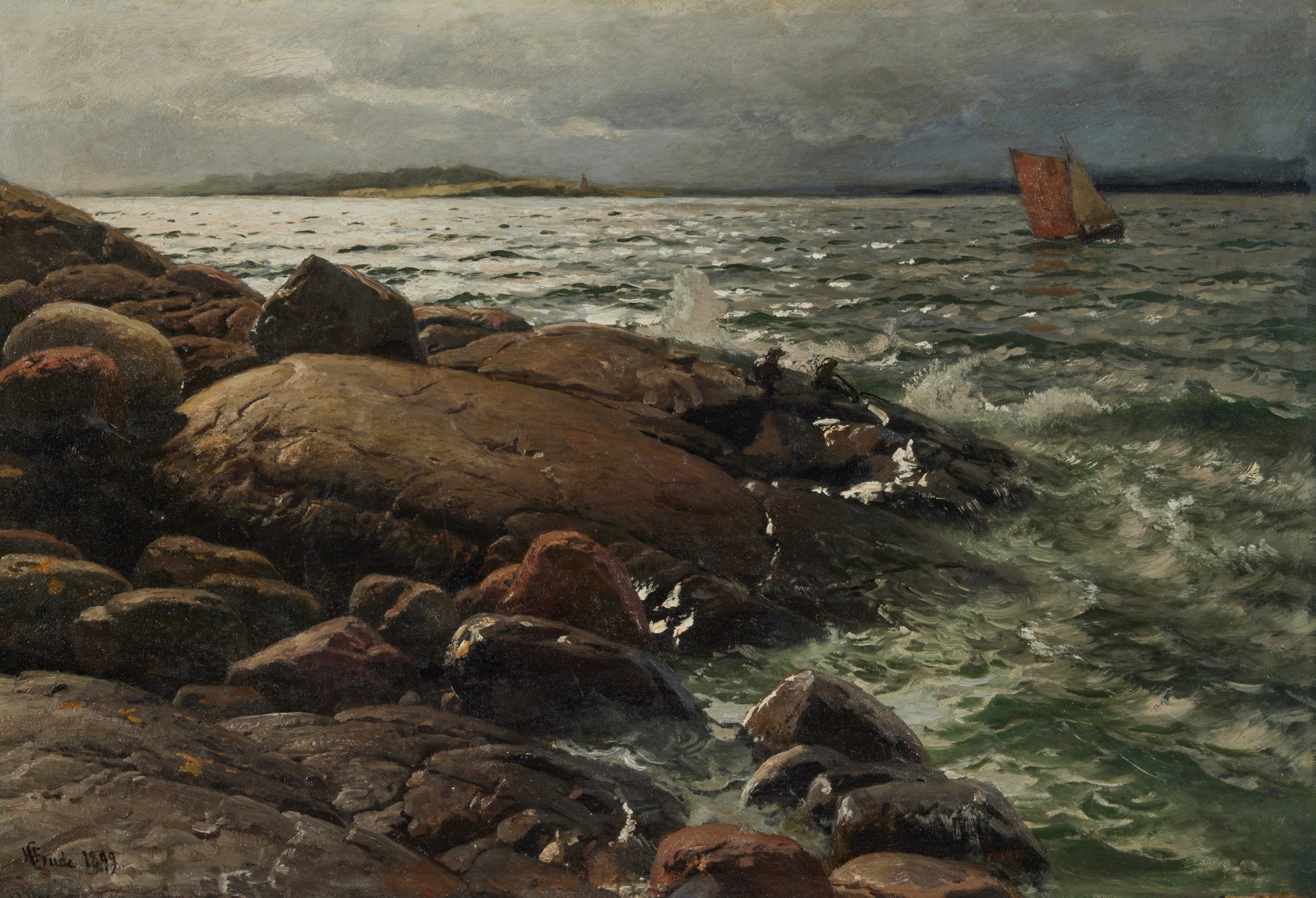
Coastal Landscape | Paysage côtier
Where other landscape painters of the Romantic era could veer toward the picturesque or the merely decorative, Gude pursued something more elemental. He was fascinated by meteorological drama: the moment when storm light transforms a mountain pass, the way fog sits in the valleys of the western fjords, the turbulence of the North Sea coastline as weather moves across it. His compositions are architecturally considered, with careful attention to the placement of land, water, and sky, but what animates them is a feeling of atmosphere caught in motion. You sense that five minutes after the scene depicted, everything will look entirely different.
Among his most celebrated works is his long collaboration with Adolph Tidemand, the Norwegian figure painter. Together the two artists produced some of the most iconic images in Norwegian cultural memory, combining Gude's majestic landscapes with Tidemand's sympathetic depictions of rural Norwegian life. Their 1848 painting Bridal Voyage on the Hardangerfjord, held in the Nasjonalmuseet, remains one of the most beloved works in the Norwegian canon. Gude handled the shimmering fjord water and the mountainous backdrop while Tidemand populated the boat with the wedding party, and the resulting image captures something that felt, to nineteenth century Norwegians, like a portrait of their own soul.
It is a testament to Gude's skill that even in collaboration, his contribution is unmistakable. For collectors today, works like Nuages du soir and Coastal Landscape offer an ideal entry point into Gude's world. Nuages du soir, French for evening clouds, shows his capacity to find poetry in transition, that threshold moment between day and night when color becomes strange and feeling runs close to the surface. The title itself, in French, speaks to the cosmopolitan world Gude inhabited, moving between Düsseldorf, Christiania, and later Karlsruhe and Berlin, always bridging the Nordic and the European.
Coastal Landscape demonstrates his command of the sea as subject: the particular grey green of northern waters, the weight of sky above a low horizon, and the sense of human smallness before natural scale. Both works reward extended looking in the way that only the best landscape painting does. Gude's place in the art market reflects his dual identity as both a national icon and a figure of genuine international stature. His works appear at major Scandinavian auction houses including Blomqvist in Oslo, where significant examples have achieved strong results among collectors who understand the depth of the tradition he represents.
In the broader European and international market, interest in Düsseldorf school painters has grown steadily as scholars and institutions have worked to recover the full richness of nineteenth century painting beyond the familiar French Impressionist narrative. Gude stands near the top of that tradition. Collectors drawn to Johan Christian Dahl, the slightly older Norwegian painter often described as the father of Norwegian landscape painting, frequently find in Gude a natural companion, a figure who took Dahl's foundational vision and gave it greater formal precision and atmospheric complexity. His legacy connects outward in multiple directions.
He is a foundational figure for understanding Norwegian National Romanticism, the cultural movement that used landscape art, folk traditions, and Norse mythology to construct a sense of national identity in the decades after independence. In that context he belongs alongside composers like Edvard Grieg and writers like Bjørnstjerne Bjørnson, all of them engaged in the same project of cultural self definition. But Gude also belongs to the broader European Romantic tradition, in conversation with painters like Caspar David Friedrich, whose metaphysical engagement with landscape Gude shares, and with the British tradition of marine and coastal painting that he encountered during his years in England from the late 1860s onward. Gude died in Berlin in 1903, having spent a long career moving between the academic and the visionary, the institutional and the deeply personal.
He left behind a body of work that is still capable of producing genuine wonder. In an art world that sometimes prizes novelty above all else, there is something quietly radical about painting that insists the natural world is endlessly sufficient as a subject, that a fjord at dusk or a coastline in gathering cloud contains everything one needs to understand about beauty, transience, and the relationship between human feeling and the larger forces of the earth. That is what Gude knew, and what his best canvases continue to teach.
Explore books about Hans Fredrik Gude
Hans Gude: Et kunstnerliv
Lorentz Dietrichson
Hans Gude 1825-1903: Norsk romantikk og europeisk realisme
Gunnar Sørensen
Hans Gude: Norwegian Romantic Painter
Patricia G. Berman
Hans Gude og tiden hans
Henning Alsvik
Gude, Tidemand og samtidens malekunst
Sigrid Willoch