Hanne Darboven

Hanne Darboven: Time, Counted and Celebrated
Artist Spotlight · The Collection Editorial
“I write, but I describe nothing.”
Hanne Darboven, artist statement
In the permanent collection of the Museum of Modern Art in New York, and in the grand survey rooms of the Hamburger Kunsthalle, there are works that stop visitors mid step. They are dense, almost architectural accumulations of handwritten numbers, looping cursive notations, and grid paper filled edge to edge with a language that feels both mathematical and deeply personal. These are the works of Hanne Darboven, and institutions across Europe and North America have spent the decades since her death in 2009 steadily affirming what her most devoted collectors understood from the very beginning: that she was one of the most original and philosophically rigorous artists of the twentieth century. A major retrospective organized by the Hamburger Kunsthalle in 2015 brought renewed critical attention to her practice, and the sustained interest from museums and auction houses since then has only deepened the conversation around her singular contribution.
Hanne Darboven
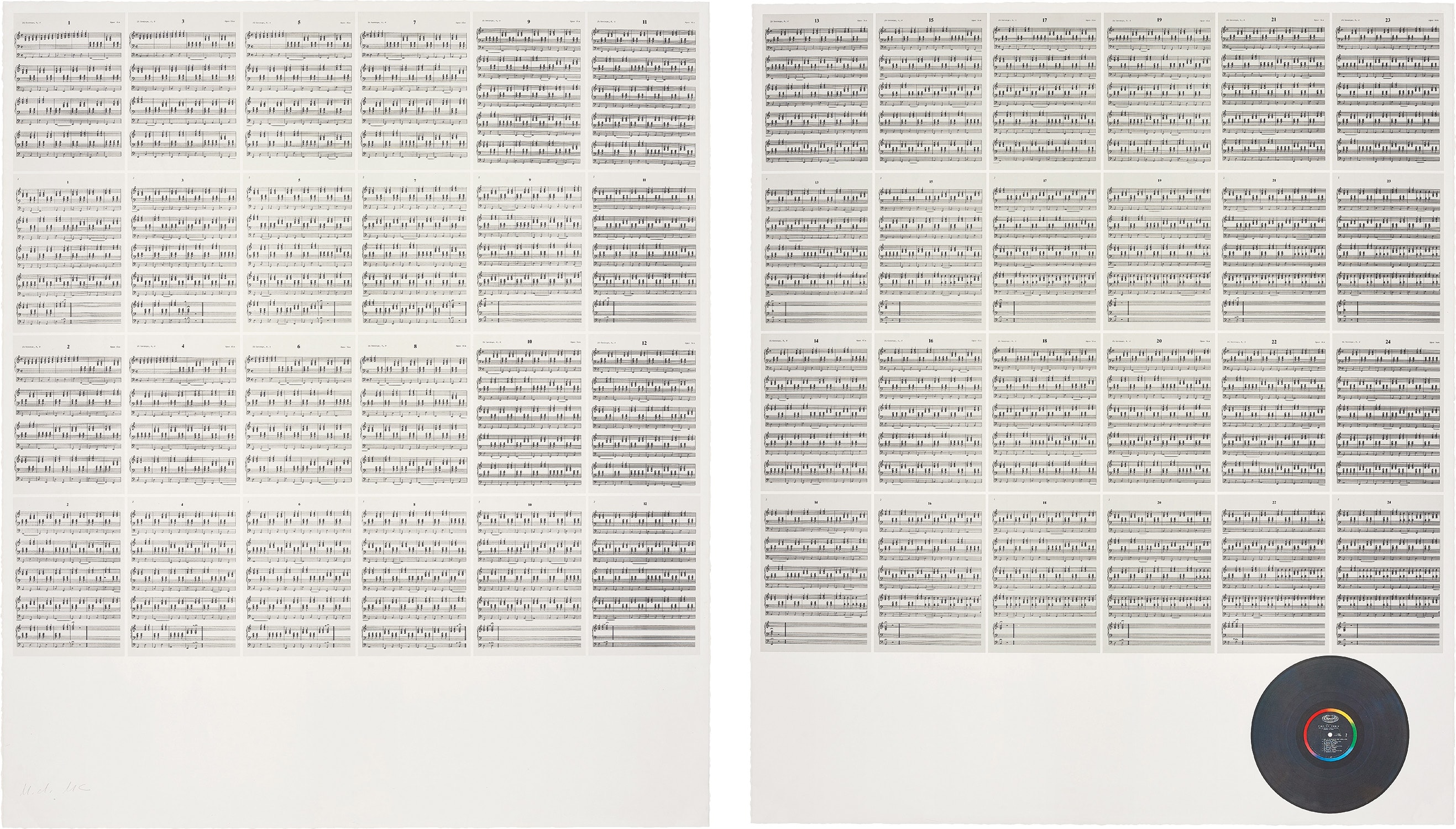
24 Gesänge (24 Chants)
Darboven was born in Munich in 1941 and grew up in Hamburg, where her family ran a successful coffee business. That bourgeois northern German setting, orderly and commercially minded, formed a productive counterpoint to the radical conceptual territory she would eventually inhabit. She studied at the Hochschule für Bildende Künste in Hamburg before moving to New York in 1966, a decision that would prove transformative. The New York art world of the late 1960s was electric with possibility, and Darboven arrived just as Minimalism was giving way to Conceptualism, just as artists were beginning to question what a work of art could be made of, and whether time itself might serve as a medium.
In New York she entered into a close friendship and artistic dialogue with Sol LeWitt and Carl Andre, figures who would remain important to her throughout her life. LeWitt in particular recognized in Darboven a kindred commitment to systematic thinking and the generative power of rules. But where LeWitt's systems often produced clean geometric forms, Darboven's produced something more obsessive and intimate: pages and pages of handwritten mathematical notations derived from her own calendar system, a method she developed in the late 1960s and refined over the following four decades. She created a personal arithmetic based on dates, reducing them to single digit sums in a process she called writing without describing.
Hanne Darboven
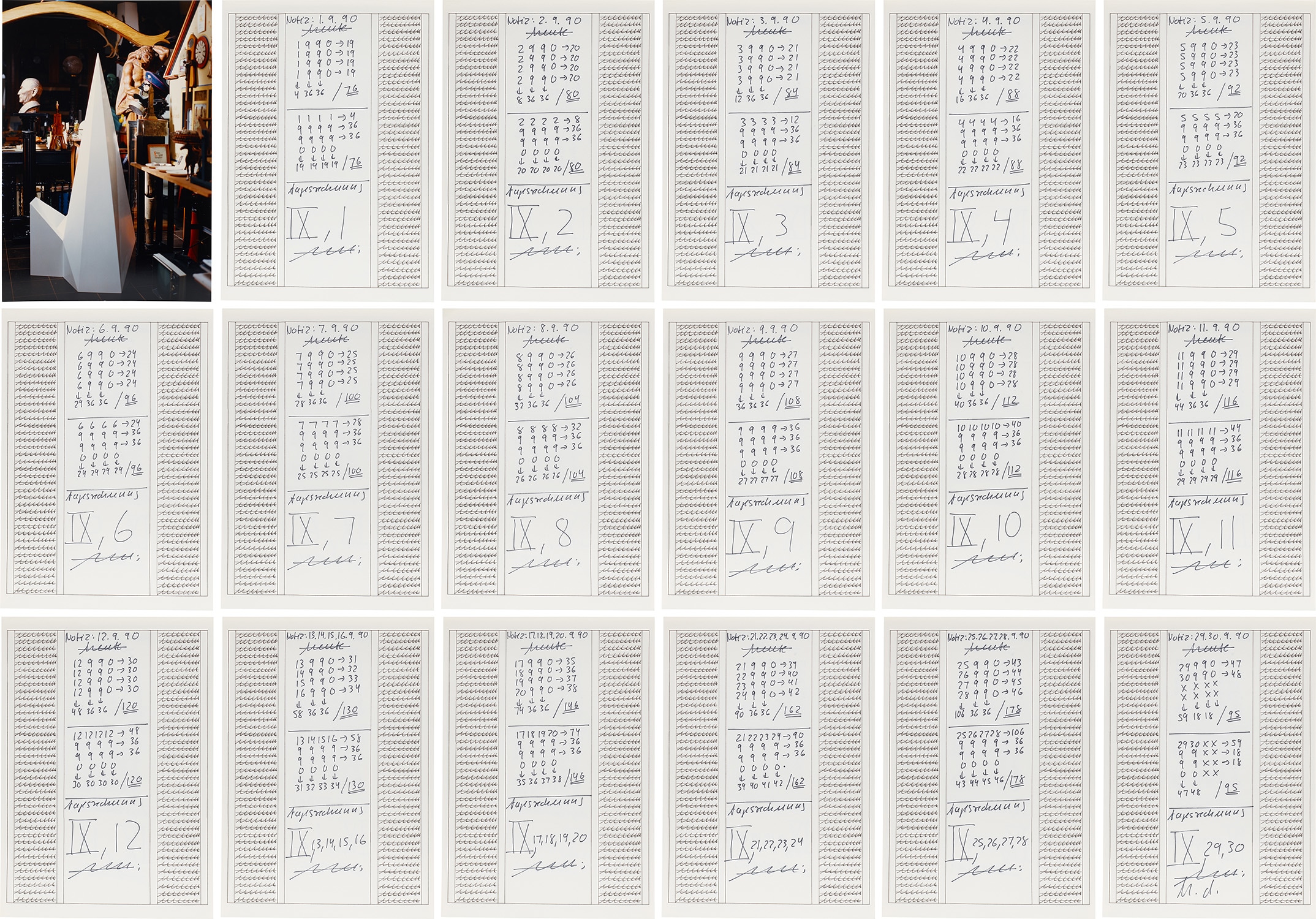
Für Sol LeWitt, 1990
The result was a visual language that was neither purely abstract nor purely linguistic, hovering in a space that felt entirely her own. Returning to Hamburg in 1968, Darboven established the studio in the family home in Hamburg Harburg that she would work in for the rest of her life. This domestic setting became the archive and engine of an extraordinary output. Over the course of her career she produced thousands of individual works, many of them conceived as vast serial installations.
Her practice expanded in the 1970s and 1980s to incorporate found imagery, photographs, postcards, newspaper clippings, and eventually musical composition. Works like Wunschkonzert from 1984 and the monumental Kulturgeschichte 1880 to 1983, which she first exhibited at the Kunsthalle Basel in 1985, demonstrated her ambition to map nothing less than the flow of human history through her systems of notation. These were not merely conceptual exercises; they were immersive environments that asked viewers to reckon with duration, with the weight of accumulated days. Among the works that best reveal the range and depth of her practice is Für Sol LeWitt from 1990, a tribute to her old friend rendered in colour photograph, ink and offset print across eighteen parts.
Hanne Darboven
Sunrise - Sunset (To: New York)
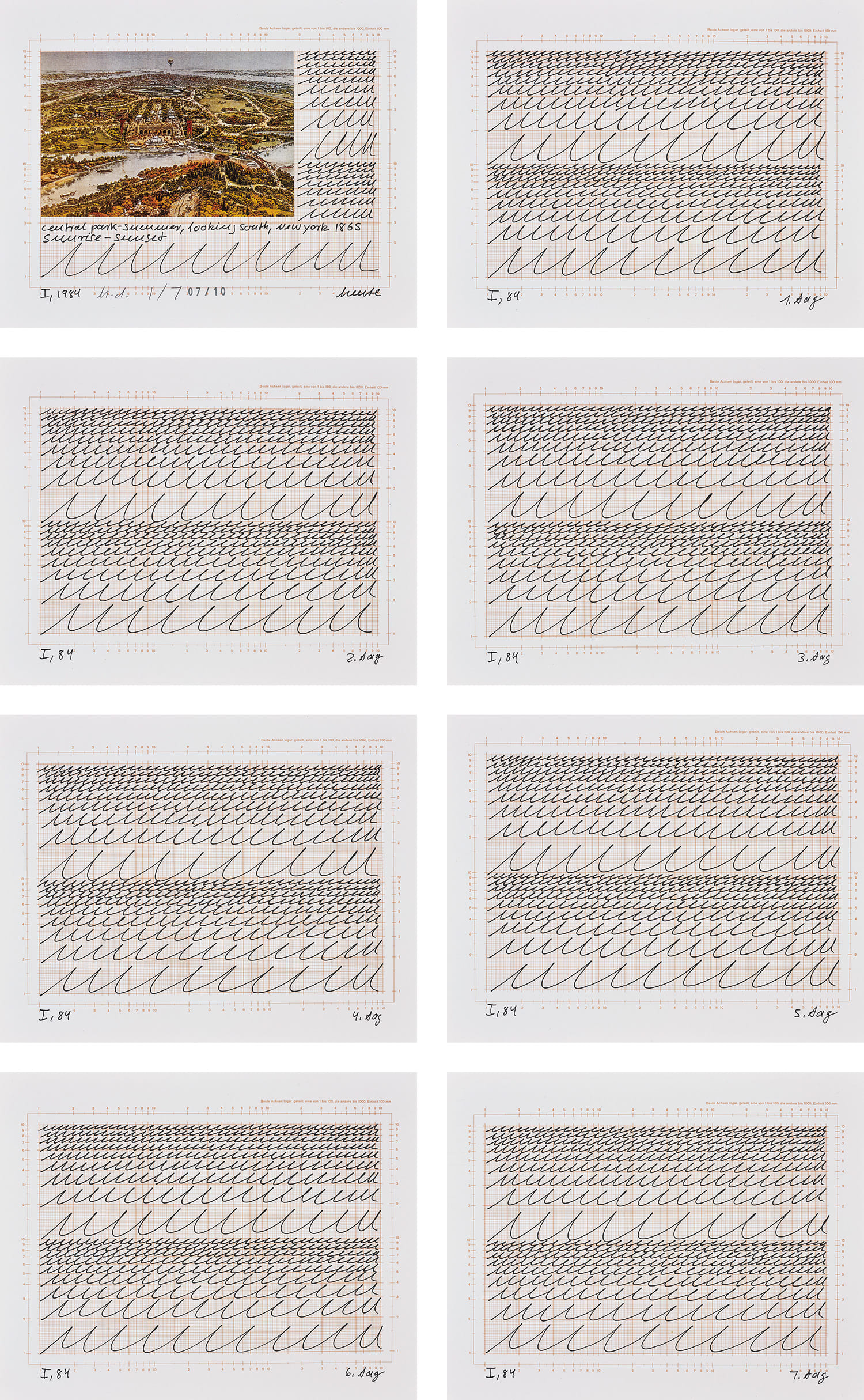
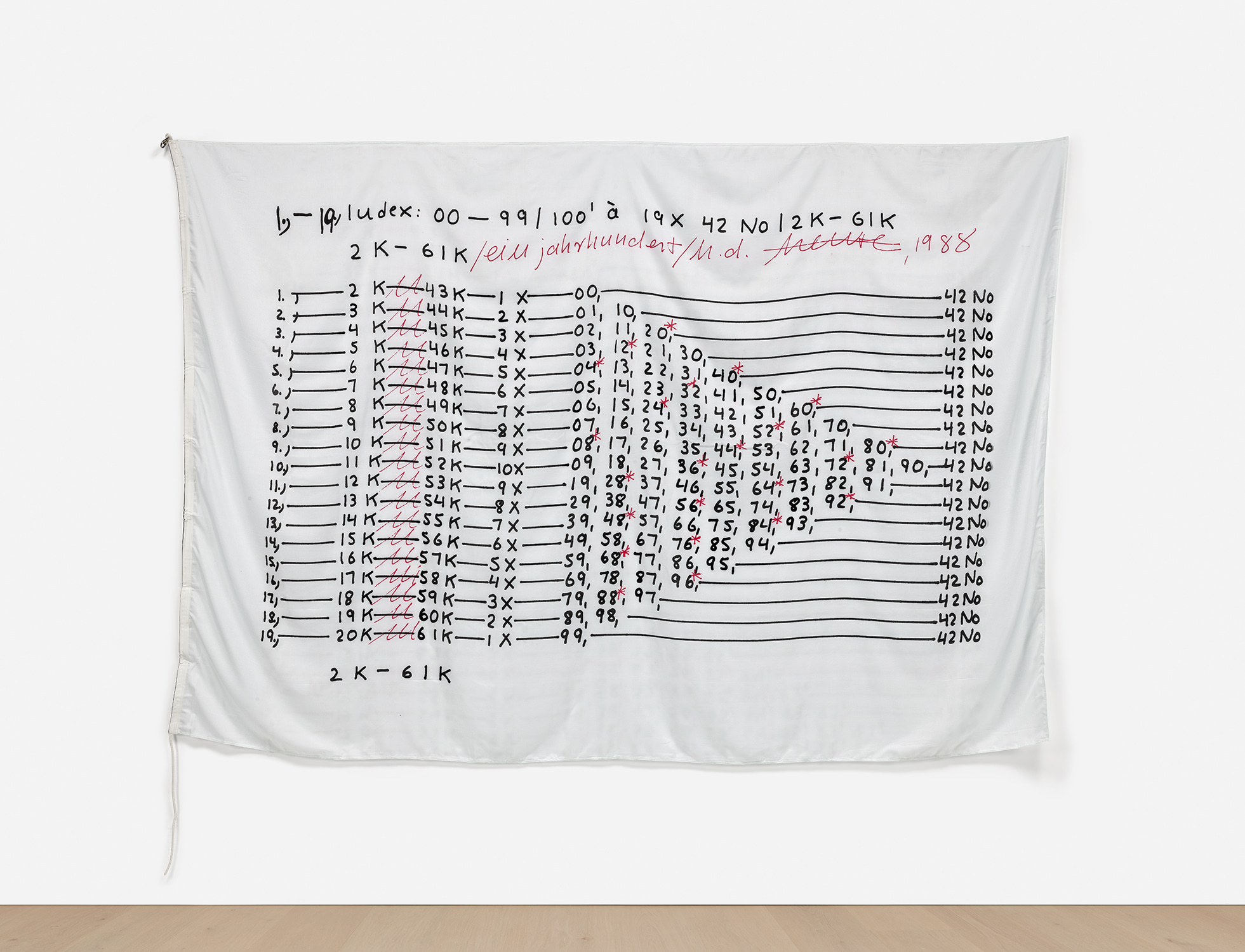
The work is tender and precise in equal measure, a dedication that doubles as a demonstration of her method. Similarly, the portfolio Sunrise to Sunset, dedicated to New York and comprising 96 prints organized by month on logarithmic paper, shows her gift for transforming the abstract measurement of time into something almost lyrical. Tagesrechnung Monat Dezember from 1989, ink on squared paper, distills her daily accounting practice to its most focused and meditative form. And the monumental screenprint on polyester flag from the Gran Pavese project brings her numerical language into the realm of the civic and the public, proof that her systems could scale from the intimate to the vast without losing their essential character.
For collectors, Darboven's work presents a particular and rewarding kind of challenge. Her output is enormous, and works exist across a wide range of formats, from small works on paper to large multi part installations. The key is understanding that any single sheet or print participates in a larger conceptual architecture, a web of time and system that gives each piece its meaning. Prints and multiples such as the 24 Gesänge screenprints and the Geigensolo edition published by Edition Schellmann offer accessible entry points into her practice, with the institutional credibility that Edition Schellmann's publications consistently provide.
Hanne Darboven
00-99, from Gran Pavese – The Flag Project
Works on paper from her daily accounting series, particularly those mounted on board or framed within their original installation logic, represent some of the most collectible material from her hand. Auction results at Christie's and Sotheby's over the past decade have shown steady, growing interest, with major multi part works drawing serious attention from European and American museum level collectors. Darboven belongs to a generation that includes not only LeWitt and Andre but also Lawrence Weiner, On Kawara, and Bernd and Hilla Becher, artists who in different ways made time, information, and repetition central to their practices. On Kawara's date paintings are perhaps the closest parallel in terms of their daily commitment and their transformation of the calendar into art, but Darboven's work is warmer, more hand made, more insistently personal in its cursive loops and accumulated pages.
She also anticipated the work of artists like Roman Opalka and Tehching Hsieh in her understanding of art as a form of durational witness, a way of marking one's passage through time with discipline and attention. What makes Darboven matter so urgently today is precisely this quality of sustained attention. In an era saturated with images and information, her practice proposes a radical alternative: the slow, systematic, handwritten accounting of days as a form of both artistic and ethical commitment. She did not simply make art about time; she gave her time, all of it, to her art.
The Hamburger Kunsthalle holds the largest collection of her work, and her estate has been thoughtfully stewarded to ensure that her practice continues to be understood in its full scope. For those encountering her work for the first time, the experience is quietly astonishing: you stand before thousands of handwritten pages and realize that what you are seeing is a life, counted out with care and offered back to the world as a gift.
Explore books about Hanne Darboven