Hajime Sorayama
Sorayama: The Future Has Never Looked Better
Artist Spotlight · The Collection Editorial
“I wanted to create something that had never existed before, a robot that was erotic and beautiful at the same time.”
Hajime Sorayama
In the summer of 2019, a gleaming chrome figure brought the house down at the Nanzuka Gallery in Tokyo. Hajime Sorayama, then in his early seventies, unveiled a suite of new sculptural works that confirmed what collectors and cultural tastemakers had long understood: this was an artist not merely of his moment but permanently ahead of it. That same year, his monumental inflatable Sexy Robot sculpture appeared outside the Dior Men's flagship store in Tokyo following his collaboration with Kim Jones for the brand's Spring 2019 collection, placing his vision of sensuous, machine perfect femininity squarely at the intersection of luxury fashion, contemporary art, and global pop culture. For an artist who has been working at the frontier of imagination since the 1970s, the recognition felt less like a late arrival than a long overdue homecoming.
Hajime Sorayama
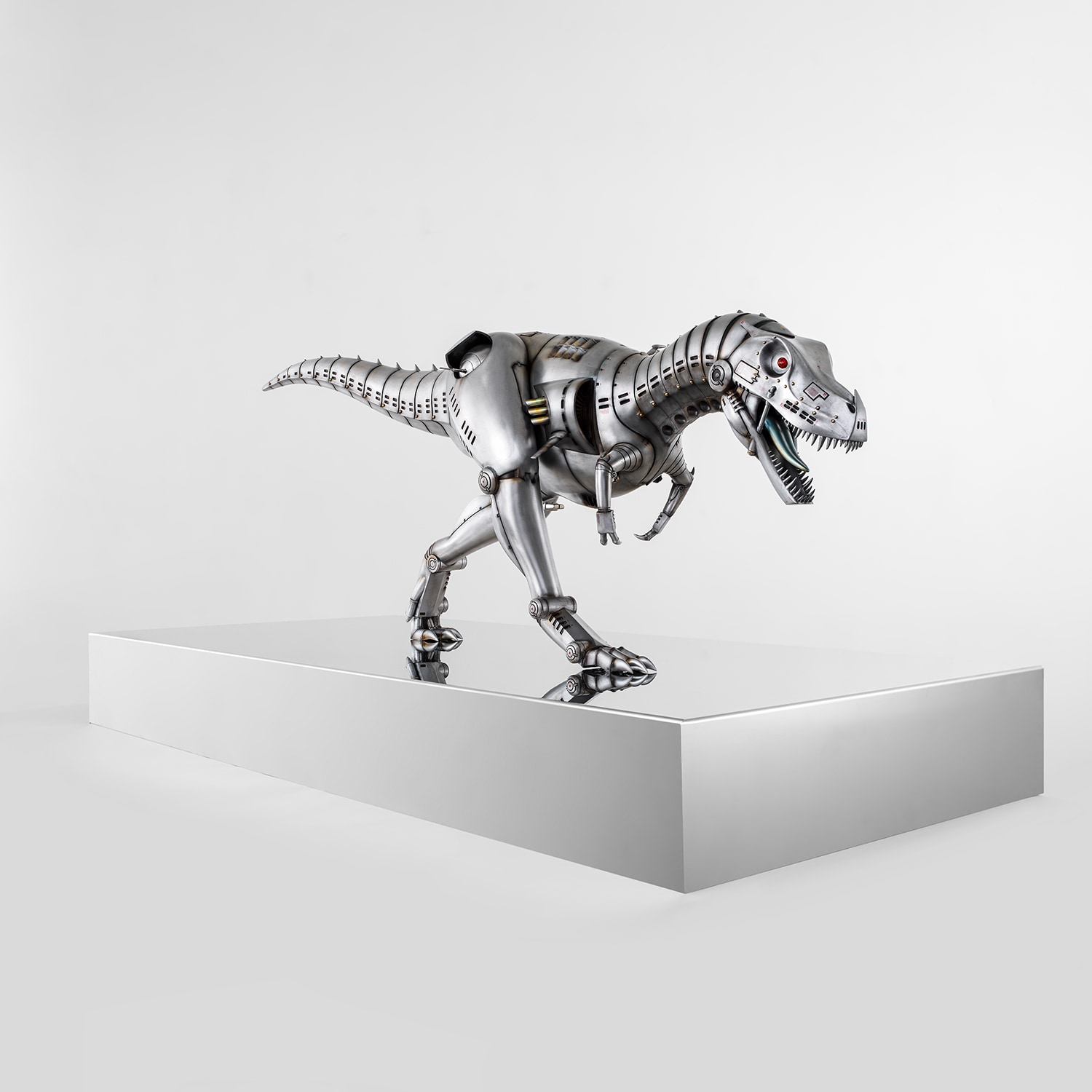
T-Rex Silver, 2019
Sorayama was born in 1947 in Nankoku City, in the Kochi Prefecture of Shikoku, Japan. He studied at Shikoku Seiwa University before moving to Tokyo, where he trained at the prestigious Chuo Art School. The postwar Japan of his youth was a society in rapid, dizzying transformation, absorbing American pop culture and science fiction imagery through film, television, and imported magazines even as it rebuilt itself into an industrial powerhouse. These twin currents, the erotic energy of Western pin up art and the cool mechanical promise of the space age, would run through Sorayama's work like a live current for the next five decades.
He has spoken of his formative encounters with the work of Alberto Vargas, the Peruvian born illustrator whose luminous, idealised women graced the pages of Esquire and Playboy, and it is not difficult to trace that lineage in Sorayama's own command of the body as a site of fantasy and formal perfection. His career as a commercial illustrator began in the 1970s, and he quickly distinguished himself through an almost supernatural mastery of the airbrush. Working for advertising agencies and major publications, Sorayama developed the technical precision that would become his signature: surfaces rendered so convincingly that they seemed to have a temperature, a weight, a reflective sheen you could almost see your own face in. It was during this period that he began experimenting with what would become his defining subject, the chrome plated female robot, a figure he would come to call the Sexy Robot.
Hajime Sorayama
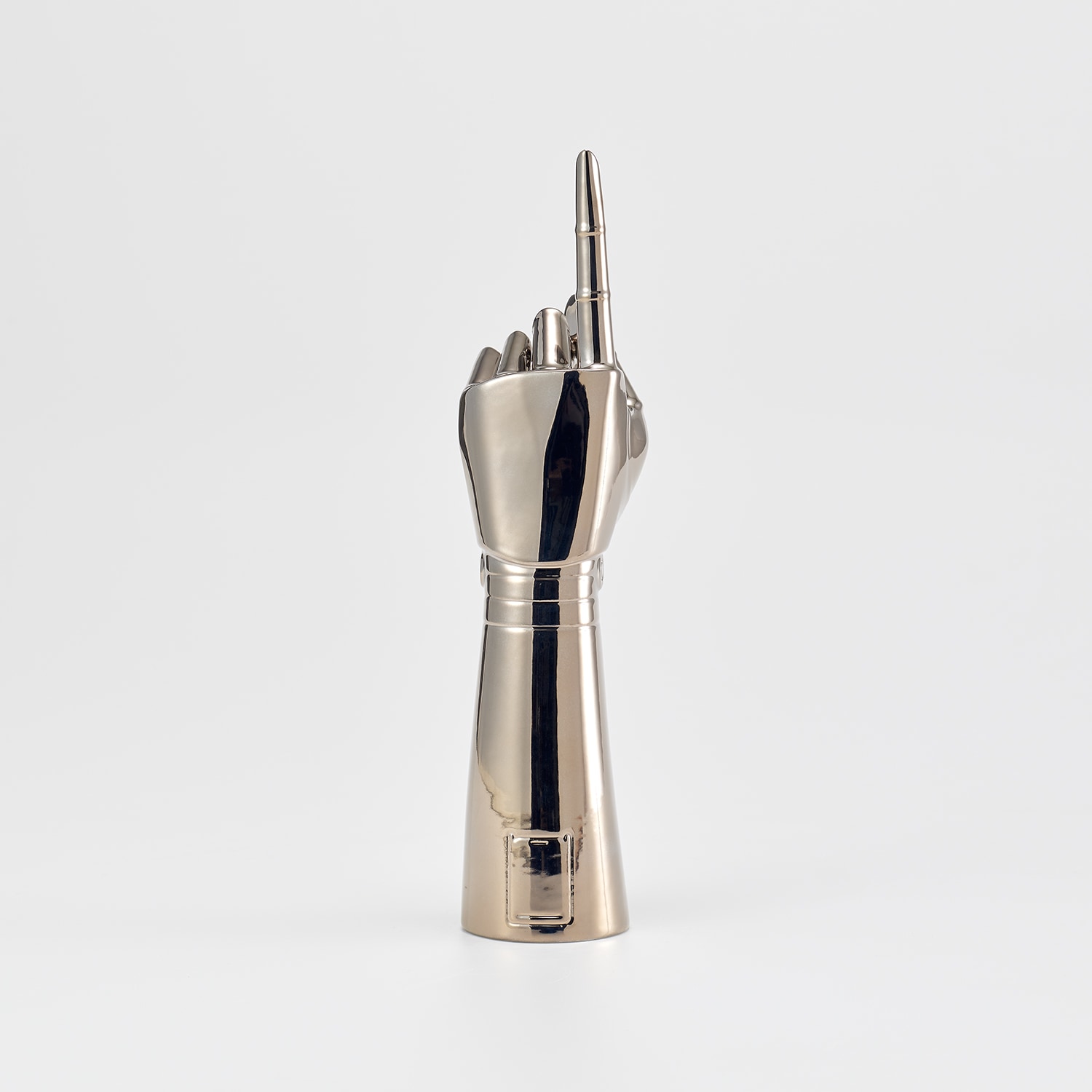
A Touch of Mercury
The concept emerged from a genuine philosophical preoccupation with the boundary between the organic and the mechanical, the question of where the body ends and the object begins. In 1983, he published Sexy Robot, the first of several monographs that would bring his work to an international audience and cement his reputation as one of the most original visual imaginations of the late twentieth century. The Sexy Robot is, in every sense, an impossible object. She is anatomically precise and industrially finished, warm in suggestion and cold in material, an object of desire rendered in the vocabulary of engineering.
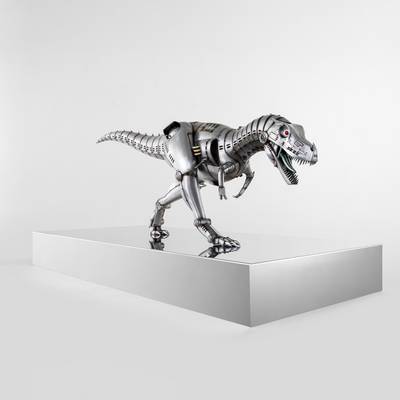
Sorayama achieved this through his unparalleled airbrush technique, building up layers of tone and highlight to create a surface that reads simultaneously as skin and metal, organic curve and fabricated form. His paintings require the viewer to hold two incompatible truths at once, and it is in that productive tension that their power resides. His sculptural works extend this logic into three dimensions with equal conviction. The Sexy Robot Infinity sculpture, released in a limited edition in 2020 in aluminum, resin, LED light, and steel, captures the same impossible fusion of flesh and chrome in physical form, while the T Rex Silver, a monumental aluminum and stainless steel work from 2019, channels his retro futurist instincts into something more overtly monumental and wild.
Hajime Sorayama
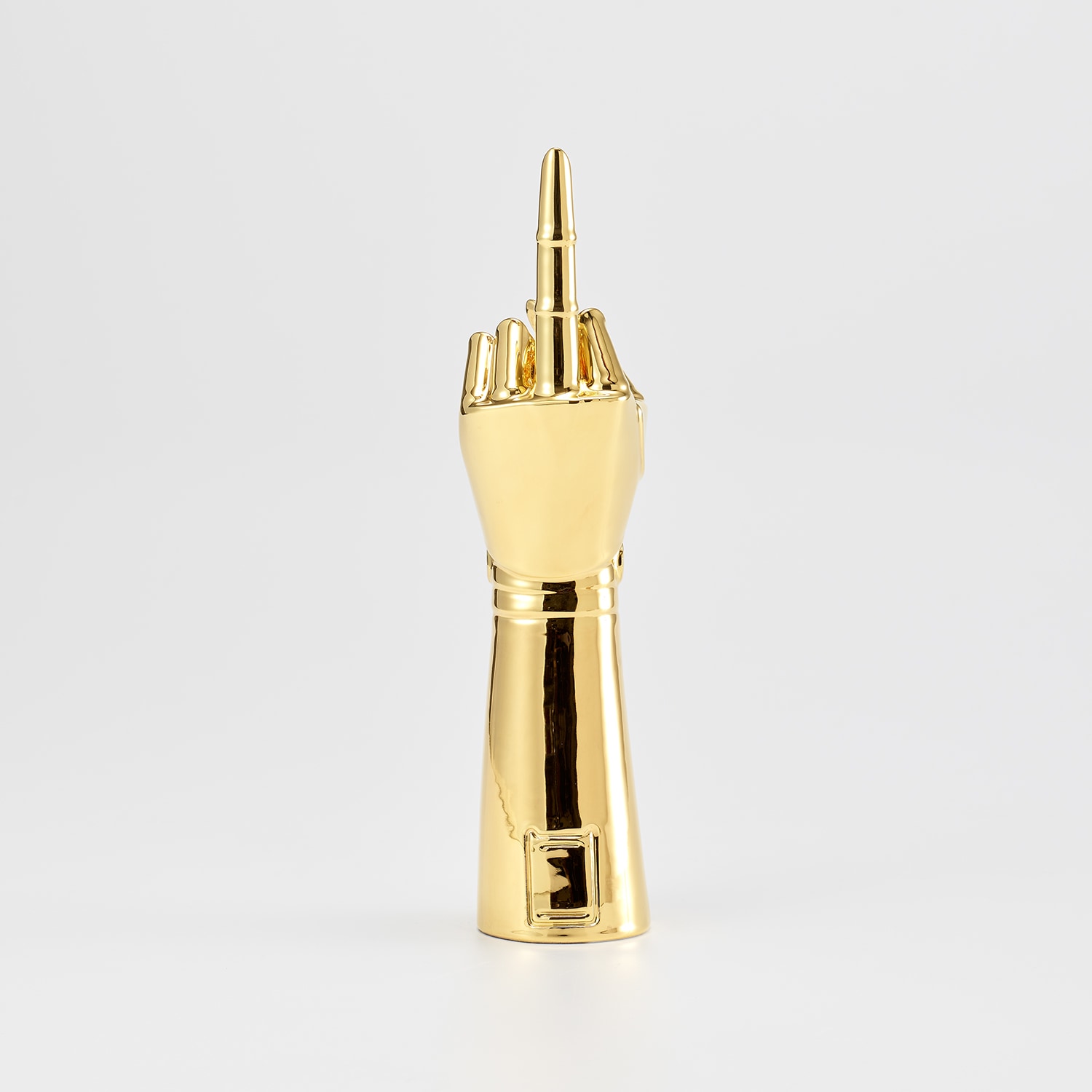
The Midas Touch
Works such as A Touch of Mercury and The Midas Touch, titanium and gold plated porcelain multiples presented in elegant black wooden boxes, demonstrate how thoughtfully Sorayama has approached the collectible object, giving each piece a ceremonial weight that honours the seriousness of the work. From a collecting perspective, Sorayama occupies a genuinely unusual position in the market. He bridges the worlds of fine art, commercial illustration, limited edition sculpture, and luxury collaboration in ways that few artists of any generation have managed so gracefully. His multiples and sculptural editions are among the most sought after objects in their category, attracting collectors from the contemporary art world, the streetwear and fashion community, and the long established world of Japanese print and illustration collecting.
The physical and material quality of his limited editions is consistently exceptional, and works presented in their original packaging and presentation boxes retain particular desirability. Collectors new to Sorayama's practice would do well to consider the sculptural editions, which offer both formal complexity and a directness of physical presence that prints and paintings, however masterful, cannot quite replicate. His auction results have strengthened steadily over the past decade, reflecting broader institutional and critical recognition of his contribution to postwar visual culture. Sorayama's place within art history is rich and multivalent.
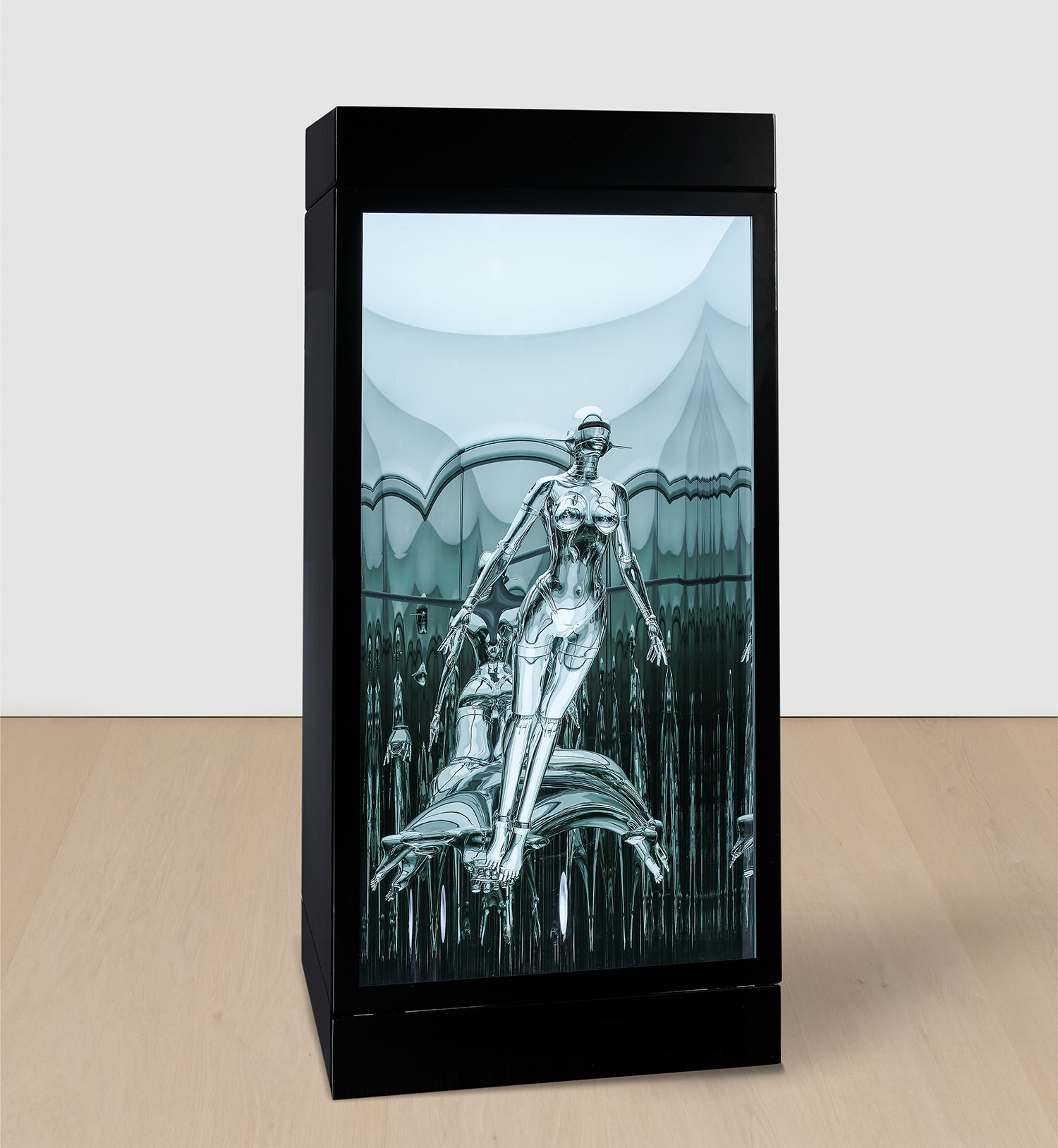
Hajime Sorayama
Sexy Robot Infinity - 1/3 Scale, 2020
He shares with artists like H.R. Giger, the Swiss surrealist best known for the visual design of the Alien franchise, a fascination with the merging of biological and mechanical forms, though where Giger tends toward the threatening and visceral, Sorayama inclines toward the seductive and idealised. His work also invites comparison with the American hyperrealists of the 1970s, such as Chuck Close and Richard Estes, in its obsessive fidelity to surface and reflective light.
Within Japanese art, his lineage runs through the tradition of bijin ga, or paintings of beautiful women, which stretches back through Utamaro and the great ukiyo e masters, though Sorayama transposes that tradition into the language of postwar technology and science fiction. He is also a clear forefather of the aesthetic now broadly associated with figures like KAWS and Takashi Murakami, artists who have navigated between commercial culture and fine art with comparable fluency. What makes Sorayama genuinely essential today is the prescience of his central subject. In an era when artificial intelligence, robotics, and the ethics of machine consciousness have moved from science fiction to daily headline, his life's work reads less like fantasy and more like prophecy.
He spent decades asking, through paint and chrome and sculpture, what it would mean for a machine to be beautiful, to be desired, to occupy the same imaginative space as a human body. Those questions have never been more urgent or more unresolved. Sorayama did not wait for the future to arrive. He built it, polished it to a mirror finish, and invited us to see ourselves in its reflection.
Explore books about Hajime Sorayama