Gustave Caillebotte
Gustave Caillebotte, The Impressionist Who Saw Everything
Artist Spotlight · The Collection Editorial
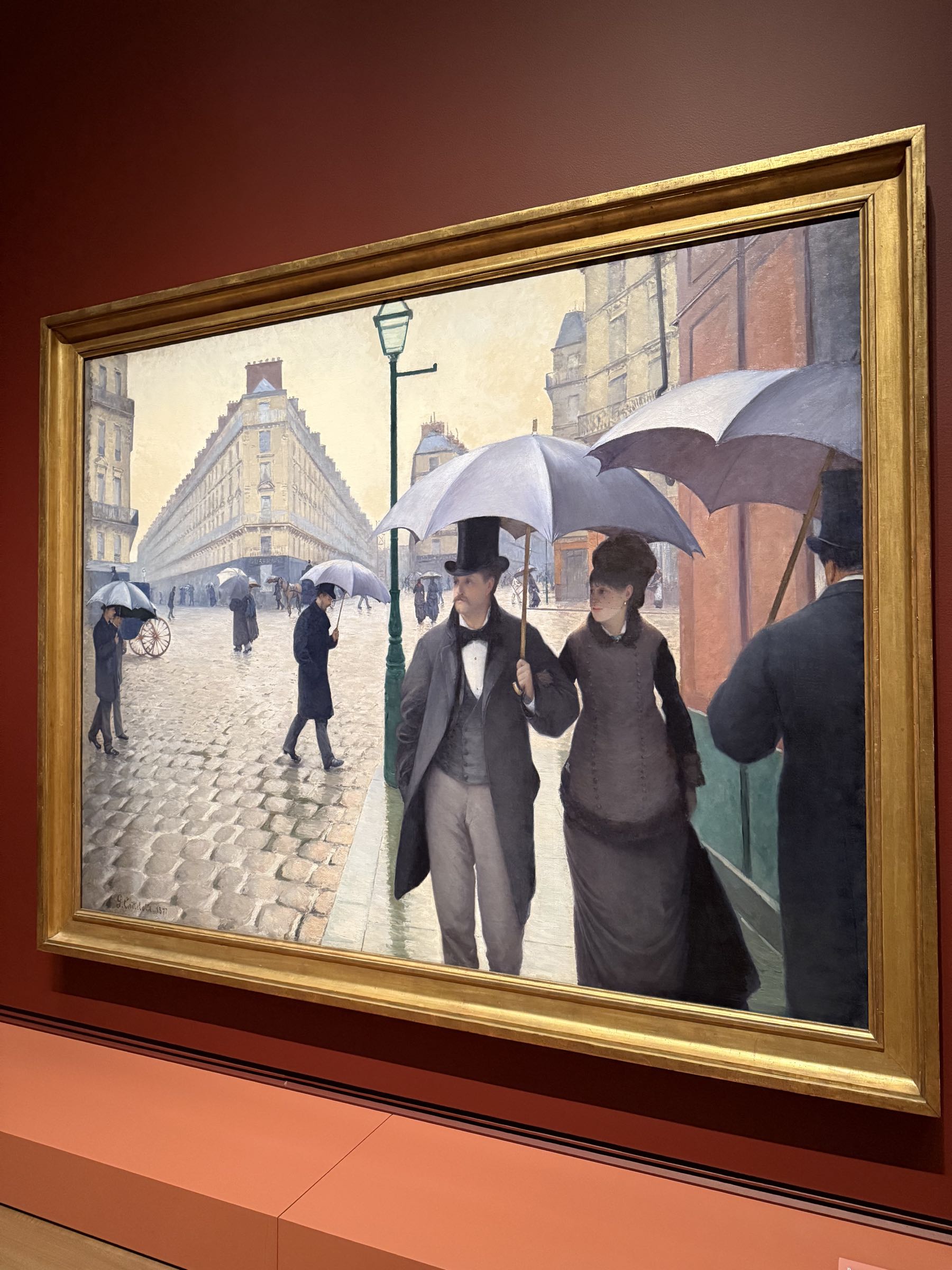
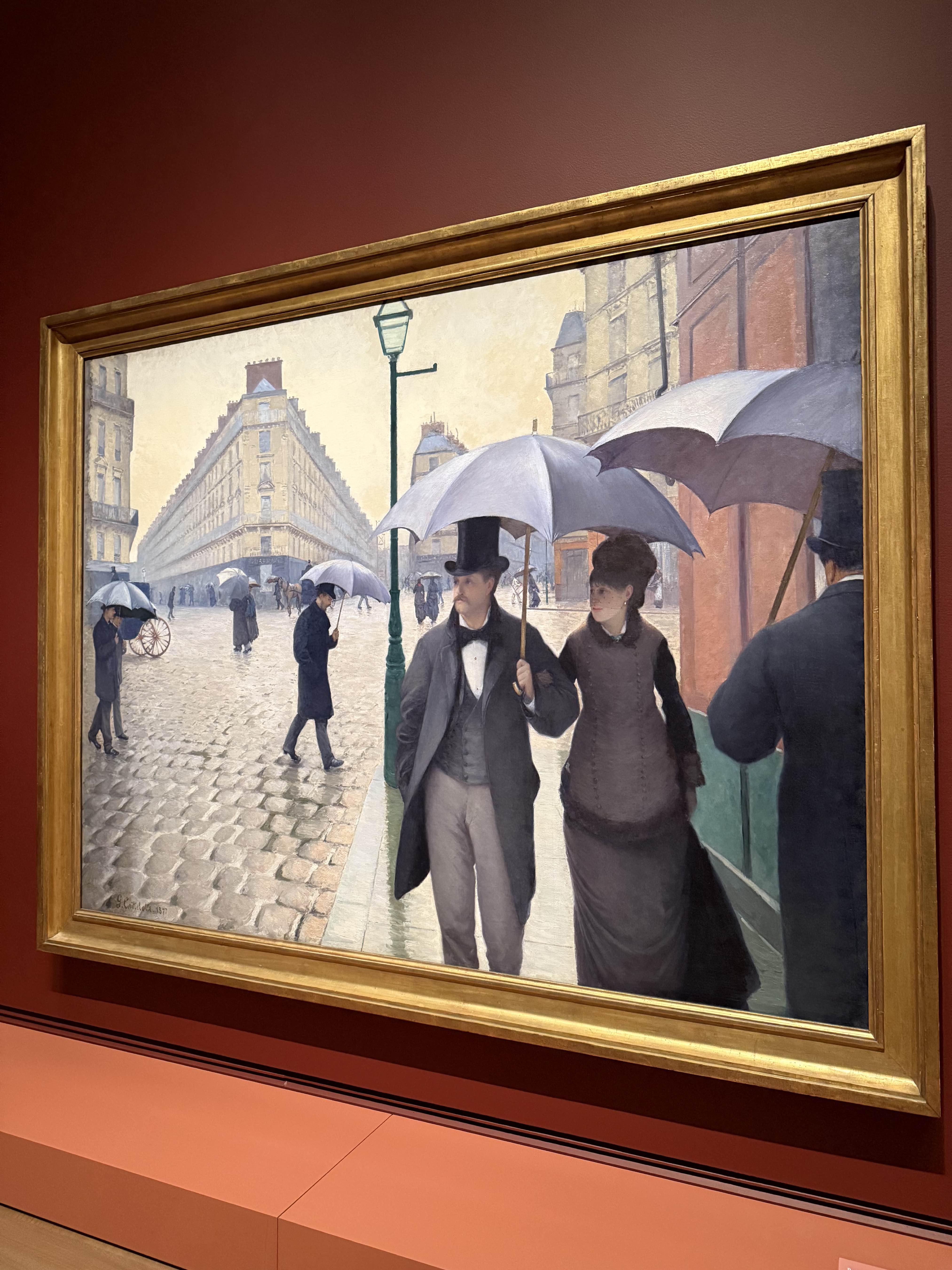
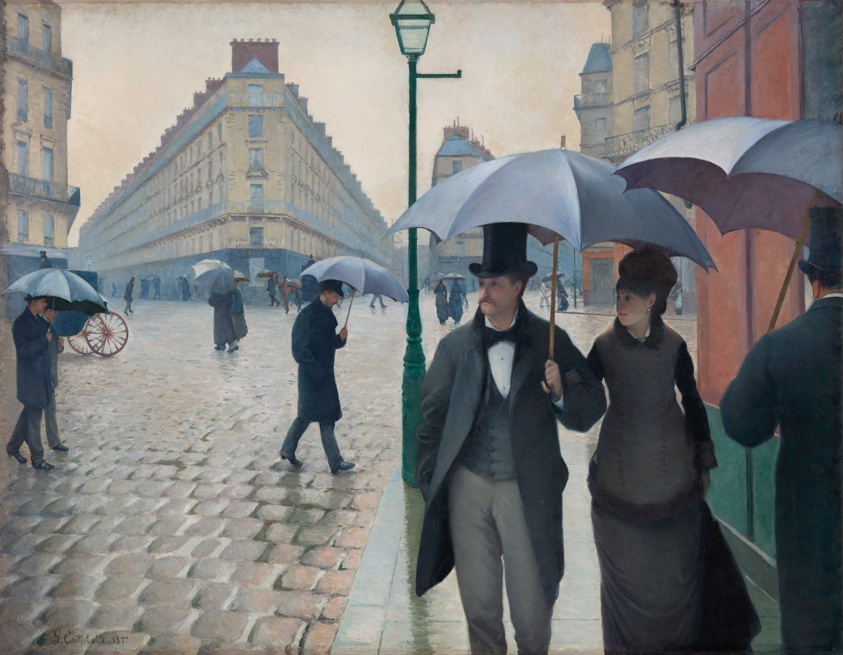
Stand in front of "Paris Street; Rainy Day" at the Art Institute of Chicago and something remarkable happens. The painting, completed in 1877 and measuring nearly seven feet tall by nine feet wide, does not simply depict a wet Parisian intersection near the Gare Saint Lazare. It pulls you into it. Umbrellas loom.
Gustave Caillebotte
Paris Street; Rainy Day, 1877
Cobblestones gleam. A couple walks toward you with an almost unsettling directness, as though you have just stepped aside to let them pass. In a century that gave us Monet's haystacks and Renoir's dappled picnics, Caillebotte achieved something entirely his own: the feeling of modern life rendered with the precision of a surgeon and the soul of a poet. Gustave Caillebotte was born in Paris on August 19, 1848, into a family of considerable wealth.
His father, Martial Caillebotte, had built a fortune through the textile trade and military supply contracts, and the family occupied a grand house on the Rue du Faubourg Saint Denis before eventually settling at a property in Yerres, southeast of Paris. It was a privileged upbringing by any measure, yet Caillebotte was not content to remain a gentleman of leisure. He trained as a lawyer and also earned an engineering degree, but painting had captured his imagination, and in 1873 he formally entered the studio of Léon Bonnat, one of the most respected academic painters in France. He received his official baccalauréat in fine arts in 1874, the same year he first encountered the circle of artists who would define his life.
Gustave Caillebotte
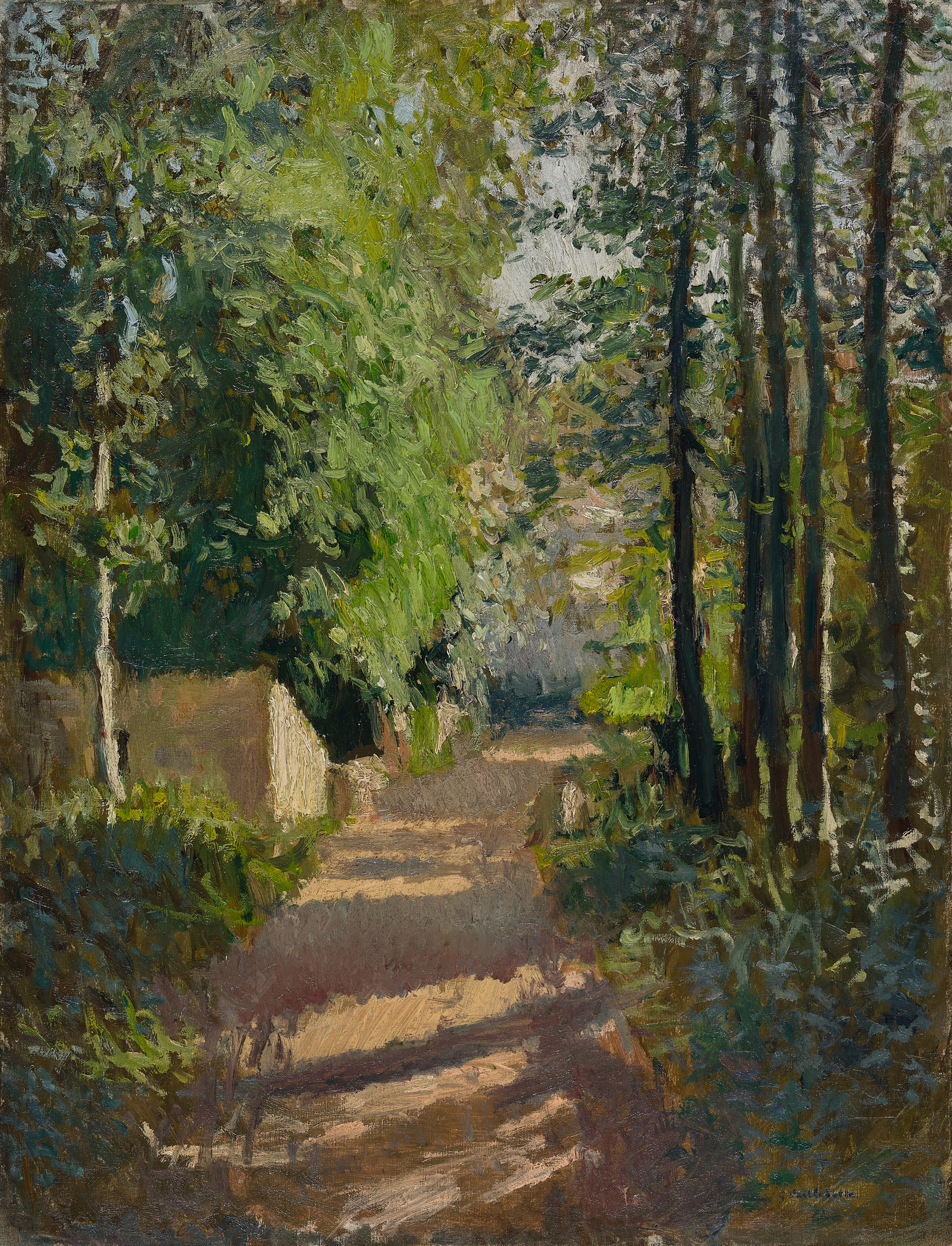
Allée sous-bois, Normandie, 1882
That encounter came through the first Impressionist exhibition of 1874, the landmark show organized independently by Monet, Degas, Pissarro, Renoir, and others who had grown frustrated with the strictures of the official Paris Salon. Caillebotte was deeply affected. He joined the group and became not only a fellow exhibitor but an indispensable supporter. Using his inherited wealth, he paid studio rents for Monet and Renoir during periods of financial hardship, purchased their works at fair prices to ensure they had income, and helped fund and organize the Impressionist exhibitions of 1876, 1877, 1879, 1880, 1881, and 1882.
His generosity was strategic as well as heartfelt: he believed in the movement and understood that its survival required more than talent alone. Caillebotte's own painting practice was evolving rapidly during these years, and what emerged was a style that sat in fascinating tension with his contemporaries. Where Monet dissolved form into light, Caillebotte held it taut. His early masterworks from the late 1870s display an almost architectural understanding of perspective, influenced in part by his engineering training and in part by his fascination with photography, which was then transforming how educated Parisians understood the visual world.
Gustave Caillebotte
Paris Street; Rainy Day, 1877
"The Floor Scrapers" from 1875, now in the Musée d'Orsay, depicted working class men stripped to the waist and bent over gleaming parquet in a manner so raw and direct that the Salon jury rejected it as vulgar. Caillebotte showed it with the Impressionists instead, and it stopped viewers in their tracks. He had found his voice: unflinching, modern, and deeply humane. "Paris Street; Rainy Day" remains the supreme achievement of that voice, and it is impossible to discuss Caillebotte seriously without dwelling on it.
The composition is built around the receding perspective of the intersection of the Rue de Turin and the Rue de Moscou, but its genius lies in its cropping, its refusal of sentimentality, and the almost cinematic quality of its figures, who do not pose but simply exist. The preparatory studies for this painting, including a meticulous graphite study that survives and is represented in several major collections, reveal an artist who worked with extraordinary discipline. Every element of the final canvas was thought through, adjusted, and refined. These studies are not afterthoughts; they are windows into one of the most methodical creative minds of the nineteenth century.
Gustave Caillebotte
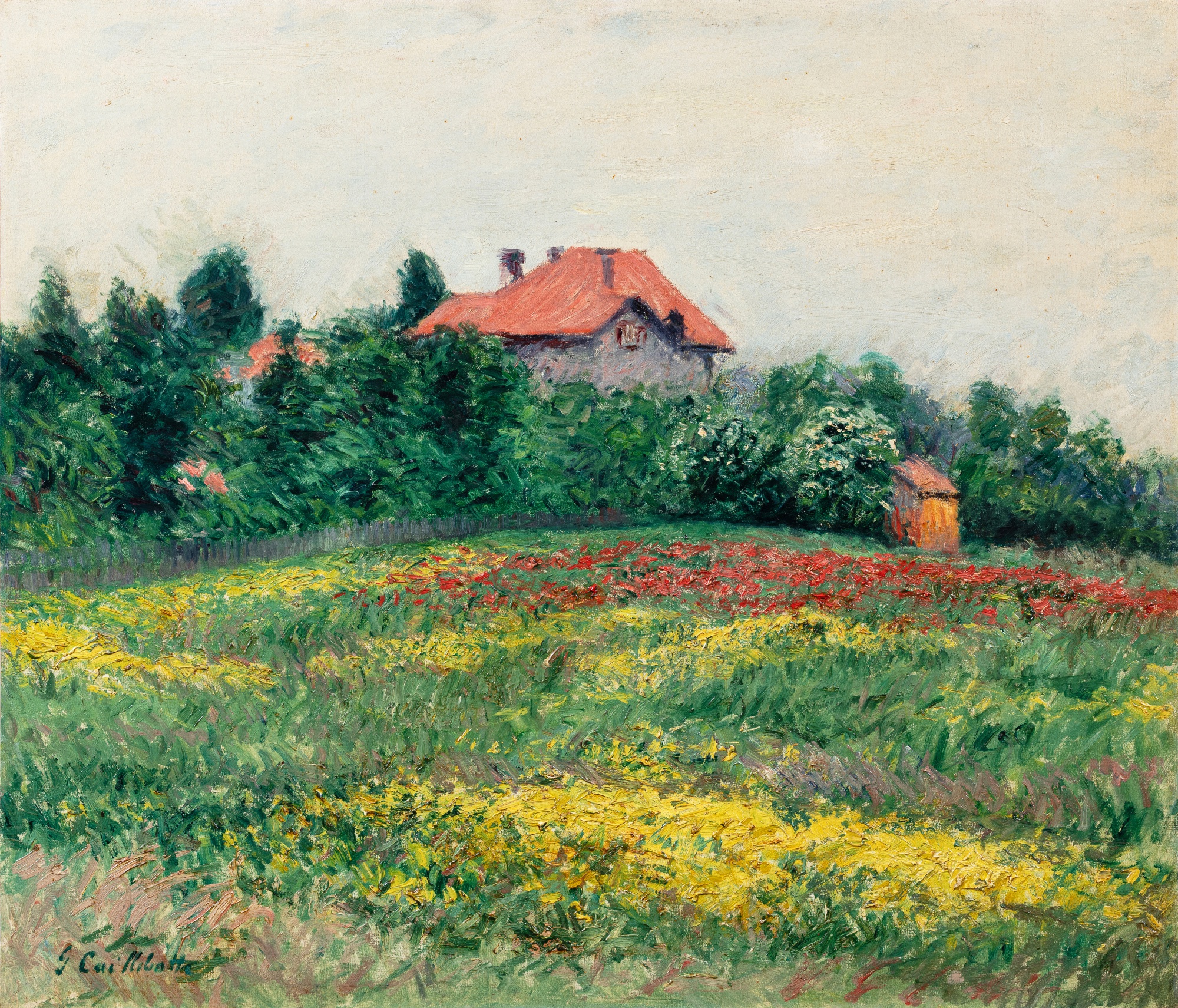
Jardin sauvage au Petit Gennevilliers, 1882
The sketchbooks and works on paper that Caillebotte left behind tell a story of constant observation, of a man who drew the world around him with restless curiosity. Beyond Paris, Caillebotte found renewed inspiration in the landscapes of Normandy and in the gardens and waterways of his property at Petit Gennevilliers, which he acquired in 1881. Works from this period, including lush garden paintings and shimmering views of the Seine, show an artist loosening his grip slightly, allowing color and atmosphere more room to breathe. "Jardin sauvage au Petit Gennevilliers" from 1882 is a gorgeous example, a tangle of wild growth rendered with warmth and an almost tactile pleasure in paint itself.
The Normandy landscapes of the same period, including works like "Allée sous bois, Normandie," demonstrate his ease in open countryside, his eye for the geometry of nature, the way light falls through trees in corridors and pools. He was also a passionate sailor and horticulturalist, and these private enthusiasms fed directly into his art. Caillebotte died young, on February 21, 1894, at the age of forty five, from pulmonary congestion while working in his garden at Petit Gennevilliers. His death was a significant loss not only to French painting but to the Impressionist collection he had so carefully assembled, which he bequeathed to the French state.
That bequest, including works by Monet, Renoir, Degas, Pissarro, Sisley, and Cézanne, formed the nucleus of what would eventually become the Impressionist holdings of the Musée d'Orsay. The French government accepted only part of the collection initially, a bureaucratic slight that history has since corrected with considerable embarrassment. For collectors today, Caillebotte presents a genuinely compelling proposition. His market has strengthened considerably in recent decades as the art world has come to appreciate both his historical importance and the quality of his output across a range of scales and mediums.
Major auction houses including Christie's have seen strong results for his works, and institutional interest, driven by exhibitions at the Art Institute of Chicago, the Musée d'Orsay, and the Kimbell Art Museum, continues to raise his profile with new generations of collectors. Works on paper, including drawings, sketchbook pages, and preparatory studies, offer a point of entry into his practice that is both intellectually rich and visually rewarding. His finished oils command prices that reflect his stature, but the intimacy of his works on paper carries its own distinct value. In art historical terms, Caillebotte belongs in the conversation alongside Degas, with whom he shared a taste for unconventional cropping and a fascination with the modern male figure, and Manet, whose unflinching realism clearly informed Caillebotte's own approach.
He also anticipates something of the cool, observational distance that would later characterize artists like Edward Hopper. Yet he is not derivative of any of them. His vision was singular: a wealthy man who looked at labor, at the street, at the quiet geometry of bourgeois interiors, and found in all of it something worth painting with complete seriousness. What makes Caillebotte feel so alive today is precisely this seriousness.
He did not paint to charm or to please; he painted because he saw things clearly and believed that clarity was its own form of beauty. His Paris is not the soft, shimmering city of legend. It is a city of angles and umbrellas, of men bent to their work, of afternoons on the river when the light is good and life feels, for a moment, perfectly balanced. That city still exists, in some essential way, and Caillebotte is the artist who most completely preserved it.
Explore books about Gustave Caillebotte
Gustave Caillebotte: A Retrospective Exhibition
Kirk Varnedoe
Caillebotte: The Painter's Eye
Anne Distel
Gustave Caillebotte and His World
Marie Berhaut
Caillebotte: Urban Realism from Paris Streets
Norma Broude
The Paintings of Gustave Caillebotte
Marie Berhaut
Gustave Caillebotte: A Private World
Barbara Ehrlich White