Georgia O'Keeffe
Georgia O'Keeffe, America's Eternal Vision
Artist Spotlight · The Collection Editorial
“I found I could say things with color and shapes that I couldn't say any other way, things I had no words for.”
Georgia O'Keeffe
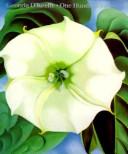
There are artists who define a moment, and then there are artists who define a landscape, a way of seeing, a country's relationship with its own wilderness. Georgia O'Keeffe belongs to the second and rarer category. In 2023, her painting 'Jimson Weed/White Flower No. 1' remained one of the most expensive works ever sold by a female artist at auction, a record set at Sotheby's New York in 2014 when it achieved 44.
Georgia O'Keeffe
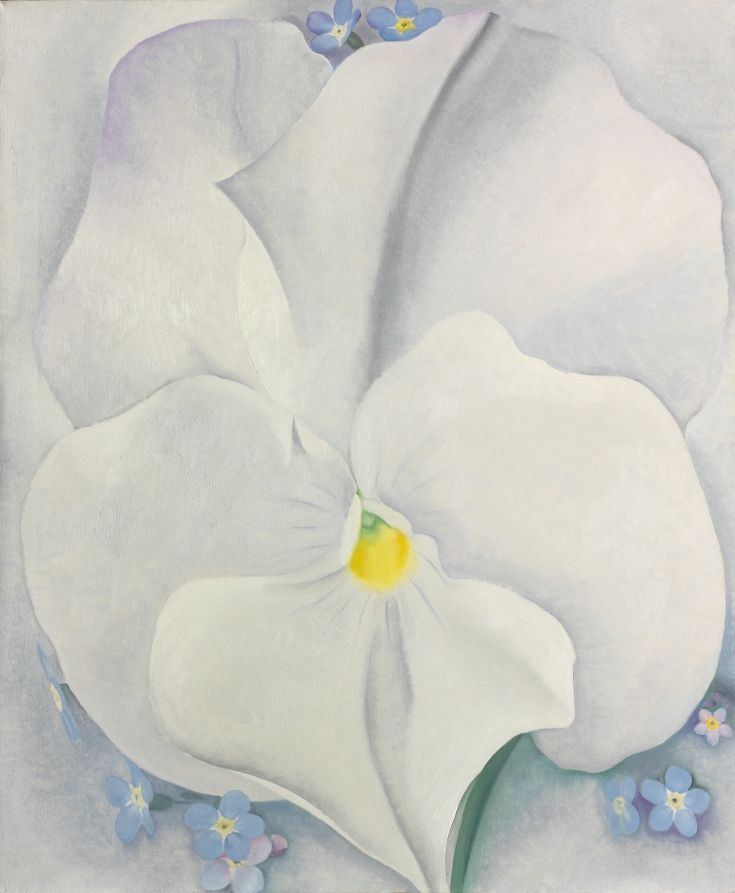
White Pansy, 1927
4 million dollars, a figure that spoke not only to market confidence but to something deeper: a collective hunger for her vision of the American sublime. Decades after her death in 1986, O'Keeffe continues to feel urgently present, her canvases as alive and demanding as the day she stretched them. She was born on November 15, 1887, on a dairy farm in Sun Prairie, Wisconsin, the second of seven children in an Irish and Hungarian immigrant family with an unusually progressive attitude toward their daughters' education. From an early age she announced, with the directness that would characterize her entire life, that she intended to be an artist.
She studied at the School of the Art Institute of Chicago beginning in 1905 and later at the Art Students League in New York, where she trained under William Merritt Chase and absorbed the technical foundations of American academic painting. But it was a lecture by Arthur Wesley Dow at Columbia University that proved transformative, introducing her to principles of design and composition rooted in Japanese aesthetics that would loosen her work from representation and point it toward something altogether freer. The pivotal moment in her public emergence came in 1916, when the photographer and gallerist Alfred Stieglitz exhibited her abstract charcoal drawings at his legendary 291 gallery in New York without her prior knowledge. O'Keeffe traveled to the city, asked him to take them down, and instead found herself drawn into one of the most consequential artistic and personal partnerships in American cultural history.
Georgia O'Keeffe
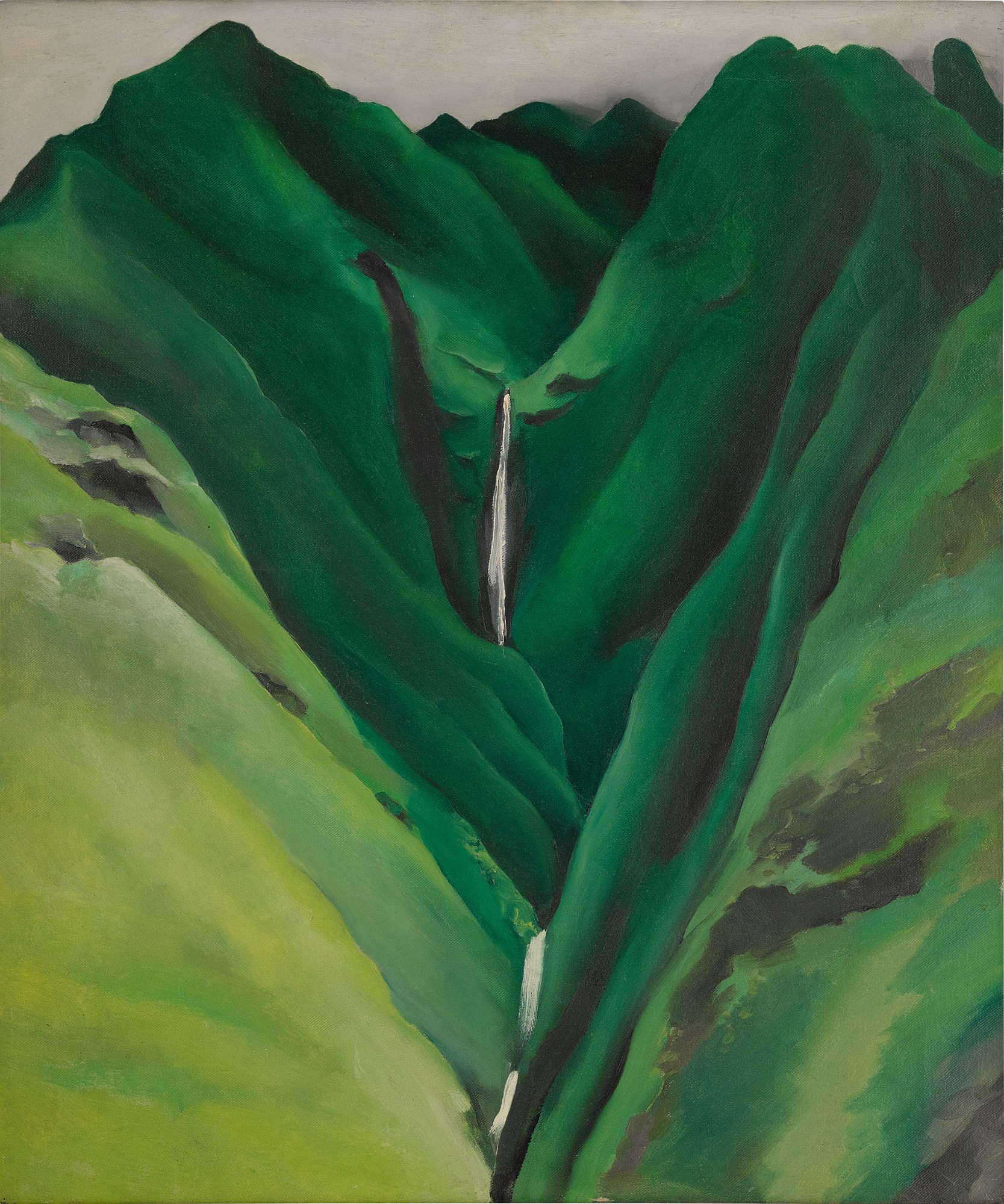
Waterfall, No. 2, Īao Valley, 1939
Stieglitz became her champion, her lover, and eventually her husband, photographing her obsessively and positioning her work at the center of American modernism. He gave her annual shows at his successive galleries, 291, the Intimate Gallery, and An American Place, through the 1920s and 1930s, building her reputation with the same curatorial conviction she brought to her own practice. Her artistic development moved in several distinct and equally commanding phases. The early abstract watercolors and charcoals of the 1910s gave way to the monumental floral paintings for which she became most widely known, works painted in New York during the late 1920s in which petals and stamens filled the entire canvas, forcing an intimacy that was simultaneously scientific and sensual.
“Nobody sees a flower really; it is so small. We haven't time, and to see takes time.”
Exhibition catalogue, An American Place, 1939
She consistently resisted the psychosexual readings that critics, led by Stieglitz, projected onto these paintings, insisting that she was painting flowers as she actually saw them: large, close, and completely. Then came New Mexico. She first visited Taos in 1929 and returned every summer, eventually making Abiquiu her permanent home after Stieglitz died in 1946. The high desert became the defining landscape of her mature work, a place where bleached animal skulls floated against brilliant blue skies, red hills dissolved into abstraction, and the bones of the earth itself seemed to offer up a kind of austere spiritual nourishment.
Georgia O'Keeffe
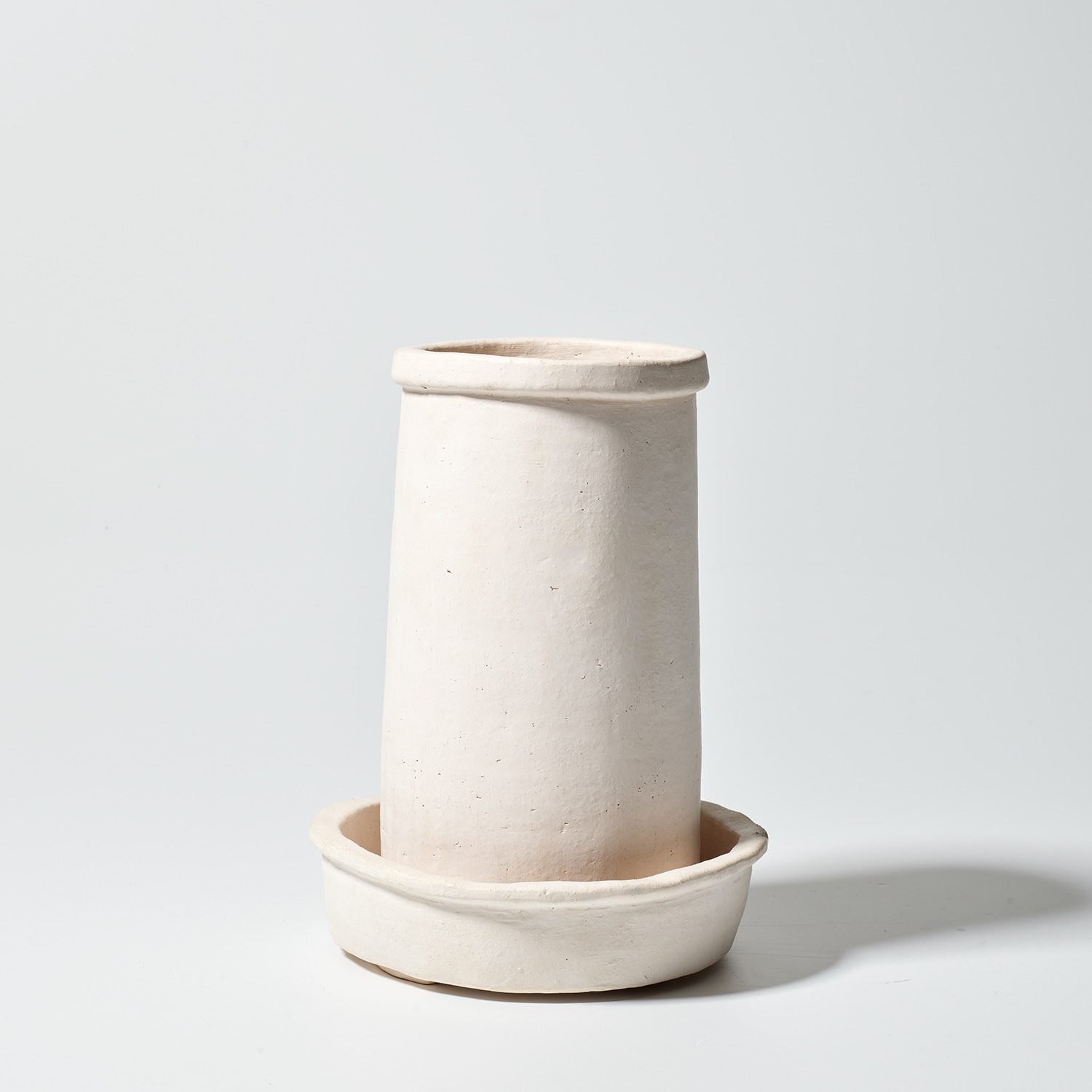
incised with the artist's initials and date "G.o.K. - 83" on the underside of the pot and stand, 1983
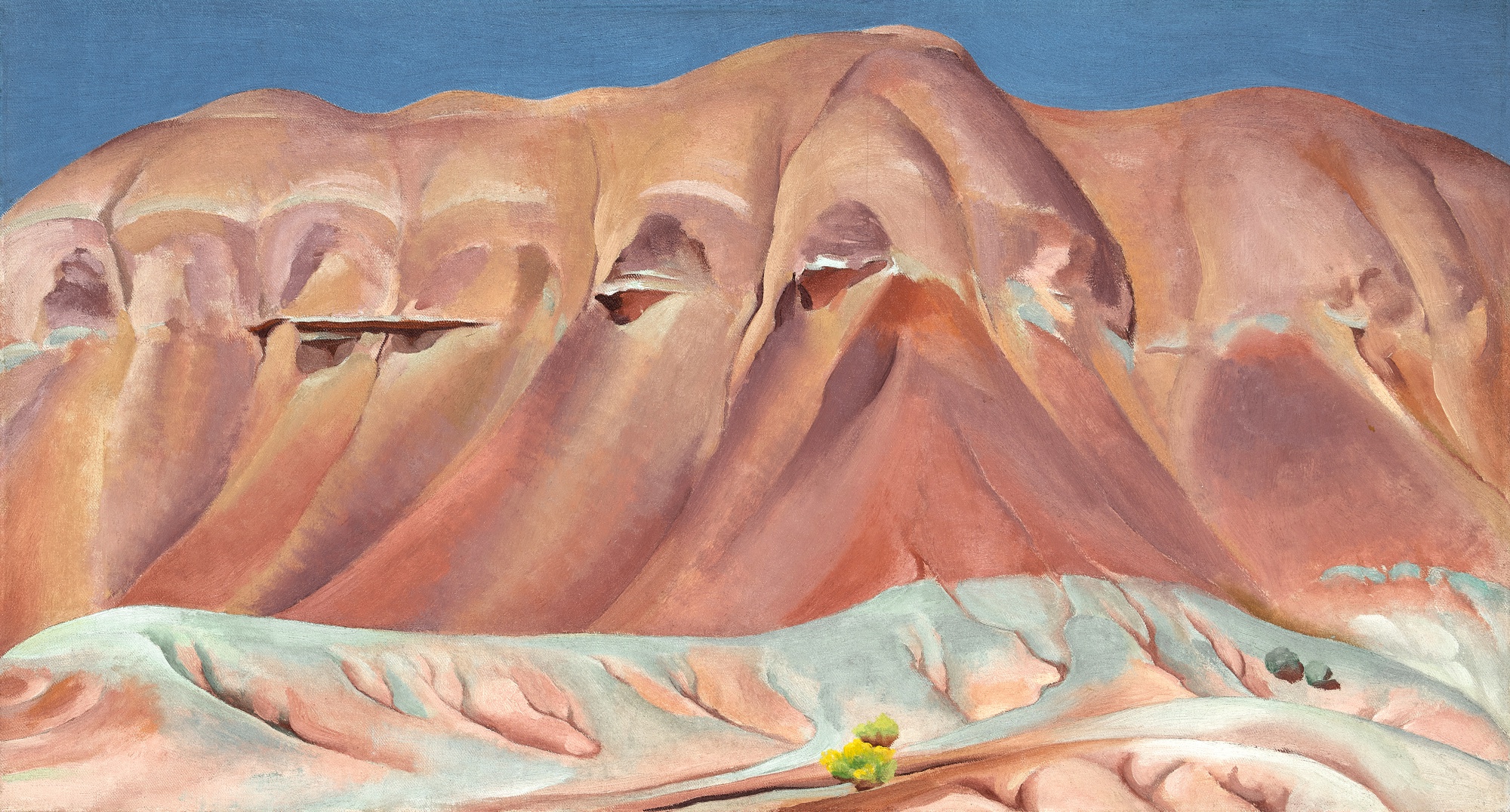
The works available through The Collection offer an extraordinarily rich survey of her range and ambition across six decades of sustained creative production. 'White Pansy' from 1927 arrives at the height of her New York floral period, the creamy petals rendered with a tenderness that rewards long looking. 'White Flower' from 1929 and 'White Shell with Red' from 1938 reveal her sustained fascination with organic form and the way natural objects could carry an almost architectural gravity. 'Lavender Hill Forms' from 1934 and 'Cross with Red Heart' from 1932 speak to her New Mexico period at its most concentrated, the landscape stripped to elemental color and shape.
“I've been absolutely terrified every moment of my life and I've never let it keep me from doing a single thing I wanted to do.”
Georgia O'Keeffe
The 'Waterfall, No. 2, Iao Valley' from 1939 documents a significant journey she made to Hawaii at the invitation of the Dole Pineapple Company, resulting in a body of lush, light soaked tropical work that sits beautifully beside her better known desert canvases. Even the early 'Trees in Snow' from 1902, a watercolor made when she was just fifteen, announces a compositional intelligence already fully awake to the expressive weight of negative space. For collectors, O'Keeffe represents one of the most secure and meaningful positions in the American modernist canon.
Georgia O'Keeffe
Lavender Hill Forms, 1934
Her market has been studied, consistent, and insulated from the volatility that affects younger or less institutionally established artists. Works on paper, including pastels and charcoals, offer accessible entry points while remaining firmly within the scope of serious collecting. Her paintings on canvas and board command premium attention, particularly those from the definitive New Mexico period and the New York floral years. Provenance traceable to Stieglitz era exhibitions adds considerable historical resonance, and works that have been exhibited in major institutional surveys carry the kind of documentation that builds a collection's credibility over generations.
Institutions holding her work include the Georgia O'Keeffe Museum in Santa Fe, the Metropolitan Museum of Art, the Art Institute of Chicago, and the Museum of Modern Art, which gave her a major retrospective in 1946 and again in 1976, cementing her place at the summit of American art. In the broader context of art history, O'Keeffe occupies a singular and sometimes deliberately independent position. She has been associated with American Precisionism through her architectural paintings of the 1920s, and her engagement with Stieglitz placed her at the center of American modernism's most dynamic decade. Yet she consistently defied categorization, rejecting both the European abstraction that dominated critical conversation in the mid century and the psychoanalytic interpretations that followed her floral work.
Artists working in adjacent territories include Arthur Dove, whose organic abstractions shared her interest in translating natural sensation into pure form, Charles Demuth, whose precision and sensuality also bridged the representational and the abstract, and Marsden Hartley, a fellow Stieglitz artist whose landscapes carried a comparable spiritual intensity. But O'Keeffe's body of work ultimately stands alone, not because she was isolated but because her singular vision was too coherent and too personal to be absorbed into any school. Her legacy in the twenty first century extends well beyond the art world. She has become a figure of cultural myth in the most genuine sense: a woman who chose solitude and landscape over the social machinery of the art world, who worked productively into her nineties, who made beauty out of the hardest materials the American West could offer.
Feminist scholars have rightly reclaimed her as a pioneer whose path through a male dominated institution required as much strategic intelligence as artistic genius. But she remains, above all, a painter of extraordinary skill and conviction whose works ask viewers to slow down, to look again, and to find in color and form a language more precise than words. To hold a work by Georgia O'Keeffe is to hold a piece of American consciousness, shaped by hands that understood both the discipline and the freedom that great art demands.
Explore books about Georgia O'Keeffe
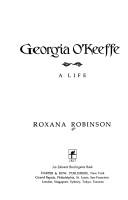
Georgia O'Keeffe: A Life
HillaryBallon
Georgia O'Keeffe
Charles C. Eldredge

Readings in American Art Since 1900
Rosalind E. Krauss
Georgia O'Keeffe: The New York Years
Elizabeth Glassman and Juan Hamilton
Georgia O'Keeffe: The Artist's Landscape
Alexandra Avis
O'Keeffe: Abstraction
Barbara Buhler Lynes
Georgia O'Keeffe: Catalogue Raisonné
Barbara Buhler Lynes
Letters of Georgia O'Keeffe
Georgia O'Keeffe