Gajin Fujita
Gajin Fujita: Gold, Graffiti, and Glory
Artist Spotlight · The Collection Editorial
When Gajin Fujita's monumental wood panel paintings enter a room, they command it entirely. Over the past decade, his work has moved from the walls of East Los Angeles to the permanent collections of major institutions, and his presence in the contemporary art conversation has only grown more assured. Exhibitions at LA Louver Gallery in Venice, California, where Fujita has been represented for years, have consistently drawn collectors, curators, and critics who recognize in his work something genuinely rare: a visual language that feels both ancient and urgently alive. Fujita was born in 1974 and raised in East Los Angeles, the son of Japanese immigrants who brought with them a deep reverence for traditional calligraphy and cultural heritage.
Gajin Fujita
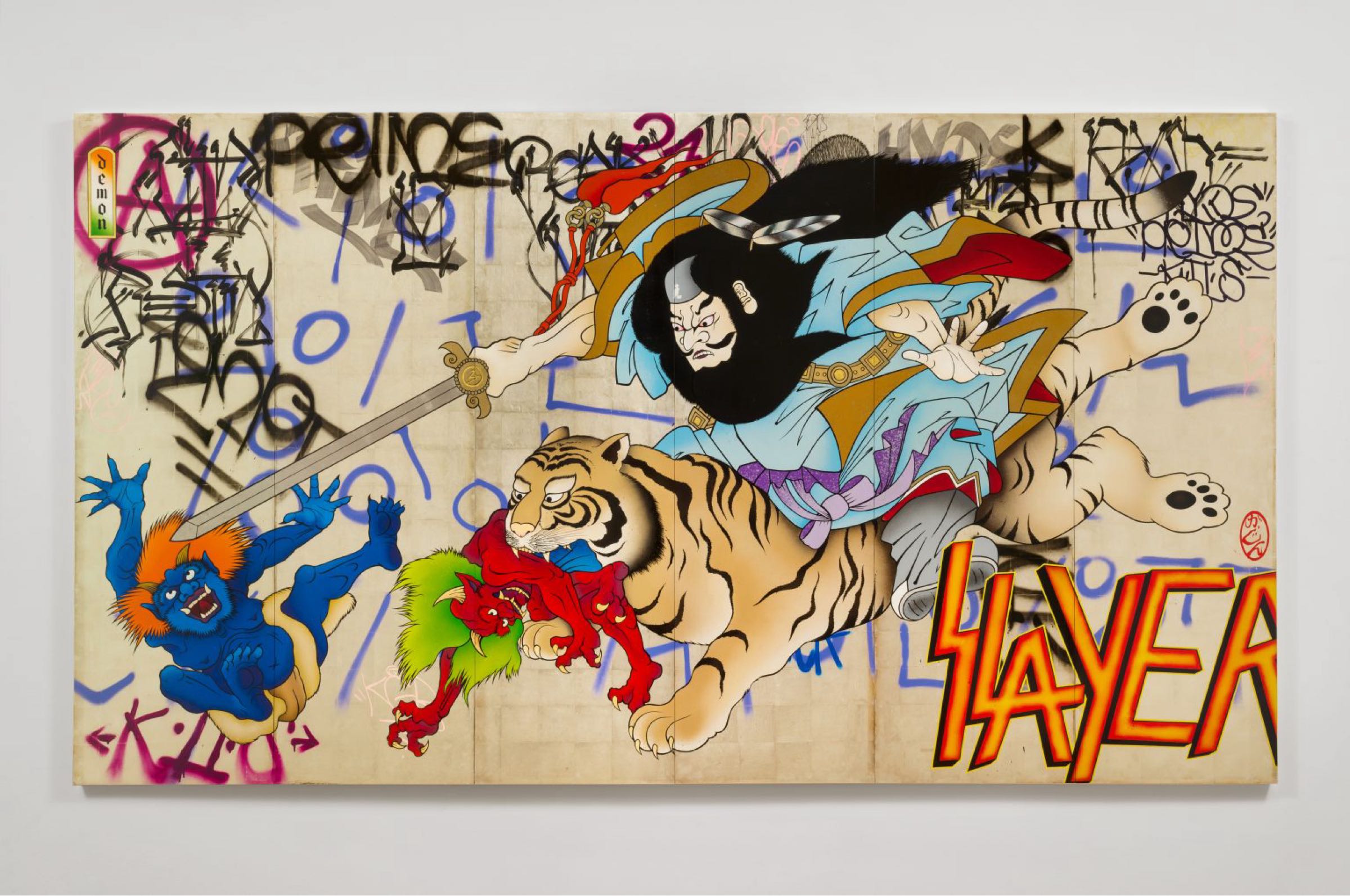
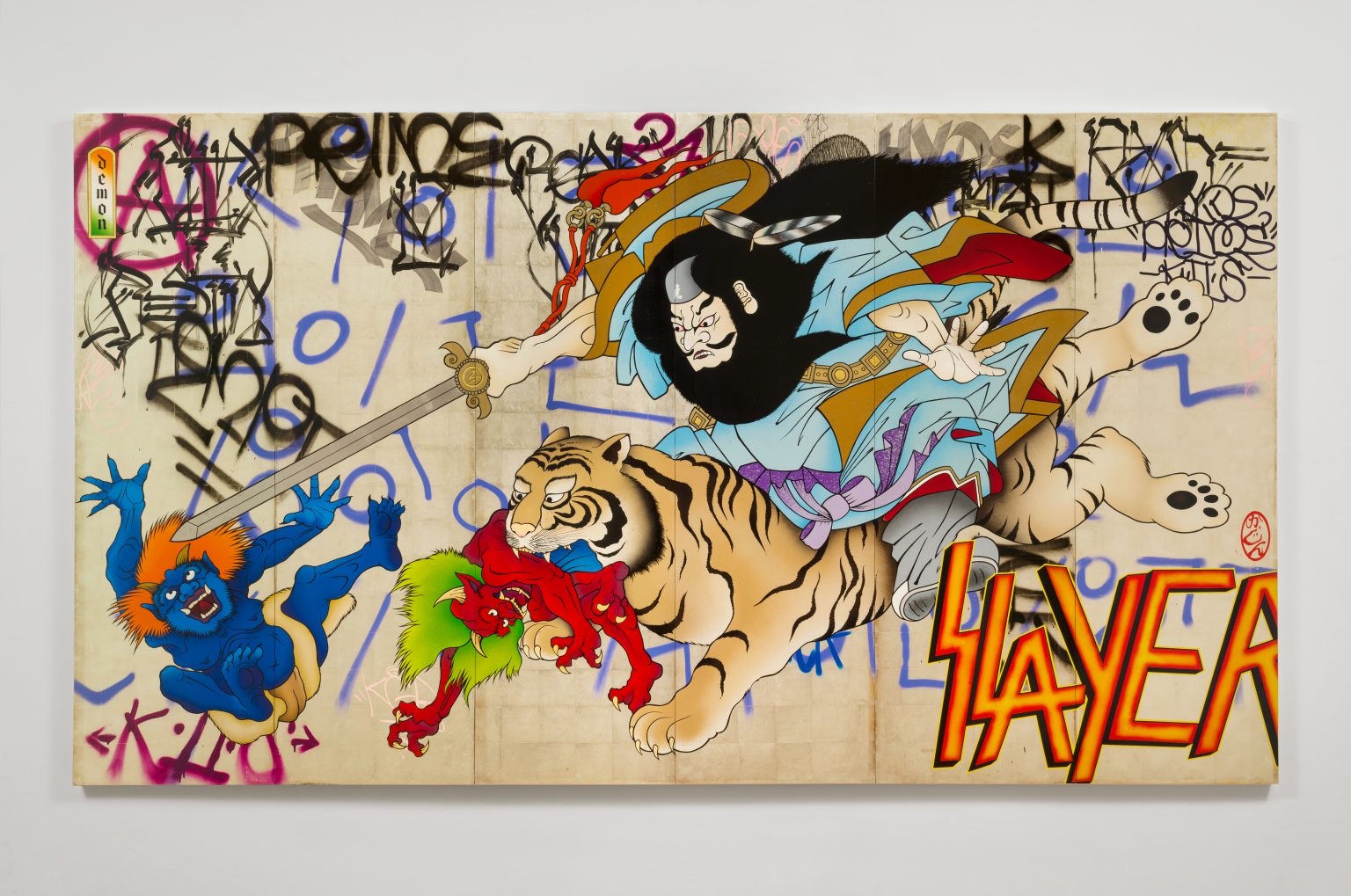
Demon Slayer, 2015
Growing up between two worlds, he absorbed the visual codes of the streets around him as naturally as he absorbed the brushwork and aesthetic discipline of his family's Japanese artistic traditions. The tension between those two inheritances never felt like a problem to Fujita. It felt like material. He studied at the Otis College of Art and Design in Los Angeles and later earned his MFA from the University of Nevada, Las Vegas.
His formal training gave him technical rigor, but it was the streets of East Los Angeles that gave him urgency. As a teenager and young man, Fujita ran with graffiti crews, learning the economy of gesture and the courage it takes to make a mark in public space. That experience never left his practice. It is embedded in the physical confidence of every stroke he makes.
Fujita's breakthrough came as collectors and institutions began to understand the full ambition of what he was doing. His paintings are not simply a fusion of East and West, tradition and street culture. They are elaborate, densely layered negotiations between those forces, carried out in spray paint, paint markers, Mean Streak paint sticks, and the extraordinary luxury of 12k white gold, 24k gold, and platinum leaf. The gold leaf in particular transforms his panels into something approaching the sacred.
They glow with the quality of Japanese folding screens or medieval illuminated manuscripts, even as figures drawn from graffiti lettering and Japanese iconography collide and intertwine across their surfaces. Among his most celebrated works is Demon Slayer, completed in 2015. Executed on wood panels with spray paint, paint markers, Mean Streak, and 12k white gold, 24k gold, and platinum leaf, the piece exemplifies everything that makes Fujita's practice so compelling. The title invokes both the warrior iconography of classical Japanese woodblock prints and the mythology of street culture, where to move through the city is itself a kind of battle.
The gold and platinum surfaces catch light unpredictably, so that the work changes depending on where you stand and how the light falls. It is a painting that rewards sustained attention, revealing new layers of mark and meaning the longer you look. For collectors, Fujita represents a compelling proposition on multiple levels. His work is visually extraordinary in reproduction but transformative in person, which is the quality that separates the truly collectible from the merely decorative.
The use of precious metal leaf gives his panels a material value that anchors them historically alongside the great decorative and devotional arts of Japan, even as their graffiti energy places them firmly in the contemporary moment. Works by Fujita have appeared at auction and in private sales with growing frequency and confidence, reflecting a collector base that spans institutional buyers, serious private collectors on the West Coast, and an international audience drawn to Los Angeles as one of the most important art cities in the world. Within the broader landscape of contemporary art, Fujita occupies a distinctive and important position. His work invites comparison with artists who have similarly navigated the space between cultural heritage and street aesthetics, including Retna, the Los Angeles based muralist whose invented script shares Fujita's investment in mark as language, and KAWS, whose trajectory from street art to gallery and institutional recognition mirrors something of Fujita's own path.
But Fujita's commitment to the specific visual and spiritual vocabulary of Japanese art history gives his work a depth of cultural specificity that sets it apart. He is not simply sampling traditions. He is translating them, living inside them, and making them his own. The question of identity sits at the center of Fujita's practice in a way that feels neither didactic nor fashionable but genuinely personal.
To be Japanese American in East Los Angeles, to carry the aesthetic memory of one culture while being formed by the visual landscape of another, is to live permanently in translation. Fujita does not resolve that condition. He celebrates it, enacts it, and makes it beautiful. His paintings are proof that the most generative artistic spaces are often the ones that refuse easy categories.
Fujita's legacy is still being written, and that is part of what makes following his work so rewarding. He is an artist in full command of his vision, with decades of practice ahead of him. Institutions that have recognized his importance early are likely to see that judgment confirmed over time, and collectors who have brought his work into their homes and galleries have acquired not just an extraordinary object but a genuine stake in one of the most compelling stories in contemporary American art. In a moment when the art world is rightly asking which voices and which visions have been undervalued, Gajin Fujita's answer arrives in gold and spray paint, luminous and unmistakable.