Fritz Scholder
Fritz Scholder: A Vision Beyond Boundaries
Artist Spotlight · The Collection Editorial
“I have tried to paint the Indian in a new way, without sentiment, without the romantic stereotype.”
Fritz Scholder
In 2008, three years after his death, the Smithsonian National Museum of the American Indian mounted a landmark survey of Fritz Scholder's work that drew audiences into the orbit of one of the most provocative and original painters the American West had ever produced. The exhibition crystallized what many in the art world had long understood: Scholder had not simply painted Native Americans differently, he had fundamentally dismantled the entire visual language through which Native Americans had been seen, romanticized, and flattened by centuries of Western art. Standing before his canvases, visitors encountered something urgent and alive, figures that refused to be mythologized, that stared back with unsettling psychological weight. Fritz Scholder was born in 1937 in Breckenridge, Minnesota, of Luiseño heritage on his father's side, though he grew up navigating a complicated relationship with that identity.
Fritz Scholder
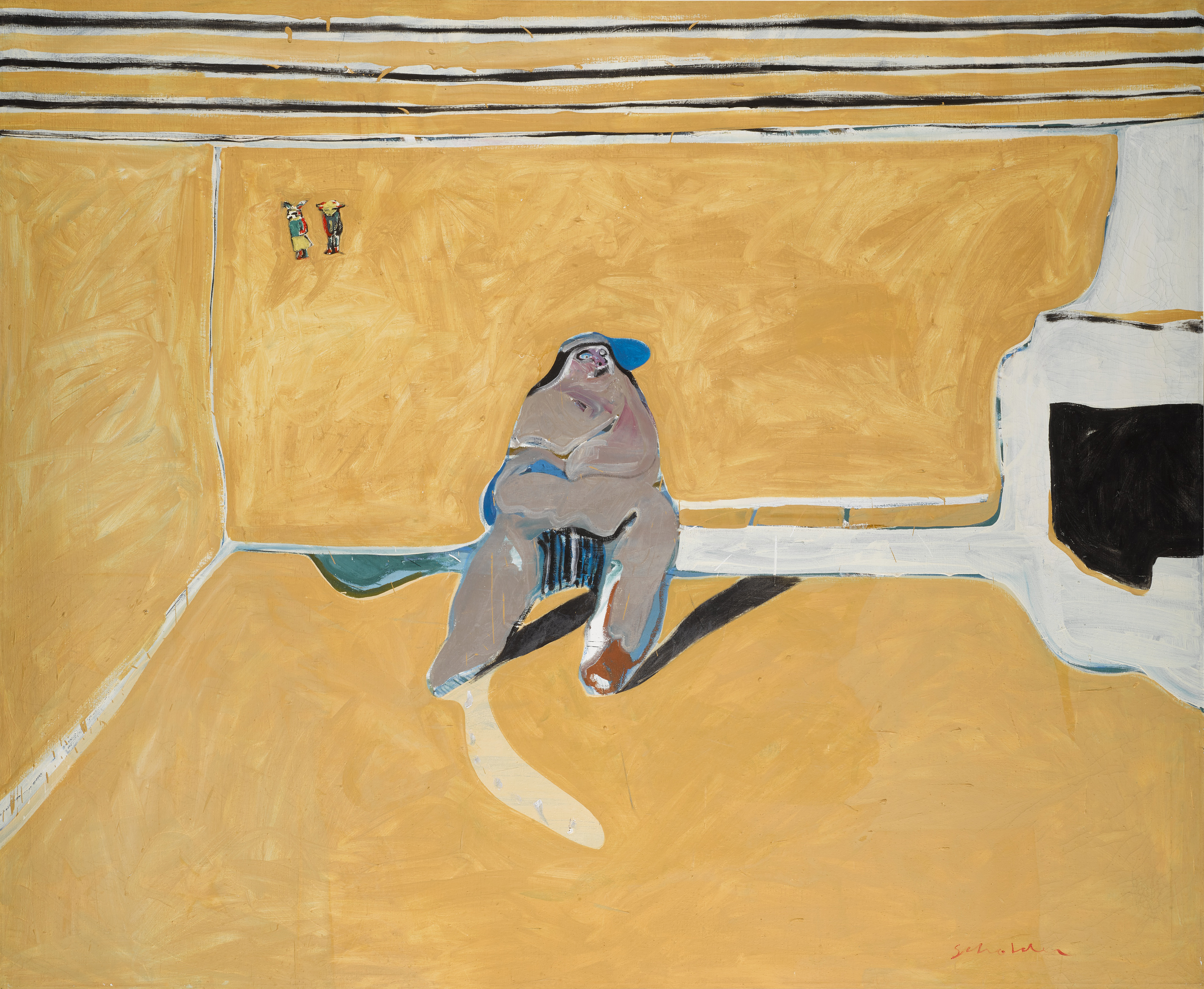
Indian in a Pueblo Interior, 1970
His early years were spent moving across the American West as his family relocated through the Southwest, and it was in California that he first encountered art with serious intention. He studied under the Pop artist Wayne Thiebaud at Sacramento City College in the late 1950s, an apprenticeship that would prove formative, giving Scholder a deep appreciation for bold color, flattened form, and the power of the vernacular image. Thiebaud recognized the younger artist's singular gifts immediately and encouraged him to pursue graduate study, which Scholder did at the University of Arizona, where he earned his Master of Fine Arts degree in 1964. It was his appointment as a faculty member at the Institute of American Indian Arts in Santa Fe, New Mexico, beginning in 1964, that truly ignited his artistic breakthrough.
Teaching alongside painters like T. C. Cannon, Scholder found himself surrounded by questions about identity, representation, and what it meant to make contemporary art as a Native American. The institutional expectation at the time was that Native artists would produce work rooted in traditional imagery and craft, a demand Scholder found artistically limiting and politically suspect.
Fritz Scholder
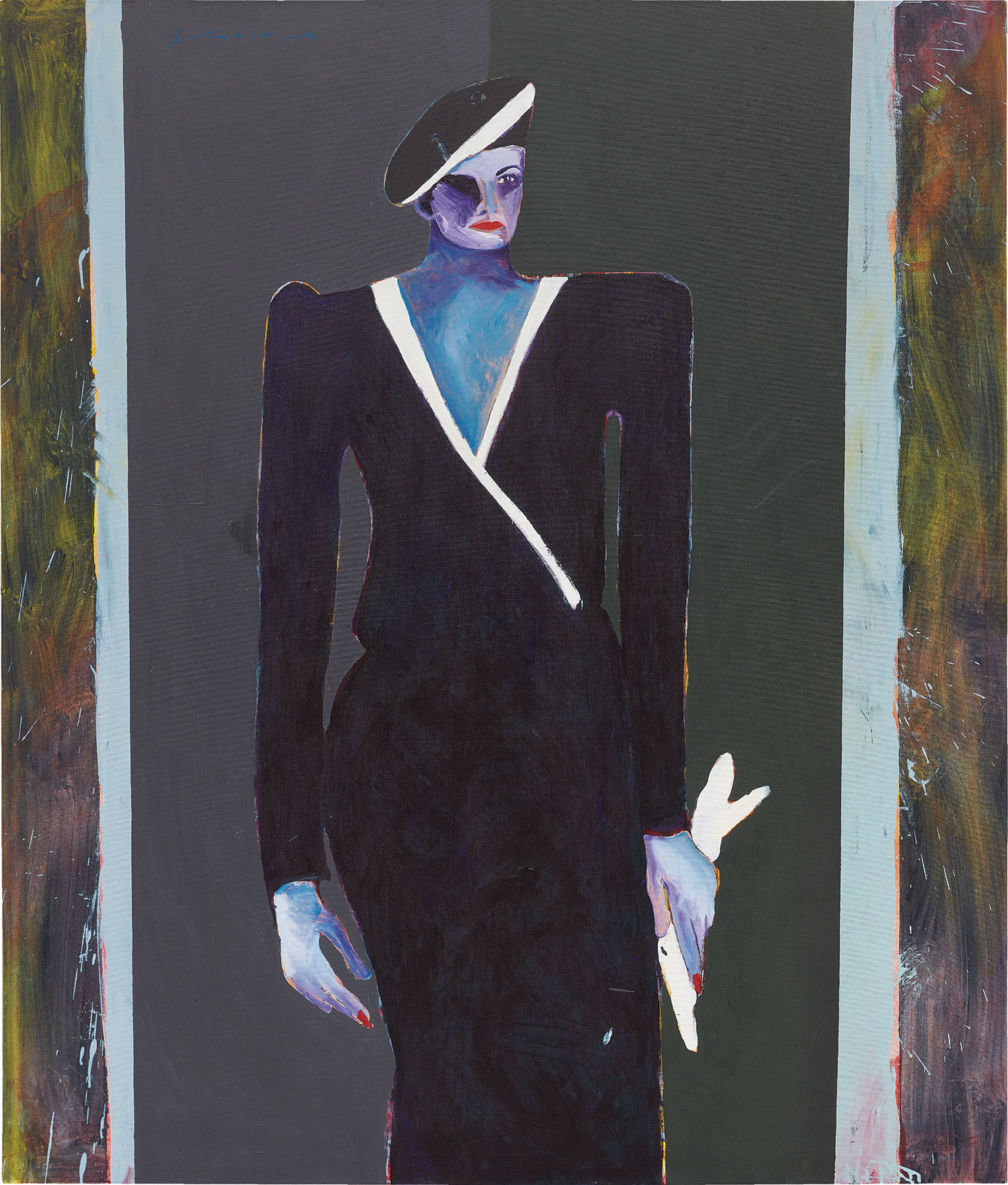
Entity No. 1
He famously declared that he would never paint a Native American, only to spend the next decade producing some of the most searching and powerful paintings of Native American subjects ever made. That tension, between refusal and obsession, became the engine of his entire practice. Scholder's artistic development owes its visual language to a remarkable set of influences that he synthesized into something entirely his own. The distorted, psychologically raw figures of Francis Bacon shaped his approach to the human body as a site of feeling rather than mere representation.
“I am not a Native American artist. I am an artist who happens to be part Native American.”
Fritz Scholder
Abstract Expressionism gave him permission to work with gestural freedom and chromatic intensity, while Pop Art sharpened his eye for irony and cultural critique. By the late 1960s and into the 1970s, he had arrived at his signature mode: large scale oil and acrylic canvases populated by monumental Native figures rendered in unnatural, electric colors, their faces often partially obscured or expressionistically blurred, their postures simultaneously regal and ruined, defiant and vulnerable. These were not noble savages for tourist consumption. They were human beings in full complexity.
Fritz Scholder
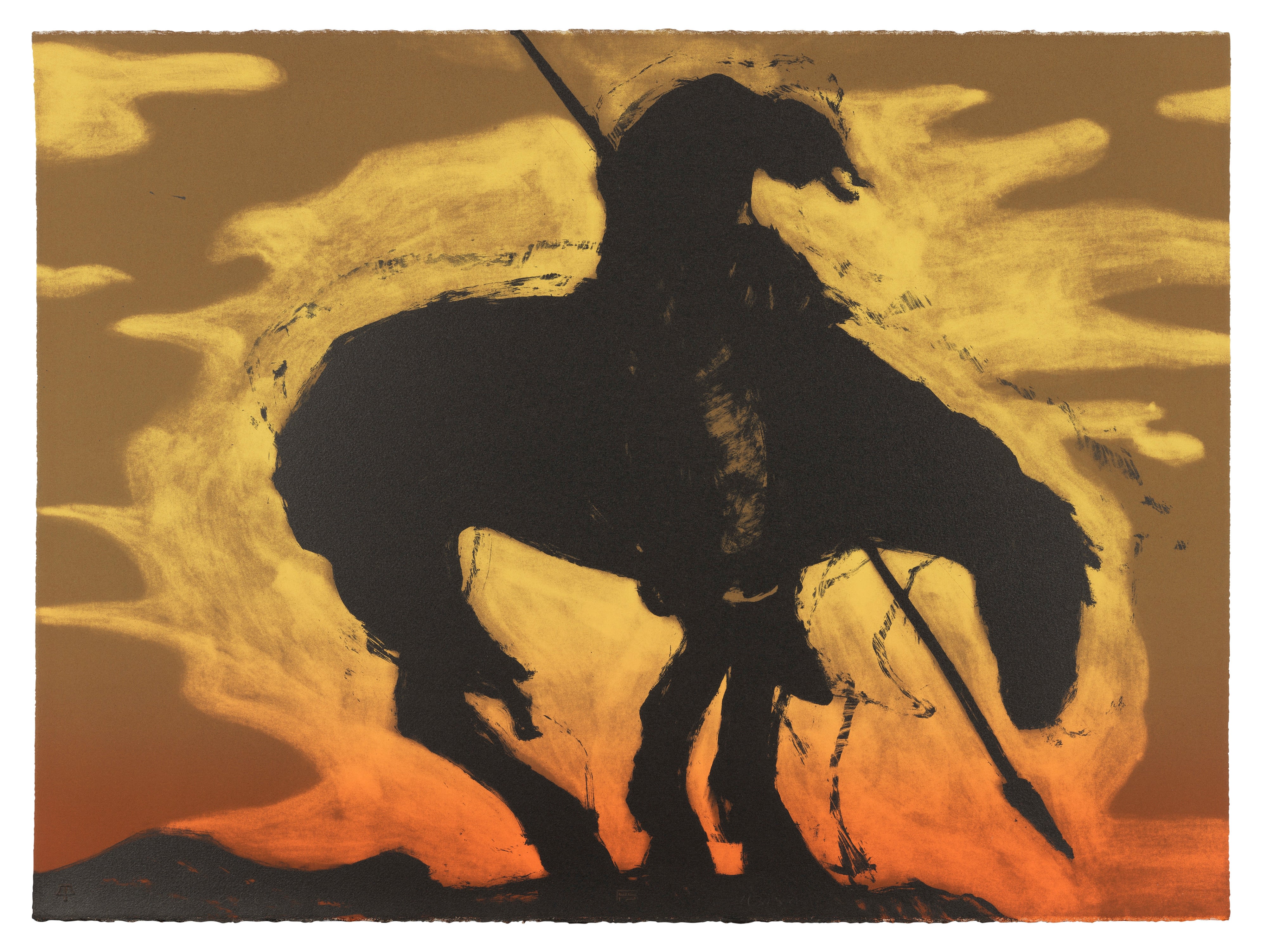
Indian Cliché (State III) (T. 78-634b)
Among his most celebrated works, Indian in a Pueblo Interior from 1970 stands as a defining statement of his early period. The painting draws on the visual codes of portraiture while subverting them entirely, placing a figure in a domestic interior rendered with a palette that feels almost hallucinatory. Super Kachina from 1976, executed in acrylic on canvas, demonstrates his mastery of scale and symbolic charge, invoking Hopi ceremonial imagery not as ethnographic document but as living, urgent presence. His extensive body of lithographs, produced in collaboration with master printers and published in editions on Arches Cover paper, brought his imagery to a broader audience and revealed his printmaking as a discipline in its own right rather than a secondary endeavor.
Works such as Indian with Beaded Sash from Suite Fifteen and Indian Cliche demonstrate how his graphic instincts translated the energy of his paintings into a more intimate register without any loss of force. For collectors, Scholder presents a compelling combination of art historical significance and genuine visual power. His works appear regularly at major auction houses, and his prints in particular offer strong entry points into a body of work that continues to appreciate in scholarly and market attention alike. Collectors drawn to his paintings often speak of an immediate physical impact before any intellectual engagement, a quality he shares with the great figurative painters of the twentieth century.
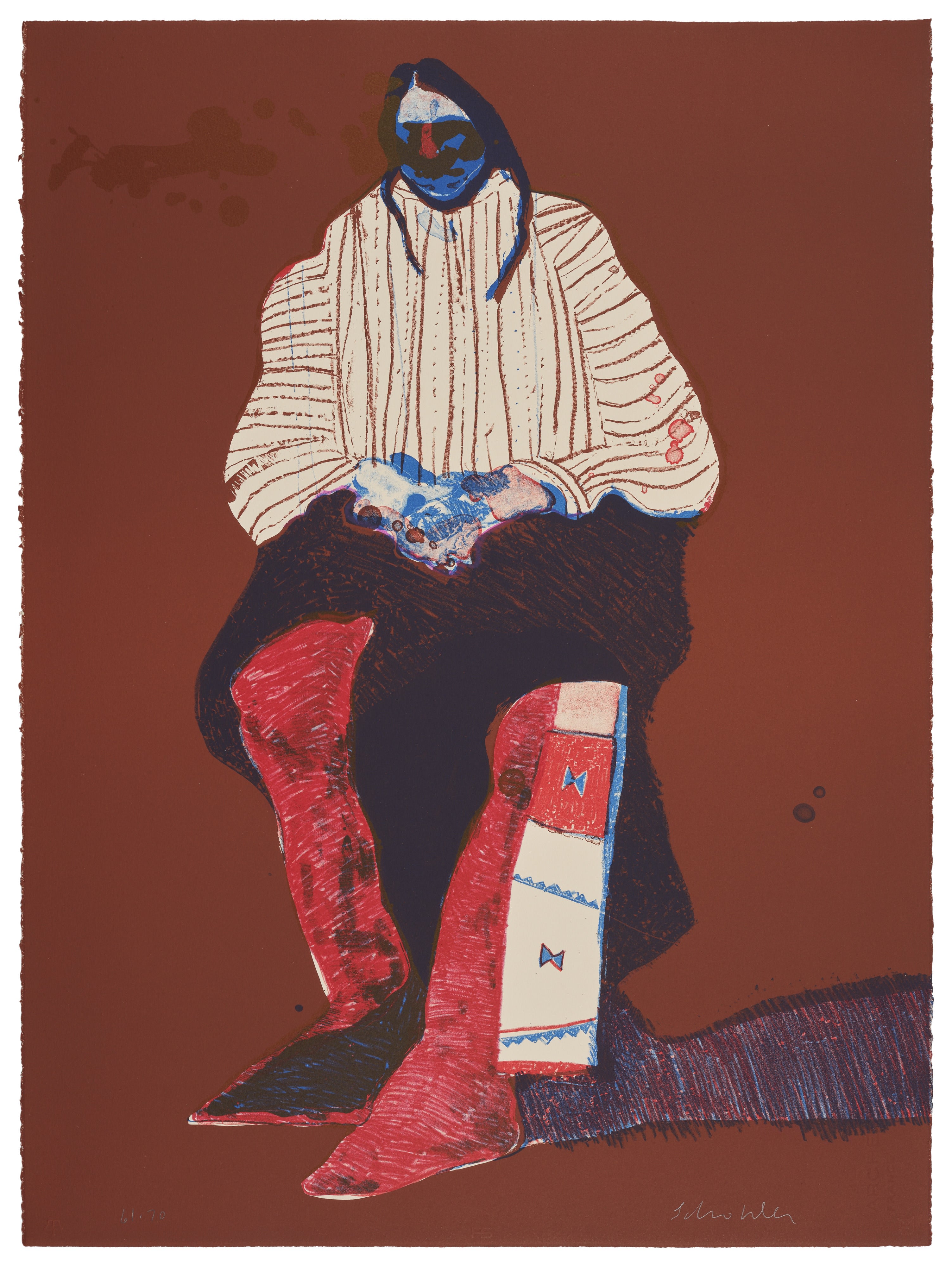
Fritz Scholder
Indian with Beaded Sash, from Suite Fifteen (T. 75-189)
When assessing works on the market, condition of the canvas support and the vibrancy of his characteristically intense palette are key considerations, as his use of unmodulated acrylic color is central to the works' psychological effect. His lithographs, particularly those produced in the 1970s with established print workshops, represent some of the most sought after multiples in the field of Native American modernism. Scholder exists in a constellation of artists who were rethinking figuration and identity in the second half of the twentieth century. His dialogue with Francis Bacon is unmistakable, but he also resonates strongly with the work of T.
C. Cannon, his former student, who shared his commitment to bold color and cultural confrontation. In a broader art historical frame, he belongs alongside artists like Jean Michel Basquiat and Leon Golub, painters who used the human figure as a vehicle for social and psychological truth rather than aesthetic comfort. His influence on subsequent generations of Native American artists has been enormous and freely acknowledged, from Jaune Quick to See Moore to Dyani White Hawk, who have all grappled with the legacy he created.
Fritz Scholder died in Scottsdale, Arizona, in 2005, but the questions his work poses have only grown more relevant with time. In an era of sustained reckoning with how Indigenous peoples are represented in cultural institutions, his paintings stand as early and radical interventions, made at a moment when such interventions were genuinely dangerous to an artist's career. He risked the disapproval of both the mainstream art world and Native American communities that sometimes found his imagery troubling or irreverent, and he made the work anyway. That courage, combined with the sheer visual intelligence on display across his canvases and prints, is what secures his place among the essential American artists of the twentieth century.
To encounter a Scholder is to understand that painting can be an act of liberation.
Explore books about Fritz Scholder
