François Morellet
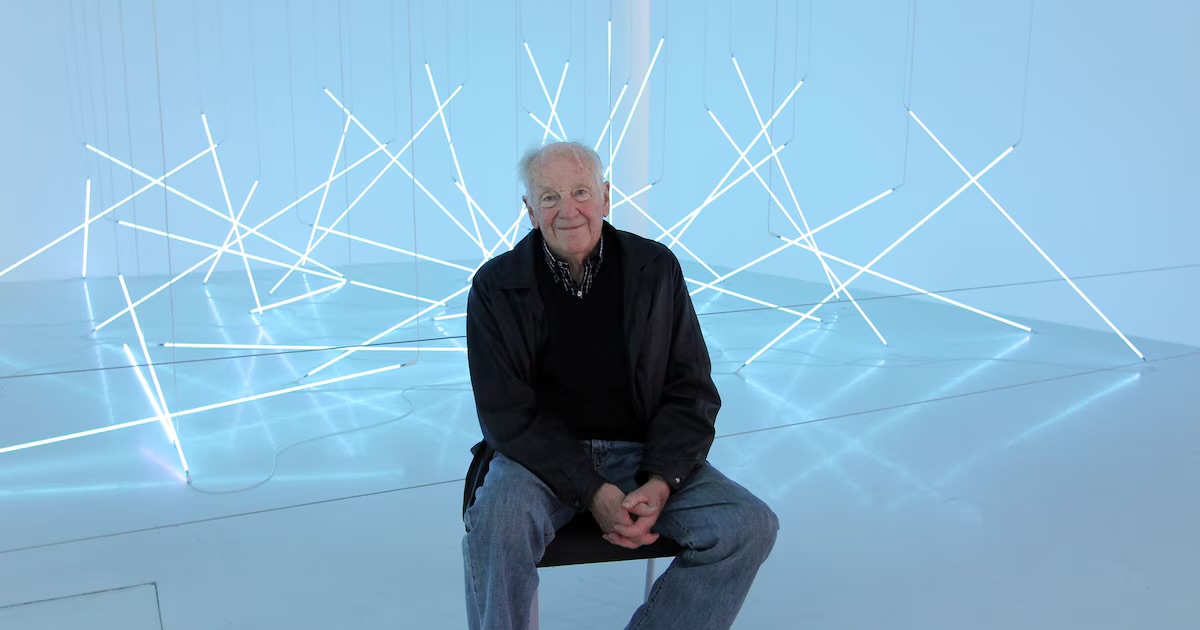
François Morellet, The Poet of Pure System
Artist Spotlight · The Collection Editorial
“I have always tried to reduce my own choices to a minimum, replacing them with systems.”
François Morellet, artist statement
In the grand atrium of the Centre Pompidou in Paris, there is a particular quality of light that seems to belong to François Morellet alone. His neon installations, commissioned across several decades for the museum's permanent collection, bend and angle through space with a calm intelligence that stops visitors mid step. It is a fitting tribute to a man who spent more than sixty years proving that rigorous logic and genuine beauty are not opposites, but the very same thing seen from different angles. Even now, years after his passing in 2016, the conversations his work ignites in galleries and auction rooms feel urgent, contemporary, and very much alive.
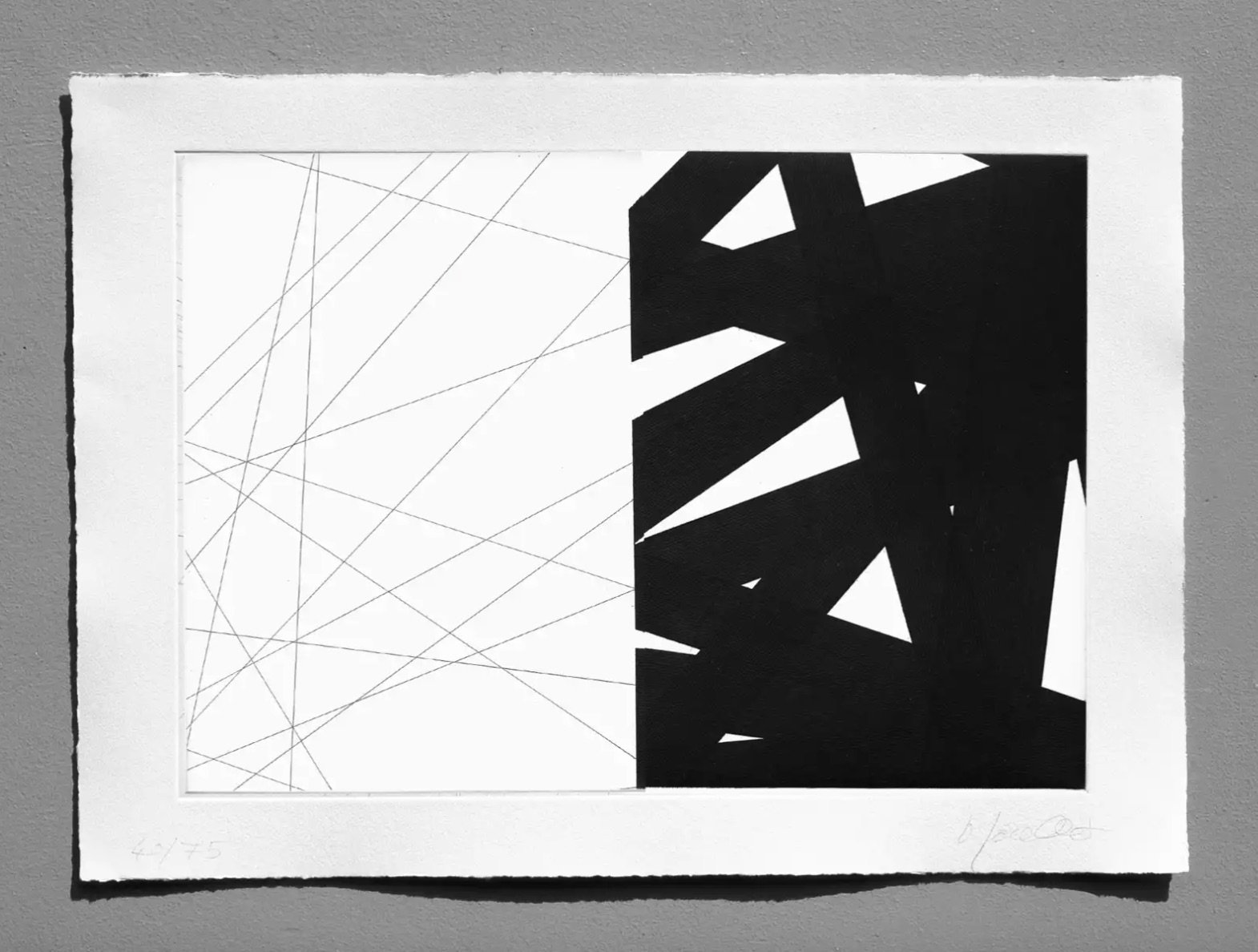
François Morellet
π striptyque, 2006
Morellet was born in 1926 in Cholet, a small industrial town in the Maine et Loire department of western France. It was not an obvious cradle for a radical abstractionist. He studied literature in Paris before returning home to help manage the family business, an enamelware factory, work that demanded precision, efficiency, and a kind of unsentimental clarity. Those qualities would become the signature of his entire artistic vision.
He began painting seriously in the late 1940s, and early canvases such as Paysage from 1947 show a young artist still finding his footing, working through figuration before geometry claimed him entirely. The decisive turn came in the early 1950s, when a visit to the São Paulo studio of Max Bill introduced Morellet to the possibilities of Concrete Art and mathematical structure as a basis for painting. Bill's conviction that art could be organized according to objective, reproducible principles resonated deeply. Morellet returned to France galvanized, and by the mid 1950s he was producing works governed entirely by predetermined rules, grids derived from numerical sequences, overlapping line systems, and configurations built from chance operations drawn from telephone directories or mathematical tables.
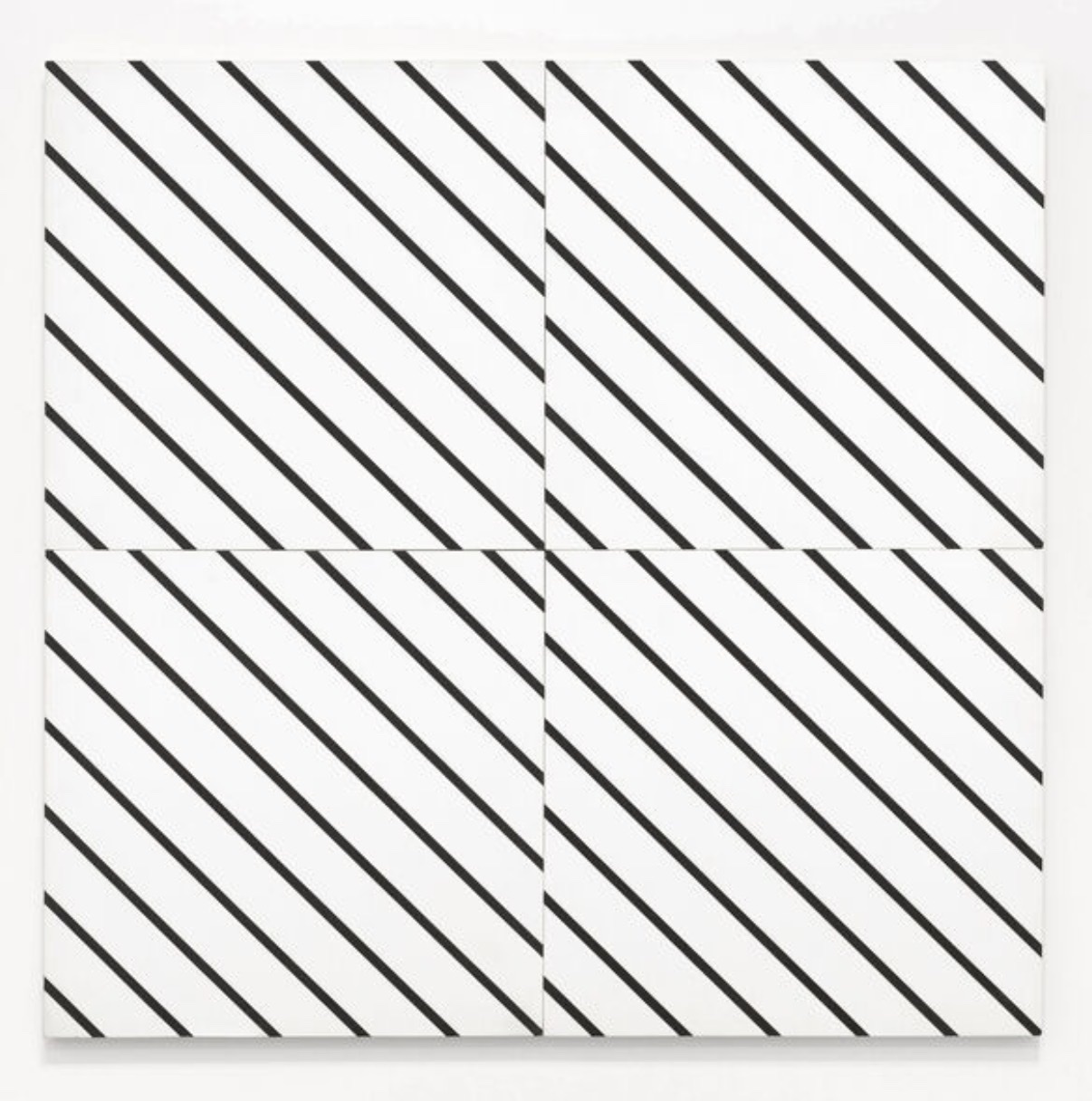
François Morellet
1 simple trame 45° coupée, décalée, 1973
The removal of personal gesture was not a rejection of expression but a redirection of it, placing the expressive burden on the system itself. In 1960, Morellet co founded the Groupe de Recherche d'Art Visuel in Paris alongside Julio Le Parc, Horacio Garcia Rossi, Francisco Sobrino, Joel Stein, and Jean Pierre Yvaral. The GRAV, as it became known, was a collective committed to demystifying the artist, to making art participatory, perceptual, and democratic. Their collaborative street happenings in Paris during the 1960s placed kinetic and optical experiences directly in the hands of the public, years before such ideas became fashionable.
“The fewer decisions I make, the more interesting the results.”
François Morellet, interview
Yet Morellet always maintained a quietly ironic distance from manifestos and movements, preferring to let the work make its own case. His signature vocabulary is immediately recognizable once encountered: superimposed grids of fine lines tilted at precise intervals, producing interference patterns that seem to vibrate and breathe; neon tubes arranged at mathematically defined angles that fill architectural space with cool luminous geometry; and trame works, those extraordinary layered mesh paintings that create chromatic depth through pure structural repetition. Works such as 4 doubles trames 0° 22.5° 50° 72.
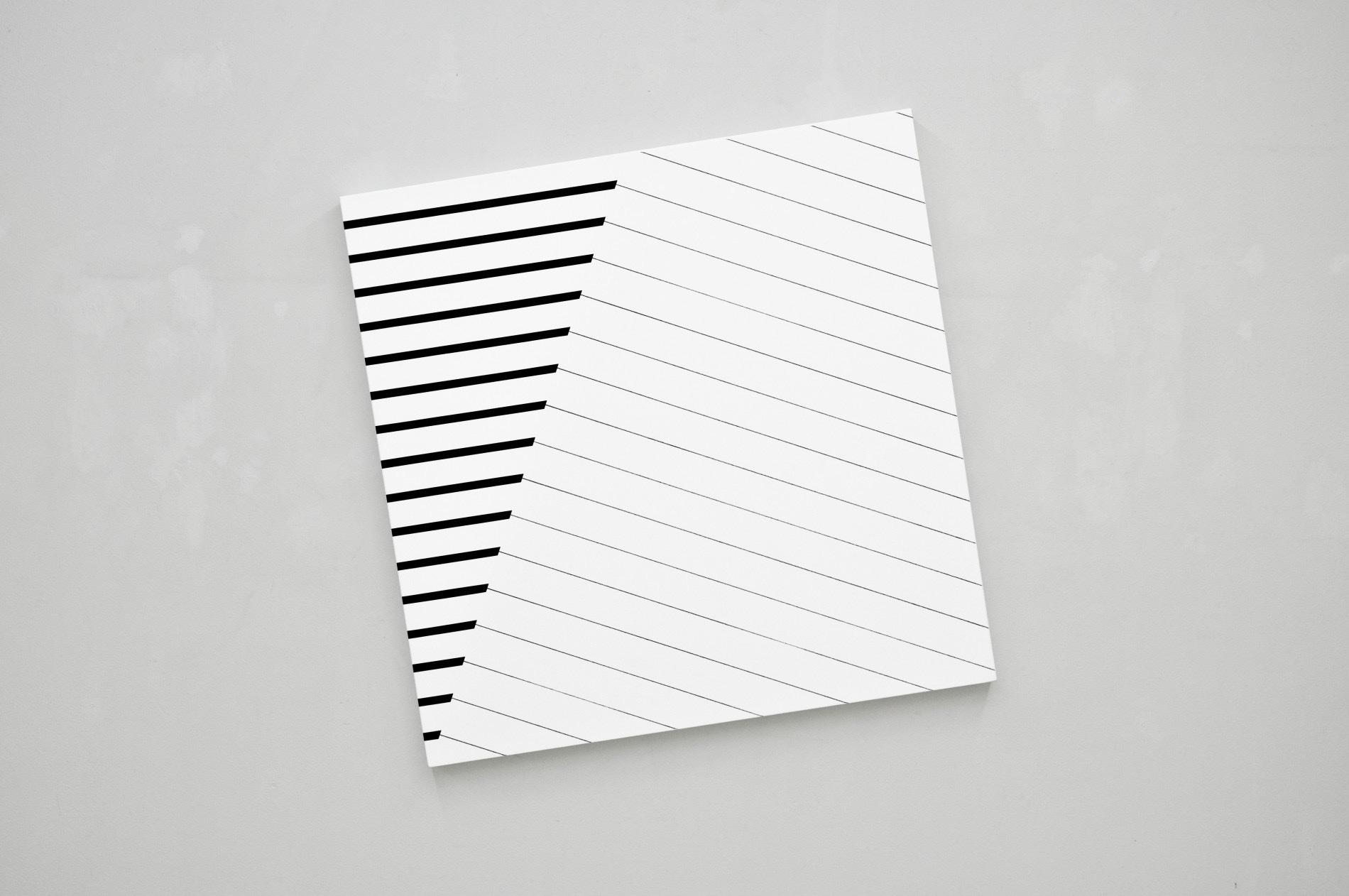
François Morellet
Untitled
5° and 2 trames 1° +1° demonstrate his mastery of optical tension, the way two nearly identical systems placed in slight misalignment generate something almost alive. The 1973 serigraphic work 1 simple trame 45° coupée, décalée, executed in four attached panels, shows how a single conceptual decision, cutting and offsetting a regular grid, can generate almost inexhaustible visual complexity. These are not cold objects. They reward sustained looking with something close to wonder.
The neon works represent perhaps the most beloved dimension of his practice among collectors and institutions alike. Neons 3D: 20° 90° 45° from 2014, in which acrylic on canvas meets three white neon tubes, captures the late period at its most refined, where light, surface, and angle conspire to make something that feels simultaneously architectural and intimate. The Centre Pompidou, the Musée d'Art Moderne de la Ville de Paris, the Museum of Modern Art in New York, the Tate in London, and the Stedelijk Museum in Amsterdam all hold significant examples of his work. Major retrospectives including a landmark showing at the Galerie nationale du Jeu de Paume in Paris in 2011 confirmed his place not at the margins of postwar abstraction but at its principled, generous center.
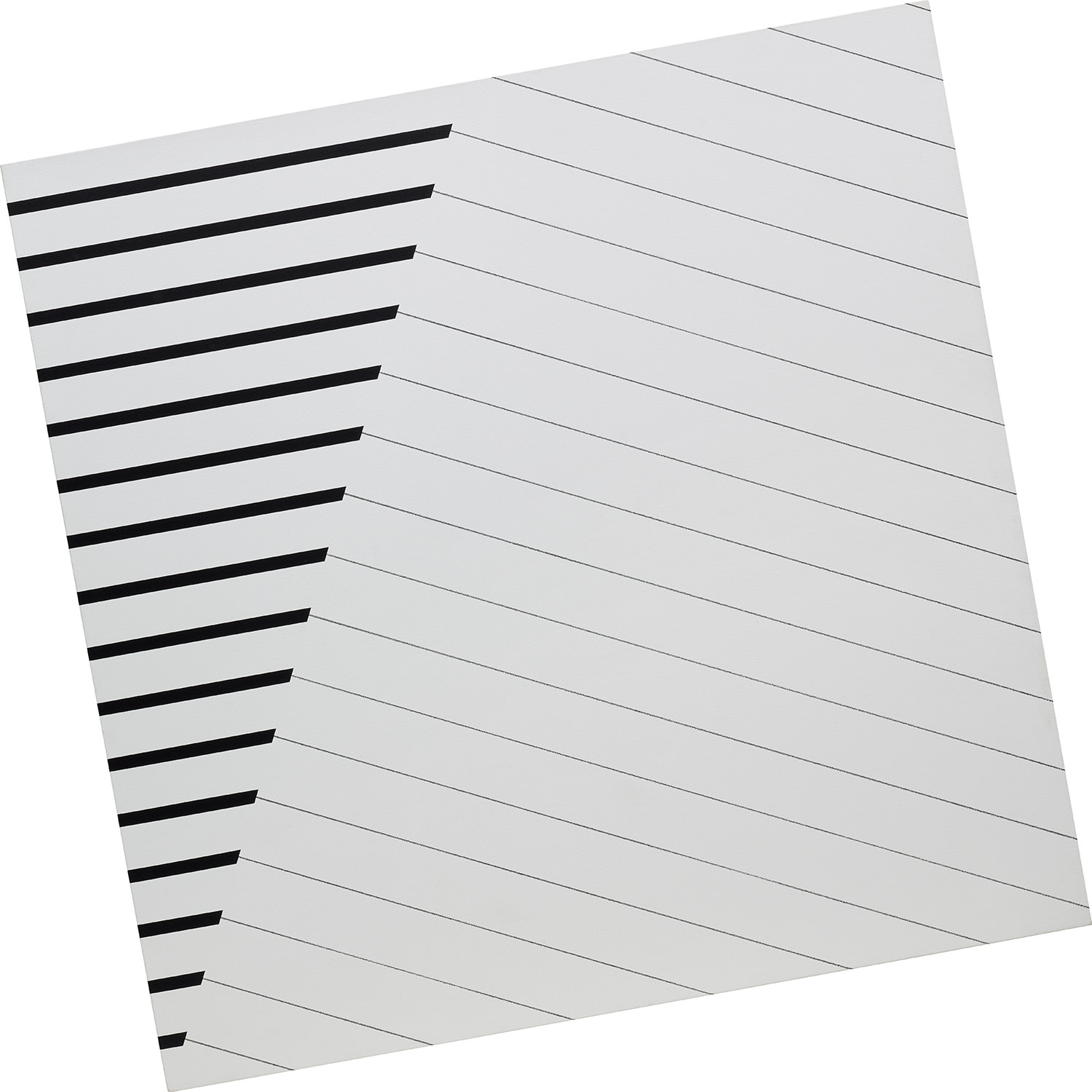
François Morellet
Confrontation n°1, 2015
For collectors, Morellet's market offers a rare combination of intellectual depth and genuine decorative power. His works span an extraordinary range in terms of medium, scale, and date, from intimate oil on wood panels from the 1950s and 60s through large scale neon installations and late paintings such as the pi striptyque of 2006, a work drawing on the irrational infinite sequence of pi as a compositional generator. The late work in particular, where Morellet allowed a loosening and even a gentle humor to enter compositions that had previously been strictly systematic, has attracted strong interest at auction. Works on paper and serigraphs offer a compelling entry point, while unique paintings and neon pieces represent the blue chip tier of the market.
Collecting Morellet is collecting a philosophy as much as an object, a reminder that constraint can be the most liberating force in art. Morellet's place in the broader map of twentieth century art is best understood alongside contemporaries such as Victor Vasarely, Bridget Riley, Sol LeWitt, and Richard Paul Lohse. Like Riley, he understood the retina as a collaborator rather than a passive receiver. Like LeWitt, he elevated the concept and the system to primary status while insisting that execution still mattered.
Like Vasarely, he believed optical experience could be a vehicle for genuine emotion. But Morellet had something distinct from all of them: a dry, affectionate wit that ran beneath every grid and angle. His titles are playful, his statements self deprecating, and his work, for all its mathematical rigor, always seems to be smiling slightly. François Morellet died in Cholet in May 2016, in the same town where he was born, having spent nine decades watching the world grow increasingly enamored with the kind of ordered uncertainty he had championed since the 1950s.
His influence on generations of artists working with systems, code, light, and perception is immeasurable and still unfolding. To live with a Morellet is to live with a question asked in the most elegant possible language, a question about what we see, how we see it, and why the difference between one degree and two degrees can feel, to a properly attentive eye, like the distance between stillness and music.
Explore books about François Morellet
François Morellet: A Life of Subversion
François Morellet
François Morellet
Bernar Venet
Morellet: Lumière, Forme, Mouvement
Musée d'Art Moderne et d'Art Contemporain de Liège
François Morellet: Systèmes
Jean-Paul Ameline
Morellet: Works and Projects
François Morellet, Georges Boudaille
François Morellet: Retrospective
Musée National d'Art Moderne