Frank Stella
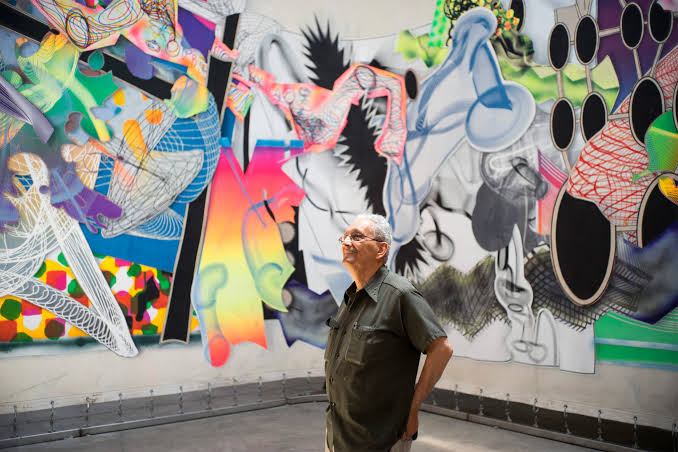
Frank Stella: The Shape of Pure Possibility
Artist Spotlight · The Collection Editorial
“What you see is what you see.”
Frank Stella, interview with Bruce Glaser, 1966
When the Museum of Modern Art mounted its landmark retrospective of Frank Stella's work in 2015, the sheer ambition of the installation stopped visitors in their tracks. Spanning six decades of relentless reinvention, the exhibition confirmed what the art world had long understood: Stella was not simply a painter who evolved, but an artist who rebuilt the very premises of painting from the ground up, again and again, with the confidence of someone who believed absolutely in the transformative power of form. His passing in May 2024 at the age of eighty seven brought an outpouring of remembrance from museums, collectors, and fellow artists across the globe, a testament to a career that had never stopped surprising. Frank Stella was born in 1936 in Malden, Massachusetts, into a family that valued education and discipline.
Frank Stella
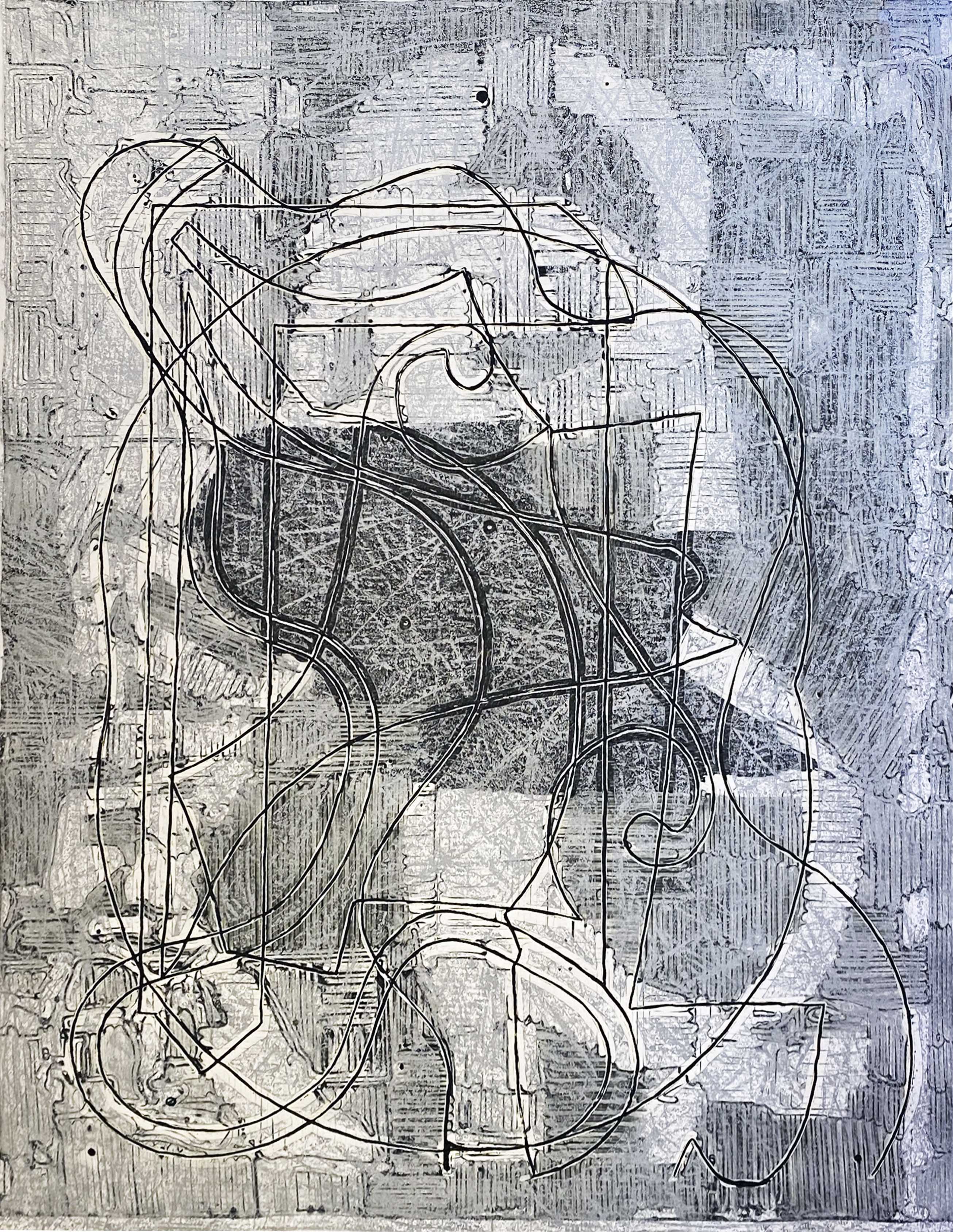
Imola Three, I (from the Circuits Series), 1982
His father was a physician, and Stella grew up with a rigorous, analytical cast of mind that would later manifest in the almost architectural logic of his compositions. He studied history at Princeton University, where he encountered the Abstract Expressionist work being made in New York and felt the full gravitational pull of contemporary painting. Princeton was not a fine arts school in the conventional sense, but its intellectual rigor suited Stella well, sharpening his instinct to think through problems rather than simply feel his way through them. When he arrived in New York City in 1958, he was twenty two years old and ready to argue with every assumption the art world held dear.
The argument Stella made in those first years was so clear and so radical that it reshaped American art almost immediately. His Black Paintings, produced between 1958 and 1960, were a direct rebuke to the gestural emotionalism of Abstract Expressionism. Using commercial black enamel applied in regular, parallel stripes separated by thin lines of bare canvas, Stella created works of extraordinary austerity and intellectual force. The stripe patterns followed the shape of the canvas itself, a principle that would become one of the defining ideas of his career and of Minimalism as a movement.
Frank Stella
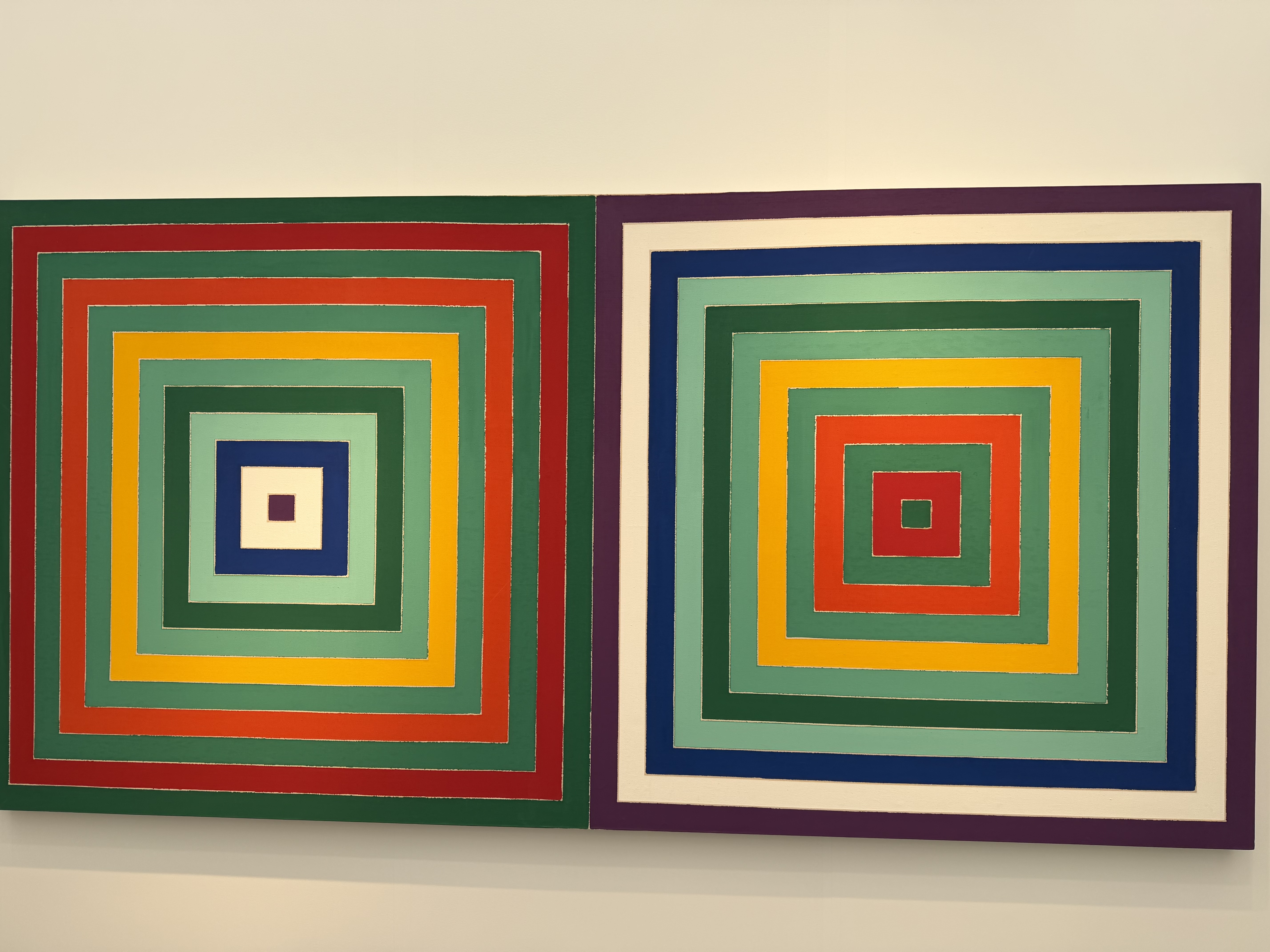
Scramble: Green Double/ Left N, Right 8, 1977
When four of the Black Paintings appeared in MoMA's Sixteen Americans exhibition in 1959, Stella was barely twenty three, and he was already changing the conversation. What followed was not consolidation but perpetual expansion. Through the 1960s, Stella pursued his investigation of the shaped canvas with extraordinary consistency and variety, moving through his Aluminum, Copper, and Notched V series. These works introduced color and more complex geometries while maintaining the essential logic of the stripe following the canvas edge.
“I always get into arguments with people who want to retain the old values in painting, the humanistic values that they always find on the canvas.”
Frank Stella, interview with Bruce Glaser, 1966
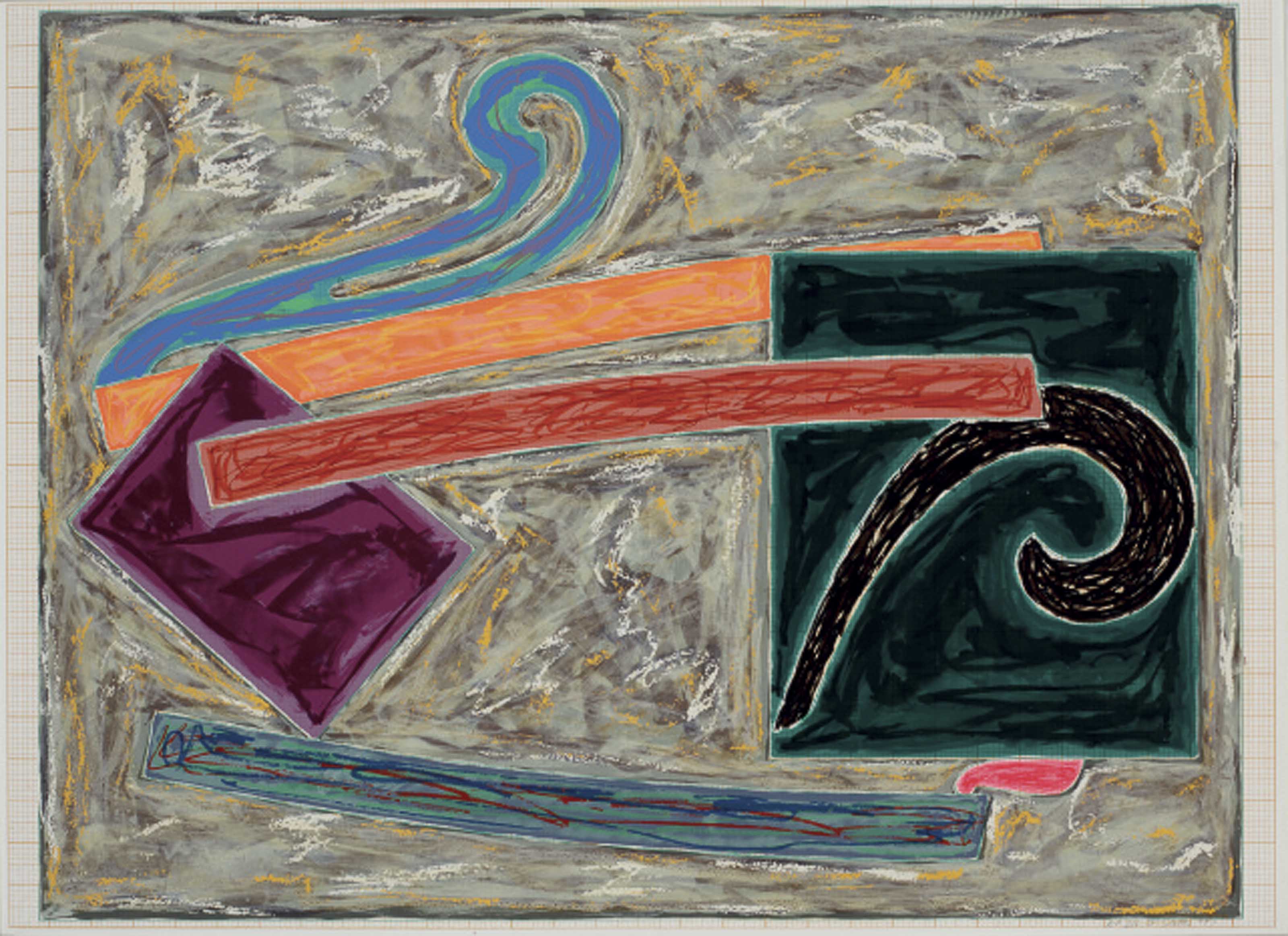
Then, in the 1970s, something shifted. The Polish Village series and the Brazilian series introduced collage, relief, and raw materials into Stella's vocabulary, and the work began to push physically off the wall. By the time he unveiled his Exotic Bird series in 1977, the flat plane of the canvas had become a launching pad for something closer to sculpture, the forms swirling and projecting outward with an exuberance that seemed to contradict everything the early Black Paintings had stood for. Yet the underlying logic remained: the work was always about the physical facts of its own making.
Frank Stella
Inaccessible Island Rail from Exotic Bird Series, 1977
The 1980s brought the Circuits series, named after famous racing tracks including Imola and Talladega, in which Stella combined engraving, etching, and relief printing on handmade paper to produce works of extraordinary complexity and visual richness. Imola Three I from 1982, one of the most admired works in this body of work, exemplifies the period's ambition: layers of mark and color coexist with structural clarity, the composition simultaneously chaotic and controlled. The Circuits works represent Stella at his most synthetic, drawing on everything he had learned about printmaking, from screenprint to lithography to etching, and deploying it all at once. His collaborations with master printers at Gemini G.
E.L. in Los Angeles were particularly fruitful, producing editions that collectors have prized for decades both for their technical brilliance and for the way they document Stella's thinking in real time. For collectors, Stella's work offers a remarkable range of entry points and a deep, well documented market.
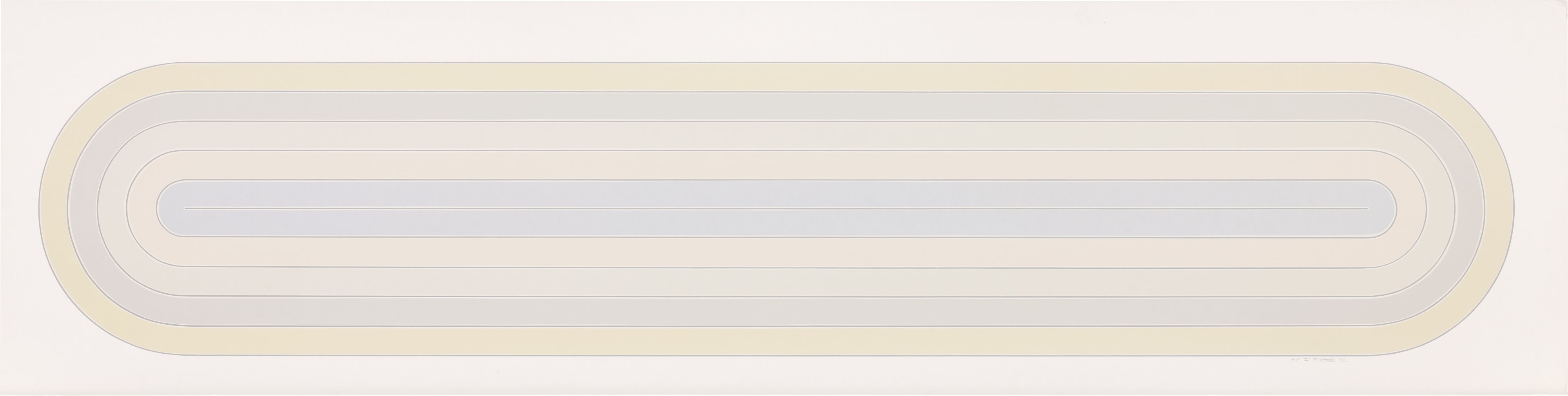
Frank Stella
Del Mar, from Race Track Series (G. 377, A. 73)
His prints and works on paper, including the celebrated Exotic Bird series of 1977 and the Double Gray Scramble screenprints, have long been among the most actively traded examples of American postwar printmaking. These works combine accessibility in scale with the full intellectual weight of Stella's ideas, making them favorites among both new collectors and established institutions. The paintings, particularly those from the Black Paintings and the shaped canvas series of the 1960s, command major prices at auction and are held by the world's leading museums, from MoMA and the Whitney to the Tate and the Pompidou. What draws collectors to Stella consistently is the sense of certainty his work projects: these are objects made by someone who knew exactly what he was doing and why, and that conviction reads as powerfully today as it did sixty years ago.
Stella belongs to a generation of American artists that includes Donald Judd, Carl Andre, and Dan Flavin, all of whom were working through the implications of Minimalism in the early 1960s. But while Judd eventually abandoned painting altogether and Andre moved into pure floor sculpture, Stella kept painting at the center of his practice and used it as a vehicle for ever greater complexity. In this sense he is as close to the Neo Expressionists of the 1980s as he is to the Minimalists, and his willingness to absorb influence from architecture, engineering, and even Baroque decoration gives his late work a richness that places him in dialogue with artists as different as Caravaggio and Rauschenberg. His career resists easy categorization, which is part of what makes it so consistently generative for scholars and collectors alike.
Frank Stella's legacy is the legacy of a mind that refused to stop questioning. He gave painters permission to think structurally, to treat the canvas as an object rather than a window, and to follow an idea wherever it led regardless of whether the destination looked like what had come before. His influence runs through generations of abstract painters, printmakers, and sculptors who have internalized his lesson that what you see is what you get, and that this is not a limitation but a liberation. To live with a Stella is to live with a work that continues to think, to press against its own edges, to insist that form is never finished asking what it can become.
Explore books about Frank Stella
Frank Stella
Carl Andre
Frank Stella
William S. Rubin
Frank Stella: 1970-1987
Barbara Rose

Frank Stella: A Retrospective
Michael Plante
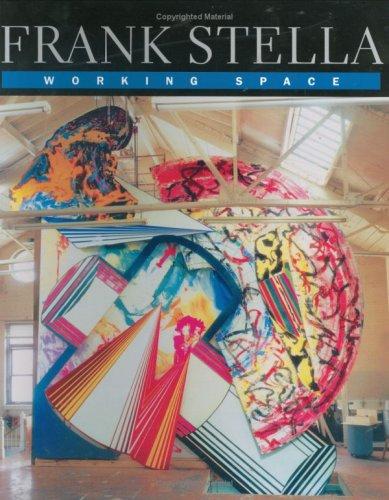
Working Space
Frank Stella

Frank Stella
Paul Moorhouse
Frank Stella: Prints, A Catalogue Raisonné
Richard V. West
Frank Stella
Robert Rosenblum