François Pompon
François Pompon, Master of the Essential Form
Artist Spotlight · The Collection Editorial
There are moments in art history when a single sculpture in a single room changes everything. At the 1922 Salon d'Automne in Paris, François Pompon, then sixty seven years old, unveiled his monumental Ours blanc to a public wholly unprepared for its radical serenity. The great white bear, smooth as a river stone and utterly self possessed, stood apart from the crowded gallery like a creature from another world. Overnight, a man who had spent decades as an assistant to others became one of the most celebrated sculptors in France.
François Pompon
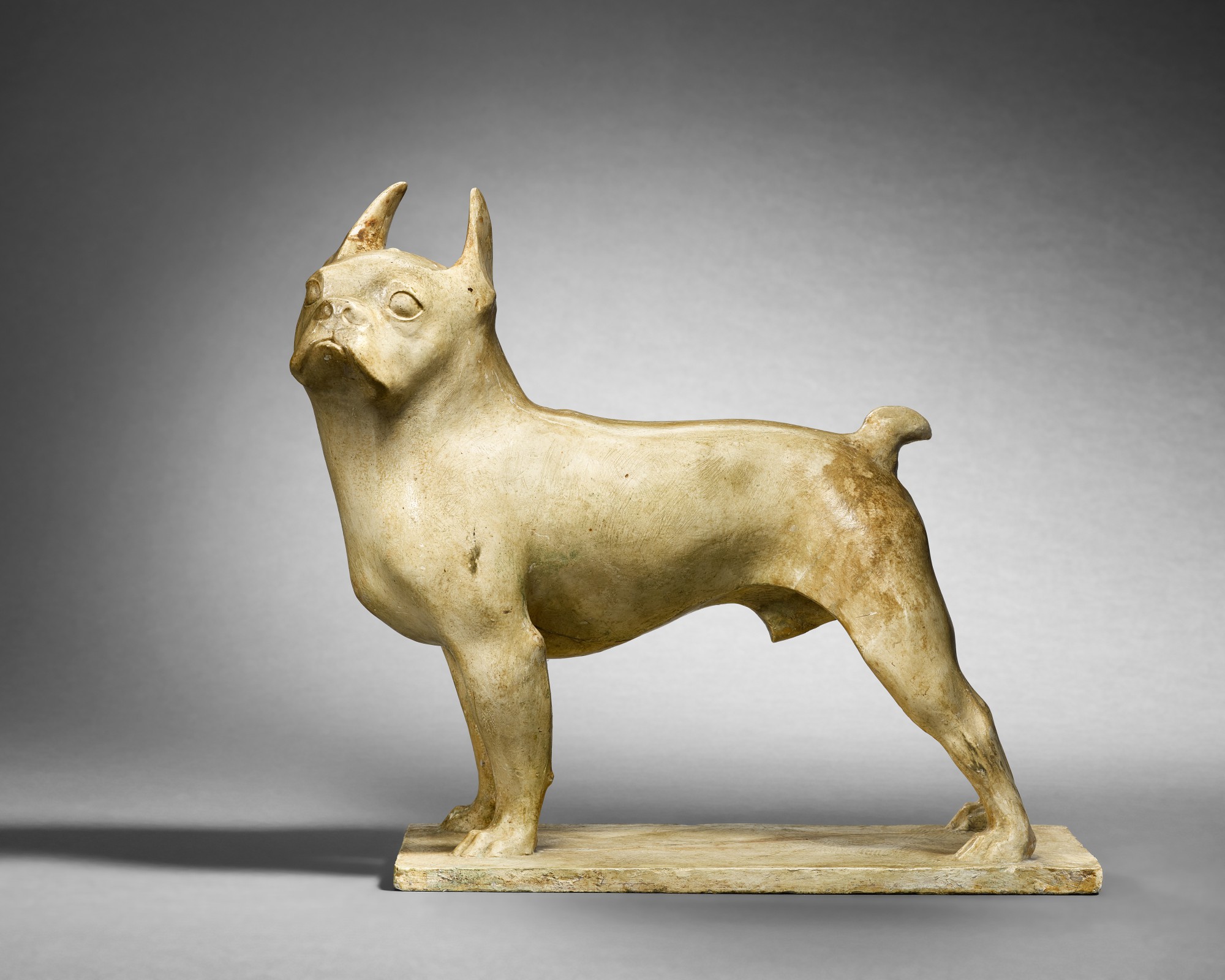
Boston Terrier, 'Toy', chien de Madame Georges Menier, 1931
It was a triumph long in the making, and one of the most moving late bloomings in the history of modern art. Pompon was born in 1855 in Saulieu, a small town in the Burgundy region of France, the son of a cabinetmaker. His early formation was deeply practical, shaped by a respect for material and craft that never left him. He trained as a stonecutter and marble carver in Dijon before making his way to Paris, where he enrolled at the École des Beaux Arts and began the slow, disciplined ascent through the ranks of academic sculpture.
Burgundy itself, with its rolling landscapes and working farms, left an impression that would resurface throughout his career in his tender attentiveness to the animal world. For much of his adult life, Pompon worked in the shadows of greater reputations. He served as a praticien, the skilled craftsman who translates a sculptor's plaster model into stone or marble, for Auguste Rodin and later for Camille Claudel. These were years of extraordinary proximity to genius, and while the work was often unglamorous, it gave Pompon an unparalleled understanding of material, surface, and form.
François Pompon
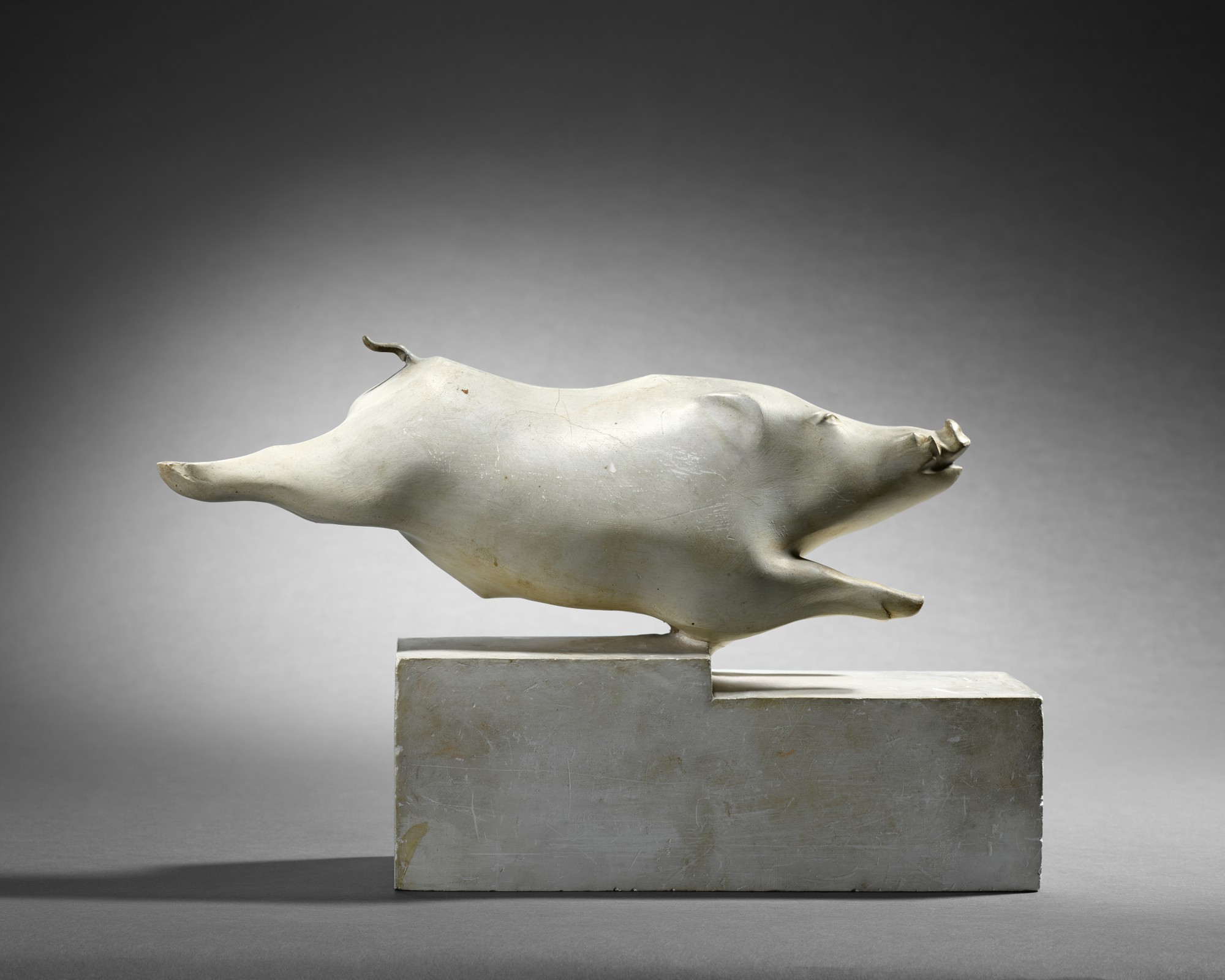
Sanglier, 1926
He absorbed Rodin's lessons about movement and presence, but his own artistic instincts were pulling him in a very different direction, away from turbulent surfaces and psychological drama and toward something quieter, cleaner, and more essential. The breakthrough that came with Ours blanc was not an accident but the culmination of decades of patient observation and formal experimentation. Pompon was a devoted visitor to the Jardin des Plantes in Paris, the great natural history garden where living animals could be observed at close quarters. He filled sketchbooks with studies of big cats, bears, birds, and domestic animals, watching the way weight shifted through a resting body or tension gathered before a movement.
What distinguished his mature work was his decision to strip away everything incidental, the texture of fur, the fussy anatomical detail, the anecdotal gesture, and to arrive instead at the living, breathing core of each creature. The result was a body of sculpture unlike anything being made in France at the time. Among the works that demonstrate the full range of Pompon's achievement, the Sanglier of 1926 is a particularly revealing example. The wild boar is rendered with a compact, almost geological solidity, its body a series of interlocking volumes that feel inevitable rather than constructed.
François Pompon
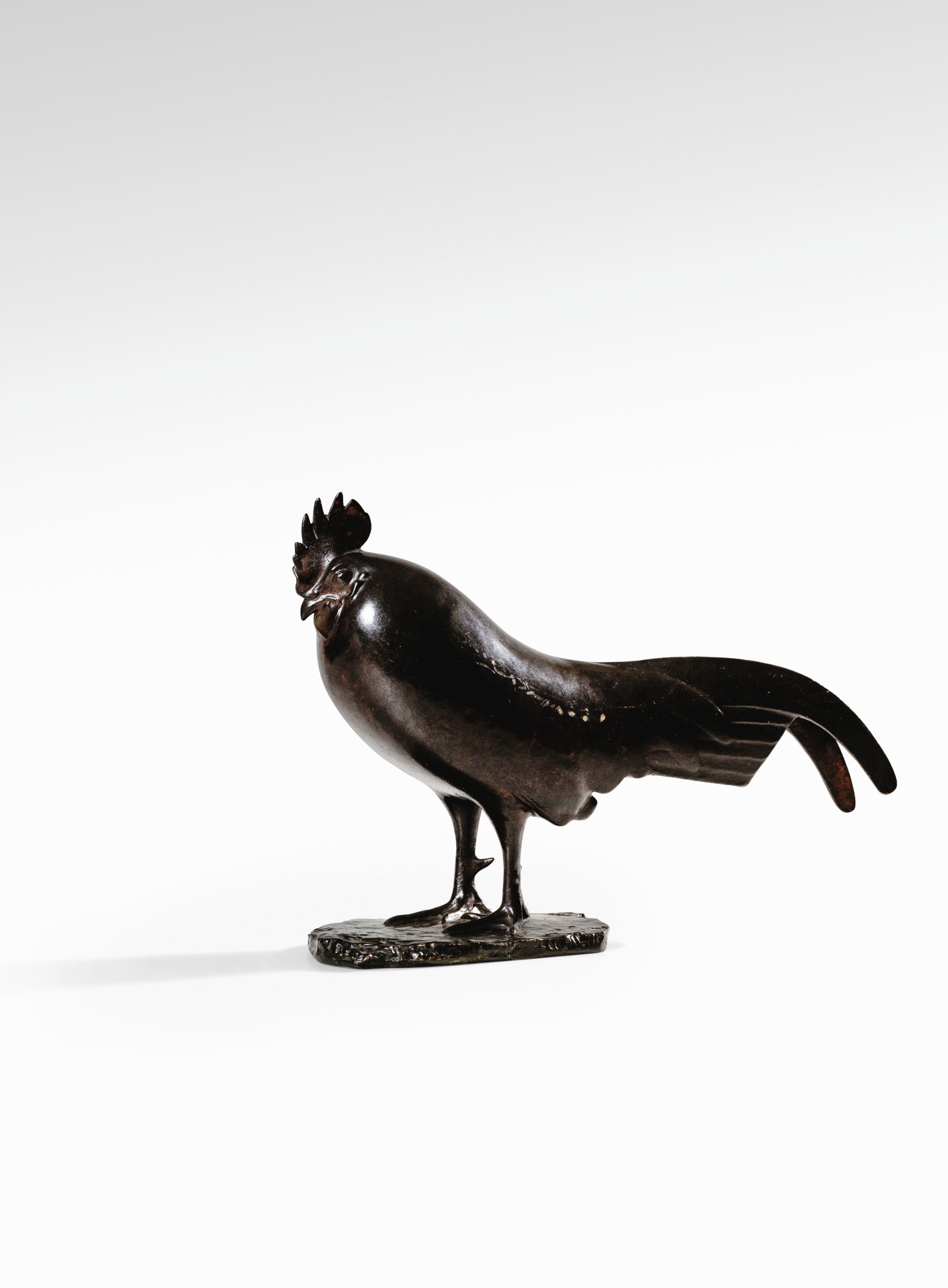
Coq dormant
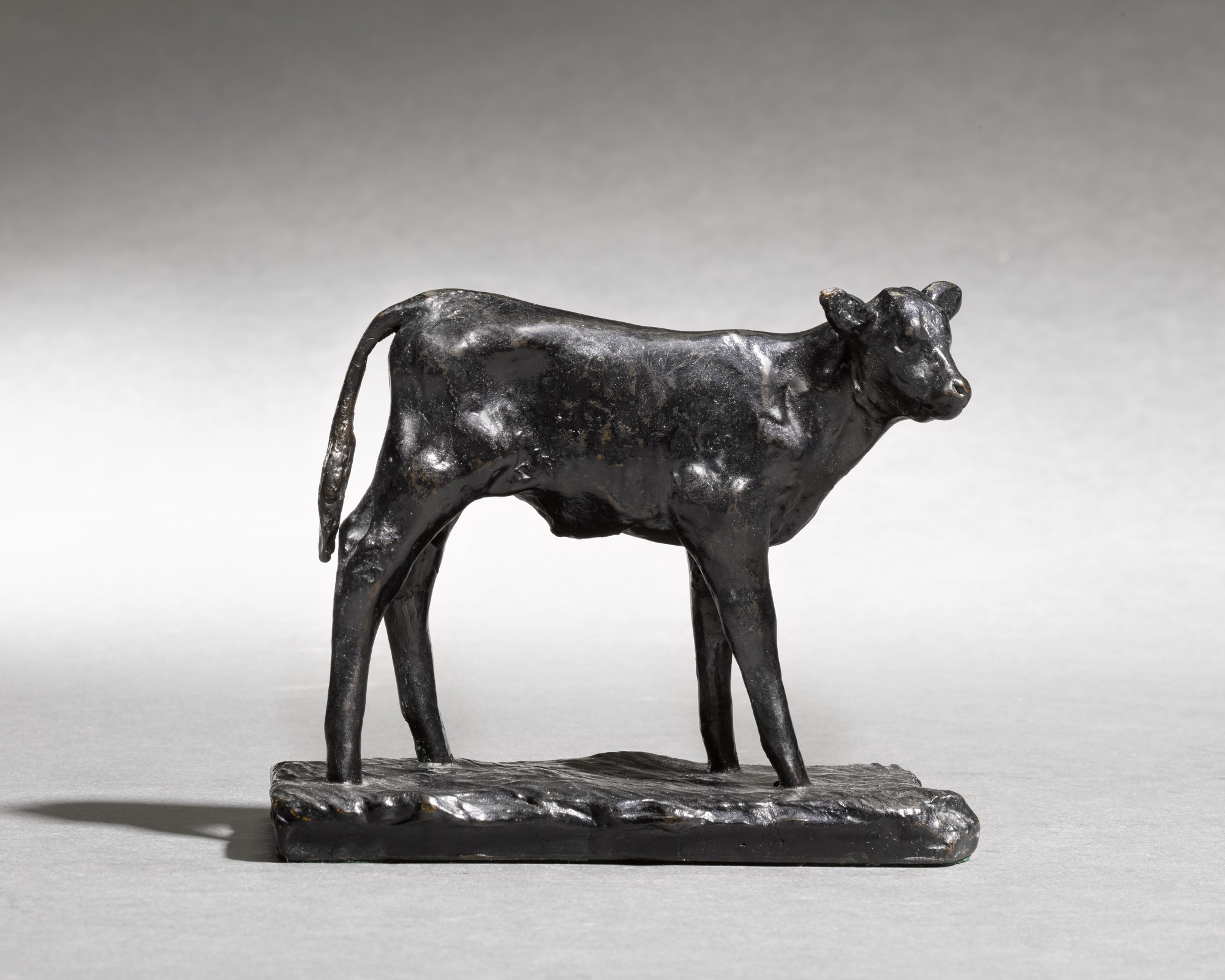
The Coq dormant, a sleeping rooster in patinated bronze, achieves something close to a paradox: it is entirely still and yet unmistakably alive. The Petite panthère noire, oreilles couchées of 1924 is perhaps his most psychologically charged work, the flattened ears and lowered head suggesting coiled concentration rendered in a surface of deep blue and black that seems to absorb light rather than reflect it. The Génisse of 1909, an early bronze, shows Pompon already moving toward his signature economy of means, the young heifer occupying its own space with a quiet authority. And in the Ours blanc, tête of 1930, a study of the great bear's head alone, one can see the sculptor returning to his most iconic subject to extract something even more concentrated and profound from it.
From a collecting perspective, Pompon occupies a position of considerable interest and genuine opportunity. His work bridges two worlds that collectors tend to prize separately: the rigorous craft tradition of the French academic school and the clean, forward looking formal language of early modernism. His sculptures sit comfortably in dialogue with the best of twentieth century decorative arts and design, and they hold their presence with authority in both intimate domestic settings and larger institutional spaces. Bronze editions in particular, especially those with fine, well preserved patinas, represent the core of the market.
François Pompon
Génisse, 1909
Works with provenance tracing back to the artist's lifetime or to early French collections carry a premium. Collectors drawn to the intersection of sculpture, nature, and modernist abstraction often find Pompon to be the artist who synthesizes those interests most elegantly. To understand Pompon fully, it helps to place him in a broader constellation of artists working at the intersection of the natural world and modern form. Rembrandt Bugatti, his contemporary, brought a similarly passionate attention to animal subjects, though with a more expressionist energy.
Paul Jouve, the great painter and sculptor of exotic animals, shared Pompon's commitment to the Jardin des Plantes as a studio and source. Further afield, the German sculptor August Gaul pursued related concerns with domesticated and wild animals rendered in a language of monumental simplicity. What sets Pompon apart from all of them is the particular quality of his stillness, an almost meditative quality that feels, in retrospect, more closely aligned with Brancusi than with any of his direct contemporaries. Pompon died in 1933, just over a decade after his spectacular public vindication at the Salon d'Automne, but the work he produced in those final years is some of the most assured sculpture made anywhere in Europe in the early twentieth century.
His legacy has proven remarkably durable. Major institutions including the Musée d'Orsay in Paris hold significant holdings of his work, and the Musée François Pompon in his native Saulieu preserves both sculptures and the memory of the man himself. For collectors and lovers of modern art, engaging with Pompon is an act of recognition: here is an artist who, through patience, devotion, and singular clarity of vision, found the still point at the center of the living world and made it permanent in bronze and stone.
Explore books about François Pompon