Francis Seymour Haden
Francis Seymour Haden, Master of Light and Shadow
Artist Spotlight · The Collection Editorial
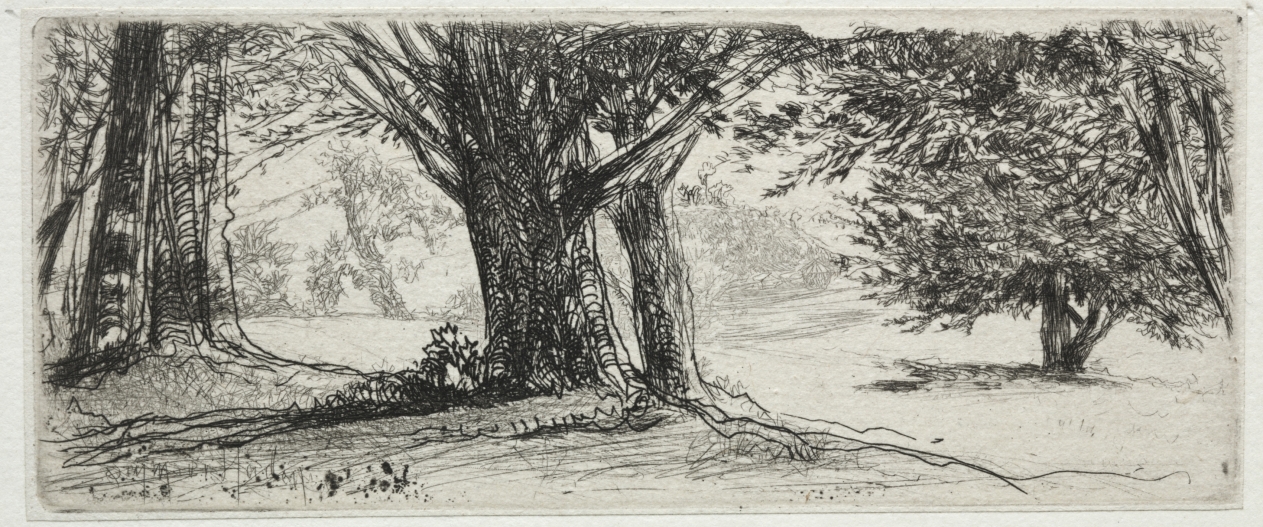
There is a moment, standing before one of Francis Seymour Haden's finest etchings, when the distinction between land and atmosphere seems to dissolve entirely. The Somerset millponds, the Irish riverbanks, the quiet glades of Kensington Gardens all rendered with a directness and physical intimacy that feels, even now, astonishing in its confidence. Haden was a man who worked outdoors, who pressed copper plates against his knee in the open air, who believed that printmaking could carry the same urgent truth as drawing itself. To encounter his work today is to understand that the great flowering of British etching in the Victorian era had, at its very center, a singular and formidably original intelligence.
Francis Seymour Haden
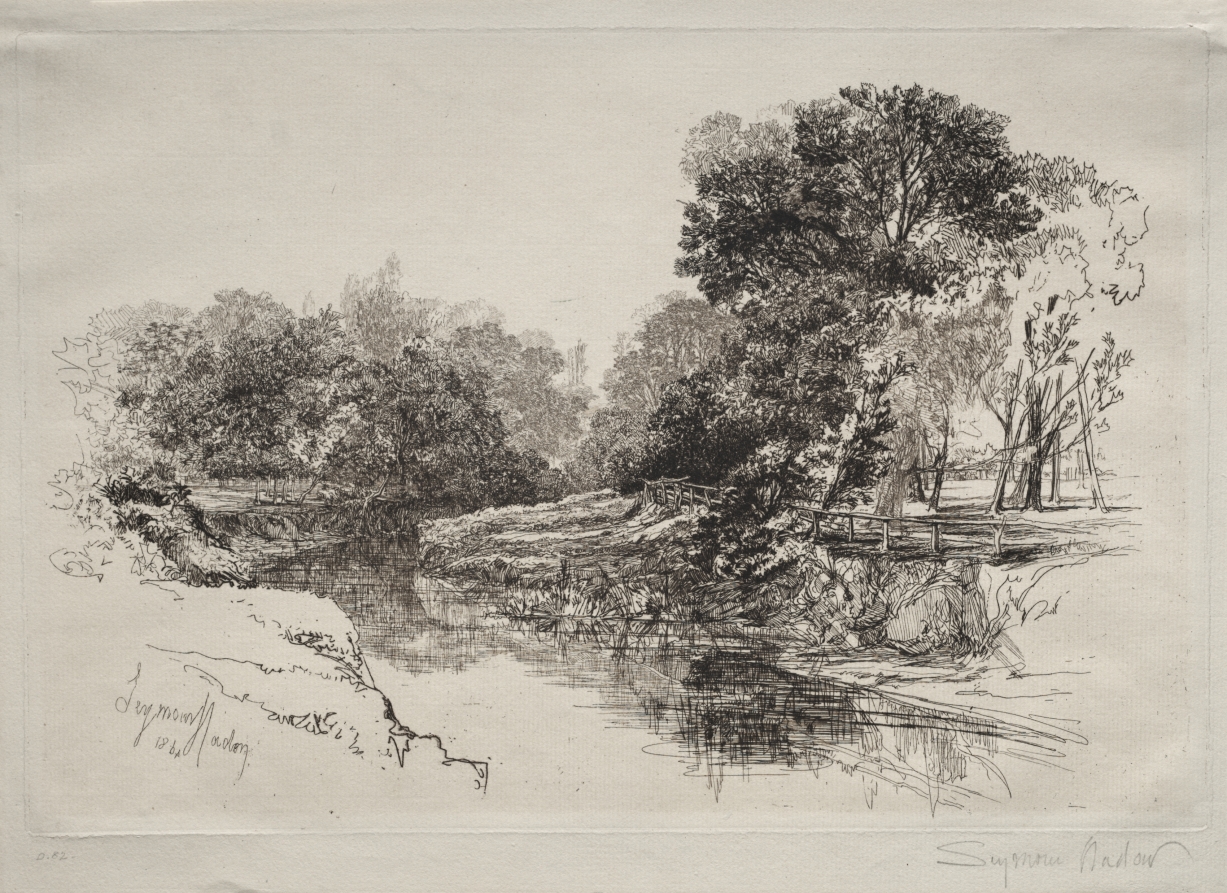
A River in Ireland, 1864
Francis Seymour Haden was born in London in 1818, into a world of professional respectability and cultivated taste. He trained and practiced as a surgeon, eventually achieving considerable distinction in that field, and the precision and analytical calm of the medical eye never fully left his art. Yet Haden was also a man of deep aesthetic passion, shaped by travel in Europe, by an intimate knowledge of Rembrandt and the Dutch etching tradition, and by a circle of friends and family that placed him at the very heart of the mid Victorian avant garde. His brother in law was James McNeill Whistler, and though the two men eventually fell into bitter estrangement, their early exchanges were enormously productive, each sharpening the other's ambitions and expanding the conversation around what a modern print could be and do.
Haden came relatively late to etching as a sustained practice. He had dabbled in his youth, but it was not until the 1850s and into the 1860s that his engagement with the medium became serious, prolific, and visionary. What distinguished him from the outset was a commitment to working directly from nature, en plein air, at a time when most printmakers labored in the studio from drawings or memory. He carried his plates into the field, worked quickly and responsively, and allowed the landscape to dictate the terms of the image.
Francis Seymour Haden
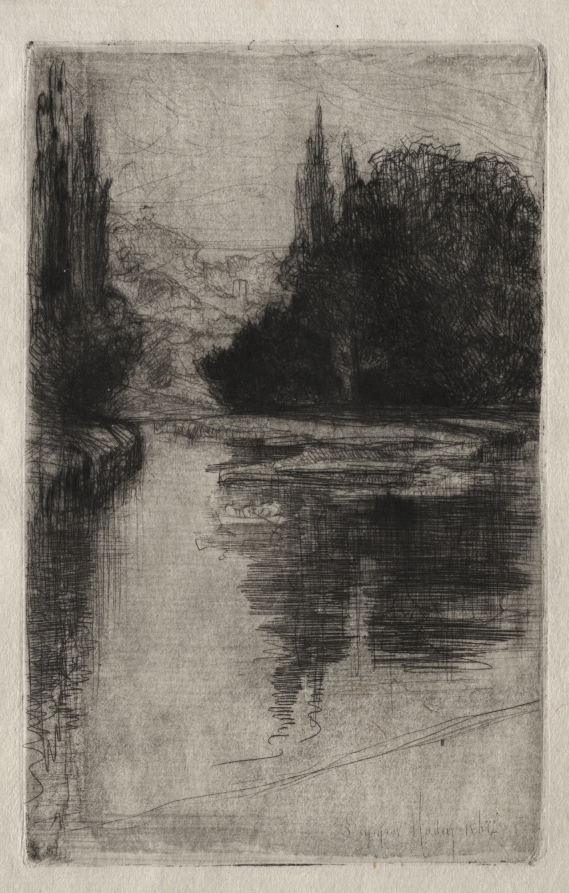
Evening, 1864
The results have a freshness and a tonal spontaneity that set them apart from almost everything being produced in Britain at the time. Critics and fellow artists recognized immediately that something new was happening. The works from the period between 1859 and 1865 represent the absolute pinnacle of Haden's achievement, and they remain the works that collectors and curators return to most eagerly. Sub Tegmine, etched in 1859, announces his mature voice with remarkable assurance, its dappled shade and loose, responsive line suggesting a mind thoroughly at ease with the expressive possibilities of the bitten plate.
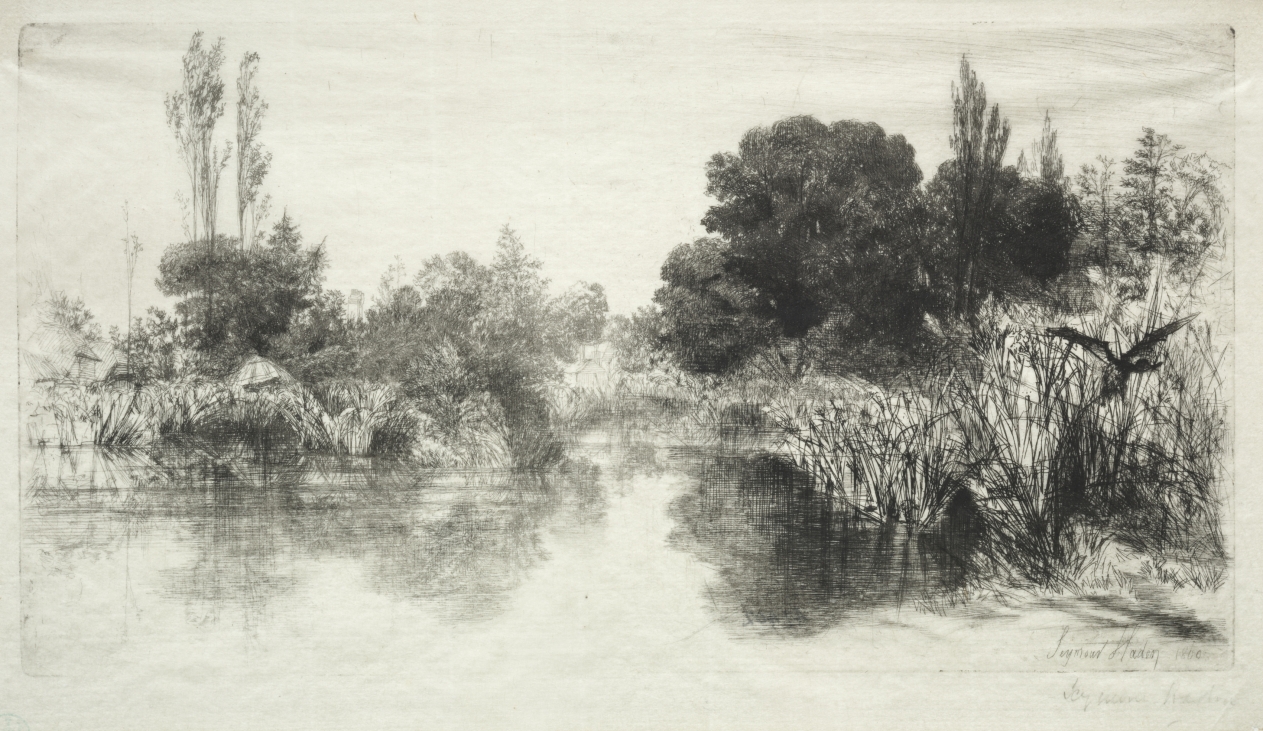
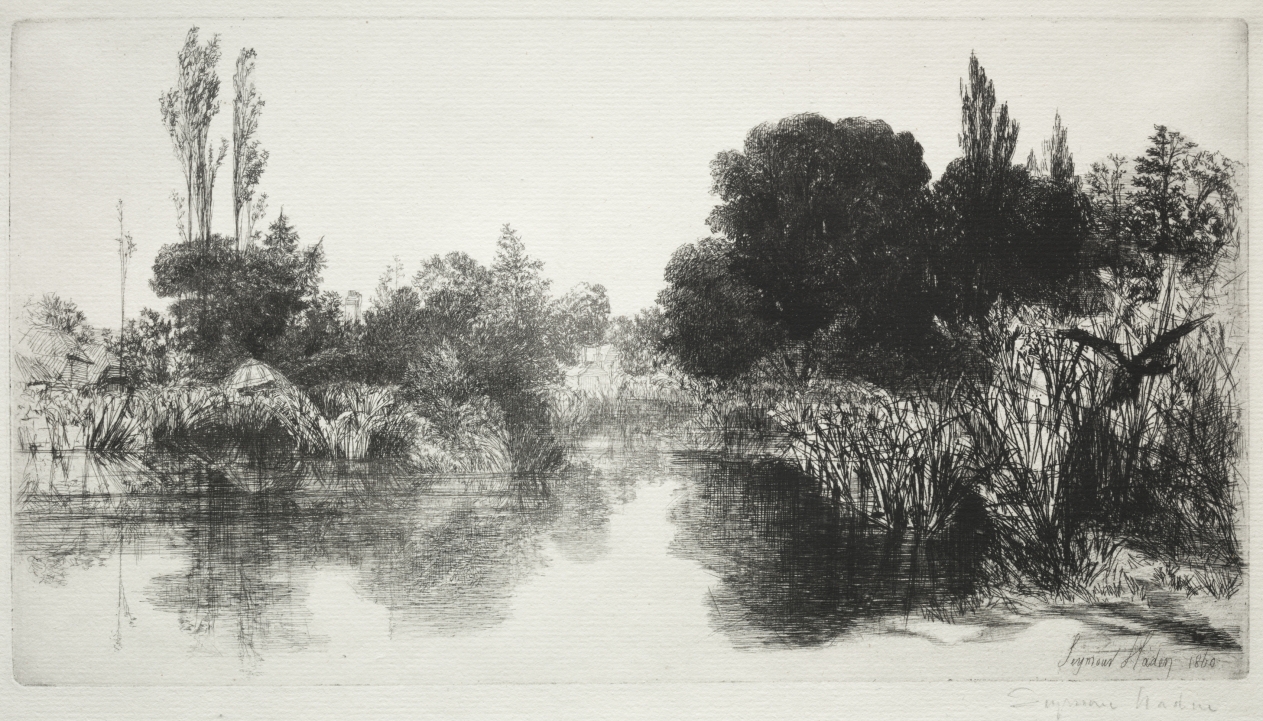
The two versions of Shere Mill Pond, both produced in 1860, are among the most beloved images in the history of British printmaking: compositions of extraordinary spatial depth, where reflections on still water and the weight of overhanging trees are rendered with a flickering, almost improvisatory touch that Rembrandt himself might have admired. Evening, from 1864, and A River in Ireland, also 1864, extend this language into new registers of mood and atmosphere, the latter carrying a particular sense of vast, rain laden Irish sky pressing down on a low and luminous horizon. Bark Refitting, etched and worked in drypoint in 1865, demonstrates another dimension of Haden's sensibility: his ability to animate a scene of working life with the same attentiveness he brought to landscape. The burr of drypoint, which Haden used with increasing confidence throughout the 1860s and into the 1870s, added a warmth and velvety richness to his tonality that pure etching alone could not provide.
Francis Seymour Haden
Shere Mill Pond (The Larger Plate), 1860
By the time of works such as Nine Barrow Down and The Cabin, both of 1877, his handling of drypoint had become supremely assured, capable of conjuring vast open downland or intimate rural shelter with equal authority. Monk at a Fountain, from the same year, shows yet another facet: a composed, almost meditative scene in which architecture and figure are absorbed into a world of light and reflection. From a collecting perspective, Haden occupies a position of enduring and well founded esteem. His prints have been held by major institutions on both sides of the Atlantic for well over a century, and the British Museum, the Victoria and Albert Museum, and the Metropolitan Museum of Art in New York all hold significant holdings of his work.
On the auction market, early and fine impressions of the Shere Mill Pond plates, the 1864 landscapes, and the major drypoints of the 1870s consistently attract serious attention from collectors who understand the depth and rarity of the field. The key distinction, as with all printmakers of this period, lies in the quality of the impression: Haden's plates were often worked and reworked across multiple states, and the finest early impressions carry a richness of tone and a freshness of line that later printings simply cannot replicate. Collectors are advised to seek impressions with full margins, strong plate tone, and provenance that reaches back through established print collections. To understand Haden fully, it is helpful to situate him within a broader constellation of artists who shared his preoccupations and his era.
Francis Seymour Haden
Shere Mill Pond, No. 11 (The Large Plate), 1860
Whistler, despite the personal rupture between them, remains the most natural point of comparison: both men were devoted to the revival of etching as a serious fine art medium, both looked to Rembrandt as a lodestar, and both produced bodies of work that collectively transformed the status of printmaking in the English speaking world. Samuel Palmer, working a generation earlier in his Shoreham period, anticipated something of Haden's pastoral intensity. Among Continental contemporaries, Charles Meryon and Alphonse Legros share his seriousness of purpose and his commitment to the medium's expressive potential. Haden was also a founding force behind the Royal Society of Painter Printmakers, and his advocacy for etching as a legitimate fine art, rather than a reproductive craft, helped reshape institutional attitudes that persisted well into the twentieth century.
Haden's legacy is, in the most genuine sense, a living one. The values he championed directness, responsiveness to nature, the primacy of the artist's hand, the print as an original creative act rather than a copy of something else have become so thoroughly embedded in the culture of printmaking that they now seem self evident. Yet they were hard won, argued for with passion and defended against considerable institutional resistance. To collect Haden today is to participate in one of the great stories of British art: the story of a man who practiced surgery by day and changed the history of printmaking by night and weekend, who carried copper plates into the English and Irish countryside and returned with images of startling beauty, and who left a body of work that continues, well into the twenty first century, to reward the attentive eye with new pleasures at every encounter.
Explore books about Francis Seymour Haden