Francis Frith
Francis Frith Brought the Ancient World Home
Artist Spotlight · The Collection Editorial
“The mind feels its way into the very atmosphere of the old, dead world, and grasps, with almost startling vividness, the facts of its history.”
Francis Frith, Egypt and Palestine, 1858
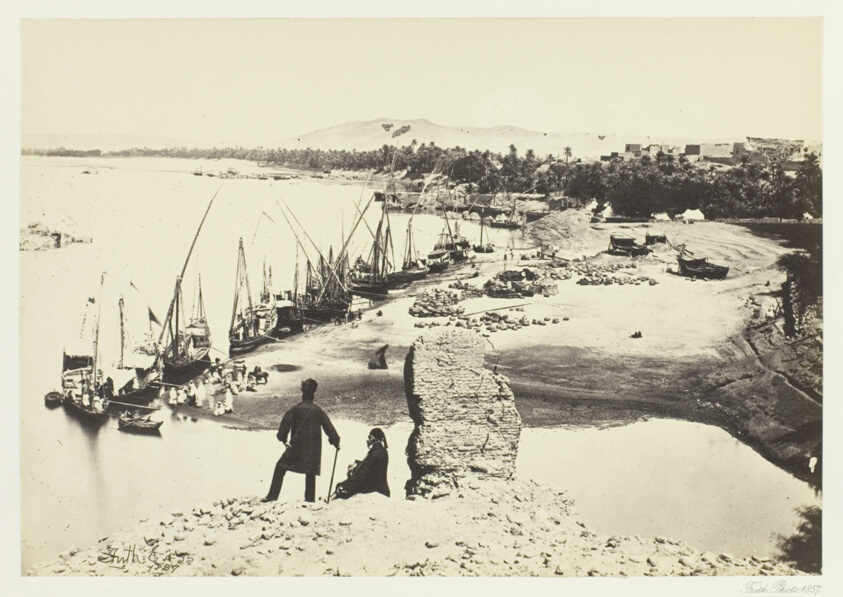
Picture the Nile in 1857. The air is thick with heat, the light is blinding off the pale sand, and somewhere near the island of Philae, a British photographer is wrestling a large format glass plate camera into position beneath a makeshift darkroom tent. The chemicals are volatile in the extreme temperatures, the collodion threatening to dry before the exposure is made. Francis Frith, barely a decade into his photographic life, is capturing images that will astonish the Western world and lay the groundwork for documentary photography as we know it.
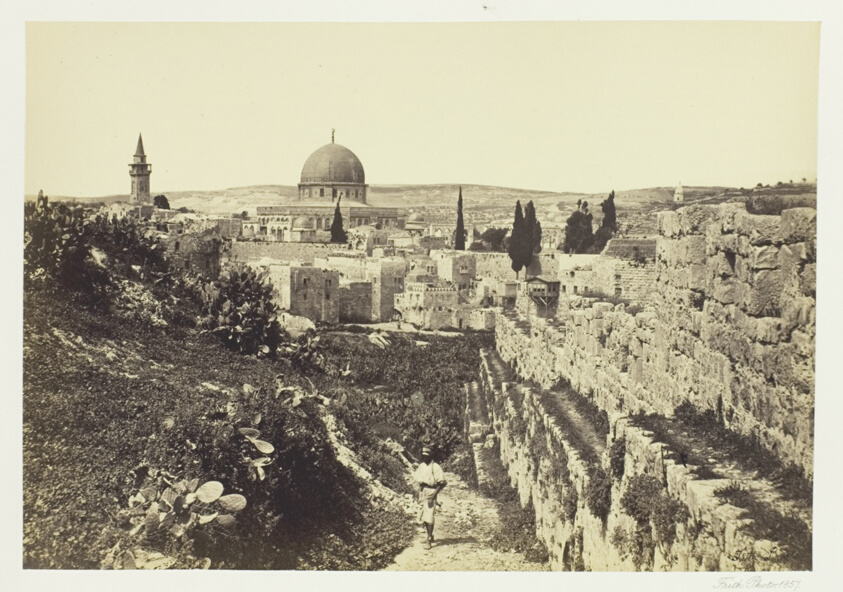
Francis Frith
City Wall and Mosque of Omar, Jerusalem, 1857
That the resulting prints remain among the most coveted Victorian photographs in the market today is a testament not merely to their rarity but to their enduring visual authority. Frith was born in Chesterfield, Derbyshire, in 1822 into a Quaker family, and the values of that community, namely industry, honesty, and a certain earnest engagement with the world, seem to have shaped him profoundly. He received a solid education and showed early aptitude for business, eventually building a successful grocery enterprise in Liverpool during the 1840s and early 1850s. It was only after selling that business, reportedly at considerable profit, that he turned his full attention to photography, a medium still in its electrifying adolescence.
His conversion was not that of a dilettante seeking a hobby but of an entrepreneur who recognised photography as both an art form and a commercial proposition of extraordinary potential. Between 1856 and 1860, Frith made three expeditions to Egypt, Palestine, and Syria, each journey pushing further into terrain that few Western photographers had attempted before him. He worked primarily with the wet collodion process on glass plates, a technique that demanded extraordinary logistical discipline under any conditions, let alone in the searing heat of the Middle East. The challenges were not merely physical.
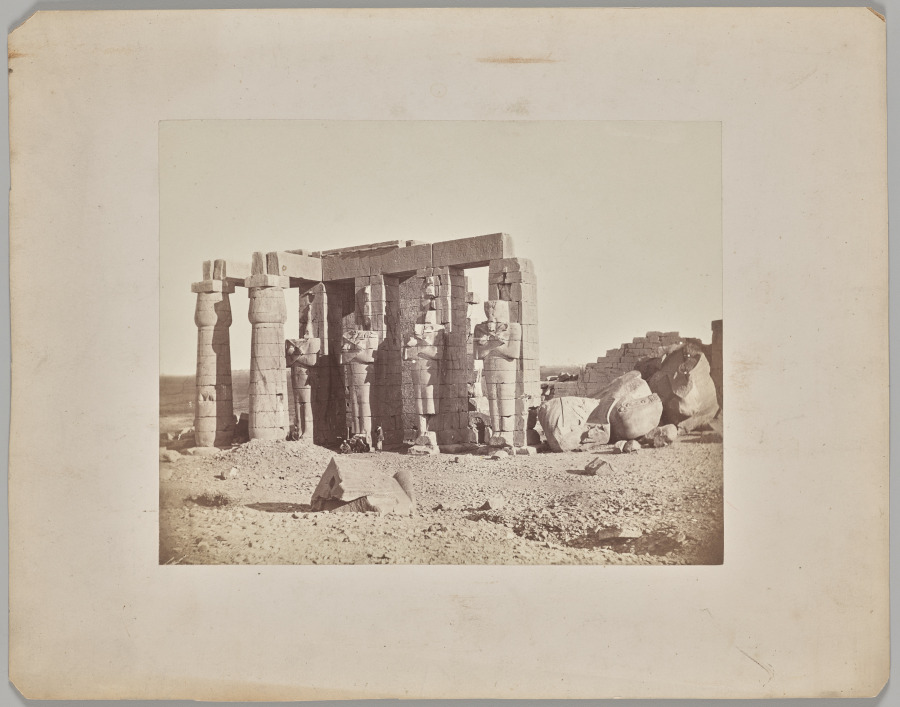
Francis Frith
Fallen Statue at the Ramasseum, Thebes, 1857
Frith was navigating unfamiliar cultures, negotiating access to sacred and ancient sites, and managing the transportation of fragile, chemically sensitive equipment across deserts and along the Nile by boat. That he succeeded so comprehensively speaks to a rare combination of artistic vision and practical tenacity. The photographs that emerged from these expeditions were published in a series of celebrated albums, most notably Egypt and Palestine in two volumes issued between 1858 and 1860, with text contributed by various scholars and writers of the day. Works such as The Pyramids of El Geezeh from the Southwest and the luminous View on the Island of Philae carry a compositional intelligence that goes far beyond mere documentation.
Frith understood the architecture of a photograph, the way light sculpts stone, the way a foreground element can anchor a vast and otherwise overwhelming scene. His image of the Fallen Statue at the Ramasseum, Thebes, places the colossal fragmentary figure of Ramesses II in a frame of such deliberate stillness that the sense of collapsed time is visceral. Likewise, his studies of Jerusalem, including the commanding City Wall and Mosque of Omar and the beautifully resolved Mosque of Omar itself, demonstrate an eye attuned to the interplay of devotion and architecture, of sacred geography and daily life. What is particularly striking for the contemporary collector is the sheer range of visual intelligence on display across Frith's Middle Eastern work.
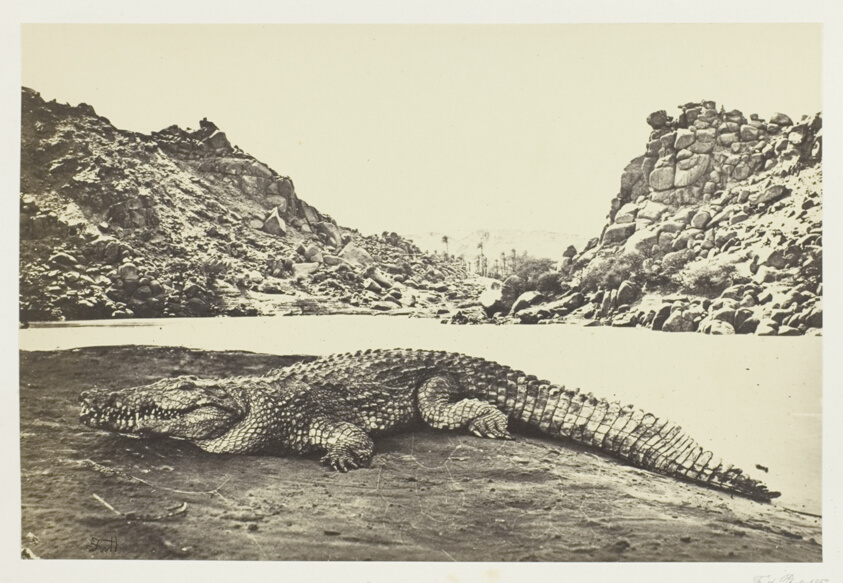
Francis Frith
Crocodile on a Sand-Bank, 1857
His Crocodile on a Sand Bank is almost journalistic in its matter of fact directness, a quality that feels startlingly modern against the more formal compositions of the period. His treatment of Philae, an island he returned to repeatedly across his expeditions, reveals an artist deepening his relationship with a subject rather than simply cataloguing it. The Doum Palm and Ruined Mosque at Philae and Pharaoh's Bed, Philae from the Great Temple are works that reward extended looking, their tonal range and compositional balance speaking equally to the traditions of landscape painting and to the emerging language of the photographic medium itself. From a collecting perspective, Frith's albumen prints from the Egypt and Palestine albums represent some of the most historically and aesthetically significant Victorian photographs available in the market.
Individual plates from these albums appear at auction at leading houses including Christie's and Sotheby's, where strong examples have consistently attracted serious institutional and private interest. Condition is paramount, as with all works on paper from this period, with collectors rightly focused on prints that retain their tonal warmth and avoid the fading that can affect albumen surfaces. Frith's prints that retain their rich brown and sepia tones, rather than having shifted toward a cooler, washed out appearance, are those that command the most attention. Provenance from the original albums, identifiable by plate numbers and period bindings, adds considerable weight to any individual work.
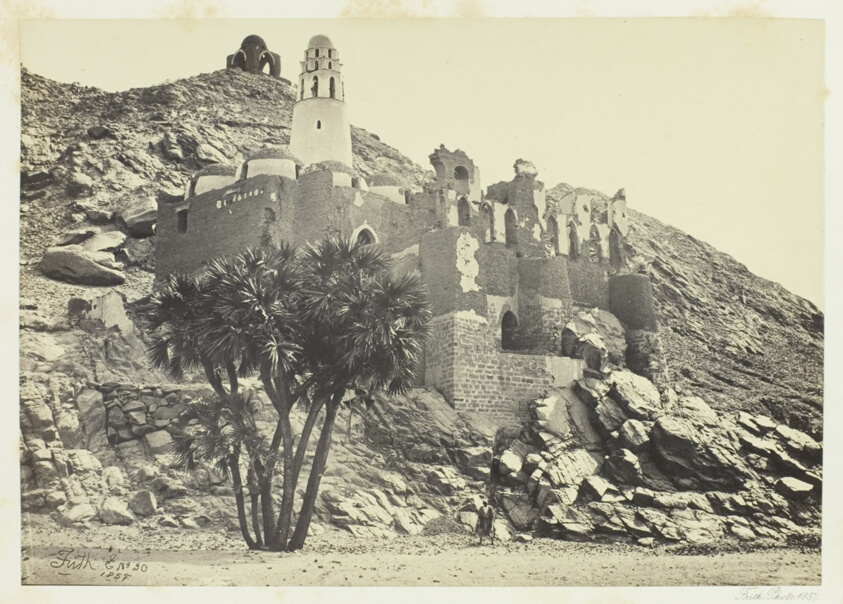
Francis Frith
Doum Palm and Ruined Mosque, Philæ, 1857
In placing Frith within the broader history of nineteenth century photography, it is natural to think of contemporaries and near contemporaries who shared his ambition to document the wider world with the new medium. The work of Roger Fenton, who photographed the Crimean War in 1855 and produced extraordinary studies of British landscapes and architecture, represents a parallel strand of serious photographic practice in the same decade. Gustave Le Gray in France was exploring the expressive possibilities of the medium at precisely the same moment, bringing a painter's sensibility to seascapes and forest studies. In the documentary tradition, Frith stands alongside figures such as Maxime Du Camp, the French photographer whose own Nile expedition of 1849 produced some of the earliest photographic records of Egyptian monuments, though Frith's technical and commercial ambitions exceeded Du Camp's considerably.
Together these figures represent the founding generation of photography as a serious artistic and cultural enterprise. Frith's later career saw him establish Francis Frith and Co. in Reigate in 1859, a photographic publishing business that grew to become one of the largest producers of topographic photographs in the world. The firm sent photographers to every corner of Britain and beyond, creating an archive of tens of thousands of images that constitute an unparalleled visual record of Victorian and Edwardian life.
Frith himself shifted from the role of solitary explorer to that of visionary publisher and archivist, understanding that photography's greatest cultural service might lie not in the singular masterwork but in the comprehensive record. He died in 1898 in Cannes, leaving behind a body of work that bridges the poetic and the encyclopaedic, the personal and the historical. For collectors today, to acquire a Frith print is to hold in one's hands a piece of the moment when photography first understood the full scale of what it might do.
Explore books about Francis Frith
Francis Frith and the Art of Photography
Peter Turner
The Mighty Athenian: The Life of Francis Frith
Bill Jay

Francis Frith's Egypt and the Holy Land
Geraldine Pinch
Francis Frith: Photographer of the Nile
Claire L. Lyons

The Landscape Vision of Francis Frith
Peter Turner and Richard Haworth