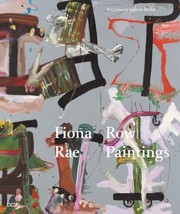
Fiona Rae
Fiona Rae: Where Every Canvas Holds Joy
Artist Spotlight · The Collection Editorial
In the permanent collection of Tate Modern, among the defining works of late twentieth century British painting, hangs evidence of a painter who refused every limit placed before her. Fiona Rae has spent more than three decades building one of the most visually joyful and intellectually generous bodies of work in contemporary art, and the art world's appetite for her canvases shows no sign of abating. Her paintings have moved through major auction houses with increasing confidence, and institutions across Europe and North America continue to seek them out, recognising in her layered surfaces a singular intelligence at play. To spend time with a Rae painting is to feel invited into a mind that loves looking, loves making, and trusts the viewer to keep up.
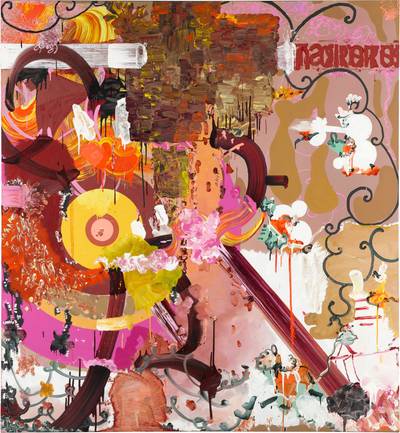
Fiona Rae
Untitled (Brown)
Rae was born in Hong Kong in 1963 and grew up in Britain, eventually studying at Croydon College of Art before completing her fine art degree at Goldsmiths, University of London, in 1987. Goldsmiths in the late 1980s was arguably the most charged environment in British art education, a place where the critical and the intuitive were held in productive tension, and where a generation of artists were learning to ask questions rather than follow inherited answers. Rae absorbed that atmosphere without being swallowed by it. She came away with a commitment to painting at precisely the moment when painting was being declared irrelevant by certain corners of the critical establishment, and she made that commitment feel like an act of genuine intellectual courage.
Her early work brought her immediate attention. She was included in the landmark Freeze exhibition of 1988, organised by Damien Hirst in a London docklands warehouse, the show widely credited with launching the Young British Artists generation into public consciousness. In 1991 she received a Turner Prize nomination, one of the youngest painters to be recognised by the prize at that point in its history. Critics responded to the sheer ambition of what she was doing on canvas: large scale compositions that seemed to compress gestural abstraction, art historical quotation, and popular cultural imagery into a single charged field.
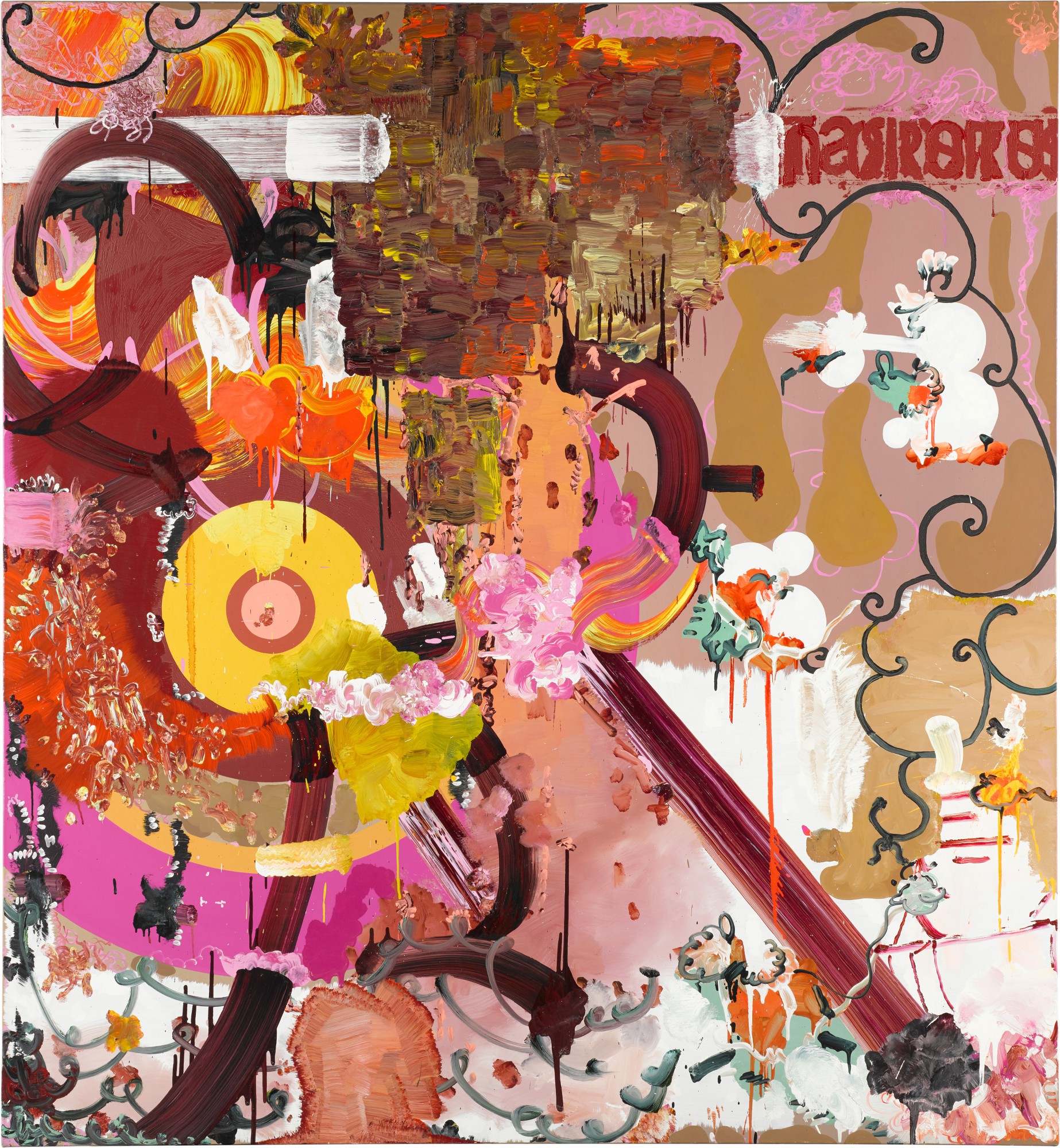
Fiona Rae
We Go in Search of Our Dream, 2007
There was nothing modest or tentative about these paintings, and that confidence, earned rather than assumed, set the tone for everything that followed. The development of Rae's practice over the subsequent decades has been marked by an expanding vocabulary rather than a narrowing one. Where early work drew heavily on the language of Abstract Expressionism, filtered through a distinctly British sensibility, later paintings opened themselves to anime, cartoon imagery, and the visual culture of Japan. Works such as Tokyo Popeyes from 2004, with its oil, acrylic and glitter on canvas, and Curse of the Golden Flower from 2009, which layers oil, acrylic and gouache into something approaching visual vertigo, reveal a painter willing to follow her enthusiasms wherever they lead.
The glitter in Tokyo Popeyes is not ironic decoration; it is a serious formal choice, one that makes the surface vibrate with a particular kind of light. Similarly, My Heart is Full of Joy from 2008 earns its title through pictorial means, not sentiment, the canvas itself becoming a kind of evidence for the feeling named. What unifies these works across their apparent diversity is Rae's relationship to the act of painting itself. She has spoken about the tension between control and accident, between the planned and the discovered, and this tension is legible in every square inch of her canvases.
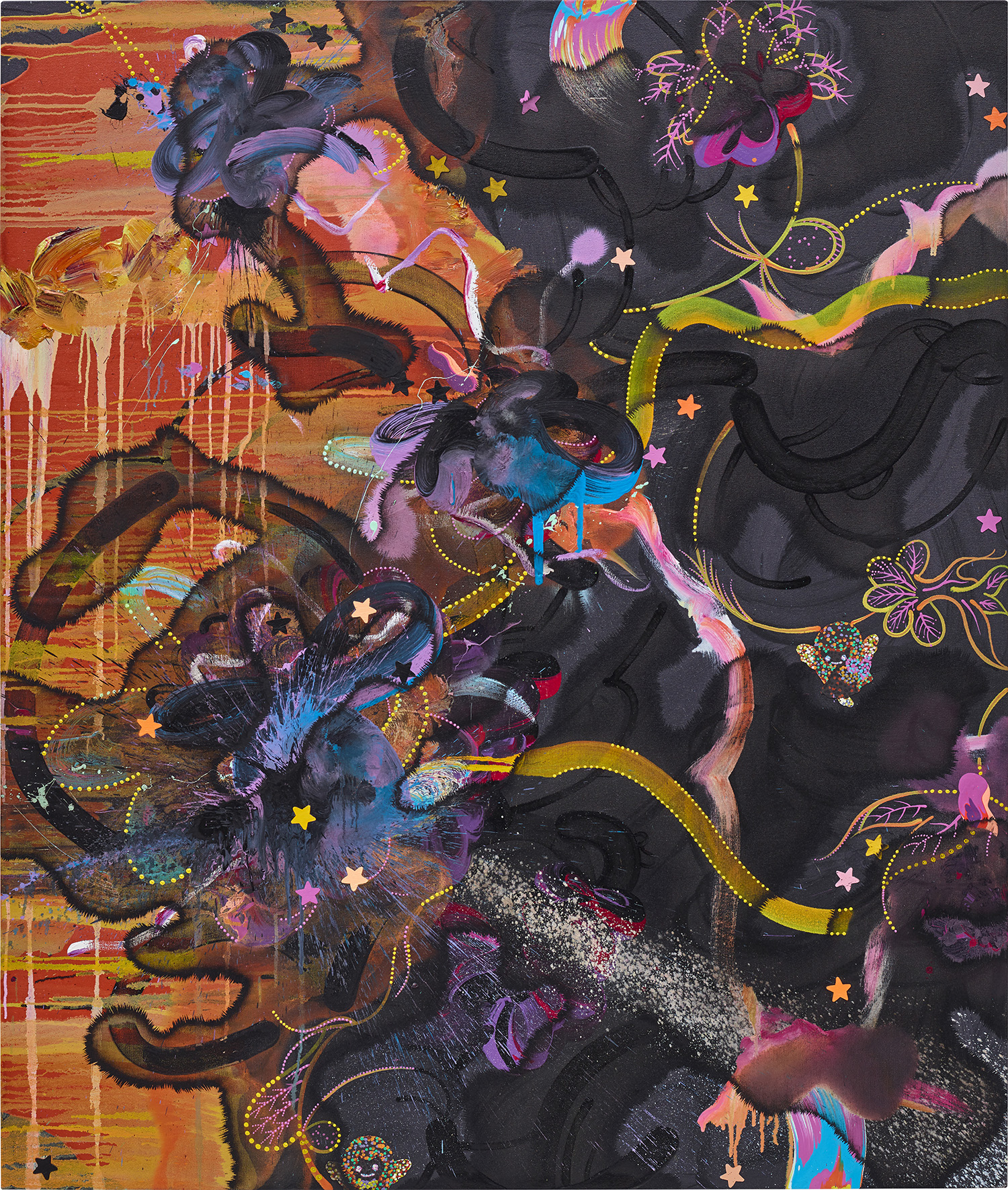
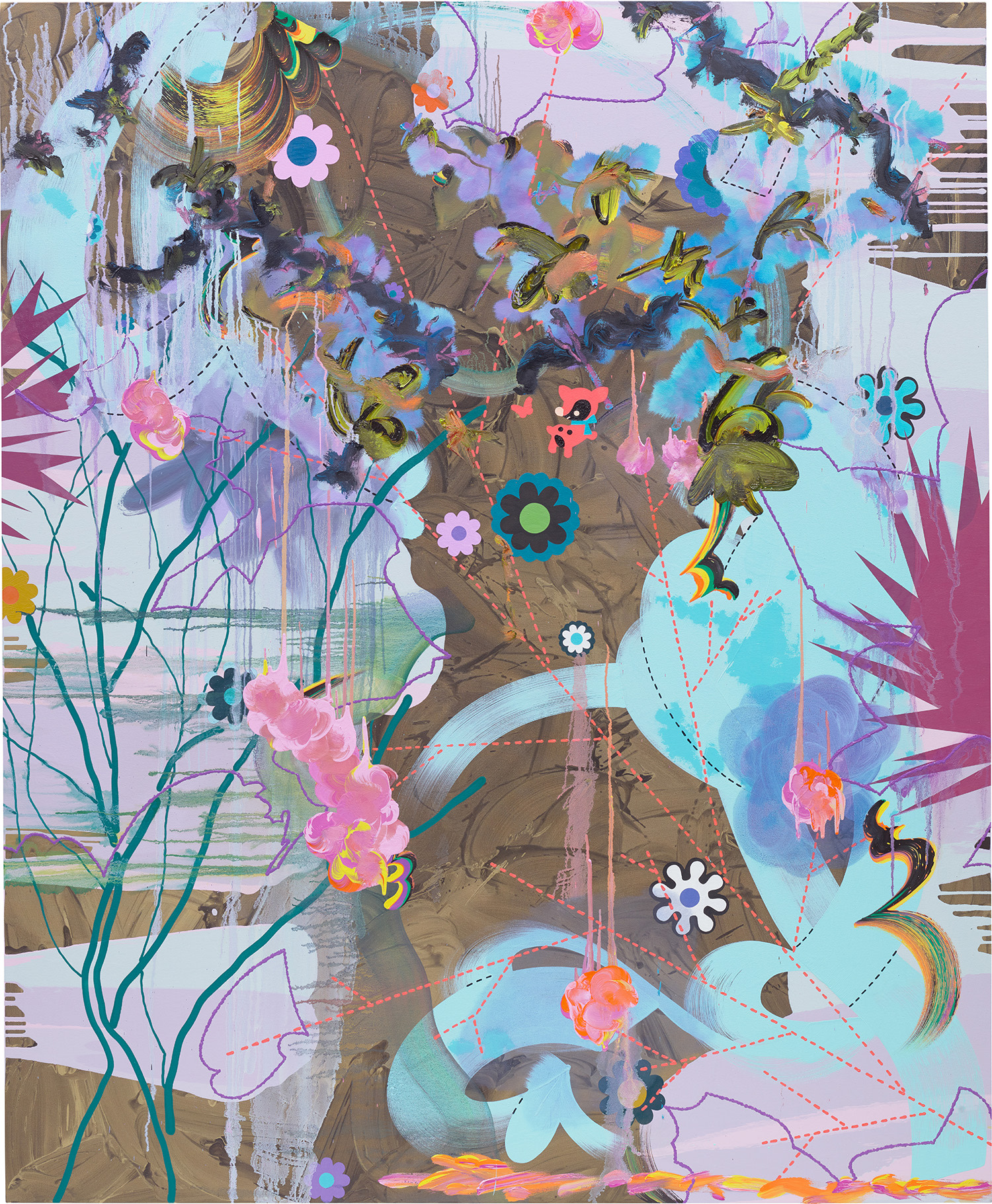
Fiona Rae
Curse of the Golden Flower, 2009
Marks appear that look spontaneous, then a passage of almost architectural precision arrives alongside them, and the viewer finds themselves unable to locate where intention ended and improvisation began. This is not confusion; it is sophistication. Rae understands that painting is a performance of thought in real time, and she makes that performance visible without making it laborious. The surfaces of works such as We Go in Search of Our Dream from 2007 carry a sense of genuine adventure, as though the painting itself did not know where it was going until it arrived.
For collectors, Rae's work presents an unusually compelling proposition. Her paintings occupy a space where critical seriousness and visual pleasure are not in competition; they reinforce each other. Works from the 1990s, when her reputation was first being established, have held and grown their value in the market with the kind of steady confidence that reflects genuine institutional endorsement rather than speculative enthusiasm. Her larger canvases command significant attention at auction, and works on paper and smaller format paintings offer collectors at various levels a point of entry into a practice of real historical importance.
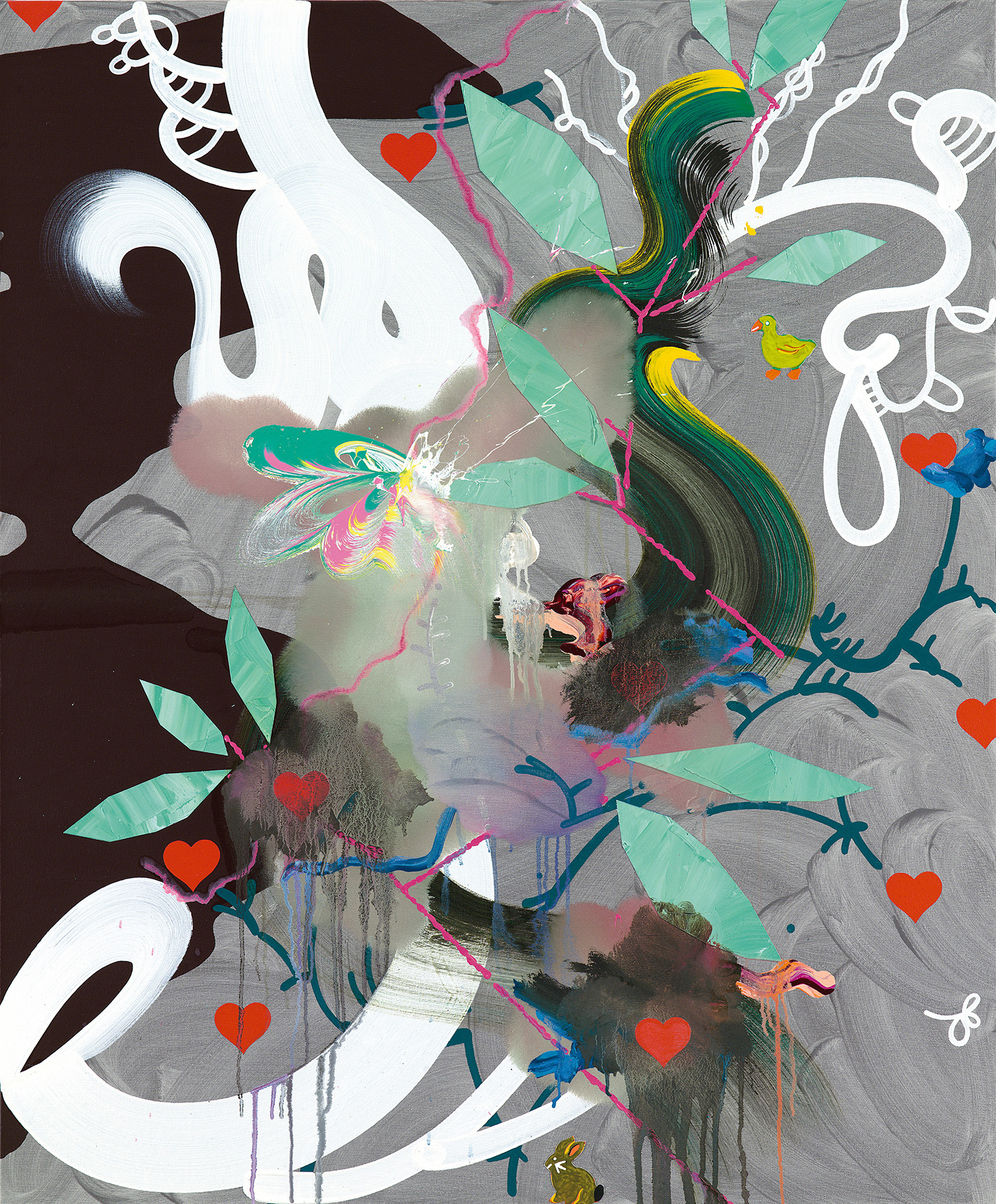
Fiona Rae
My Heart is Full of Joy, 2008
The key thing to look for is that quality of productive tension, the sense that the painting is alive with competing energies that have been brought into a temporary and thrilling equilibrium. When that quality is present, which in Rae's work it almost always is, the painting will continue to reward looking for decades. In the broader context of art history, Rae's position is one that rewards careful consideration. She belongs to a tradition of painters who take the history of abstraction seriously while refusing to be imprisoned by it, a lineage that runs from Willem de Kooning through to contemporaries such as Albert Oehlen and Laura Owens.
Like those painters, she is interested in what painting can absorb, how much information and how many competing languages a single surface can hold before it collapses, and like the best of them she has found ways to keep pushing that threshold further without losing the coherence that makes the work readable. She has held a professorship at the Royal College of Art in London, shaping the thinking of a subsequent generation of painters, which means her influence extends well beyond the studio. Fiona Rae matters today for the same reasons she mattered in 1991 and will matter in 2041: she is a painter of genuine conviction making work of genuine beauty and genuine complexity. In an era when the art world sometimes seems to favour the conceptually clever over the sensuously alive, her canvases make the case, quietly but insistently, for the continuing power of paint to hold the world and transform it.
To own a Rae painting is to live with something that will surprise you on a regular basis, a painting that has more to give each time you return to it. That quality of inexhaustibility is among the rarest things a work of art can offer, and Fiona Rae offers it consistently.
Explore books about Fiona Rae