Eugène Boudin

Boudin's Light Still Holds Us Spellbound
Artist Spotlight · The Collection Editorial
“Everything that is painted directly and on the spot has a strength, a power, a vivacity of touch that one cannot recover in the studio.”
Eugène Boudin, personal writings
Stand at the edge of the Normandy coast on a blustering autumn afternoon, when the clouds race and the sea shifts between pewter and silver and the faintest warmth of the low sun catches the wet sand, and you will understand immediately what Eugène Boudin spent a lifetime chasing. That quality of fleeting, honest atmospheric truth is precisely what draws collectors and museum curators back to his work again and again. In recent years, major French institutions including the Musée d'Orsay in Paris and the Musée Eugène Boudin in Honfleur have reaffirmed his place not at the margins of art history but at its very centre, presenting him as the essential bridge between the Barbizon school and the Impressionist revolution that would transform Western painting. Eugène Louis Boudin was born on 12 July 1824 in Honfleur, a small port town on the Seine estuary in Normandy, and the sea entered his blood early.
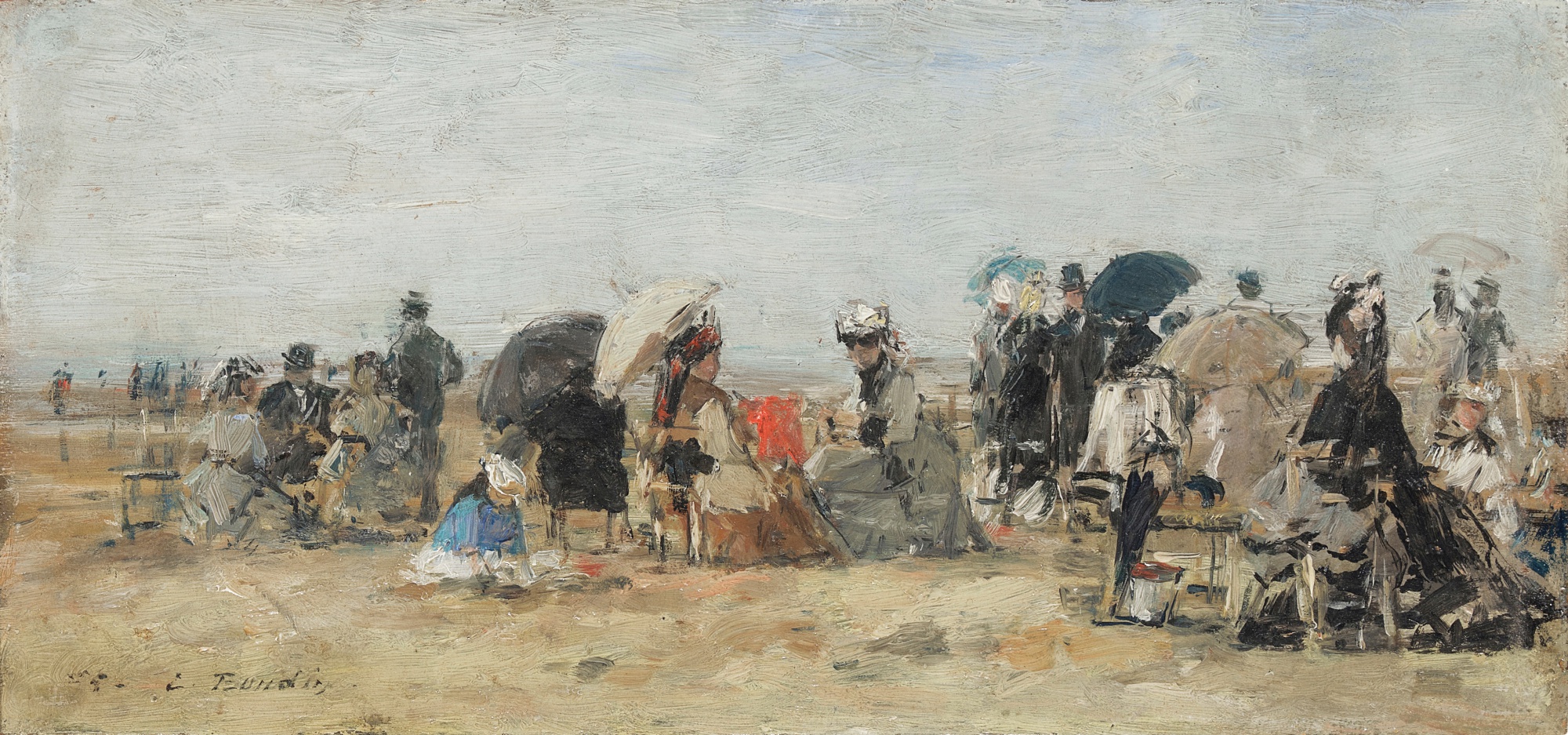
Eugène Boudin
Scène de plage, 1875
His father was a harbour pilot, and the family later moved to Le Havre, where the young Boudin took work as a cabin boy and then as a stationer and frame maker. That modest shop became a kind of informal salon where travelling artists would leave their canvases for sale, and the walls of the young Boudin's workplace were hung with the work of Millet, Troyon, and Isabey, among others. These encounters seeded a fierce ambition in him, and by his mid twenties he had received enough encouragement from Millet and Troyon to pursue painting seriously, aided in part by a grant from the city of Le Havre that allowed him to study in Paris. Those formative years in Paris were important but not defining.
What truly shaped Boudin's practice was his return to the Normandy coast and his commitment to painting directly outdoors, in front of the motif, in all weathers and at all hours. He became one of the earliest and most devoted practitioners of plein air painting in France, long before the term itself became a manifesto. His sketchbooks and small panel studies from the 1850s and 1860s reveal an artist in restless dialogue with the natural world, someone who understood that the sky was not a backdrop but the very subject of a painting. It was Jean Baptiste Camille Corot, one of the most respected landscape painters of the age, who gave Boudin the nickname that has followed him ever since: "King of the Skies.
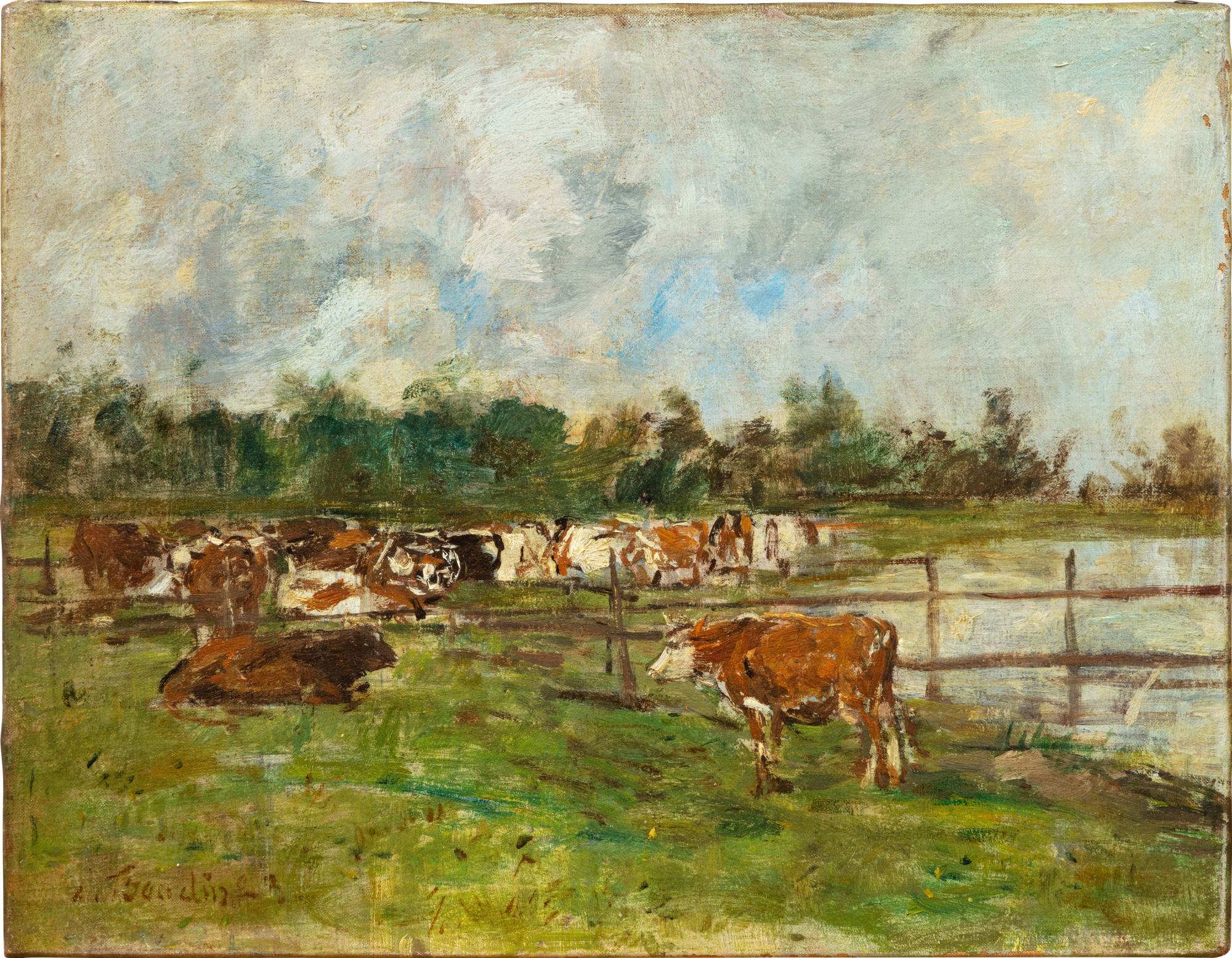
Eugène Boudin
Vaches au pré, 1888
" Coming from Corot, that was not flattery. It was recognition. Boudin's artistic breakthrough and his most enduring contribution to the history of painting came through his sustained attention to the beaches and estuaries of Normandy. From the late 1850s onward he worked repeatedly at Trouville and Deauville, painting the fashionable visitors who gathered on the beach in their crinolines and top hats, the fishing boats rocking in the harbour at low tide, the vast skies pressing down on narrow strips of sand and water.
“Three strokes of the brush after nature are worth more than two days of work at the easel.”
Eugène Boudin, letters
Works such as "Trouville, les jetées marée basse" from 1880 exemplify his method at its most assured: the composition divided broadly between a luminous sky and a reflective sea, human figures rendered with quick, confident brushwork that suggests rather than defines, and a tone of observed reality entirely free of sentiment or artifice. His "Laveuses près d'un bateau échoué le long du port de Trouville, marée basse" from 1888 is a quietly masterful study in the everyday poetry of coastal labour, its cradled panel surface carrying the full weight of his technical confidence. Perhaps the most historically consequential thing Boudin ever did was to take a young man named Oscar Claude Monet out onto the beach at Honfleur in 1857 and persuade him to try painting outdoors. Monet was sixteen years old and had been making a reputation as a caricaturist.
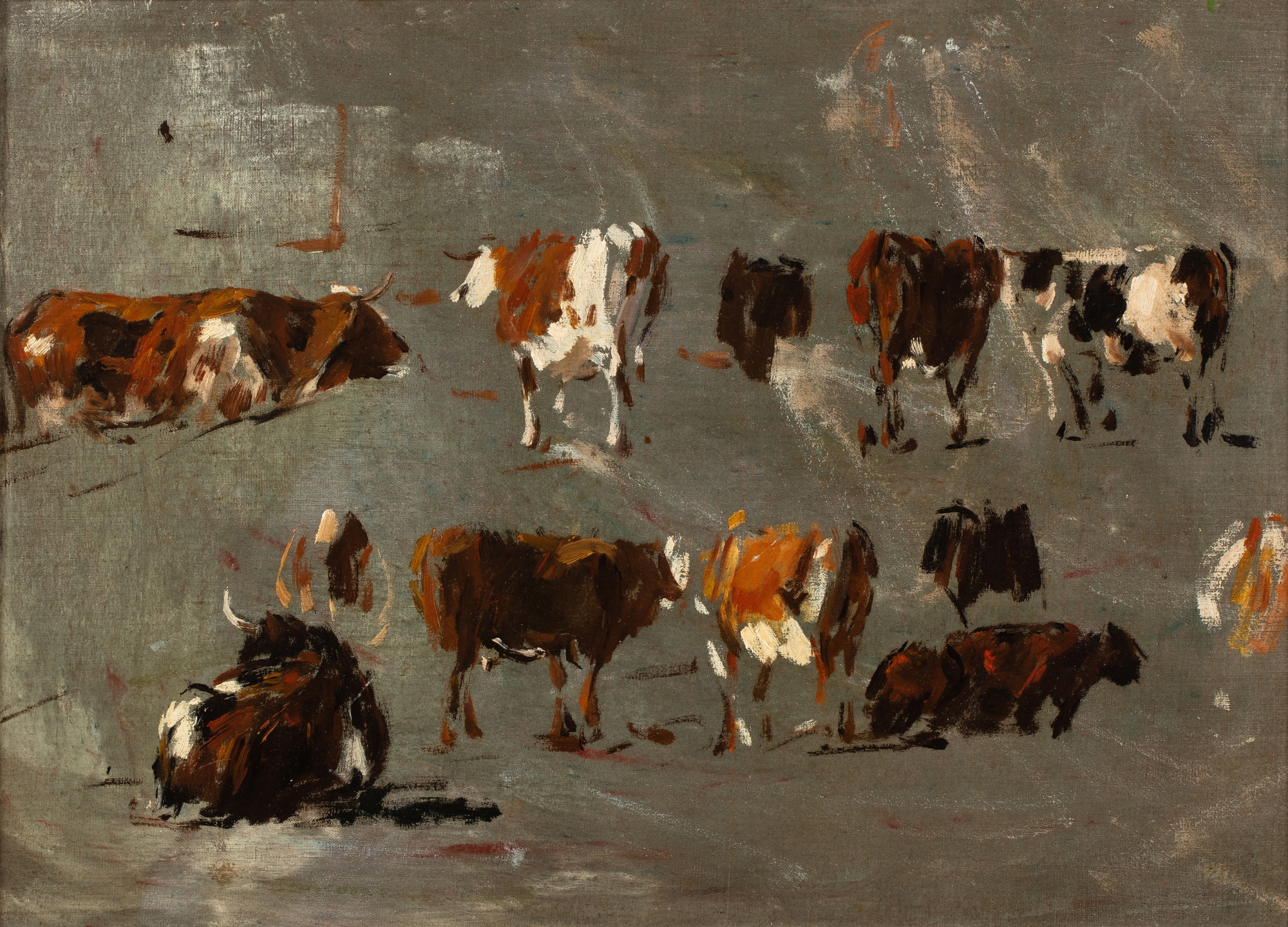
Eugène Boudin
Étude de vaches, 1881
Boudin, already in his early thirties and committed to his practice, became a mentor and a model. Monet would later speak with deep gratitude about what Boudin taught him in those early sessions, describing the older painter as someone who opened his eyes to the real possibilities of light and atmosphere. Without Boudin there is no Impressionism in the form we know it. That is not hyperbole; it is simply the trajectory of the history.
Boudin's range was wider than his coastal reputation sometimes suggests. His studies of cattle in the Norman countryside, including "Vaches au pré" from 1888 and "Étude de vaches" from 1881, reveal an artist of deep observation and genuine tenderness toward the land itself. Later works such as "Abbeville, Rue et Église Saint Vulfran" from 1894 and his studies of the Mediterranean coast around Antibes, including the quietly jewel like "Antibes, Le Fort Carré," show how he carried his northern sensibility southward, translating the clarity of Mediterranean light through the same honest, unpretentious eye he had trained on the grey skies of the Channel. These southern works are among his most underappreciated and reward close attention from collectors seeking depth beyond the famous beach scenes.
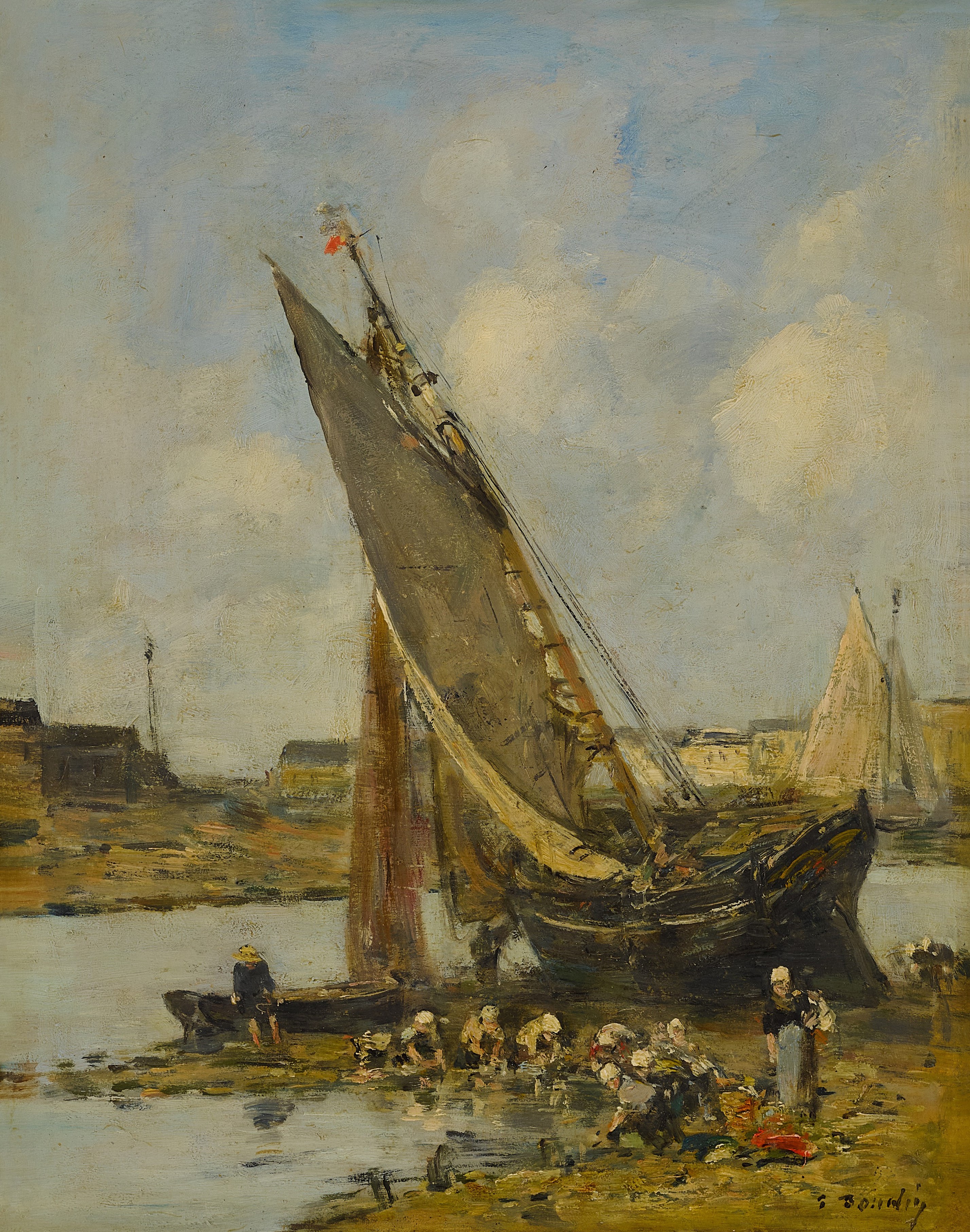
Eugène Boudin
Laveuses près d'un bateau échoué le long du port de Trouville, marée basse, 1888
For collectors, Boudin occupies a position that is at once historically secure and practically accessible relative to many of his contemporaries. His work appears regularly at the major auction houses including Christie's and Sotheby's, where small to medium panel studies and oil sketches have achieved prices ranging from the mid tens of thousands to several hundred thousand euros depending on subject, size, and condition. The beach scenes and harbour views from the 1870s and 1880s attract the strongest interest, but works on panel from any period carry a particular appeal given the intimacy and directness of the format. Provenance connected to early French collections or to exhibition histories at the Salon, where Boudin showed regularly from 1859 onward, adds meaningful value.
Collectors drawn to the roots of Impressionism frequently find that acquiring a Boudin provides a kind of historical grounding that enriches everything else in a collection. In the broader sweep of art history, Boudin sits in a lineage that runs from Constable and the Dutch marine painters through the Barbizon masters and forward into the full flowering of Impressionism. Those drawn to his work will find natural companions in Johan Barthold Jongkind, the Dutch painter whose friendship with Boudin was mutual and formative, and in the early seascapes of Courbet, whose realism overlapped with Boudin's own commitments even as their temperaments differed. The younger Impressionists, Monet above all but also Pissarro and Sisley, owe him an acknowledged debt.
Seeing Boudin in this context, as the essential connective tissue of a revolutionary moment in European painting, only deepens the pleasure of spending time with his work. Eugène Boudin died on 8 August 1898 in Deauville, the very town whose beaches had given him so much of his greatest material. He was seventy four years old and had been painting with seriousness and dedication for more than four decades. What he left behind is a body of work of remarkable consistency and quiet power, paintings that ask nothing of the viewer except a willingness to slow down and look at the sky, really look at it, and to feel the particular quality of light that falls on water and sand on an ordinary afternoon.
That invitation remains as open and as generous as it ever was.
Explore books about Eugène Boudin
Eugène Boudin: Sa vie et son œuvre
Adolphe Jeanron
Eugène Boudin (1824-1898)
Jean-Marie Leclair

Boudin: Master of Sky and Sea
Robert Schmit
Eugène Boudin: 1824-1898
Christophe Duvivier
Eugène Boudin: Peindre en Normandie
Sylvain Amic

The Essence of Light: Boudin and Coastal Impressionism
David Sellin