Ernst Ludwig Kirchner
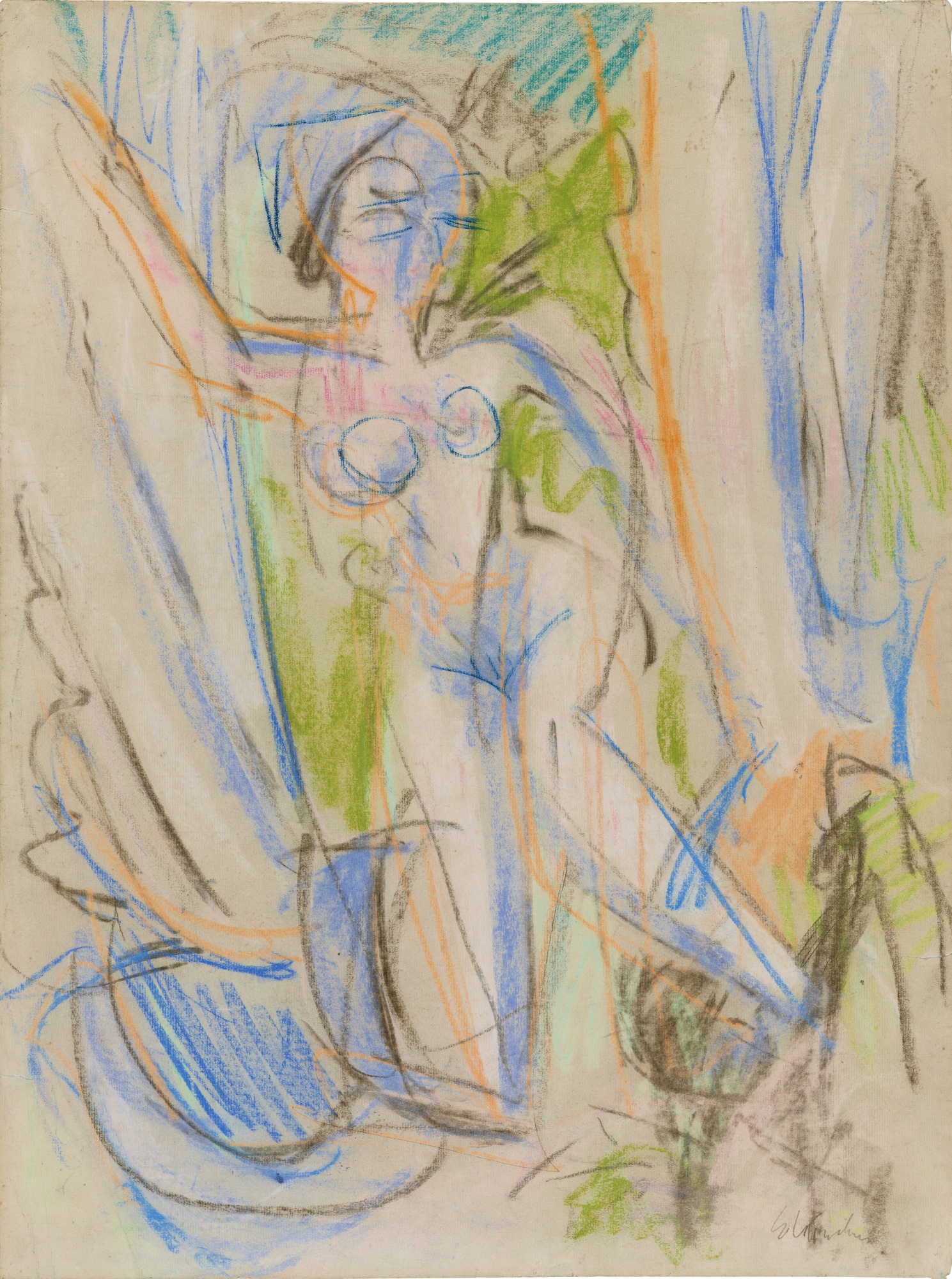
Ernst Ludwig Kirchner, Forever Vivid and Alive
Artist Spotlight · The Collection Editorial
“The creative force and the artwork are a mystery. I am only the tool through which everything flows.”
Ernst Ludwig Kirchner, diary entry
Few artists of the twentieth century captured the electric unease of modern life with quite the ferocity of Ernst Ludwig Kirchner. His canvases crackle with nervous energy, his figures strain against their contours, and his colors burn with an intensity that feels less like observation than confession. This year, major institutions across Europe continue to revisit his legacy with renewed seriousness, recognizing him not merely as a founding figure of German Expressionism but as one of the great visual poets of psychological experience. His works on paper in particular, long prized by connoisseurs, have attracted renewed attention from a younger generation of collectors who respond to their rawness, their speed, and their astonishing intimacy.
Ernst Ludwig Kirchner
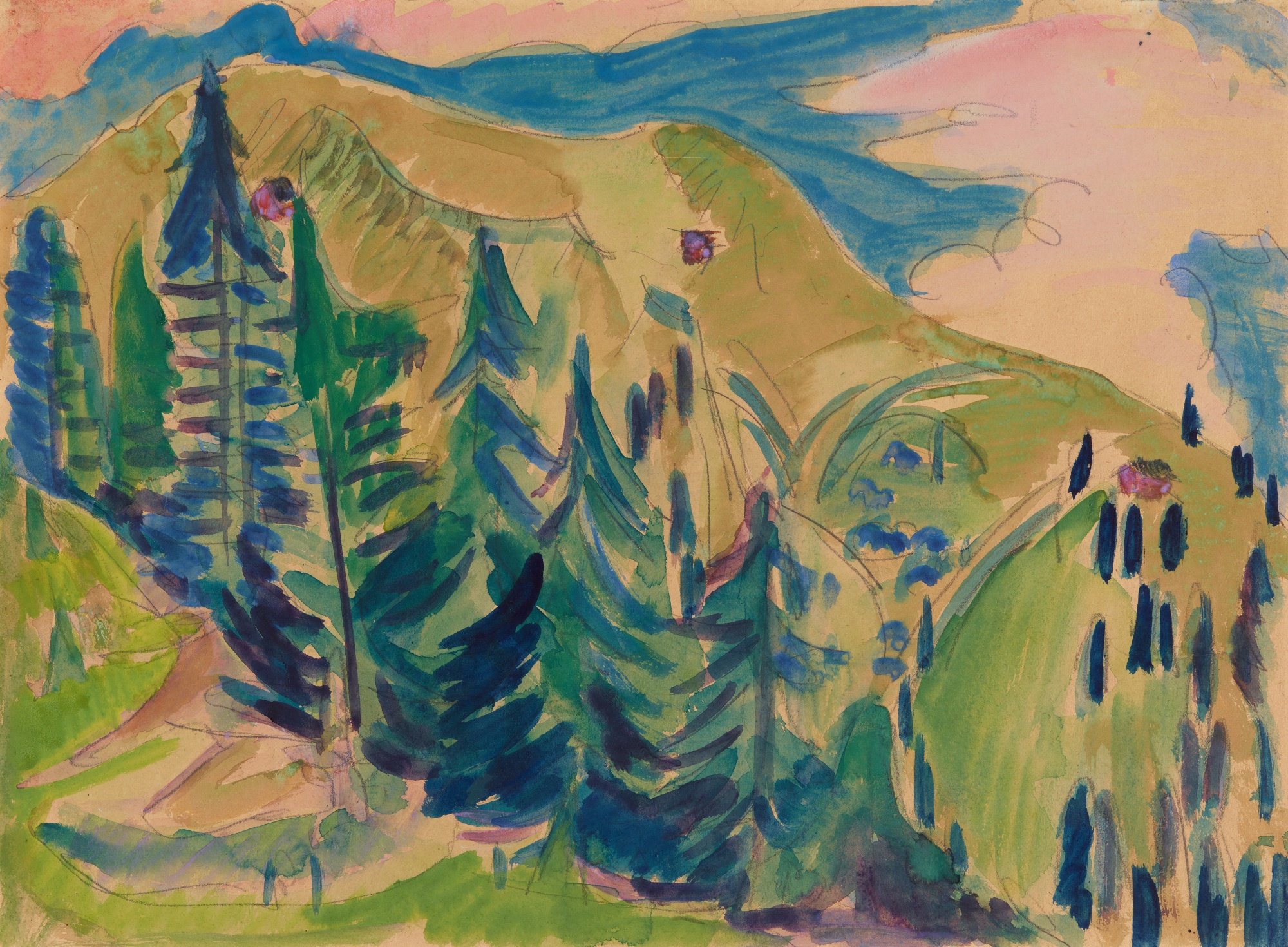
Tannen über dem Sertigtal (Davoser Landschaft), 1918
Kirchner was born in 1880 in Aschaffenburg, Bavaria, into a bourgeois family that valued education and professional achievement. His father was a chemical engineer, and Kirchner initially pursued a degree in architecture at the Technische Hochschule in Dresden. It was there, in the first years of the twentieth century, that the collision between his technical training and his consuming passion for drawing and painting produced something remarkable. He encountered the woodblock prints of Albrecht Dürer and the graphic traditions of medieval German art, as well as the bold flat patterning of Post Impressionist painting from France, and from these seemingly contradictory sources he began to forge a singular vision.
Dresden at that moment was alive with artistic ambition, and Kirchner found in it exactly the friction he needed. In 1905, alongside Fritz Bleyl, Erich Heckel, and Karl Schmidt Rottluff, Kirchner co founded the artists' collective known as Die Brücke, or The Bridge, a name that announced their desire to connect the art of the past with a raw and unmediated future. The group rejected the academic conventions of the day, embracing distortion, expressive color, and the primal energy of non Western art they encountered in the ethnographic collections of Dresden. Kirchner became the group's most prolific and arguably most gifted member, developing a style in which angular forms, compressed space, and confrontational line work combined to produce images of startling psychological directness.
Ernst Ludwig Kirchner
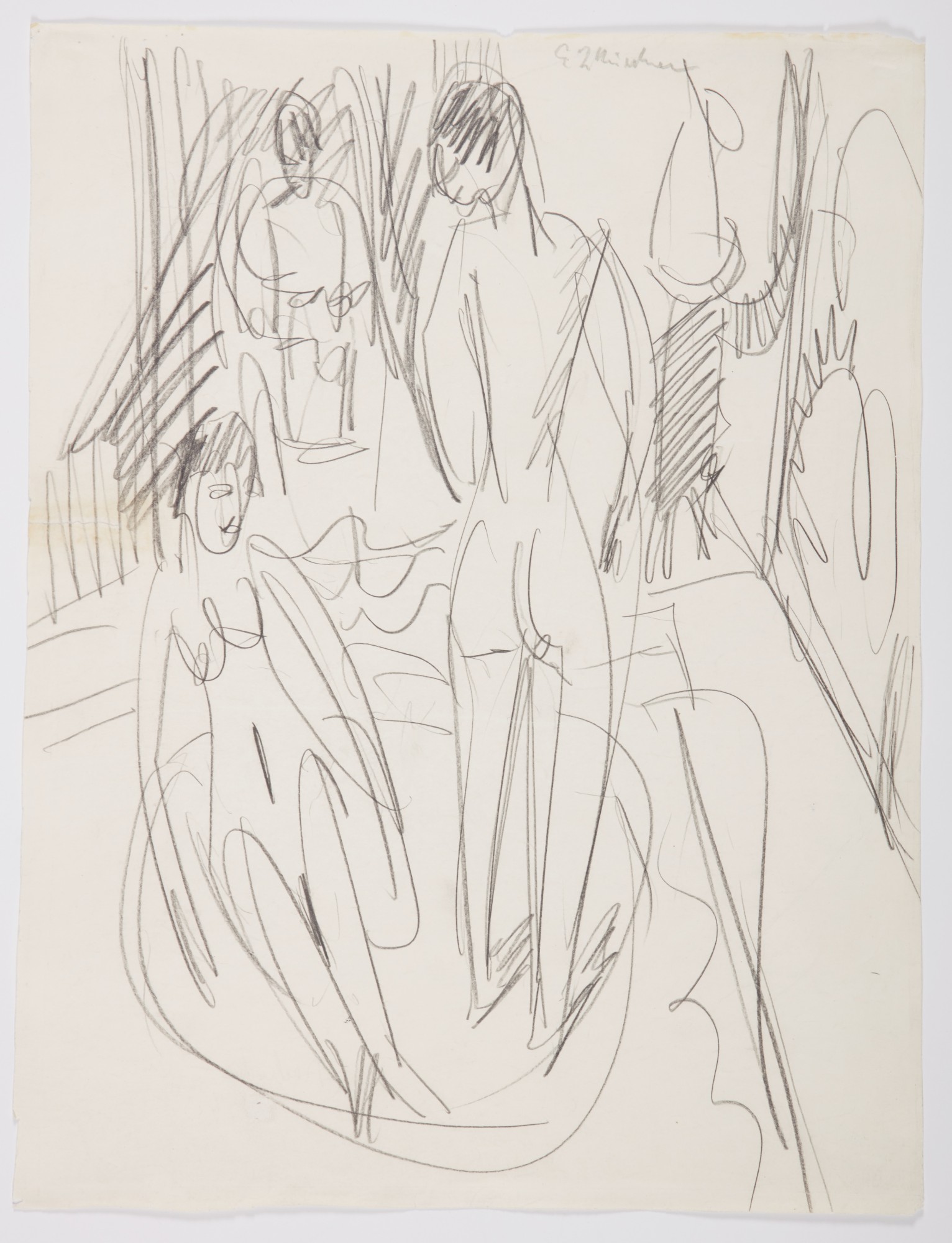
Badende im Tub, 1914
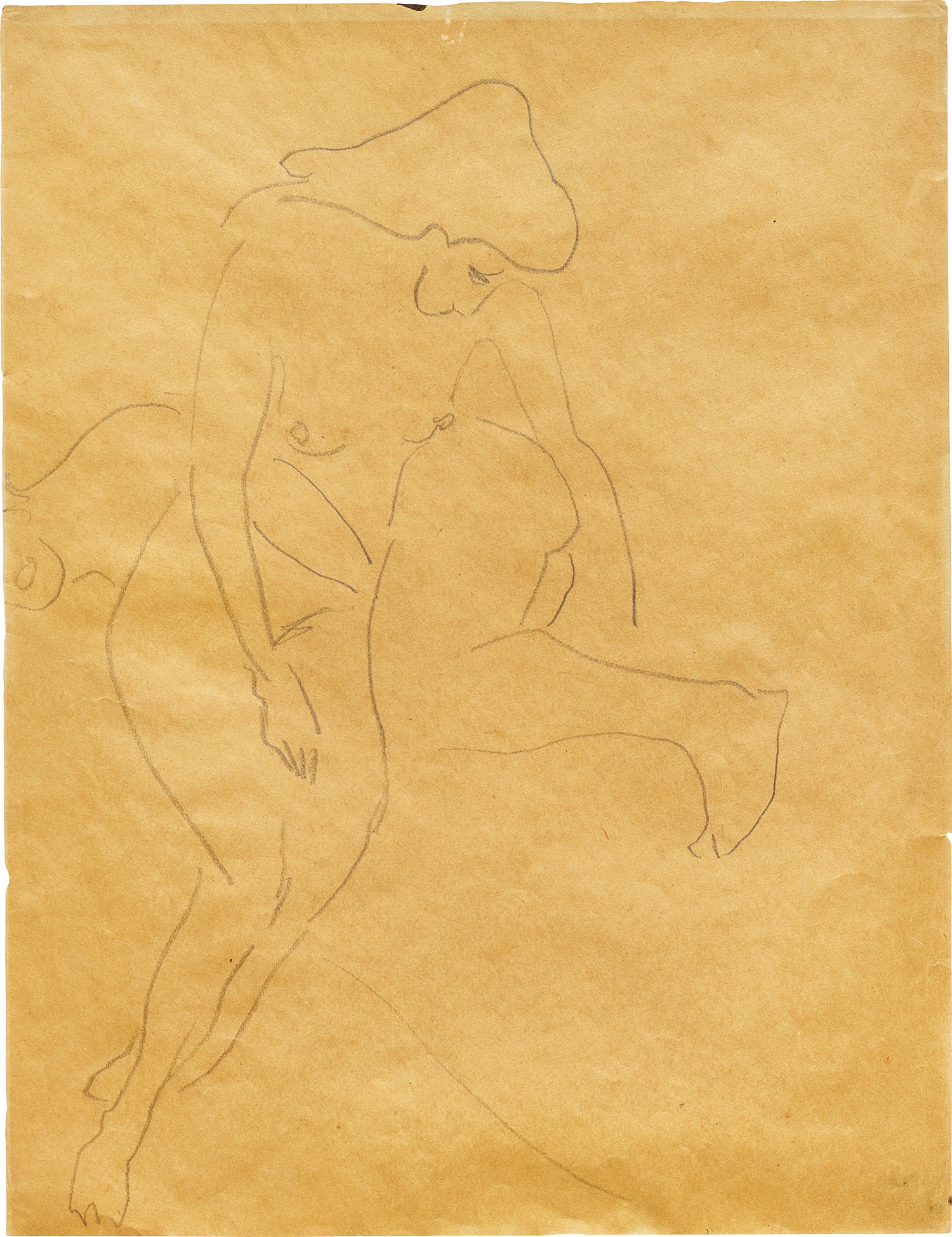
His early figure studies and nudes, including works like "Zwei liegende Akte" from 1907, already show a draughtsman of uncommon confidence, reducing the body to essential gestures without ever losing its warmth or presence. When Kirchner moved to Berlin in 1911, his art entered its most celebrated phase. The city's overstimulated rhythms, its crowded streets and artificial lights, its commerce and desire, became his primary subject. His Berlin street scenes, populated by elongated, mask faced figures in movement, are among the most recognizable images in modern art.
“I have always worked from life. Nature is always the basis of everything I do.”
Ernst Ludwig Kirchner, letter, circa 1920s
Works on paper from this period, such as the etching and aquatint "On the Street" from 1914, distill the metropolitan experience into pure graphic tension. His pastel and pencil "Tänzerin" from 1910 and the later pastel and charcoal "Tänzerin (Nina Hardt)" from 1921 reveal his sustained fascination with performance and the body in motion, capturing a kind of suspended electricity in figures that seem both entirely present and utterly elusive. The dancer became for Kirchner a symbol of freedom and artifice simultaneously, a figure who performs selfhood under the pressure of observation. The First World War brought crisis.
Ernst Ludwig Kirchner
Zwei liegende Akte, 1907
Kirchner was drafted into military service in 1914 and suffered a breakdown that led to his hospitalization and eventual convalescence in Switzerland. He settled in Davos in 1917, and the alpine landscape of the Sertig valley became his new obsession. Works such as "Tannen über dem Sertigtal (Davoser Landschaft)" from 1918 and "Mountain Landscape with Fir Trees" of the same year show the remarkable adaptability of his vision. The jagged peaks and dense fir forests of the Swiss Alps suited his graphic instincts perfectly, and his landscapes from this period have a grandeur entirely their own, charged with the same intensity he brought to the urban figure.
The watercolour and pencil medium he favored during these years carries a lightness and immediacy that makes these works especially prized by collectors today. For those entering the market for works on paper, Kirchner represents a genuinely compelling proposition. His graphic output was enormous and his technical range extraordinary, encompassing pencil, pastel, watercolour, pen and ink, etching, and the woodcut for which he is particularly celebrated. Works like "Kopf Ludwig Schames," a woodcut portrait of his Frankfurt dealer Ludwig Schames, and the richly layered "Melancholie" woodcut with its monotype coloring in black, mauve, and red, demonstrate the depth and diversity of his printmaking practice.
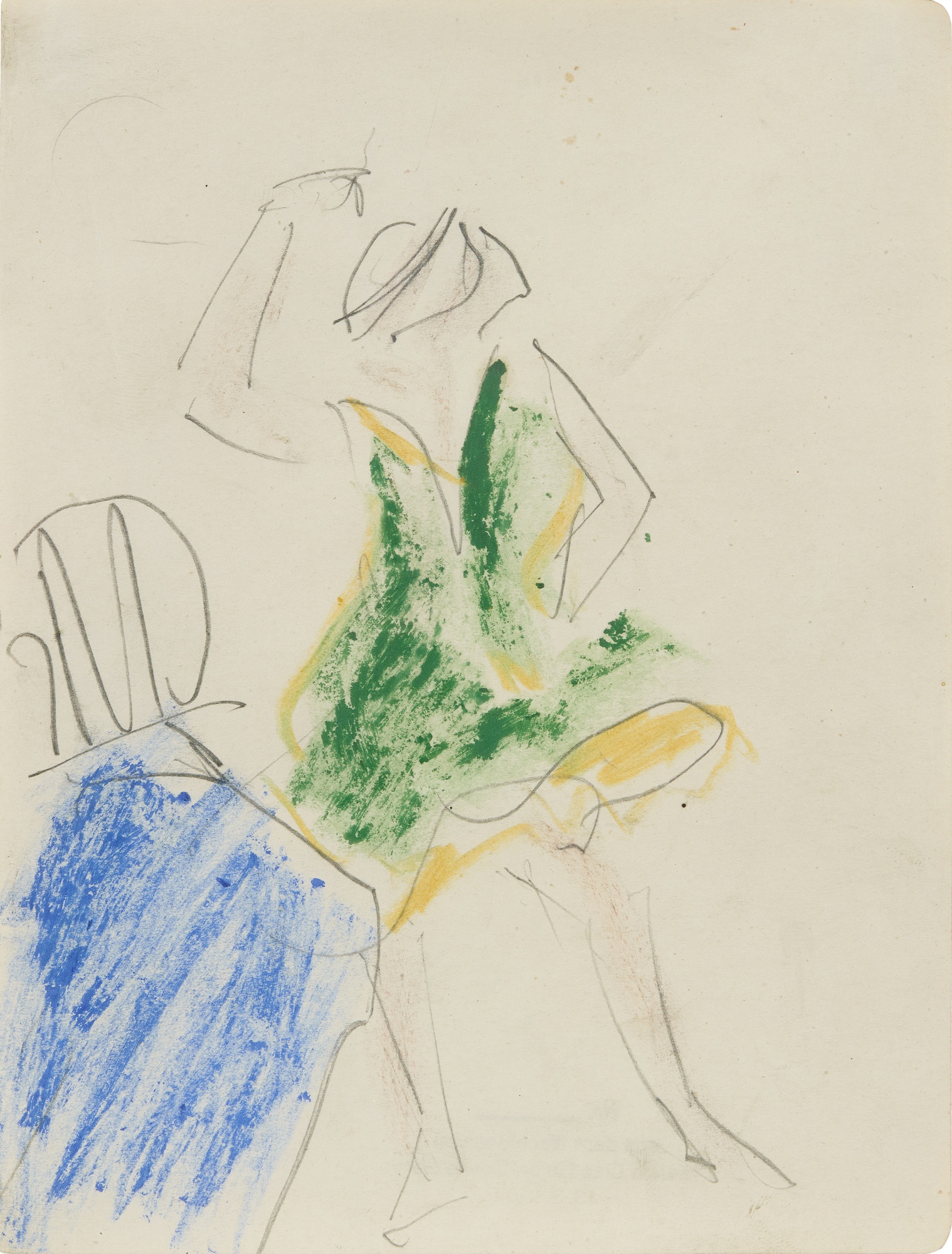
Ernst Ludwig Kirchner
Tänzerin, 1910
Prints and works on paper offer access to Kirchner's vision at a range of price points, and their intimacy, the sense of the artist's hand and mind working in real time, gives them a quality of presence that larger oil paintings do not always match. Major auction houses including Christie's, Sotheby's, and Phillips have handled significant Kirchner works in recent years, with strong results reflecting sustained institutional and private demand. Kirchner belongs to a constellation of early twentieth century artists who collectively redefined the expressive possibilities of figuration and line. His work exists in productive dialogue with that of his Die Brücke colleagues Heckel and Schmidt Rottluff, as well as with Emil Nolde and Max Pechstein.
Further afield, his distortions of space and figure resonate with the work of Egon Schiele in Vienna and with the figurative boldness of Henri Matisse, whose Fauve paintings Kirchner admired and argued with simultaneously. In the contemporary market, collectors drawn to Kirchner often find themselves equally drawn to Schiele, Nolde, and the broader tradition of Northern European Expressionism, a tradition that continues to exert profound influence on painters working today. Kirchner's life ended in tragedy in 1938 when, despairing over the Nazi regime's condemnation of his work as degenerate and the destruction that condemnation had already wrought, he died in Davos. Yet his art has survived that darkness entirely intact, and it speaks today with undiminished force.
To look at a Kirchner drawing is to be in the presence of a mind that perceived the world with almost painful acuity and that refused, always, to soften what it saw. He gave modernity a face, and that face remains one of the most searching and unforgettable in the history of art. For collectors who value work that combines formal brilliance with genuine emotional stakes, Kirchner is, quite simply, essential.
Explore books about Ernst Ludwig Kirchner
Ernst Ludwig Kirchner: 1880-1938
Donald E. Gordon
Ernst Ludwig Kirchner: Davos 1917-1938
Lucius Grisebach

Kirchner: Catalogue Raisonné of the Paintings
Donald E. Gordon

Ernst Ludwig Kirchner and the Berlin Street
Peter Selz
Ernst Ludwig Kirchner: Retrospective
Magdalena M. Moeller
Kirchner: Tanzende Mädchen, Nudes and Dancers
Anita Bekmambetova
Ernst Ludwig Kirchner: The Berlin Years
Reinhard Spieler