Emmet Gowin
Emmet Gowin: Tenderness, Earth, and Wonder
Artist Spotlight · The Collection Editorial
“Photography is a way of putting distance between myself and the work I fear to do.”
Emmet Gowin
There are photographers who document the world, and there are photographers who love it into meaning. Emmet Gowin belongs unmistakably to the second company. His work has been the subject of sustained institutional attention for decades, with the Princeton University Art Museum holding one of the most significant collections of his prints anywhere, a relationship that deepened through the long friendship and mentorship of curator Peter C. Bunnell.
Emmet Gowin
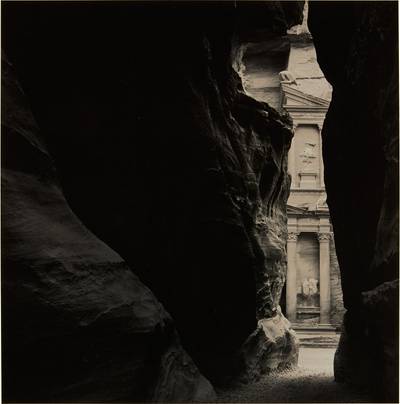
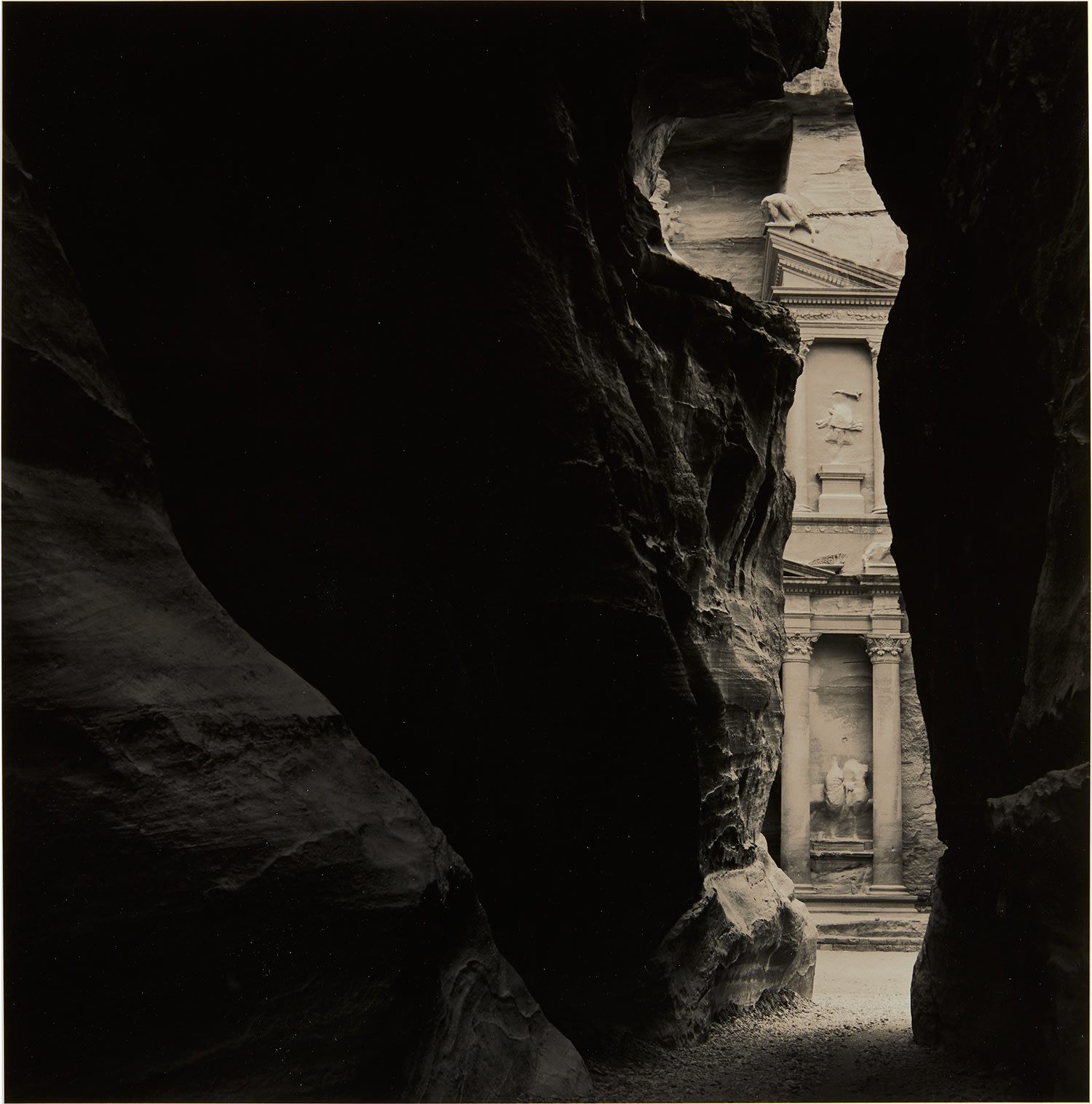
El Khazneh from the Siq, Petra, Jordan, 1986
That bond produced some of the most important groupings of Gowin's work in public hands, and the prints that circulate today through collections like The Collection trace their lineage directly to that legacy of careful, passionate stewardship. Gowin was born in 1941 in Danville, Virginia, a small city in the Piedmont South that would become one of the most charged geographic coordinates in American photography. He studied at the Richmond Professional Institute before completing his graduate work at the Rhode Island School of Design, where he encountered Harry Callahan, a meeting that proved transformative. Callahan's commitment to the personal, to the domestic, to the quietly sacred life of the ordinary, found in Gowin a devoted and original inheritor.
From Callahan he absorbed the understanding that the most intimate subject could carry universal weight, that a photograph of a wife or a child or a back porch could hold as much metaphysical ambition as any monument. It was in Danville, among his wife Edith and her extended family the Boohers, that Gowin first discovered his photographic voice. Beginning in the mid 1960s, he photographed this world with an intensity that felt less like documentary and more like devotion. The images of Edith became among the most celebrated in the American photographic tradition: tender, strange, occasionally surreal, shot on a large format camera with a wide angle lens that introduced a quality of immersive presence unlike anything being made at the time.
Emmet Gowin
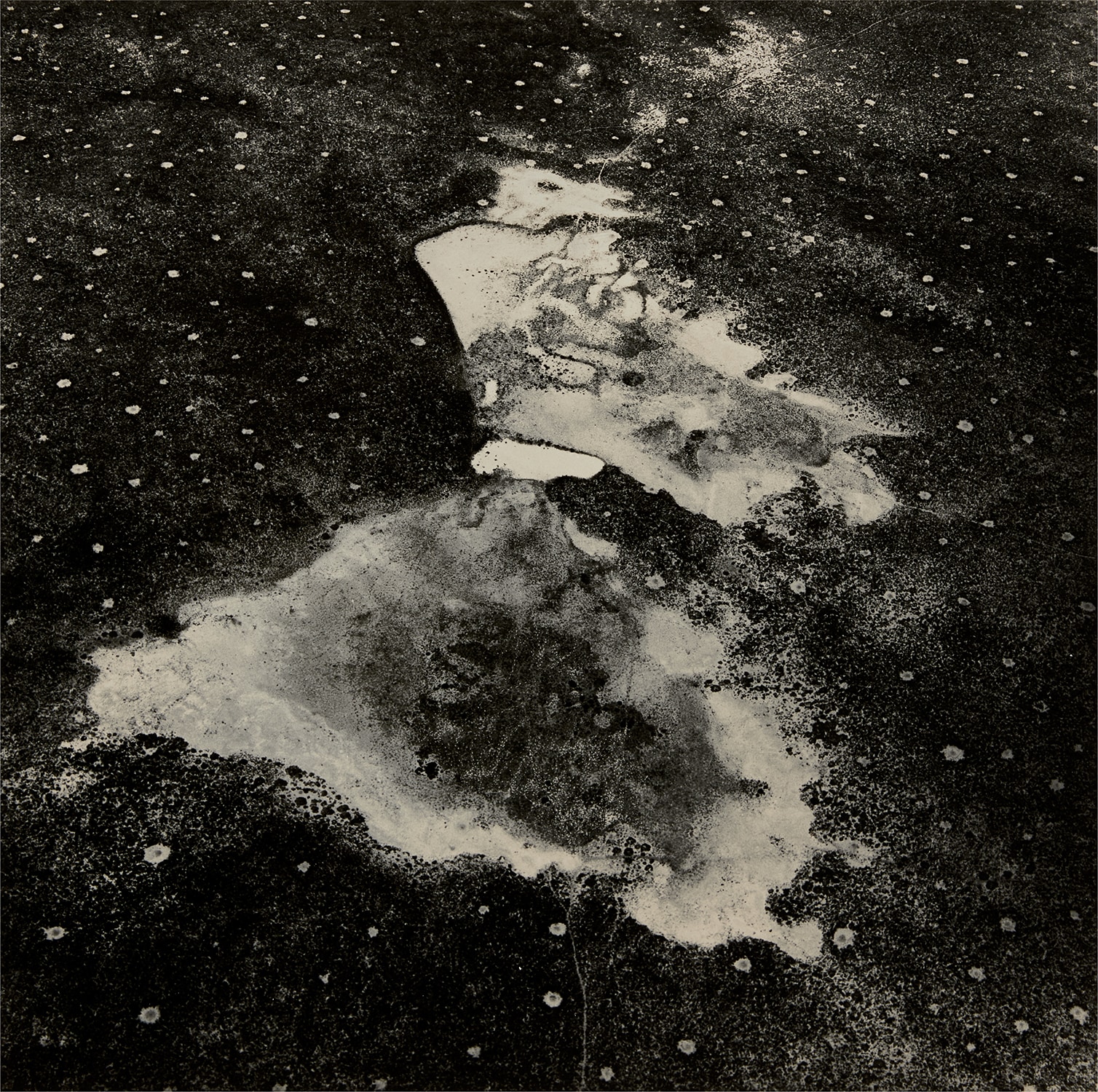
Dry Wash and Watering Hole, Near the Very Large Array, Magdelena, New Mexico, 1989
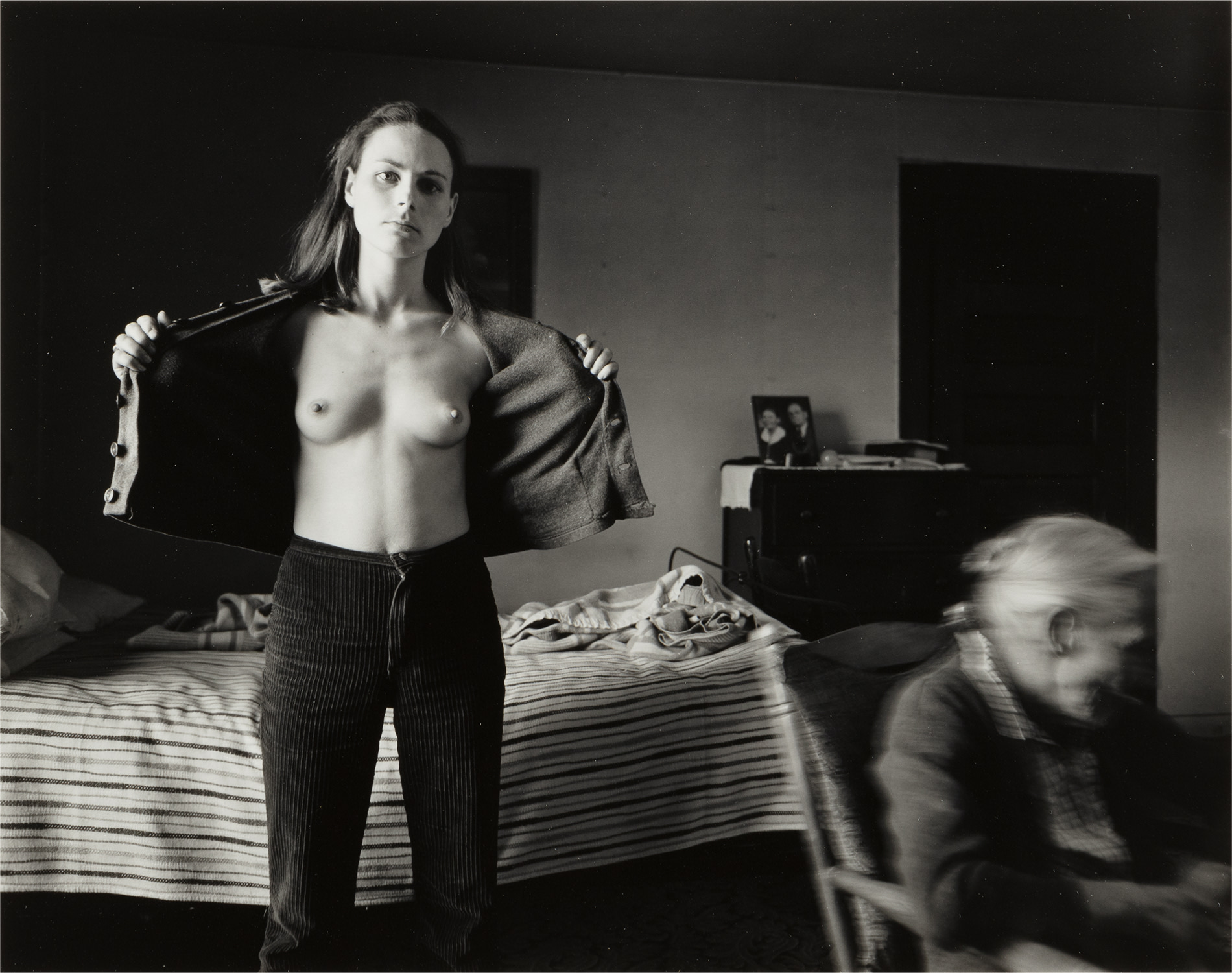
Works such as Edith, Chincoteague, Virginia and Edith and Rennie Booher, Danville, Virginia carry that unmistakable feeling of someone photographing not merely what they see but what they feel and remember and treasure. The gelatin silver prints from this period have a luminous, breathing quality that rewards close looking and rewards it again. The Danville pictures are remarkable not only for their emotional depth but for the way they absorbed and transformed the vernacular of American family photography. Gowin looked at snapshots, at the casual and the accidental, and found within them a formal intelligence that could be made conscious and purposeful.
“Edith is not so much the subject of my photographs as she is a reason to make photographs.”
Emmet Gowin
Works like Nancy and Dwayne, Danville, Virginia and Nancy, Twine and Blanket Construction, Danville, Virginia show a photographer attuned to the theatrical possibilities of ordinary life, to the way people perform themselves, sometimes absurdly and sometimes beautifully, within the spaces they inhabit. These prints, several of which appear in the celebrated Inside the Photograph collection assembled by Peter C. Bunnell, feel as alive today as they did when they were made. In the 1980s and into the 1990s, Gowin's practice underwent a significant and courageous evolution.
Emmet Gowin
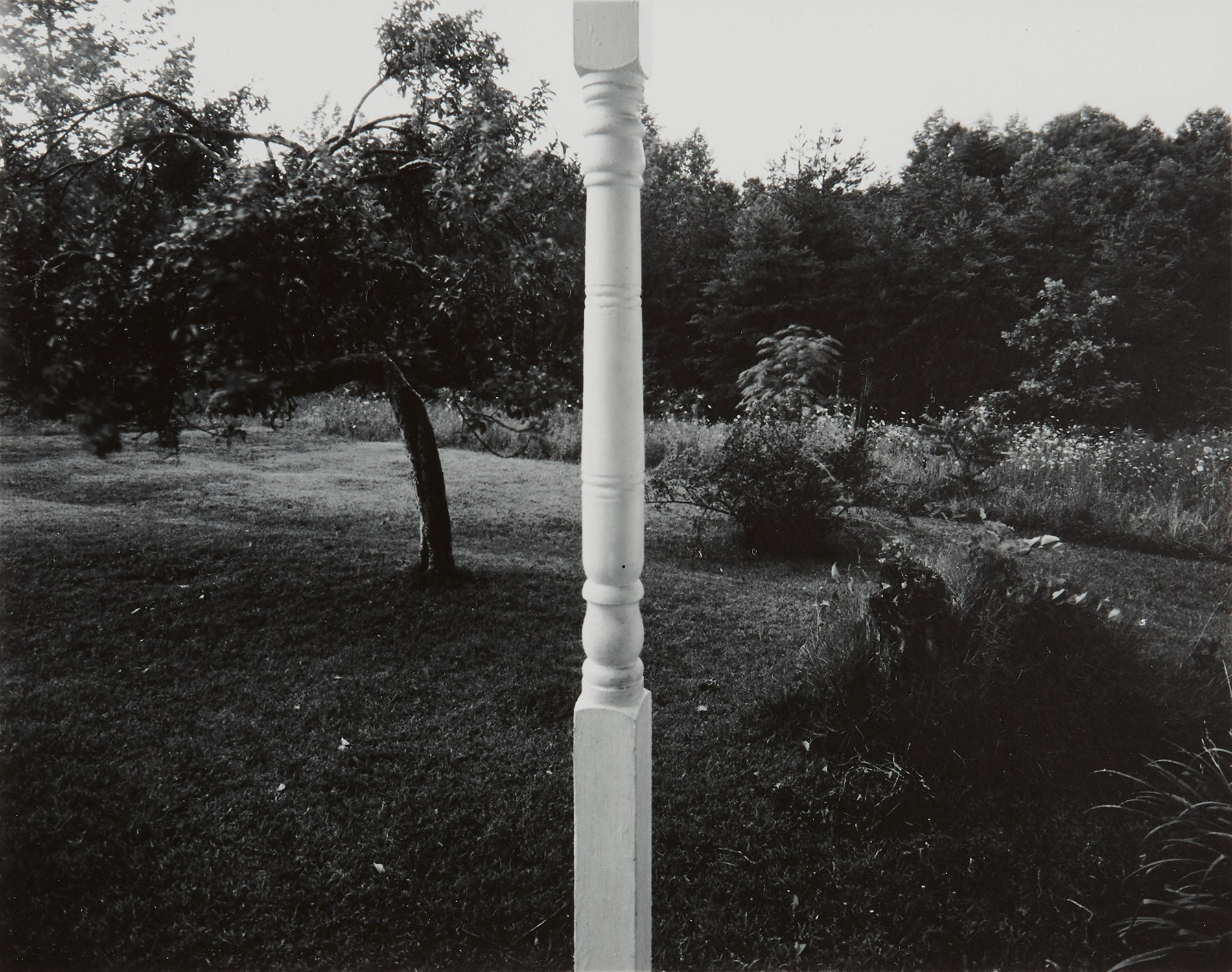
Post, Danville, VA
He turned to the aerial photograph, hiring small planes to carry him over landscapes scarred by human ambition and carelessness. The Nevada Test Site, the volcanic terrain of Mount St. Helens, and the ancient ruins of Jordan all became subjects in a body of work that expanded his poetic method to encompass the environmental and the geopolitical. The image Subsidence Craters on Yucca Flat, Nevada Test Site is among the most haunting photographs of the late twentieth century: a view of the earth's surface pocked and collapsed by decades of underground nuclear testing, rendered in gelatin silver with a formal beauty that intensifies rather than softens its horror.
The aerial works ask how we see power, how we measure what has been done to the land, and whether beauty is an ethical tool or a moral complication. The range of Gowin's geographic vision during this period is extraordinary. El Khazneh from the Siq, Petra, Jordan, made in 1986, shows the photographer moving through one of the ancient world's most astonishing architectural achievements with the same combination of awe and formal precision he brought to the landscapes of the American West. The two gelatin silver prints of Garden, Siena, Italy and Poggibonsi, Italy reveal a sensibility equally at home in the cultivated European landscape, responsive to the long human effort of tending and shaping the earth.
Emmet Gowin
Edith and Rennie Booher, Danville, Virginia
Across all of these geographies, Gowin's eye remains consistent: patient, attentive, and in possession of a lyrical intelligence that transforms documentation into something closer to meditation. For collectors, Gowin's work represents one of the most rewarding propositions in the American photography market. His prints occupy a space between the canonical masters of the medium and the more recent generation, meaning they are simultaneously well understood by institutions and still available to private collectors at prices that reflect genuine value rather than speculative inflation. The gelatin silver prints from the Danville period, particularly those printed close to the time of shooting, are especially prized for their tonal richness and the irreplaceable quality of their surface.
The aerial works from the late 1980s and early 1990s have attracted growing attention as environmental themes have become central to contemporary collecting culture, and their visual power holds up against any standard of photographic achievement. Collectors drawn to the work of Sally Mann, whose own explorations of family and Southern landscape owe something to the path Gowin opened, or to the lyrical documentary tradition of Robert Adams and the New Topographics movement, will find in Gowin an artist who is foundational to both conversations. Gowin spent many years on the faculty at Princeton University, where his teaching shaped generations of photographers and where his thinking about the ethics and poetics of the camera found its fullest articulation. His influence on American photography is both broad and deep, felt in the work of photographers who may not always name him but who absorbed his lessons through the culture he helped create.
He stands alongside figures like Callahan, Frederick Sommer, and Minor White as one of the essential voices in the tradition that insists photography is not merely a technology of recording but an art of seeing, feeling, and knowing. To collect Gowin is to hold something from the center of that tradition, something made with love and rigor and a profound respect for the visible world.
Explore books about Emmet Gowin