Elizabeth Catlett
Elizabeth Catlett, A Legacy Beautifully Carved
Artist Spotlight · The Collection Editorial
“Art for me must serve a purpose. It must be for the people, not for art galleries.”
Elizabeth Catlett, interview
In 2023, the Baltimore Museum of Art mounted a sweeping presentation of works by Elizabeth Catlett that drew record attendance and reminded a new generation of collectors exactly why this artist belongs in the same breath as the greatest printmakers and sculptors of the twentieth century. Her linocuts and lithographs, bold and unsparing and full of human warmth, moved through the galleries with the authority of someone who had always known exactly what art was for. Catlett made work for the people who needed it most, and the art world is still catching up to the full dimensions of her achievement. Elizabeth Catlett was born in Washington D.
Elizabeth Catlett
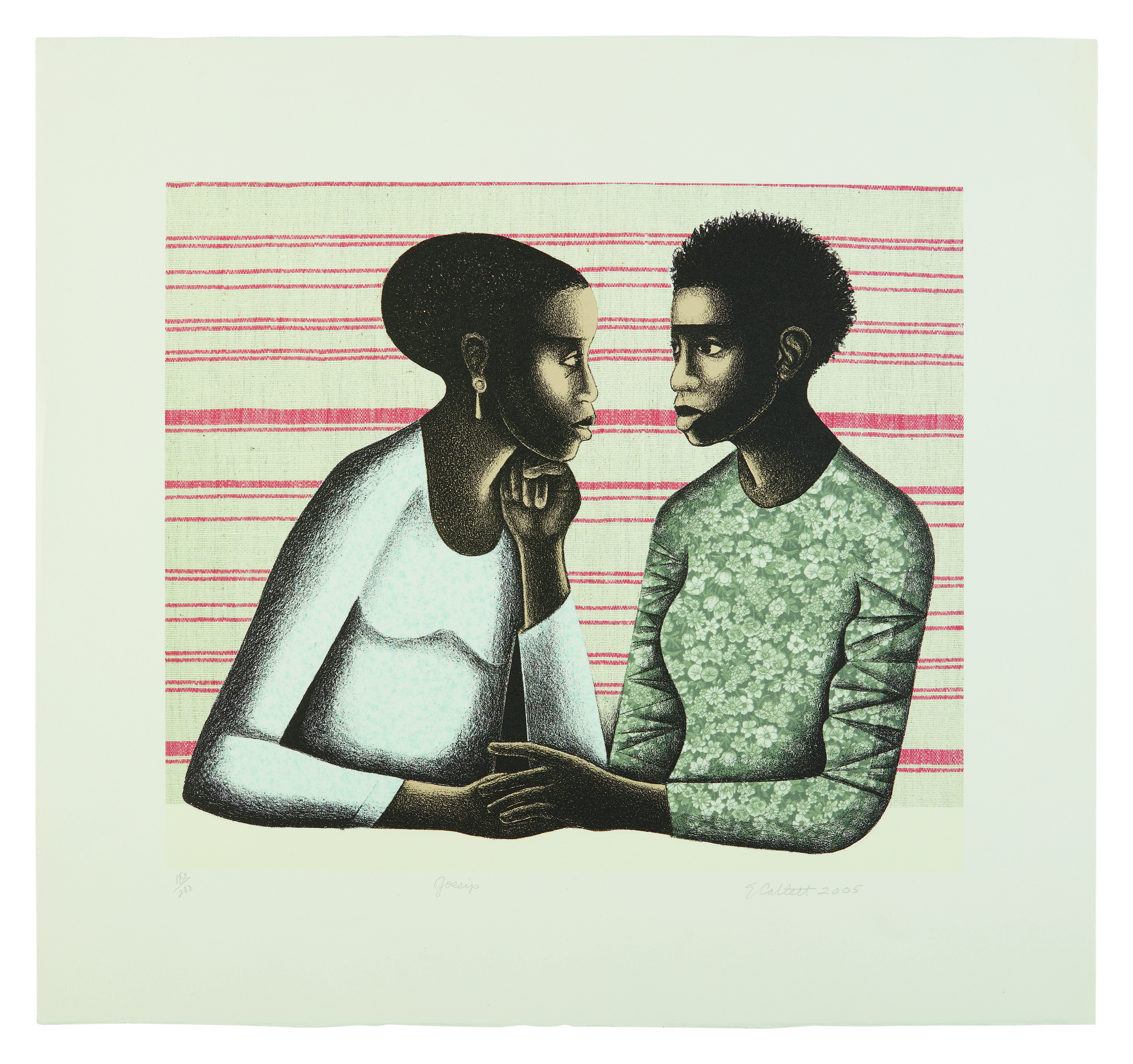
Gossip
C. in 1915, the granddaughter of enslaved people, and she came of age in a city shaped by segregation and intellectual ambition in equal measure. She applied to the Carnegie Institute of Technology and was accepted, then turned away when the school discovered she was Black. She enrolled instead at Howard University, where she studied design and printmaking under the painter Lois Mailou Jones, an encounter that planted in her the conviction that rigorous formal training was inseparable from a commitment to social purpose.
She went on to earn her MFA from the University of Iowa in 1940, becoming the first student to complete the program, studying under Grant Wood, who pushed her toward a more direct and emotionally grounded approach to subject matter. The 1940s were transformative for Catlett in every sense. She moved to New York and became part of the vibrant intellectual life of Harlem, where she encountered artists, writers, and activists who reinforced her belief that art must speak to lived experience. A Julius Rosenwald Fellowship in 1945 brought her to Mexico City, where she joined the Taller de Gráfica Popular, a collective of politically committed printmakers whose influence on her visual language would prove decisive.
Elizabeth Catlett
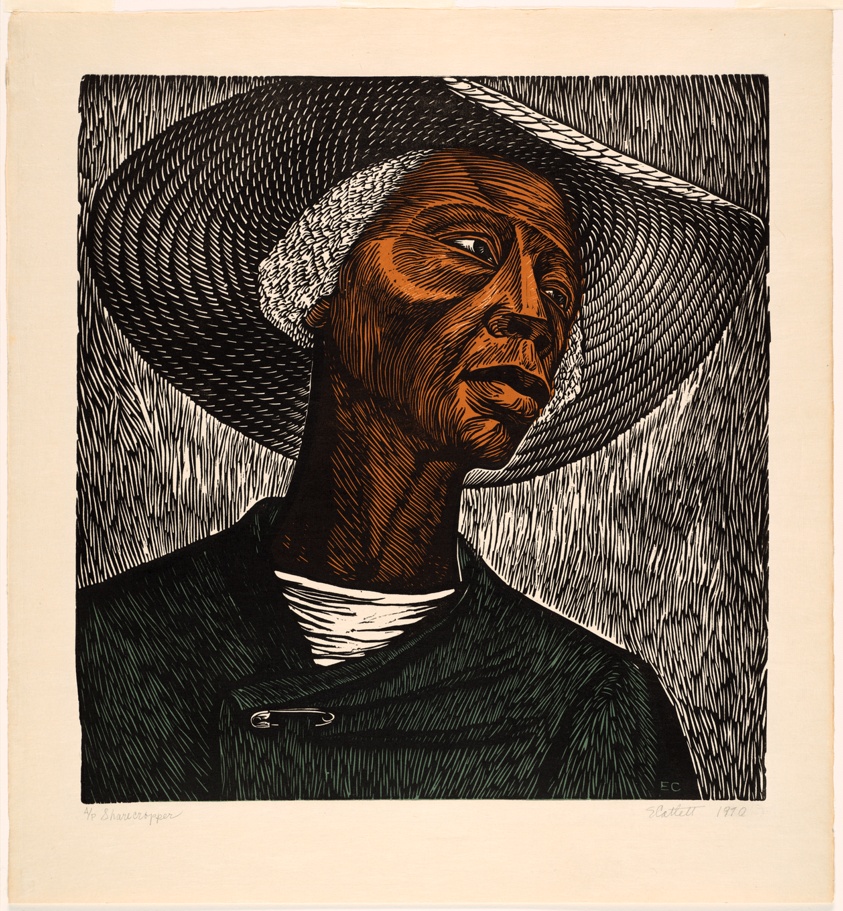
Sharecropper, 1952
The TGP taught her the communicative power of bold line, high contrast, and images that could be reproduced and distributed widely. Mexico also became her permanent home. She married the Mexican artist Francisco Mora in 1947, eventually became a Mexican citizen in 1962, and spent the rest of her long life rooted in Cuernavaca. Catlett's signature works are studies in moral clarity and formal confidence.
“I have always wanted my art to serve Black people, to reflect us, to relate to us.”
Elizabeth Catlett
Her 1952 linocut Sharecropper is perhaps the single image most associated with her name, a close portrait of a Black woman in a wide brimmed hat, her face rendered with geometric precision and absolute dignity. The work carries no sentimentality and demands no pity. It simply insists on full humanity, and it does so with a graphic economy that makes it unforgettable. Her 1969 lithograph Black is Beautiful, also known as Negro es bello II, captures the spirit of that particular cultural moment with the kind of visual intelligence that ensures the image transcends its moment entirely.
Elizabeth Catlett
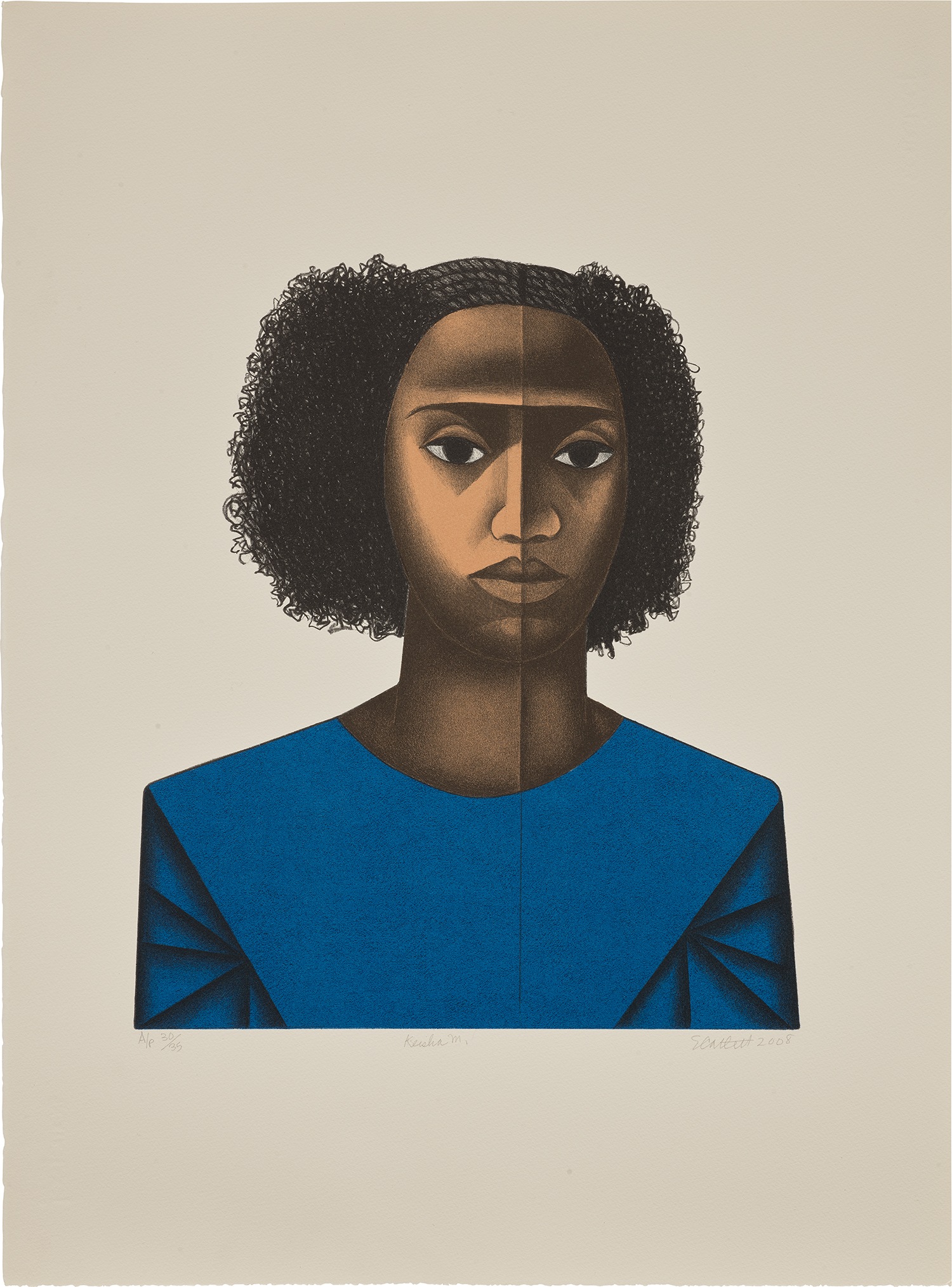
Keisha M.
The woman at the center of that composition looks outward with a calm, undefeatable assurance. These are not documents of suffering. They are declarations of presence. For collectors, Catlett's prints represent one of the more compelling opportunities in the postwar American and Latin American market.
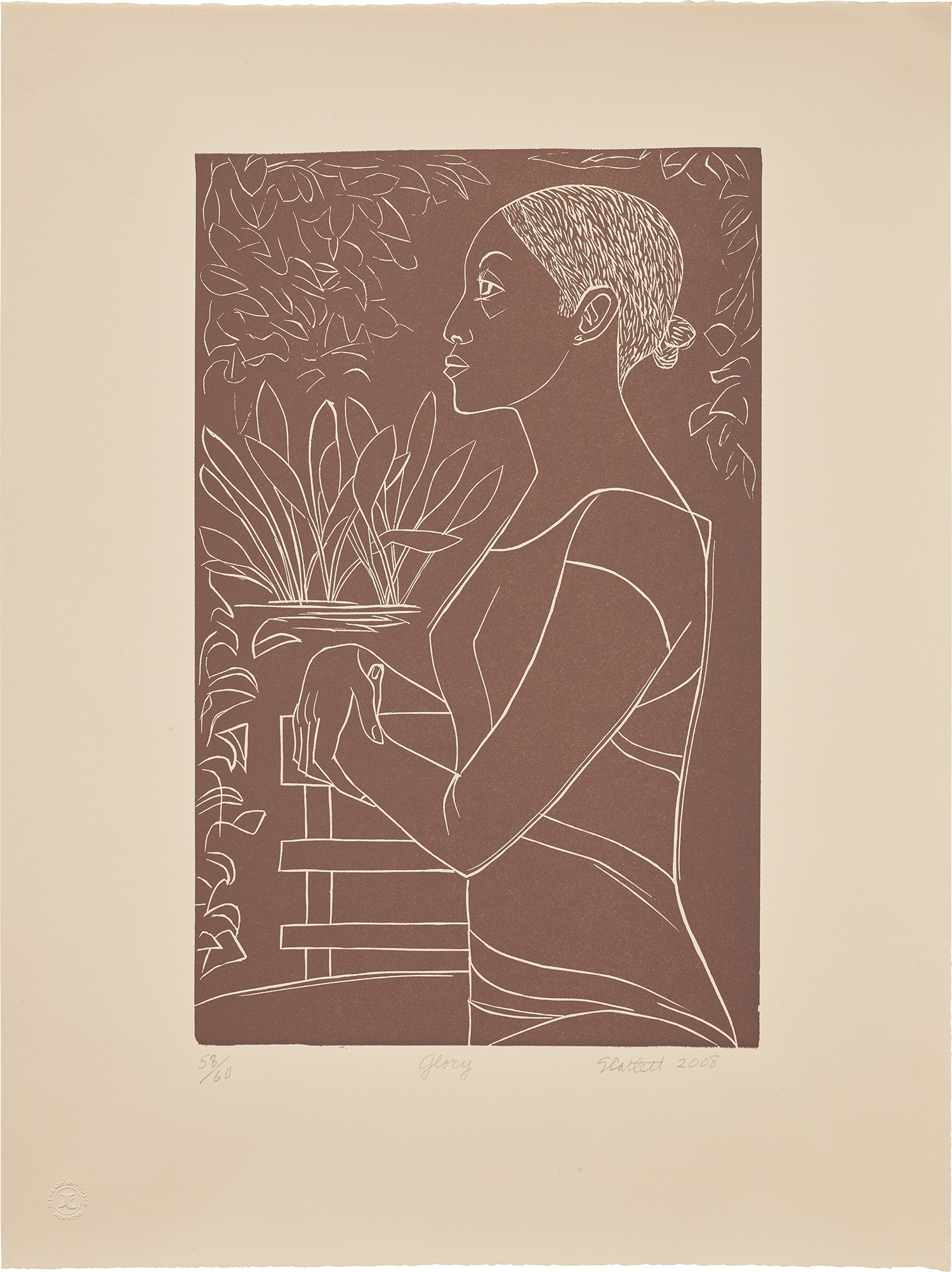
Her linocuts on cream Japanese paper, her lithographs on Somerset and Hahnemühle, her signed and numbered editions including works like Glory and Irena, all speak to a practice grounded in the print as a vehicle for democratic circulation as well as aesthetic excellence. The market for her work has grown steadily over the past two decades as institutions and private collectors have recognized what scholars knew long before the auction houses caught on. Works on paper by Catlett that once changed hands modestly now appear with serious estimates at major salesrooms, and her sculptures in bronze have achieved significant results at Christie's and Sotheby's. Collectors who engage with her editions are acquiring not just beautiful objects but objects with a genuinely important place in the history of American and Mexican modernism.
Elizabeth Catlett
Glory
Catlett belongs to a tradition that includes her contemporary Charles White, with whom she was once married and with whom she shared a deep commitment to representing Black American life with dignity and artistic rigor. Her work also resonates alongside that of Diego Rivera and José Clemente Orozco, whose influence she absorbed at the TGP, and she stands as a clear precursor to artists like Kara Walker and Kerry James Marshall, both of whom have cited the power of her graphic legacy. To place a Catlett print in a collection is to locate oneself within one of the most meaningful threads running through twentieth century art, one that connects social commitment to formal mastery without ever sacrificing either. Elizabeth Catlett continued working well into her nineties and died in Cuernavaca in 2012 at the age of ninety six.
The breadth of that life and the consistency of purpose that runs through it from her earliest student prints to her final sculptures is what gives her work its unusual gravity. She never chased trends and never abandoned her subjects. Her images of Black women, of workers, of mothers and daughters and communities enduring and persisting, feel as alive today as they did when she first pulled them from the press. For anyone building a collection with a genuine historical consciousness, Catlett is not simply a name to know.
She is an artist whose work rewards deep looking and whose legacy is still, with each new generation of eyes, expanding.
Explore books about Elizabeth Catlett
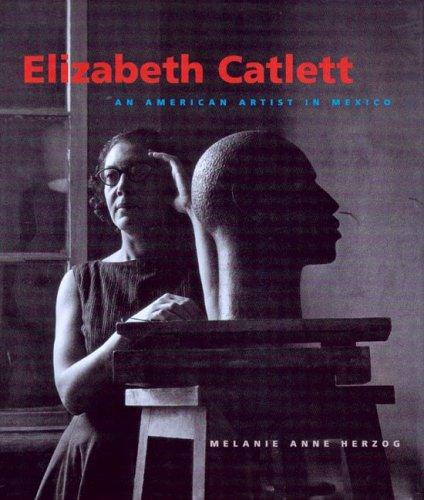
Elizabeth Catlett: An American Artist in Mexico
Melanie Herzog

Elizabeth Catlett: Art and Social Activism
Marilyn Richardson
Elizabeth Catlett: Printmaker
Helen Forman
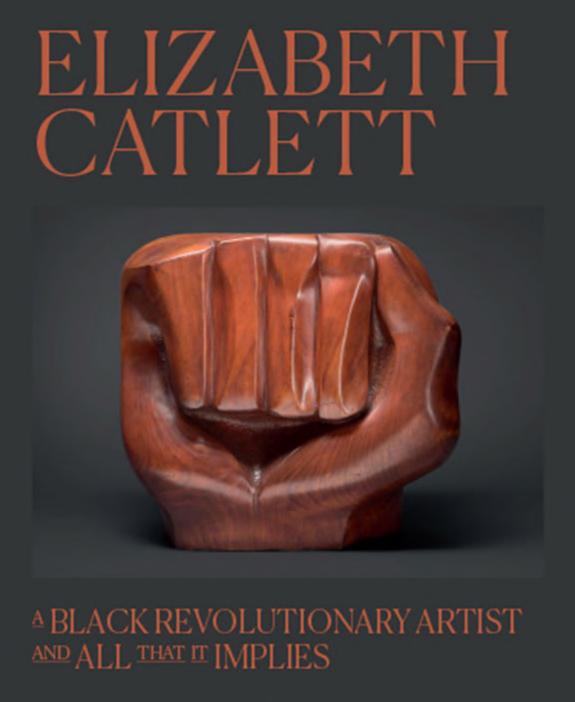
The Life and Art of Elizabeth Catlett
Freida High W. Tesfagiorgis
Elizabeth Catlett: Sculptor
Melanie Herzog
A Search for Equality: The Life and Legacy of Elizabeth Catlett
Marilyn Richardson