Edvard Munch

Edvard Munch: The Artist Who Felt Everything
Artist Spotlight · The Collection Editorial
“I was born dying. It was part of my nature and it has been my most powerful source of inspiration.”
Edvard Munch, diary writings
There is a moment in Oslo's Munch Museum, the vast Bjørvika building that opened in 2021 to house the largest collection of a single artist's work anywhere in the world, where visitors stop walking. They stand before canvases that seem to breathe, portraits that seem to listen, landscapes that hum with an almost unbearable inner life. The museum, with its extraordinary holdings of over 26,000 works across paintings, prints, drawings, watercolors, and writings, has reintroduced Edvard Munch to a new generation not merely as the painter of a single screaming figure but as one of the most prodigiously gifted, emotionally articulate, and formally inventive artists who ever lived. The world, it turns out, was always ready for him.
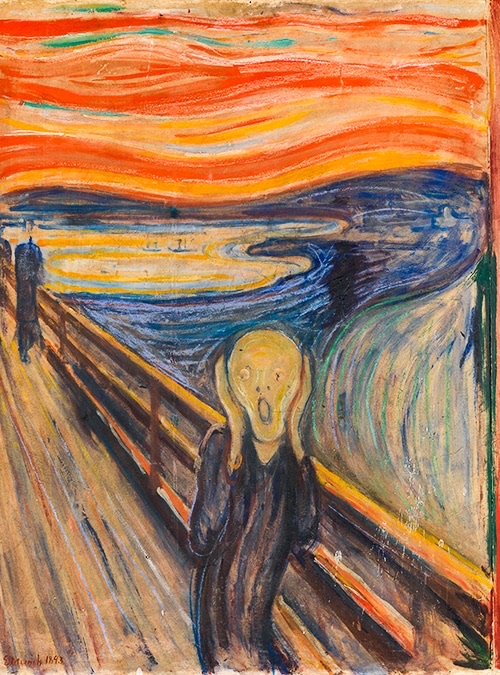
Edvard Munch
The Scream, 1893
It simply needed reminding. Edvard Munch was born on December 12, 1863, in Løten, a small municipality in Innlandet, Norway. His childhood was shaped by proximity to death and by an intensity of feeling that he would spend his entire career attempting to make visible. His mother died of tuberculosis when he was five years old, and his sister Sophie died of the same disease when Munch was fourteen.
His father, a military doctor with deep religious convictions, filled the household with both tenderness and an anxious, brooding piety. Munch would later write that illness, madness, and death were the dark angels that stood at his cradle, and that sense of life as something luminous but fragile runs through every work he made. He enrolled at the Royal School of Art and Design in Christiania, the city now called Oslo, in 1881, and by the mid 1880s he had already begun to absorb the influence of the naturalist painter Christian Krohg and the radical intellectual circles gathering around the anarchist writer Hans Jaeger. It was in the late 1880s and through the 1890s that Munch's art underwent its most decisive transformation.
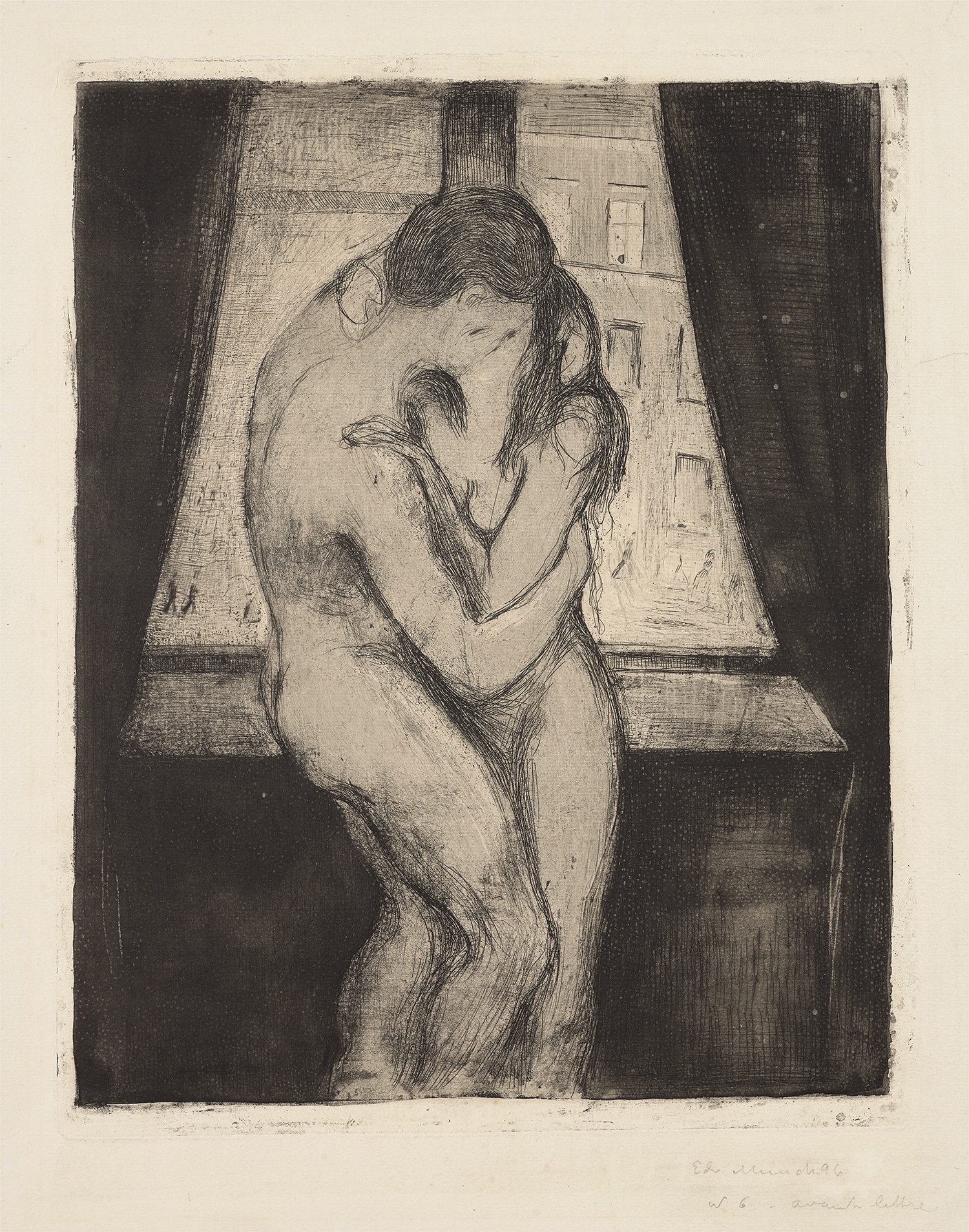
Edvard Munch
Der Kuss, Kyss (The Kiss) (W. 23, Sch. 22)
Travels to Paris brought him into contact with Post Impressionism, the work of Paul Gauguin, and the searing color logic of Vincent van Gogh. But Munch was pursuing something more interior than landscape or social observation. He began conceiving of a series of interconnected paintings that he called the Frieze of Life, a monumental meditation on love, anxiety, and mortality organized into thematic cycles. These were not simply paintings.
“From my rotting body, flowers shall grow and I am in them and that is eternity.”
Edvard Munch, diary writings
They were a new kind of psychological theater, in which the human figure becomes an instrument for registering invisible forces, dread, longing, dissolution, and ecstatic surrender. The works from this period demonstrate a command of line and composition that is almost operatic in its ambition. The works that collectors and institutions prize most highly tell that story with extraordinary range. The Scream, conceived in 1893 and realized in multiple versions across painting and printmaking, is perhaps the most reproduced image in the history of Western art, and yet it rewards close looking with a complexity that reproduction cannot convey.
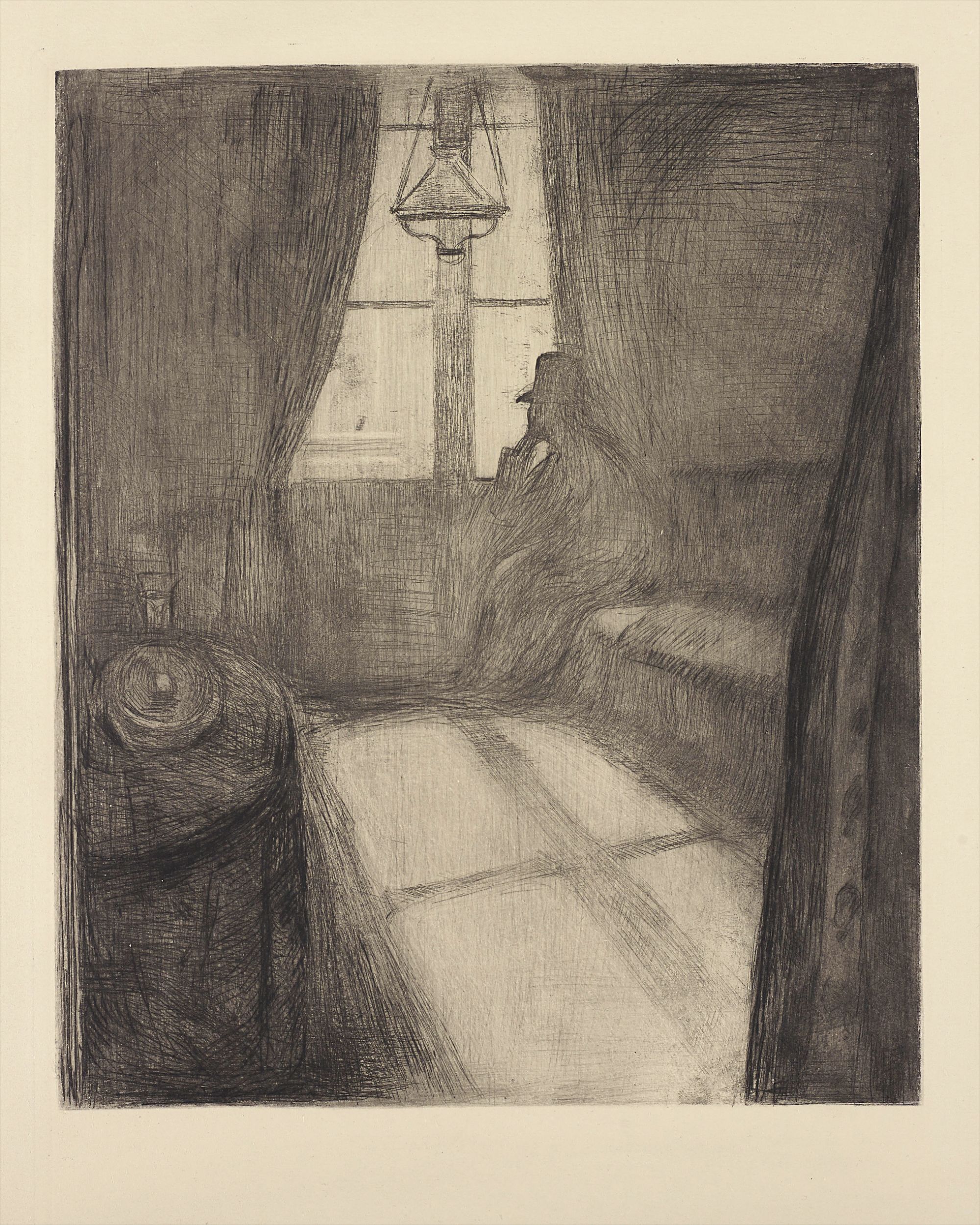
Edvard Munch
Moonlight. Night in St. Cloud
The swirling, rust and blood colored sky, the bridge receding at a vertiginous angle, the central figure whose body seems on the verge of dissolving into the landscape: this is not despair but perception, a moment in which the membrane between self and world becomes terrifyingly thin. Equally significant is the Madonna, executed in lithograph form from 1895 through 1902, which presents feminine energy as something cosmic and untamed, framed by a border of spermatozoa and a small fetal figure in one corner. The Kiss, rendered here in etching with drypoint, shows two figures merging so completely that individual identity seems to dissolve, a vision of love as absorption rather than union. And the Vampire series, striking in lithograph and woodcut, depicts intimacy as something between surrender and predation, with a tenderness that complicates any simple reading.
“I paint not what I see but what I saw.”
Edvard Munch
Munch's prints deserve particular attention from collectors, and the selection available on The Collection reflects the full breadth of his graphic genius. His lithographs, etchings, and woodcuts were not reproductions of his paintings but independent investigations, works in which the resistance of the plate or the woodblock pushed him toward new formal decisions. Vampire II from 1895, printed in both lithograph and woodcut, carries a visceral color saturation that feels entirely modern. Moonlight: Night in St.
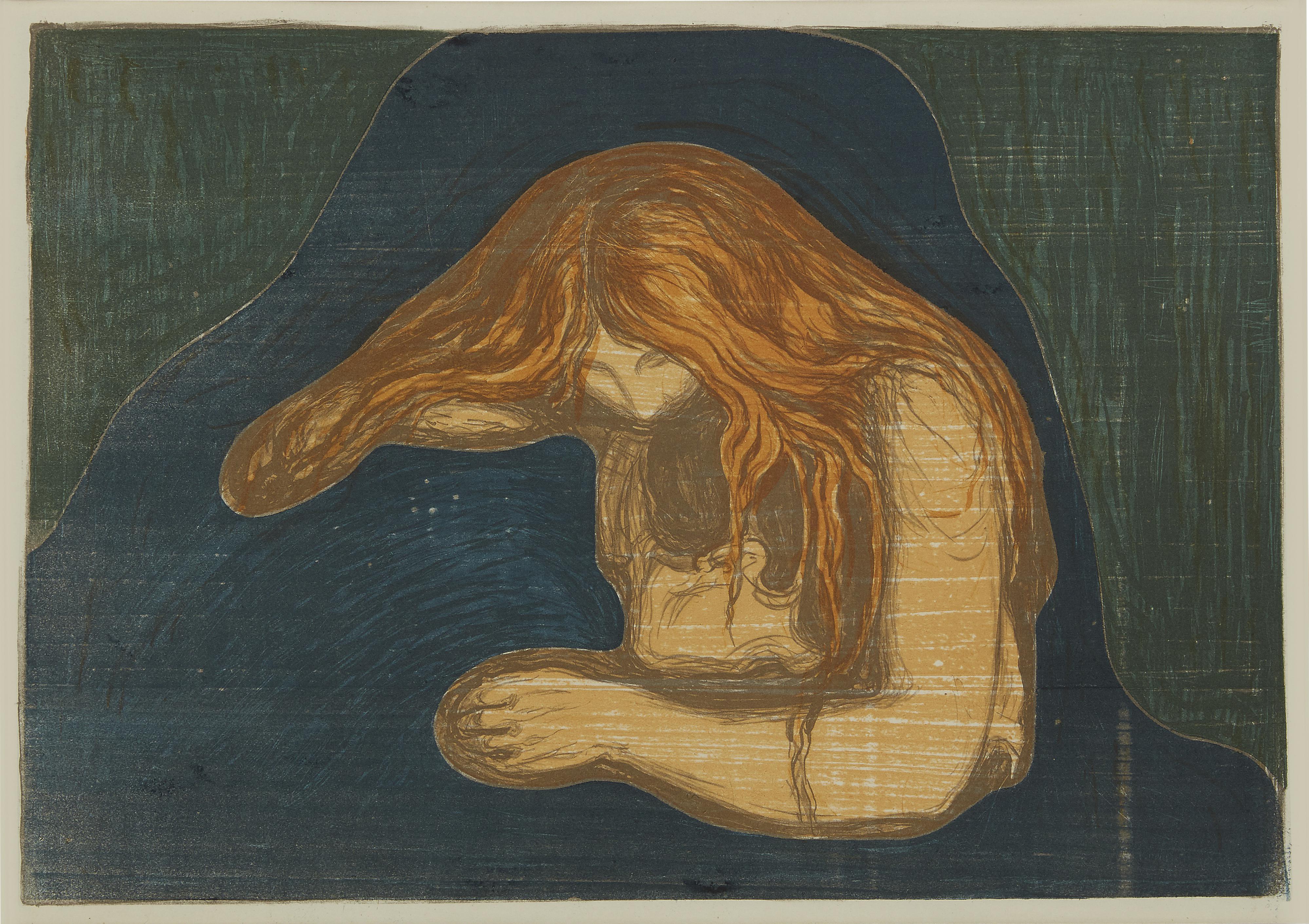
Edvard Munch
Vampire II (Schiefler 34; Woll 41), 1895
Cloud, a drypoint with open bite and burnisher work, demonstrates his mastery of atmospheric darkness and psychological stillness. Summer Night (The Voice) from 1895 uses the etched line with a lyrical economy that anticipates much of twentieth century graphic art. These are not lesser works by a painter who also made prints. They are masterpieces in a medium to which Munch brought genuine revolutionary vision.
The market for Munch has reflected his canonical stature for decades. The Scream in its pastel version sold at Sotheby's New York in May 2012 for approximately 119.9 million dollars, setting a record at the time for any work sold at auction. But the deeper collecting opportunity has always been in the prints and works on paper, where Munch's technical inventiveness and emotional range are fully present at prices that represent remarkable value relative to his historical importance.
Collectors are drawn to the rarity of different states, the quality of individual impressions, and the way each work opens a window onto a singular creative intelligence. Munch kept enormous numbers of works in his studio throughout his life, a practice he called the horse cure, believing that paintings should survive harsh conditions or be discarded. Works that emerged from that extraordinary archive carry a particular authenticity. To understand Munch fully it helps to place him in relation to the artists with whom he was in dialogue.
James Ensor in Belgium was pursuing a similarly unsettling vision of masked and carnival humanity at roughly the same moment. Gustav Klimt in Vienna was exploring eros and death with comparable decorative intensity. The German Expressionists, particularly Ernst Ludwig Kirchner and Erich Heckel, absorbed Munch's woodcut techniques and his willingness to distort form in the service of inner truth. He is, in many senses, the hinge figure between late nineteenth century Symbolism and the full explosion of Expressionism, a connective tissue in the body of modern art that becomes more visible the more carefully one looks.
Munch lived until 1944, working prolifically at his estate at Ekely outside Oslo, painting landscapes, self portraits, and figures in nature with a freedom and directness that continues to astonish. The late painting Epletre i hagen på Ekely, Apple Tree in the Garden at Ekely from 1928, is a radiantly alive work, the tree rendered with a brushwork that feels simultaneously spontaneous and deeply considered, its branches reaching into a sky of luminous cool gray. The Bathing Scene from Åsgårdstrand from 1904 glows with the particular quality of Nordic summer light, figures in a landscape that is both utterly specific and somehow universal. These are works by an artist who never stopped looking, never stopped feeling, and never stopped discovering new ways to make the inner life visible.
That is the enduring gift of Edvard Munch, and it is why his work continues to feel, more than a century after it was made, urgently, unmistakably alive.
Explore books about Edvard Munch
Edvard Munch: Life and Work
Reinhold Heller
The Scream
Michael Levey
Edvard Munch: A Master of Line and Color
Gerd Woll
Munch
Arne Eggum
The Complete Paintings of Edvard Munch
Paolo Lecaldano
Edvard Munch: Symbols and Images
Reinhold Heller
Munch: His Life and Art
Rolf E. Stenersen
The Frieze of Life
Reinhold Heller