Édouard Baldus
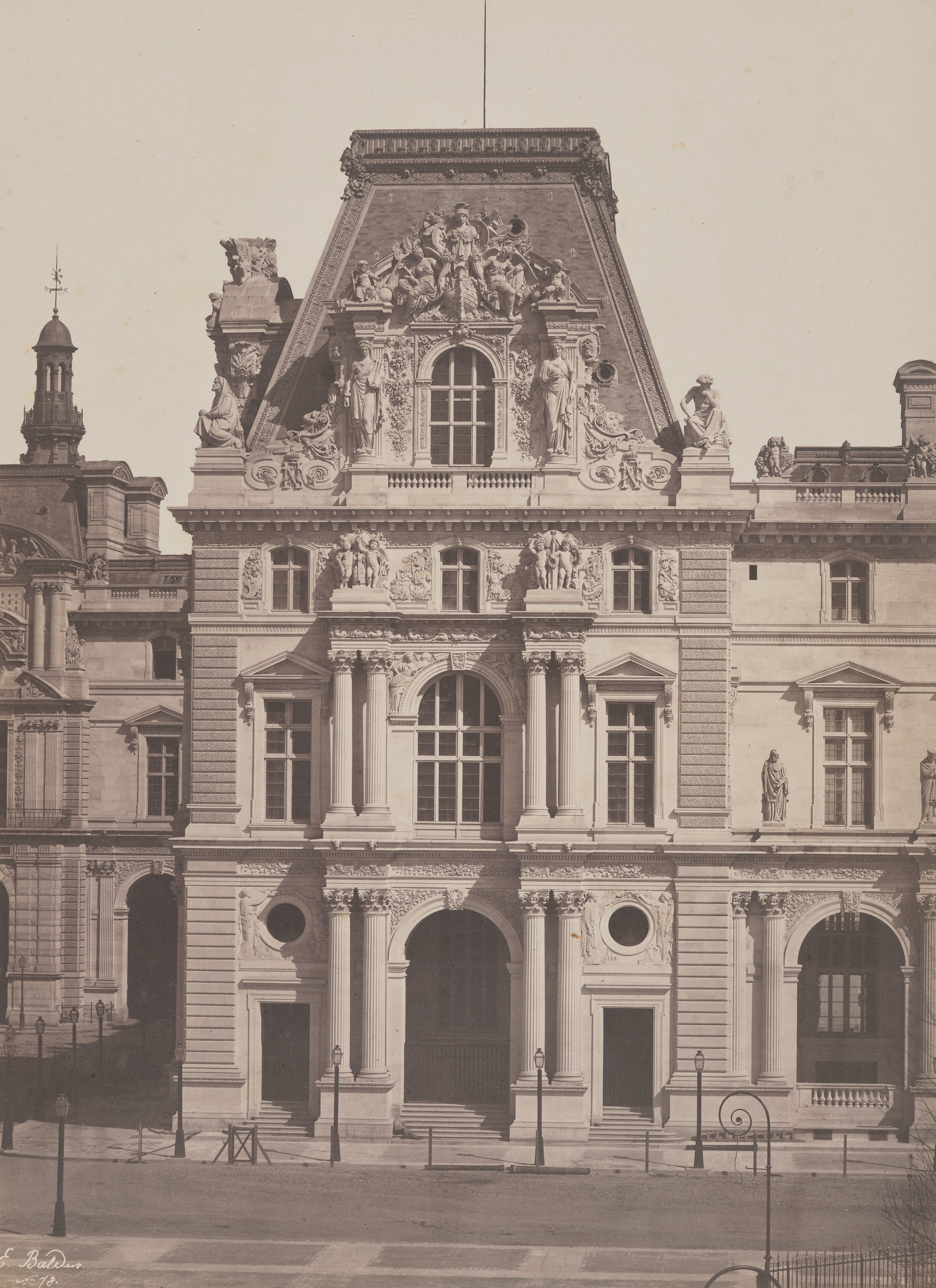
Édouard Baldus: Light, Stone, and Grandeur
Artist Spotlight · The Collection Editorial
Imagine standing before the newly completed Louvre in the Paris of the 1850s, the scaffolding barely down, the stone still pale and raw in the morning light. A man sets up his large format camera in the courtyard, adjusts his lens with the patience of a painter, and waits for the sun to reach exactly the right angle across the carved facades. That man is Édouard Baldus, and the photographs he made in those extraordinary years remain among the most commanding images of architecture ever produced. More than a century and a half later, his prints still carry the weight and stillness of monuments built to last forever.
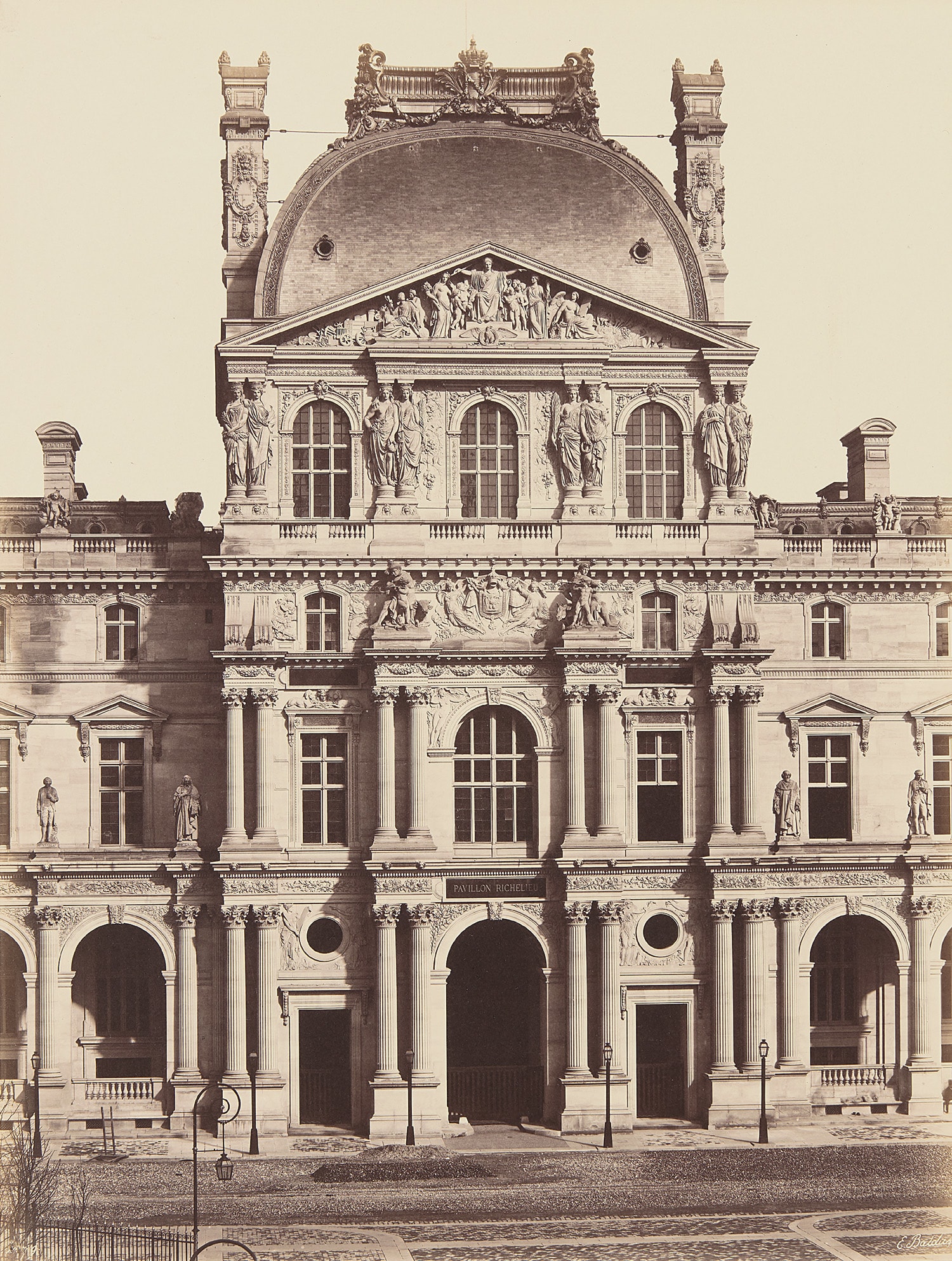
Édouard Baldus
Au Louvre, Pavillon Richelieu, Paris
Baldus was born in 1813 in Grünebach, in the Prussian Rhineland, and arrived in France as a young man, eventually settling in Paris and training initially as a painter. He took French citizenship and immersed himself in the cultural life of a city that was rapidly reinventing itself. His turn toward photography came in the late 1840s and early 1850s, a period when the medium was still finding its footing, when practitioners were simultaneously scientists, artisans, and visionaries. Baldus brought to photography the compositional instincts of a classically trained artist and a craftsman's obsessive attention to process and material quality.
His breakthrough came swiftly and decisively. In 1851, Baldus was selected as one of five photographers commissioned for the Missions Héliographiques, a landmark French government initiative that dispatched photographers across the country to document historic architecture and monuments at risk of deterioration or destruction. Alongside Charles Nègre, Henri Le Secq, Gustave Le Gray, and O. Mestral, Baldus traveled through southern France, capturing Roman temples, medieval churches, and Romanesque cloisters with a clarity and formal authority that distinguished his work from the start.
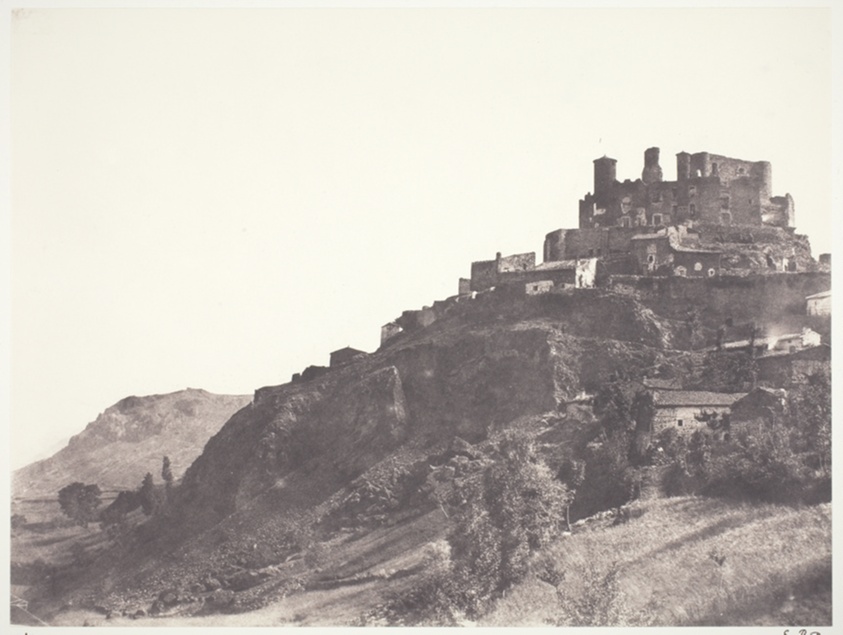
Édouard Baldus
Chateau de Murol en Auvergne, 1854
His salted paper print of the facade of the Temple of Augustus and Livia in Vienne, made in 1851, already demonstrates his signature approach: a frontal, monumental framing that honors the geometry of the structure while allowing the texture of ancient stone to breathe across the surface of the print. The decades that followed cemented his reputation as the preeminent photographer of French architecture and public works. His extensive documentation of the Nouveau Louvre, produced as Napoleon III and Baron Haussmann were transforming Paris into a modern imperial capital, is among the most sustained and ambitious photographic projects of the nineteenth century. Works such as the Pavillon Turgot and the Pavillon Richelieu capture the new construction with a sweep and grandeur that feels almost cinematic in its ambition.
These are not merely records of buildings. They are celebrations of a nation performing its own magnificence, seen through the eyes of an artist who understood that photography could carry the rhetorical weight of history painting. His 1855 albumen print of the Louvre facade along the rue de Rivoli is particularly breathtaking: long, serene, and structurally perfect, it transforms a construction site into a vision of eternal order. Baldus was also among the earliest photographers to work at significant scale, producing large prints and even panoramic compositions that demonstrated a mastery of technical process matched by few contemporaries.
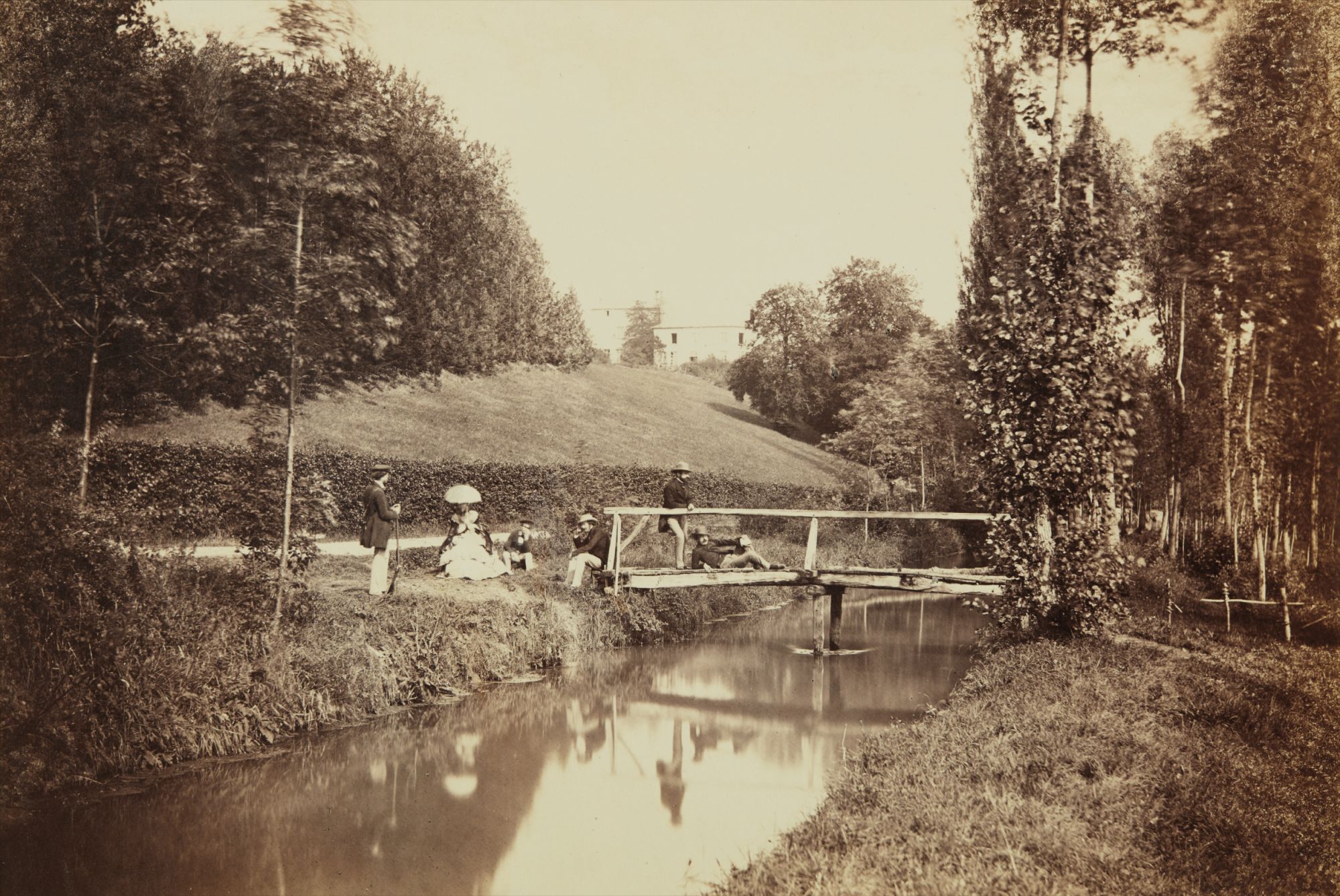
Édouard Baldus
Groupe dans le parc du Château de la Faloise
He worked across multiple photographic techniques throughout his career, moving from salted paper prints made from waxed paper negatives in his early years to albumen prints from wet collodion negatives as the technology evolved. His 1856 salted paper albumenized print of the Pavillon Richelieu and his 1855 salted paper print of the Church at Auvers both reveal an artist in full command of his materials, coaxing tonal ranges and surface qualities from each process that feel entirely deliberate and painterly. His later exploration of heliogravure, seen in the 1860 Main Portal at Chartres Cathedral, shows him embracing printmaking as a natural extension of his photographic vision, producing works that sit comfortably in both the history of photography and the history of the printed image. For collectors, Baldus occupies a singular position.
His work appears consistently at the major auction houses, and fine examples in good condition command serious attention from institutions and private collectors alike. What to look for: the quality of the print surface and the preservation of tonal range are paramount, as early salted paper prints are susceptible to fading and uneven oxidation. Signed prints, particularly those bearing the blue signature stamp on the mount or pencil signatures, carry additional documentary and aesthetic interest. Works from the Missions Héliographiques period and the Louvre documentation project represent the historical core of his output and are among the most sought after.
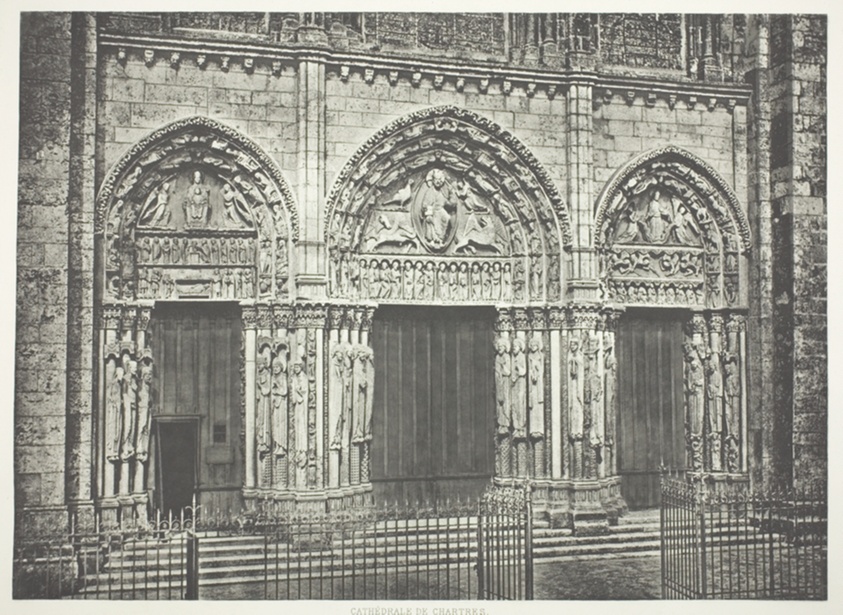
Édouard Baldus
Main Portal, Chartres Cathedral, 1860
The Chateau de Murol en Auvergne from 1854, with its dramatic landscape setting, shows a more romantic sensibility and appeals to collectors drawn to the intersection of photography and landscape tradition. Works on paper with strong, stable impressions and well preserved mounts are the standard to hold. In the broader context of art history, Baldus belongs to a generation of photographers who established the medium as a legitimate form of artistic expression at the exact moment when that argument still needed to be made. His peers among the Missions Héliographiques photographers each brought distinct sensibilities to the same mandate: where Le Gray pursued atmospheric light and tonal drama, and Le Secq embraced a more melancholic romanticism, Baldus remained committed to clarity, structure, and civic grandeur.
His work anticipates the architectural photography of the twentieth century, from the precision of Charles Sheeler to the monumental coolness of Bernd and Hilla Becher, and his influence on how we photograph buildings and public space is difficult to overstate. He understood intuitively that architecture is not merely a subject but a collaborator, and that the camera, positioned correctly and with sufficient patience, could make stone speak. The legacy of Édouard Baldus is held in major collections across the world, including the Bibliothèque nationale de France, the Metropolitan Museum of Art in New York, and the Getty Museum in Los Angeles, institutions that recognized long ago what collectors are increasingly affirming today: that his photographs are not historical artifacts to be studied but works of art to be lived with, contemplated, and treasured. In an era when photography's place within the art market has never been stronger, and when the origins of the medium are being reassessed with fresh eyes and genuine admiration, Baldus stands as a foundational figure whose work rewards every close looking.
The stone he photographed has weathered. The light he captured has not.
Explore books about Édouard Baldus
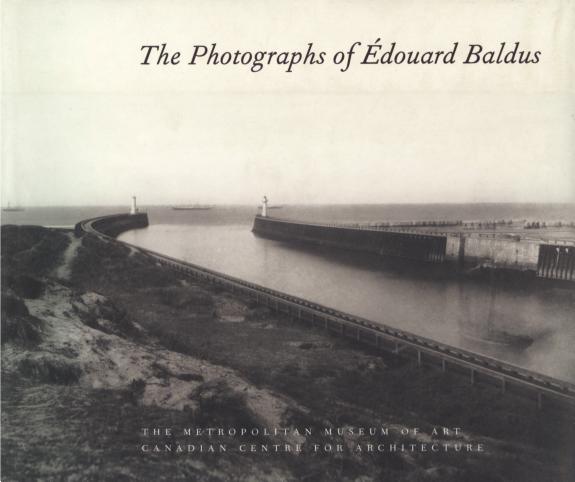
Édouard Baldus: Photographs from the Collections of the Metropolitan Museum of Art and the Musée d'Orsay
Malcolm Daniel
Baldus: Master Photographer
André Jammes
The Orient Observed: Images of the Middle East from the Collections of the Metropolitan Museum of Art
Malcolm Daniel
Édouard Baldus: La Vallée du Rhône
Jean-Claude Lemagny
Photography: A Very Short Introduction
Steve Edwards
Before Photography: Painting and the Invention of Photography
Peter Galassi