Donald Judd
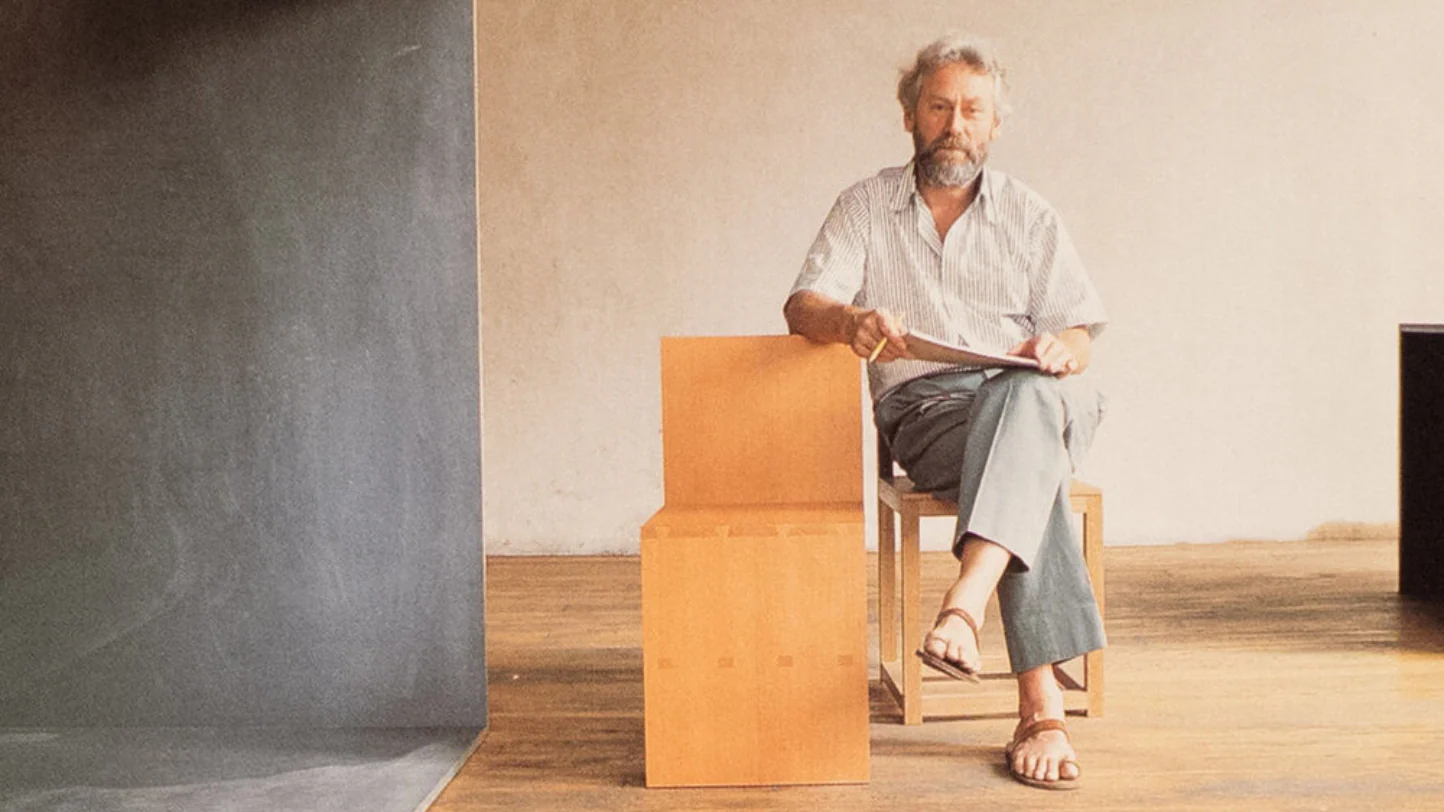
Donald Judd: Space, Light, and Pure Conviction
Artist Spotlight · The Collection Editorial
“A shape, a volume, a color, a surface is something itself. It shouldn't be concealed as part of a fairly different whole.”
Donald Judd, "Specific Objects," Arts Yearbook, 1965
In the spring of 2022, the Tate Modern in London presented a sweeping survey of Donald Judd's work that drew queues around the building and reminded a new generation just how radical, how alive, and how inexhaustibly beautiful his vision remains. Visitors stood in silence before walls of stacked aluminum boxes and floors scattered with gleaming copper progressions, many of them encountering Judd for the first time, yet sensing immediately that something foundational was at stake. That capacity to arrest a viewer, to make the physical world feel newly legible, is the hallmark of an artist who did not merely participate in the history of twentieth century art but quietly rewrote its terms. Donald Clarence Judd was born in 1928 in Excelsior Springs, Missouri, a small town whose plainspoken Midwestern character would leave a lasting impression on an artist who came to champion clarity above all else.
Donald Judd
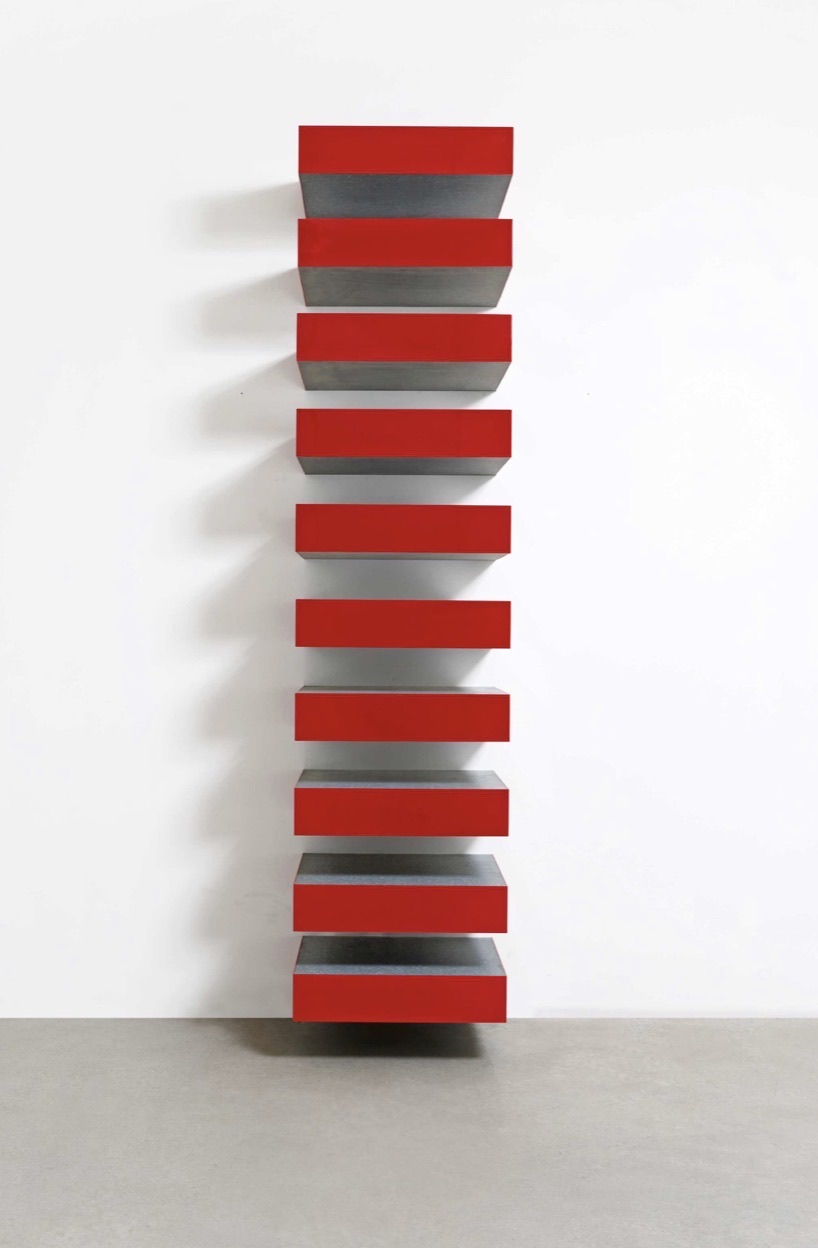
Untitled (Stack), 1967
He served in the United States Army in Korea before returning to pursue a serious education, studying at the Art Students League of New York and later at Columbia University, where he earned degrees in philosophy and art history. That philosophical grounding was not incidental. Judd thought rigorously about what objects could mean and what they were obligated to be, and his years writing criticism for Arts Magazine in the late 1950s and early 1960s gave him an unusually sharp intellectual framework for his own emerging practice. Judd began as a painter, working in a gestural idiom that owed something to Abstract Expressionism, but he grew increasingly dissatisfied with what he saw as the illusionism inherent in two dimensional work.
By the early 1960s he was constructing objects that sat emphatically in real space, made from industrial materials including steel, aluminum, plexiglass, and lacquer, fabricated by professional manufacturers to his precise specifications. This decision to remove the artist's hand from fabrication was not laziness but conviction. Judd believed that the integrity of an object depended on its resistance to metaphor, to narrative, to anything that asked the viewer to look through the thing rather than at it. His landmark 1965 essay "Specific Objects," published in Arts Yearbook, articulated this position with the force of a manifesto and established him as the era's most compelling theoretical voice.
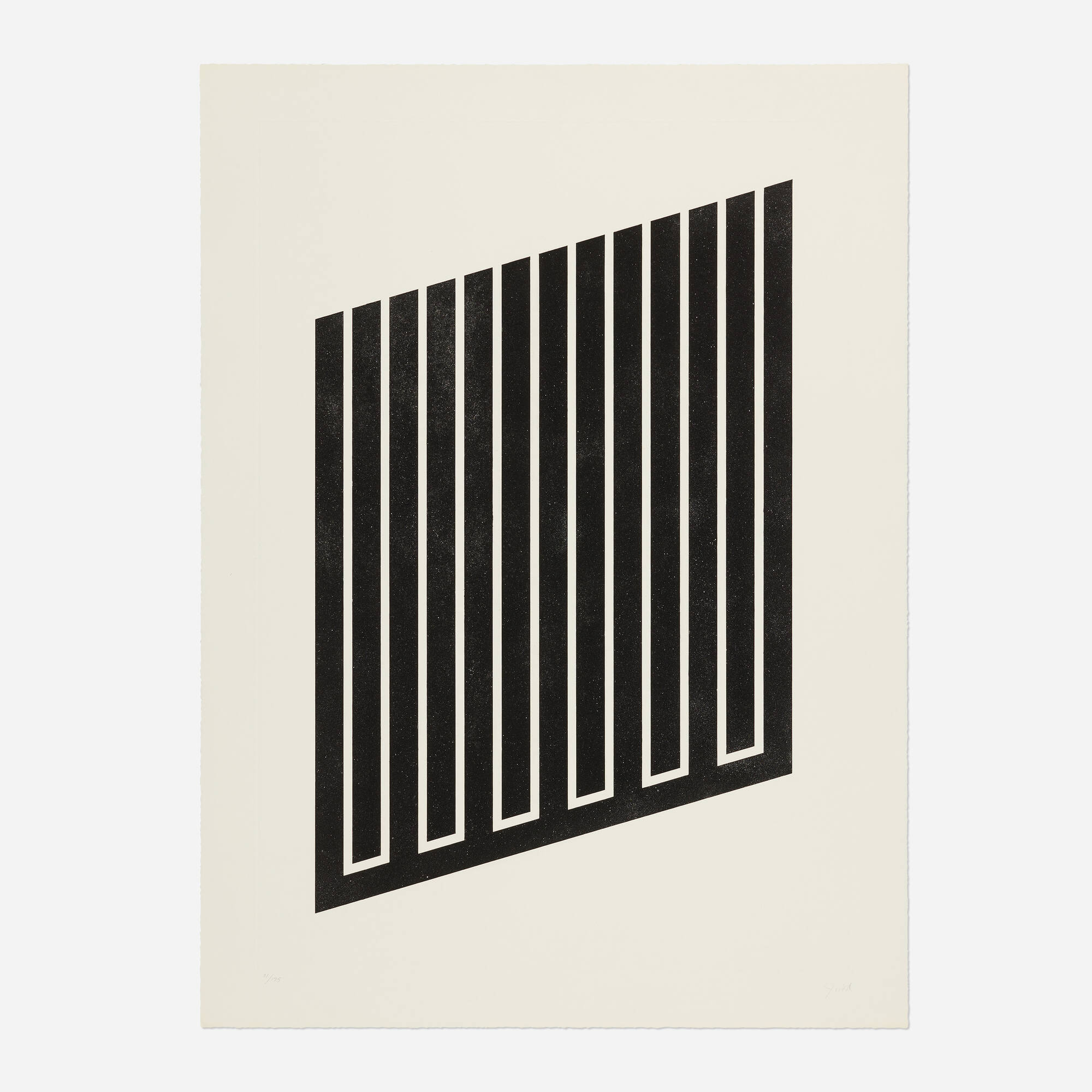
Donald Judd
Untitled, 1979
The works Judd produced across the late 1960s and 1970s represent some of the most enduring contributions to postwar art. The stacks, perhaps his most iconic series, consist of identical rectangular units mounted vertically on a wall at equal intervals, the negative spaces between each unit precisely matching the units themselves. "Untitled (Stack)" from 1967 is a definitive example: the repetition is neither mechanical nor cold but rhythmic, almost musical, inviting the eye to move through a sequence that feels simultaneously inevitable and astonishing. Judd worked with color with equal seriousness, deploying cadmium reds, brilliant blues, and anodized golds not as decoration but as structural fact.
“The main virtue of geometric shapes is that they aren't organic, as almost all primitive art is.”
Donald Judd, "Specific Objects," Arts Yearbook, 1965
A work such as the 1969 piece in blue lacquer on aluminum and brass demonstrates how color could function as a spatial force, advancing or receding, warming or cooling the air around an object. Judd's practice extended far beyond the gallery. In 1971 he began acquiring buildings in Marfa, a remote town in the high desert of West Texas, and over the following two decades he transformed it into one of the most extraordinary permanent installations in the world. Through the Chinati Foundation, established in 1986, Judd permanently installed one hundred large aluminum works in two converted artillery sheds, filling them with shifting desert light throughout the day.
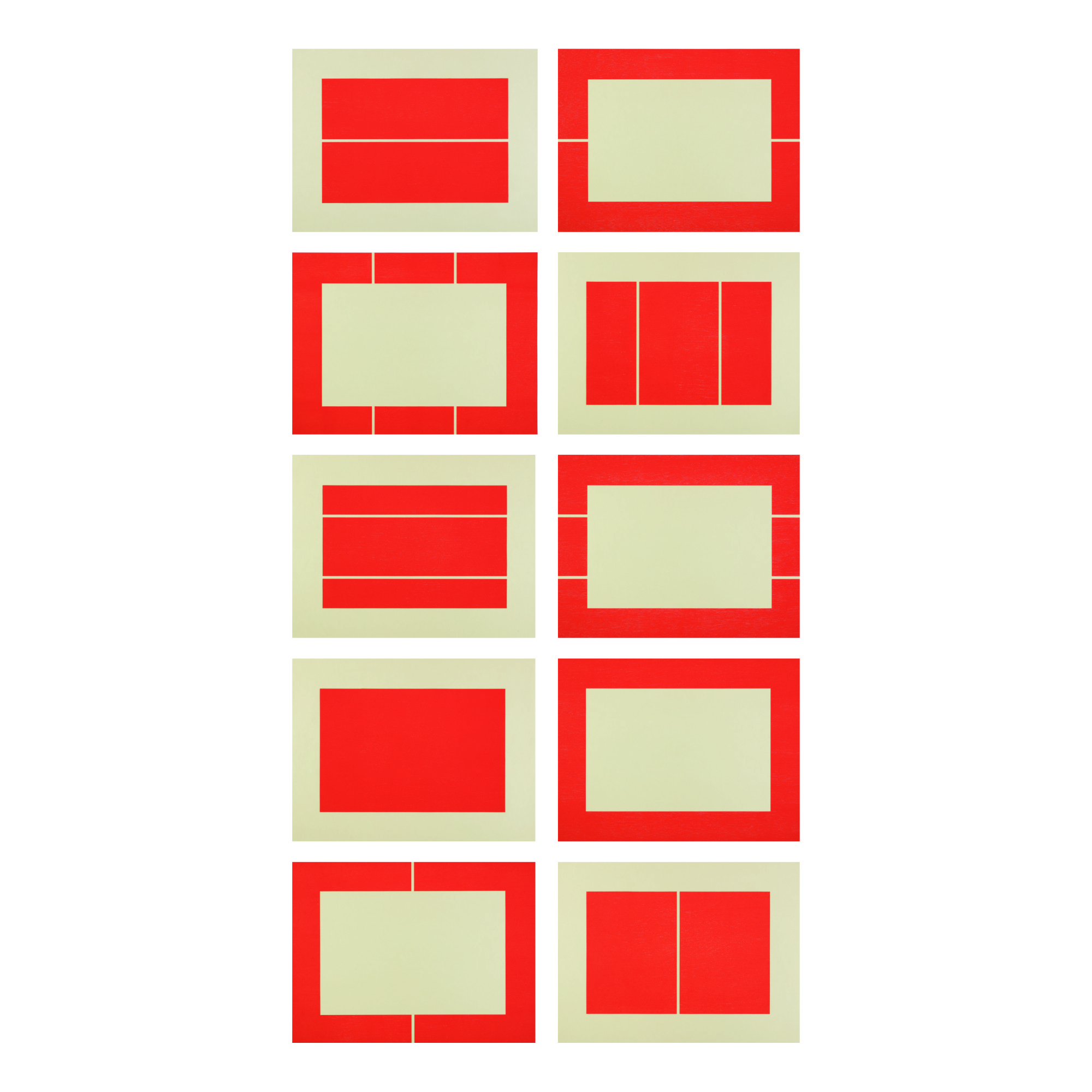
Donald Judd
Untitled (schellmann 157 - 166)
Marfa became a pilgrimage site, a proof of concept that art could inhabit the world on its own terms, outside the commercial and institutional machinery of the art world. The experience of seeing those aluminum boxes as dawn light moves across them is, for anyone who has made the journey, genuinely transformative. For collectors, Judd's work occupies a singular position in the market. His pieces appear regularly at Christie's, Sotheby's, and Phillips, where major works routinely achieve results in the millions of dollars.
A canonical stack or progression in galvanized iron or copper represents the most sought after tier of his output, but Judd was also a prolific printmaker and designer, and works on paper, including the aquatints and etchings he produced with sustained commitment, offer a more accessible point of entry into his universe. Functional objects such as the powder coated aluminum shelves, including works like "Shelf No. 14" from 1984, occupy a fascinating borderland between art and design that Judd himself refused to acknowledge as a meaningful distinction. Collecting across these categories gives a nuanced picture of an artist who brought the same uncompromising intelligence to every format he touched.
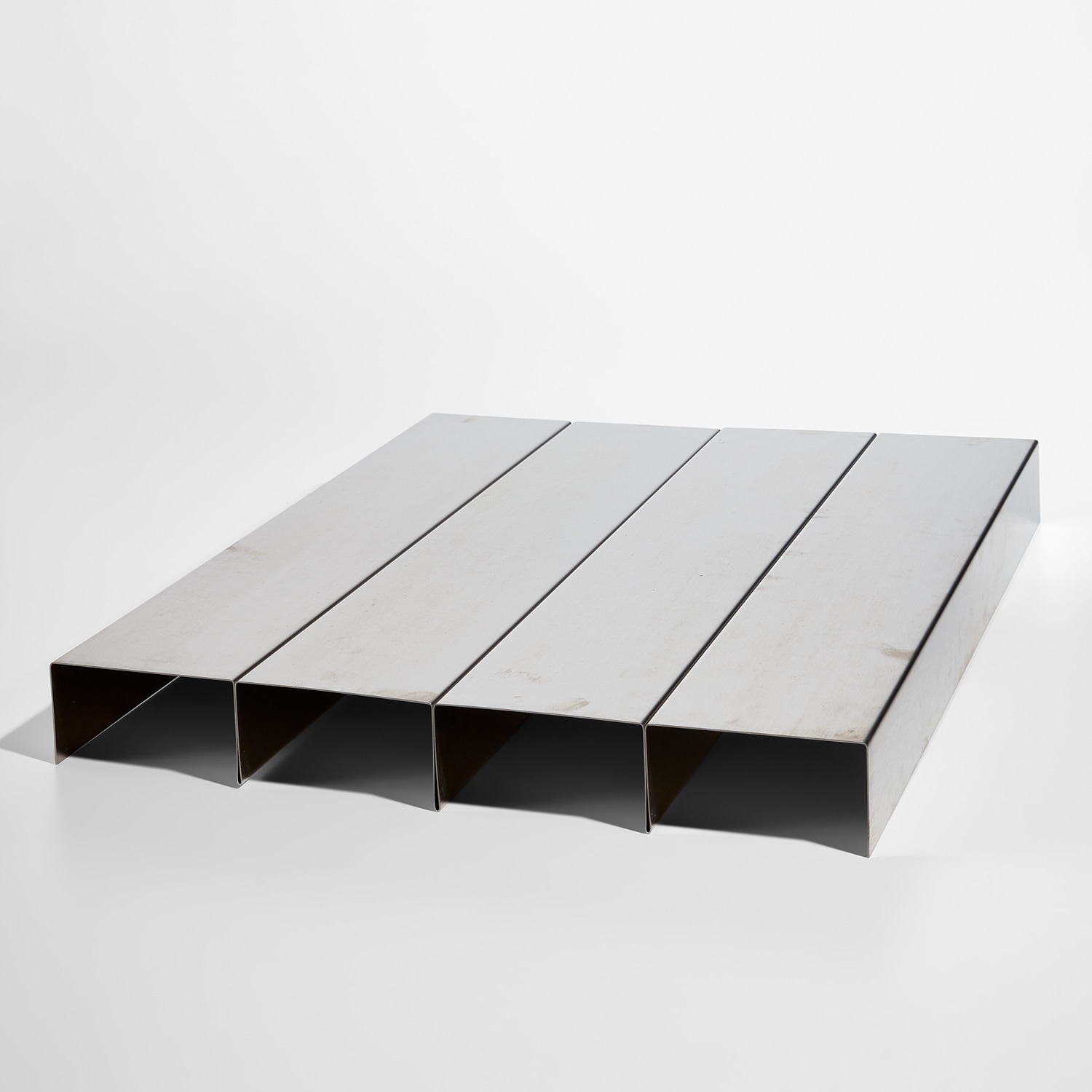
Donald Judd
Table Object, from Ten from Leo Castelli (S. 1)
Judd's place in art history is impossible to discuss without reference to the constellation of artists working in adjacent territory during the same era. Carl Andre, whose floor sculptures share Judd's commitment to industrial materials and real space, was a close peer. Dan Flavin, who worked with fluorescent light, and Robert Morris, whose practice encompassed sculpture, performance, and theory, were fellow travelers in what critics called Minimalism, a term Judd persistently rejected as too reductive for what he believed was simply honest work. Further afield, his insistence on the integrity of the object connects him to Sol LeWitt's conceptual structures and to the later generation of artists including John McCracken and Anne Truitt who took his example in new directions.
Donald Judd died in New York in February 1994, but the institutions, writings, and objects he left behind continue to shape how artists, curators, and collectors think about space, material, and the nature of art itself. The Judd Foundation maintains his New York lofts on Spring Street and the Marfa complex with scrupulous attention to his intentions, ensuring that the environments he created remain as he meant them to be experienced. To collect Judd is to participate in one of the great ongoing conversations of modern culture, a conversation about what it means to make something true and to insist that the world receive it on its own terms. Few artists of any era have asked that question with such clarity, and fewer still have answered it so magnificently.
Explore books about Donald Judd