Domenico Gnoli
Domenico Gnoli: The Beauty of Looking Closer
Artist Spotlight · The Collection Editorial
There is a moment, standing before a Domenico Gnoli canvas, when the world as you know it simply reorganizes itself. A shirt collar becomes a landscape. A coil of hair becomes a topographical study. A buttonhole becomes a portal.
Domenico Gnoli
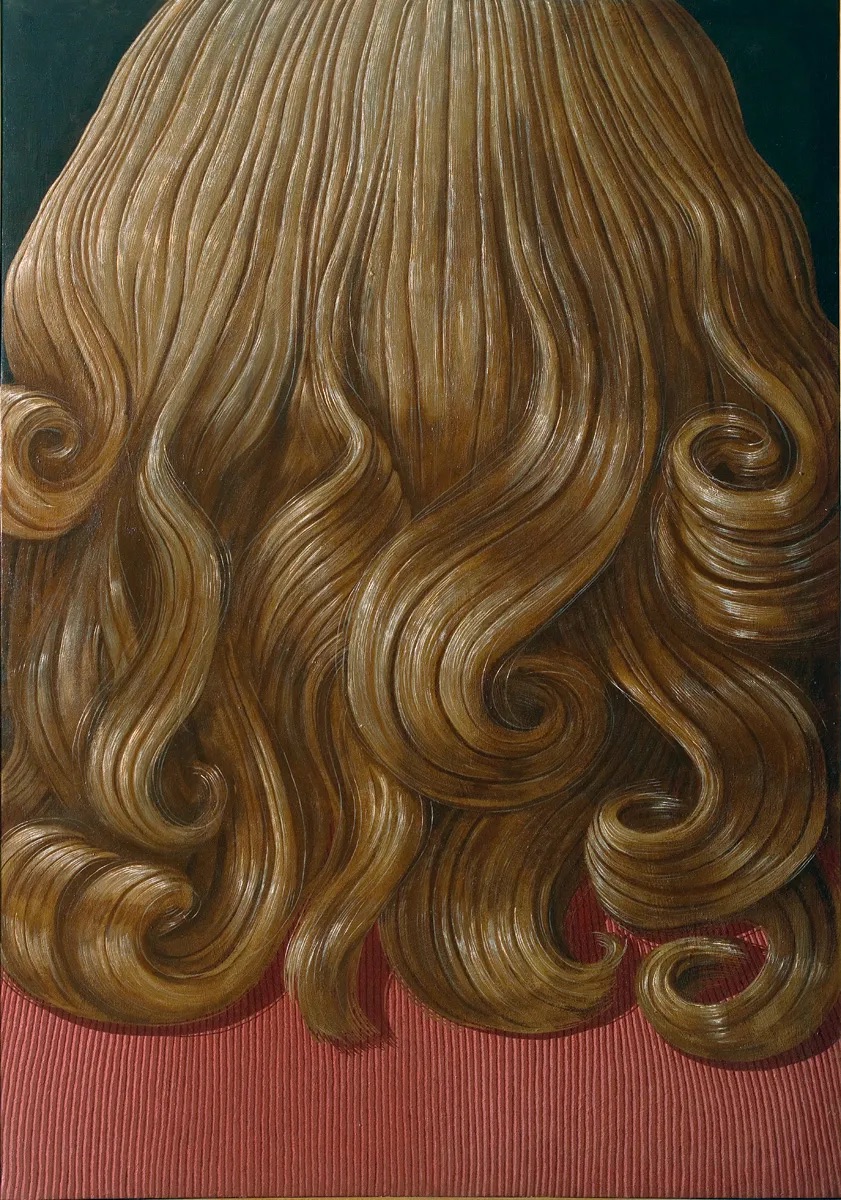
Red Curly Hair, 1969
This is the quiet revolution Gnoli staged in the 1960s, and it is one that continues to arrest viewers today just as powerfully as it did when his paintings first appeared in galleries across New York, Rome, and Paris. In recent years, major institutions and discerning collectors have returned to his work with renewed urgency, recognizing in his tightly cropped, luminous paintings something that feels not only prescient but urgently contemporary: a meditation on attention itself, on what it means to truly see the objects that populate our daily lives. Gnoli was born in Rome in 1933 into a family that breathed art and literature as naturally as air. His father, Domenico Gnoli the elder, was a respected art historian and director of the Biblioteca Nazionale in Rome, and the household was steeped in culture, conversation, and the visual traditions of Italy.
This foundation gave the younger Gnoli an unusually sophisticated relationship with art history from an early age, one that would later allow him to press against the weight of that tradition rather than simply inherit it. He studied at the Accademia di Belle Arti in Rome and showed early promise as a draftsman and illustrator, a skill that would never leave him and that underpins the almost architectural precision of his mature paintings. Before he became known as a painter, Gnoli carved out a distinguished career as a set and costume designer for theater and opera, working across Europe and the United States throughout the 1950s. His work in stage design brought him into contact with directors and performers who understood the power of visual scale and the drama of a single, isolated detail.
Domenico Gnoli
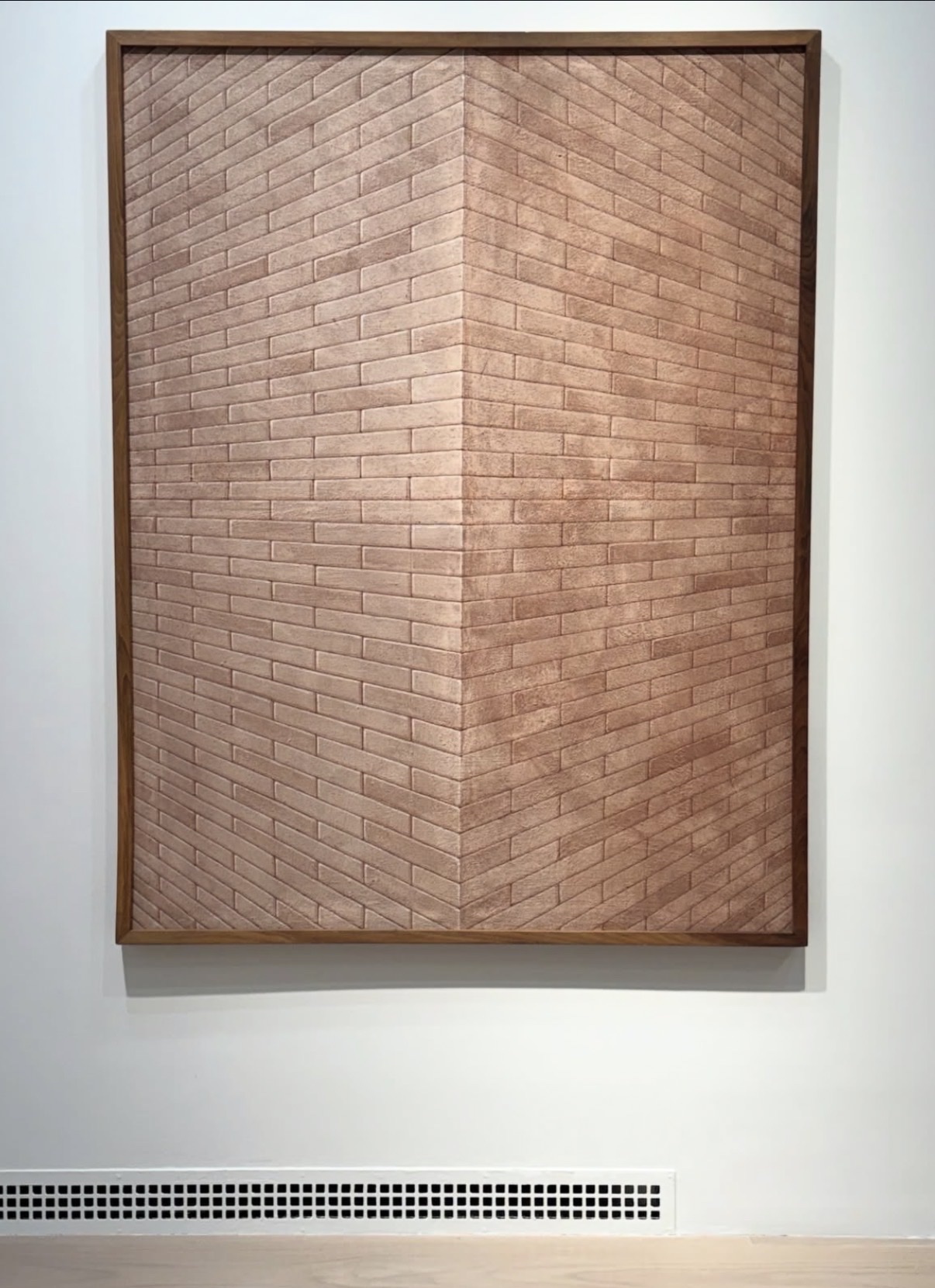
Untitled
He designed productions at major venues in London, Stockholm, and New York, and his facility with theatrical space sharpened his intuition for composition and proportion. This period also produced early works such as Giochi I, a 1956 tempera on canvas that shows a younger sensibility already fascinated with the formal potential of simplified, almost emblematic imagery. The great breakthrough came in the early 1960s when Gnoli essentially abandoned the world of stage design to commit fully to painting. What emerged was a body of work unlike anything being made at the time.
He developed a technique of applying acrylic paint mixed with sand onto canvas or masonite, building surfaces of extraordinary tactile richness that seem almost to breathe. The sand introduced a granular, almost geological quality to his surfaces, making a trouser fold or a shoe lining feel as monumental as a cliff face. Works like La Tranche from 1965, with its acrylic and sand on canvas, demonstrate how this material innovation served his conceptual ambitions perfectly. The texture was not decorative; it was argumentative, insisting that the surface of an object deserved the same reverence we might grant a Renaissance altarpiece.
Domenico Gnoli
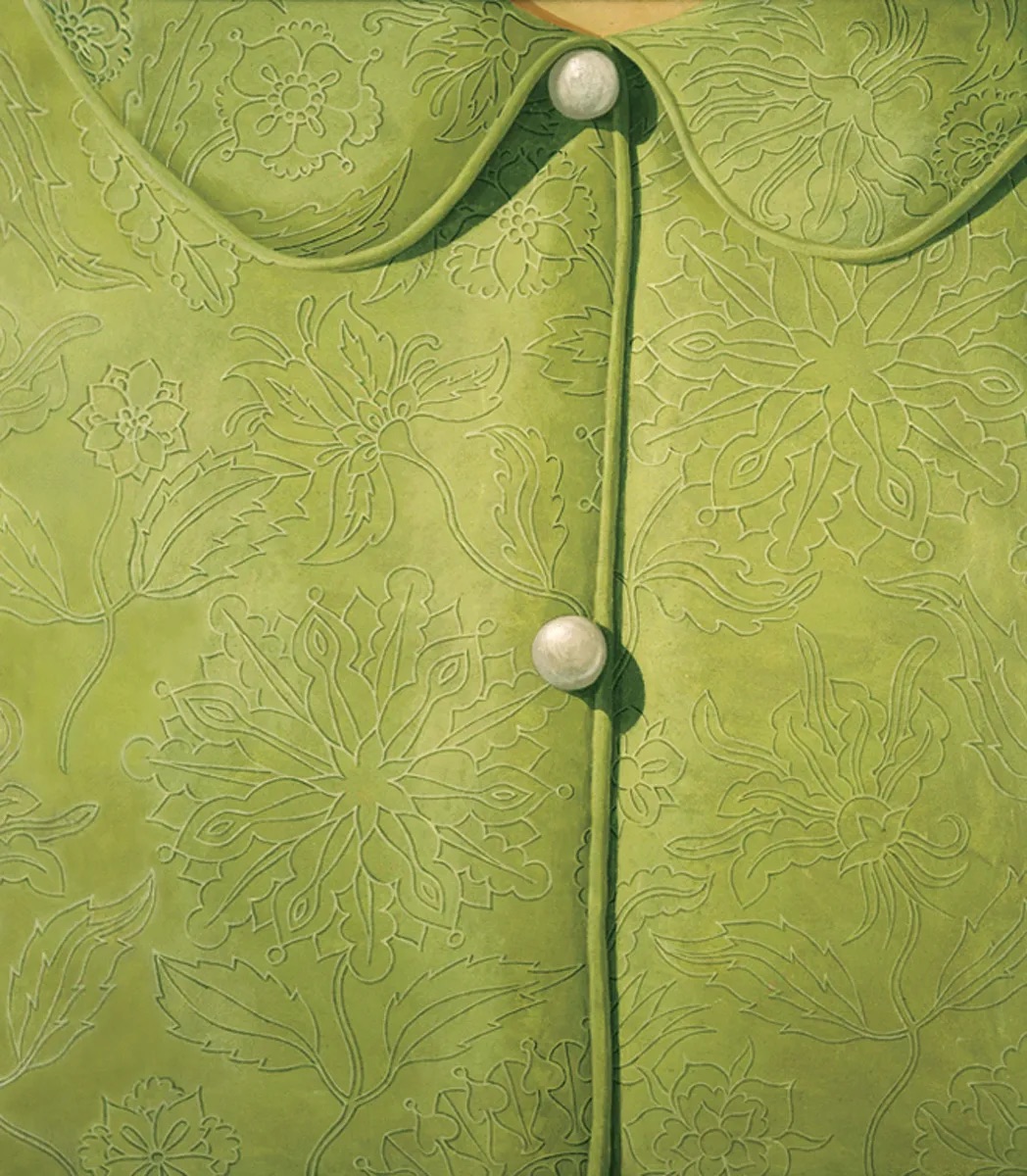
Chemisette Verte, 1967
What made Gnoli's project so intellectually charged was its relationship to the dominant movements of his era and yet its stubborn refusal to be absorbed by any of them. He was clearly in conversation with Pop Art, sharing its appetite for the vernacular and the consumer object. He was aligned with Photorealism in his commitment to a kind of heightened optical fidelity. And yet his work carries a dreamlike stillness, a displacement of scale so thorough that it tips into something closer to Surrealism, the uncanny made visible through pure formal means rather than fantastical imagery.
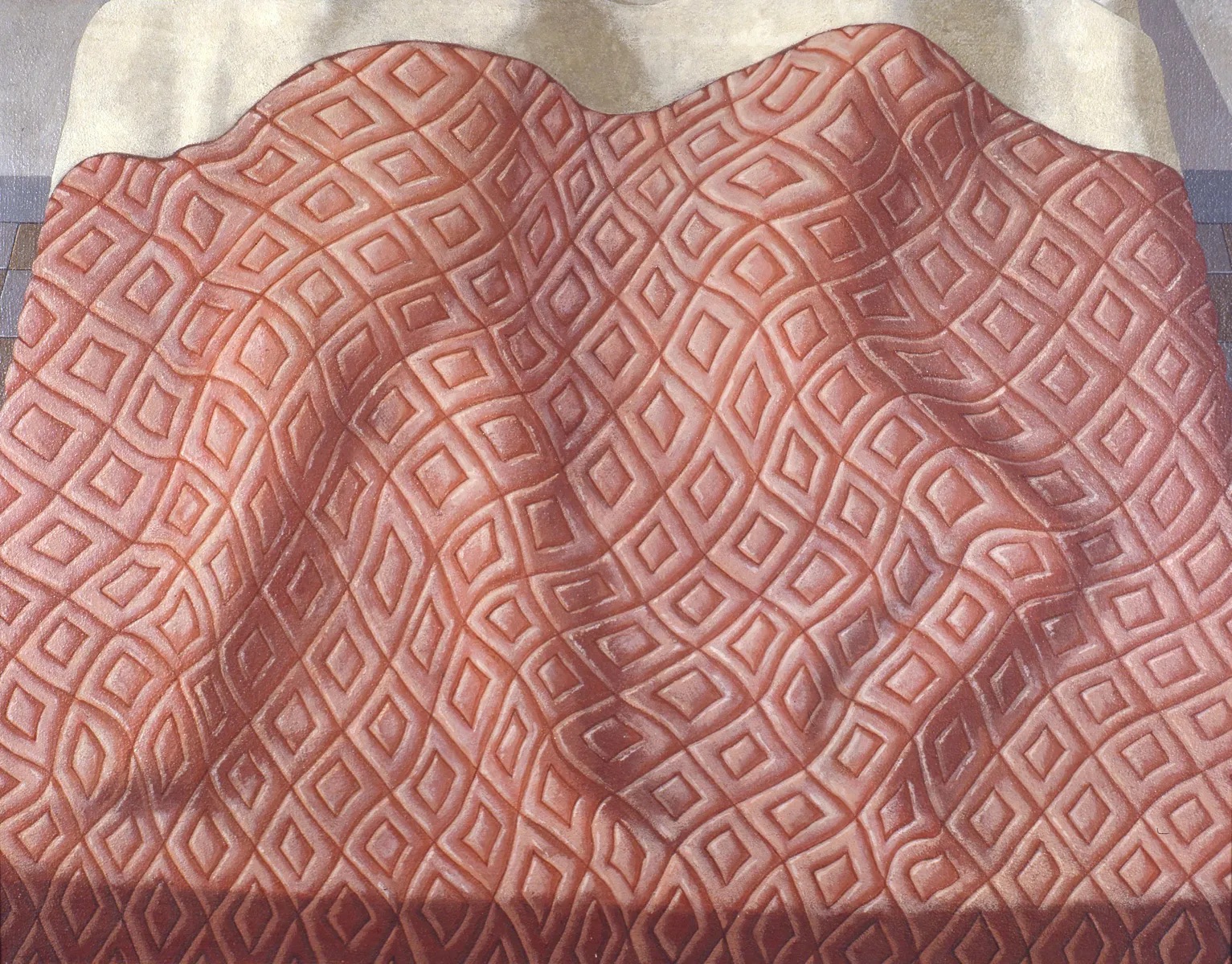
A painting like Chemisette Verte from 1967 or the extraordinary Red Curly Hair from 1969 achieves this balance with breathtaking confidence. The subject is entirely legible and yet somehow estranged, familiar and foreign at once, elevated by Gnoli's attention into something approaching the sacred. Gnoli's signature works from the final decade of his life represent one of the most cohesive and distinctive bodies of work produced in postwar European painting. Due Dormienti from 1966 presents two sleeping figures reduced to the undulating geometry of their bodies beneath fabric, a study in intimacy and distance simultaneously.
Domenico Gnoli
Due Dormienti, 1966
Striped Shirt Lapel from 1969 transforms a fragment of men's tailoring into an object of almost vertiginous grandeur. Inside of Lady's Shoe turns the lining of a shoe into an intimate, slightly mysterious interior space. Across these works, there is a consistent philosophy at work: that the overlooked fragment contains within it the whole of human experience, if only we will consent to stop and look. For collectors, Gnoli's work occupies a position of genuine rarity and cultural weight.
His career was tragically cut short by his death in New York in 1970 at the age of thirty six, meaning his total output is finite and his most significant paintings are held by major museums and private collections across Europe and the United States. The Museo Nacional Thyssen Bornemisza in Madrid holds key works, as does the Galleria Nazionale d'Arte Moderna in Rome. When significant Gnoli paintings do appear at auction, they command serious attention, and his market has strengthened considerably as collectors drawn to the intersection of conceptualism, craft, and postwar European painting have come to appreciate the singular intelligence of his vision. Works on paper and his earlier tempera paintings offer points of entry for collectors building familiarity with his practice, while the mature acrylic and sand canvases represent the pinnacle of his achievement.
In art historical terms, Gnoli belongs to a fascinating generation of artists who operated between categories with deliberate intelligence. He invites comparison with artists like Mel Ramos and Wayne Thiebaud in his attention to consumer objects, with Claes Oldenburg in his playful manipulation of scale, and with the Italian strand of Nouveau Réalisme in his regrounding of painting in the physical world. But he remains distinctly himself, a painter whose work rewards prolonged looking in a way that few of his contemporaries can match. His legacy grows clearer with every passing decade.
In an era of accelerating images and fractured attention, Gnoli's insistence on the single fragment, the one collar, the one curl of hair, the one lapel, feels less like an artistic conceit and more like a form of wisdom. To collect Gnoli is to collect a reminder that the world, looked at with sufficient love and patience, is inexhaustibly strange and beautiful.
Explore books about Domenico Gnoli
Domenico Gnoli
Maurizio Fagiolo dell'Arco
Domenico Gnoli: Catalogo Ragionato
Maurizio Fagiolo dell'Arco, Giordana Mariani Canova
Domenico Gnoli: Drawings and Paintings
Comune di Roma
Gnoli: A Retrospective
Bruno Corà
Domenico Gnoli: Gli anni Sessanta
Italo Tomassoni