Diego Rivera

Diego Rivera: A Vision That Remade the World
Artist Spotlight · The Collection Editorial
“I am not merely an artist, but a man carrying out a biological function.”
Diego Rivera
Few artists in the twentieth century managed to collapse the distance between monumental public ambition and intimate human tenderness quite the way Diego Rivera did. The Metropolitan Museum of Art's holdings of his works draw steady pilgrimage, and his murals at the Detroit Institute of Arts remain among the most visited permanent installations in American museum history. In 2023 and 2024, Rivera's works on paper and his easel paintings continued to command serious attention at auction, with collectors worldwide recognizing that his output beyond the famous frescoes reveals a prolific and extraordinarily sensitive artist whose range is still being fully appreciated. This is a painter whose legacy, far from receding, keeps expanding.
Diego Rivera
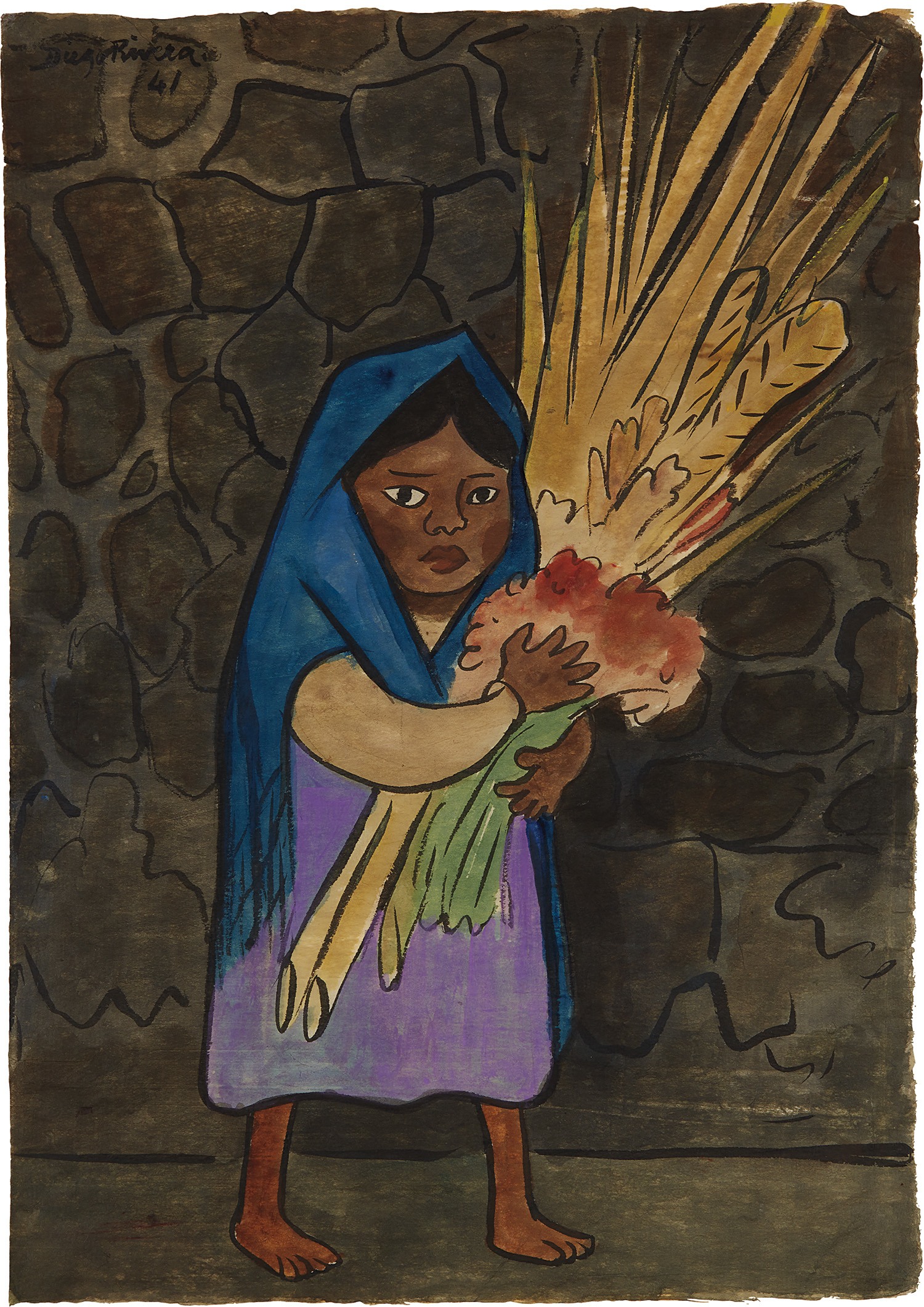
Girl Holding Flowers, 1941
Diego María de la Concepción Juan Nepomuceno Estanislao de la Rivera y Barrientos Acosta y Rodríguez was born on December 8, 1886, in Guanajuato, Mexico, into a family that recognized his gifts almost immediately. He began studying at the Academy of San Carlos in Mexico City at the age of ten, an institution that gave him rigorous academic training even as the wider culture around him was shifting beneath political and social pressures. A scholarship from the Governor of Veracruz sent him to Europe in 1907, and it was in Madrid and then Paris where the young Rivera found himself at the center of one of the great artistic revolutions of the modern era. He became a close friend of Pablo Picasso, shared studios and conversations with Amedeo Modigliani, and absorbed the full force of Cubism, producing a substantial body of Cubist paintings that demonstrate genuine mastery of the form.
Yet Rivera eventually turned away from Cubism, a decision that felt almost contrarian in the Paris of the 1910s but proved visionary in retrospect. A journey to Italy in 1920 and 1921, where he spent fourteen months studying Renaissance frescoes and the great cycles of Giotto, reoriented everything. He returned to Mexico in 1921 committed to an art that belonged to the people, one painted on walls, legible to anyone who stood before it, and rooted in the deep pre Columbian and mestizo heritage of his country. This was the beginning of what the world came to call the Mexican Muralist movement, which Rivera shaped alongside José Clemente Orozco and David Alfaro Siqueiros.
Diego Rivera
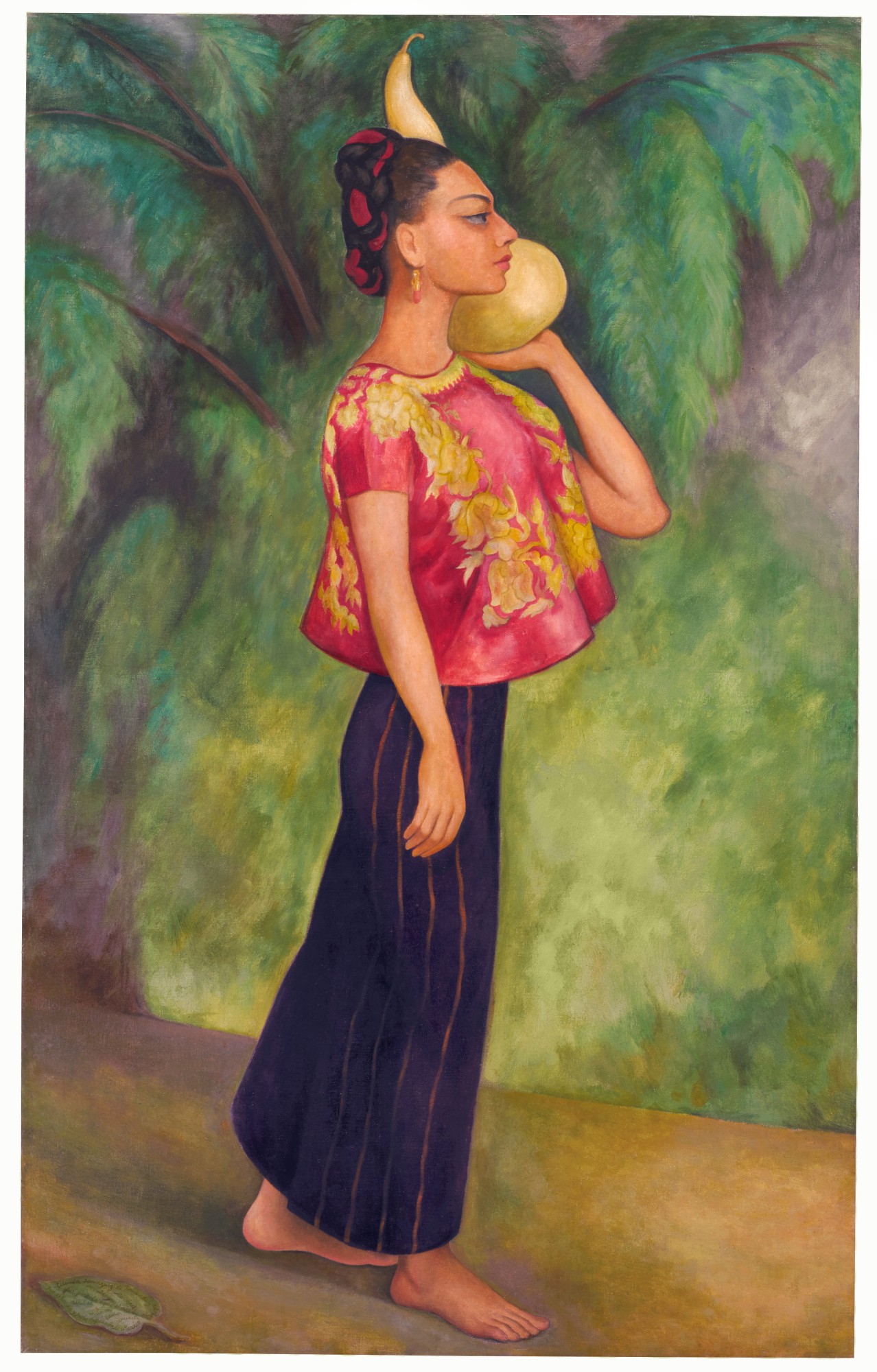
Retrato de Columba Domínguez de Fernández
The murals Rivera painted at the Ministry of Public Education in Mexico City, which he began in 1923, and at the National Preparatory School, established a visual language of extraordinary power and became landmarks of the entire century. What collectors and scholars have come to cherish with growing intensity is Rivera's parallel practice in smaller, more personal formats. His watercolors are studies in restraint and luminosity, works in which a few washes of color and a line of extraordinary confidence conjure a complete world. "Girl Holding Flowers" from 1941, rendered in watercolor on rice paper, exemplifies this gift entirely.
“My sole ambition is to express, as completely as I can, the reality of the Mexican people.”
Diego Rivera
The composition breathes, the figure is at once specific and universal, and the handling of the paper as an active element in the image shows a sensibility closer to East Asian brushwork than to anything strictly Western. "Niño" from 1945 is equally revelatory, a work in watercolor and brush and ink that captures childhood with warmth and psychological acuity. In "El peluquero" from 1934 and "Hombre cargando cesta" from 1937, Rivera demonstrates that the monumental social concerns of the murals could be held within the most intimate scale without any loss of dignity or weight. His prints deserve equal attention.
Diego Rivera
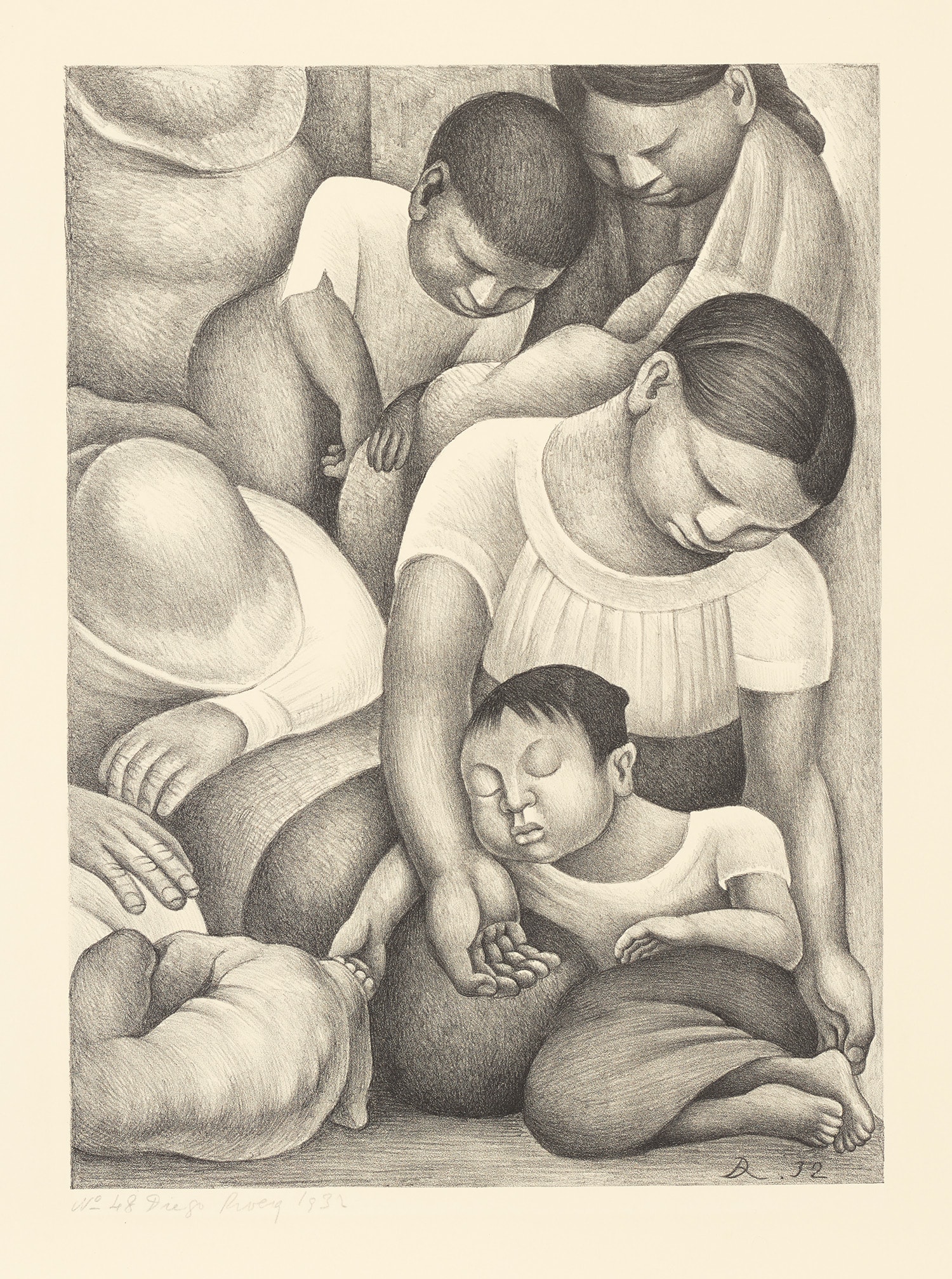
El Sueño (La Noche de los pobres) (The Dream (The Night of the Poor))
The lithograph "El Sueño (La Noche de los pobres)" is a quietly devastating meditation on poverty and rest, translated into tonal contrasts that feel both documentary and dreamlike. "Desnudo de Lola Olmedo" reveals Rivera's lifelong commitment to the figure, drawn with a confidence that connects him directly to the grand European tradition while remaining entirely his own. His "Minotaure" gouache from 1939, created as a proposed cover for the celebrated Surrealist journal of the same name, places him squarely within the Parisian avant garde conversations that continued to orbit him even after his return to the Americas. His colored pencil and charcoal study "Perfil de tehuana" from 1935 is a gorgeous example of his sustained devotion to depicting Indigenous Mexican women with complexity, elegance, and genuine respect.
From a collecting perspective, Rivera occupies a category that serious advisors describe as both historically secure and still actively rewarding. His major murals are, of course, immovable and belong to institutions, but his works on paper, his oil paintings on canvas and Masonite, and his prints represent a body of work that moves through major auction houses with consistent strength. Christie's and Sotheby's have each seen significant Rivera works on paper exceed their estimates in recent years, reflecting a collector base that now stretches well beyond Mexico and the United States into Europe and Asia. Works from the 1930s and 1940s, the period of his greatest personal intensity and formal confidence, tend to attract the most competitive bidding.
Diego Rivera
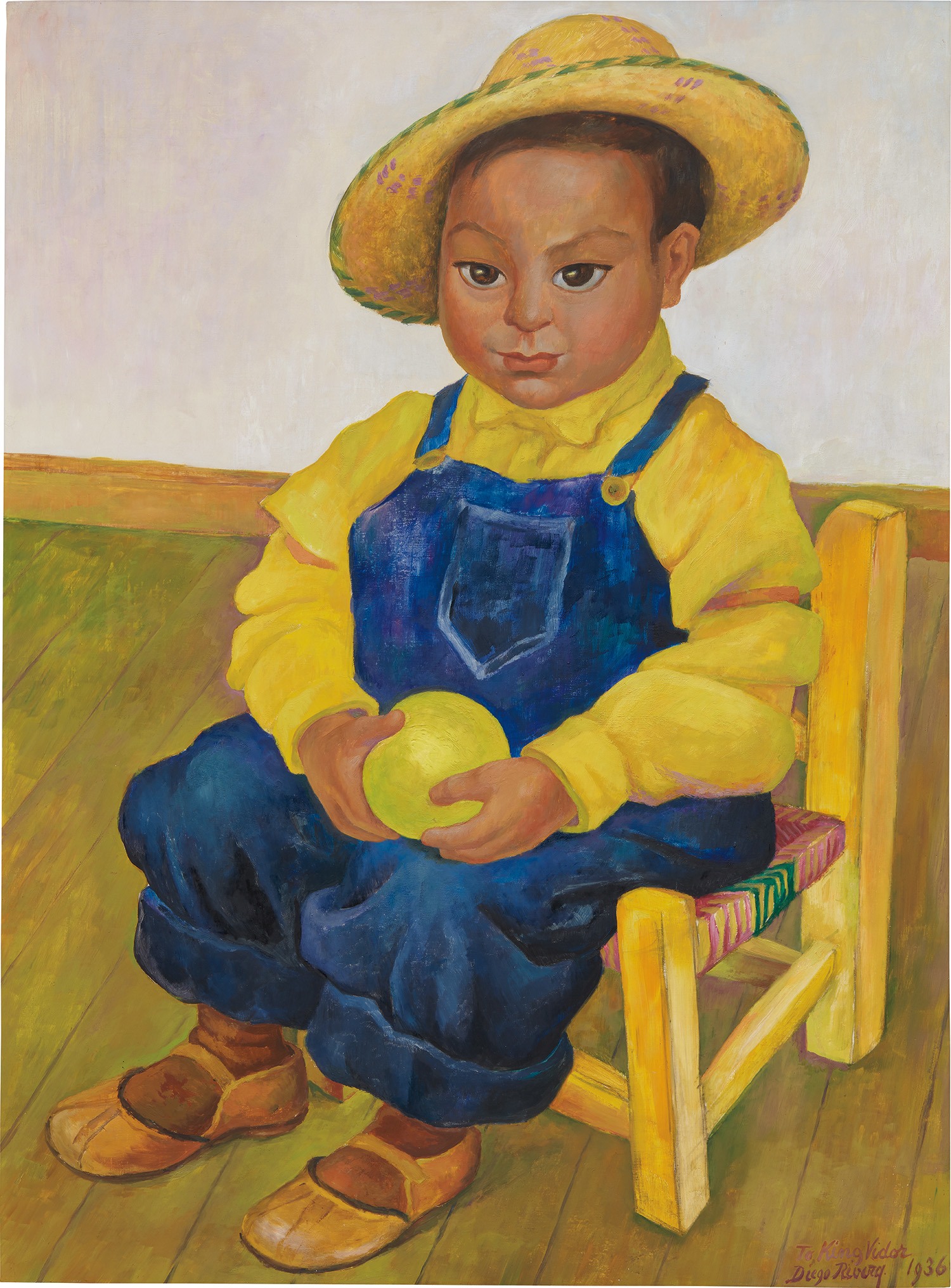
Don Lupito, 1936
The oil on Masonite "Don Lupito" from 1936 and the portrait "Retrato de Columba Domínguez de Fernández" in oil on canvas represent the kind of intimate scale easel painting that allows a collector to live with Rivera's genius in a deeply personal way. Rivera's place in art history is genuinely without parallel in the way he braided together seemingly incompatible impulses. His affinities connect outward in every direction: to the European modernists he befriended and challenged, to the Social Realist painters working across the Americas, and to the long tradition of Mexican visual culture reaching back centuries before the Spanish conquest. Artists like Frida Kahlo, to whom he was famously married twice, and Rufino Tamayo worked in dialogue with the world he helped to create.
His influence on American painting, particularly after his controversial commissions for the Rockefeller Center in 1933 and the Detroit Industry Murals of 1932 and 1933, reshaped how an entire generation of artists thought about the relationship between art and public life. What endures most powerfully about Diego Rivera is precisely this refusal to accept a ceiling on what art could do or who it could speak to. He believed that beauty was not a privilege and that the highest technical achievement meant nothing unless it was in service of something larger than itself. The intimacy of a small watercolor of a child and the sweep of a wall covered in the history of a civilization were, for him, expressions of the same fundamental conviction.
For collectors who bring his works into their lives, they are not simply acquiring remarkable objects. They are becoming part of a conversation about humanity that Rivera began more than a century ago and that shows no sign of ending.
Explore books about Diego Rivera
Diego Rivera: A Life
Patrick Marnham

Diego Rivera and His World
Linda Bank Downs
The Murals of Diego Rivera
James Britton
My Art, My Life
Diego Rivera
Diego Rivera: The Cubist Years
Juan Manuel Bonet
Diego Rivera: Art and Revolution
Pete Hamill
The Portable Diego Rivera
James Britton
Diego Rivera: Complete Murals
Charlot Jean