Daniel Buren

Artist Spotlight · The Collection Editorial
```json { "headline": "Daniel Buren: Stripes That Rewrote Space", "body": "Standing in the courtyard of the Palais Royal in Paris, beneath a sky that shifts with the seasons, visitors encounter one of the most quietly radical permanent installations in the world. Les Deux Plateaux, completed in 1986, fills the historic courtyard with 260 striped columns of varying heights, a work that caused public controversy at its unveiling and has since become one of the most beloved and visited works of public art in France. Decades after its contentious debut, it stands as proof of something Daniel Buren has always known: that art which genuinely challenges the nature of its surroundings takes time to be fully understood, and that patience is always rewarded.\n\nBuren was born in Boulogne Billancourt in 1938, a suburb of Paris, and came of age in a city still reassembling itself after the war.
Daniel Buren
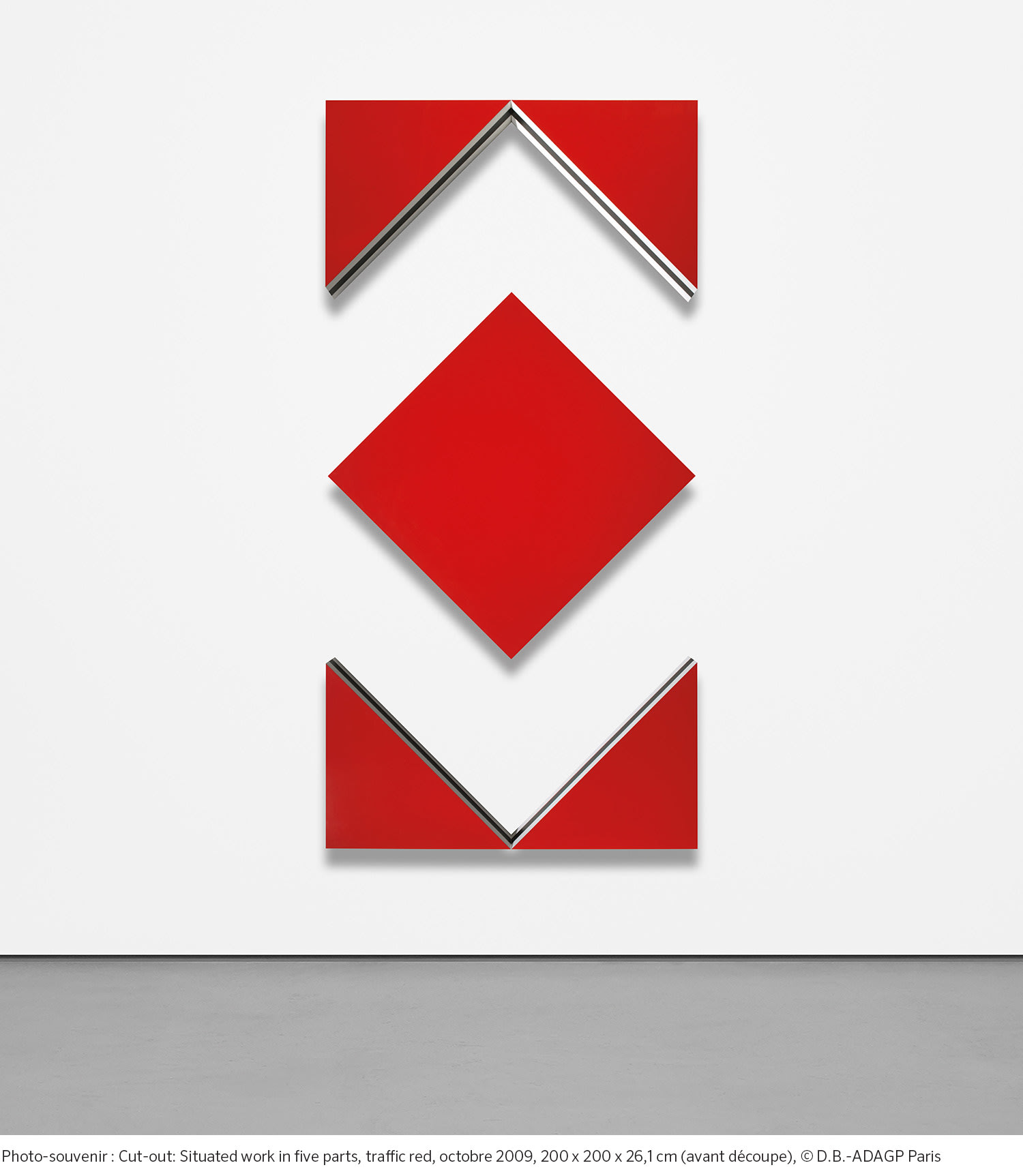
Cut-out: Situated work in five parts, traffic red, 2009
He studied at the École Nationale Supérieure des Métiers d'Art in Paris during the late 1950s, where he trained in textile design, a background that would prove formative in ways no academic program could have anticipated. His early exposure to woven fabrics, to the repetitive logic of pattern and the physicality of cloth, planted the seeds of what would become one of the most immediately recognizable visual vocabularies in contemporary art.\n\nBy the mid 1960s, Buren had arrived at the tool that would define his entire practice: the vertical stripe, alternating white with a single color, each band precisely 8.7 centimeters wide.
This was not an arbitrary choice but a deliberate act of aesthetic reduction, a way of stripping painting down to something so visually neutral it could function almost like a measuring instrument. In 1966 he began pasting these striped posters across Paris, working alongside fellow artists Olivier Mosset, Michel Parmentier, and Niele Toroni as part of the collective known as BMPT. Together they staged provocative demonstrations rejecting the authority of the art object and the mythology surrounding artistic genius, positioning their repeated, impersonal gestures as alternatives to the cult of the individual painter.\n\nThe breakthrough that announced Buren to an international audience came in a moment of institutional drama.
Daniel Buren
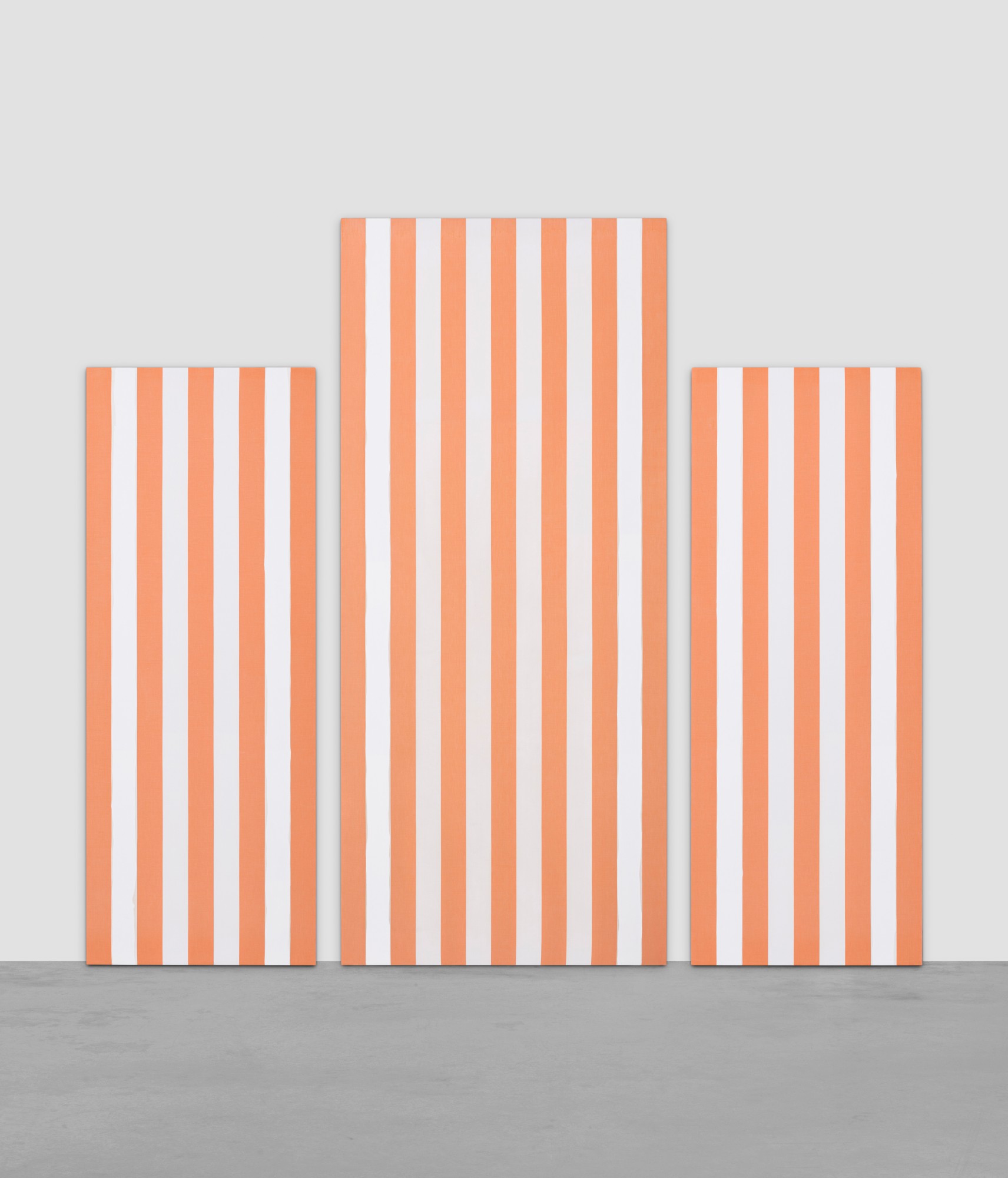
Peinture acrylique recto-verso sur tissu rayé blanc et orange, Anvers, 1976
At the 1971 Guggenheim International Exhibition in New York, his contribution, a massive striped banner hung through the museum's central rotunda, was removed by the exhibition committee before the show opened, with fellow artists objecting that it obscured their own works. Buren's response was to document the removal and present that documentation as the work itself, a move that crystallized his entire project. The question was never simply what stripes looked like, but what happens when a work insists on existing in relation to its architecture, its institution, and the social forces that govern both.\n\nThe works available on The Collection offer a remarkable window into the full range of Buren's thinking across several decades.
The 1976 triptych Peinture acrylique recto verso sur tissu rayé blanc et orange, Anvers demonstrates the foundational elegance of his approach, acrylic applied to fabric already woven in stripes, the painted and the structural inseparable from one another. Up and Down, In and Out, Step by Step, A Sculpture from 1977 extends that logic into three dimensions, using removable paper or vinyl printed with his signature 8.7 centimeter stripes to transform the exhibition space itself into the medium. Works such as D'un Losange à L'Autre from 2006, in which white self adhesive vinyl is applied over blue acrylic in a wall painting, show how his practice has continued to evolve, introducing geometric complexity while remaining faithful to the foundational discipline of site and surface.
Daniel Buren
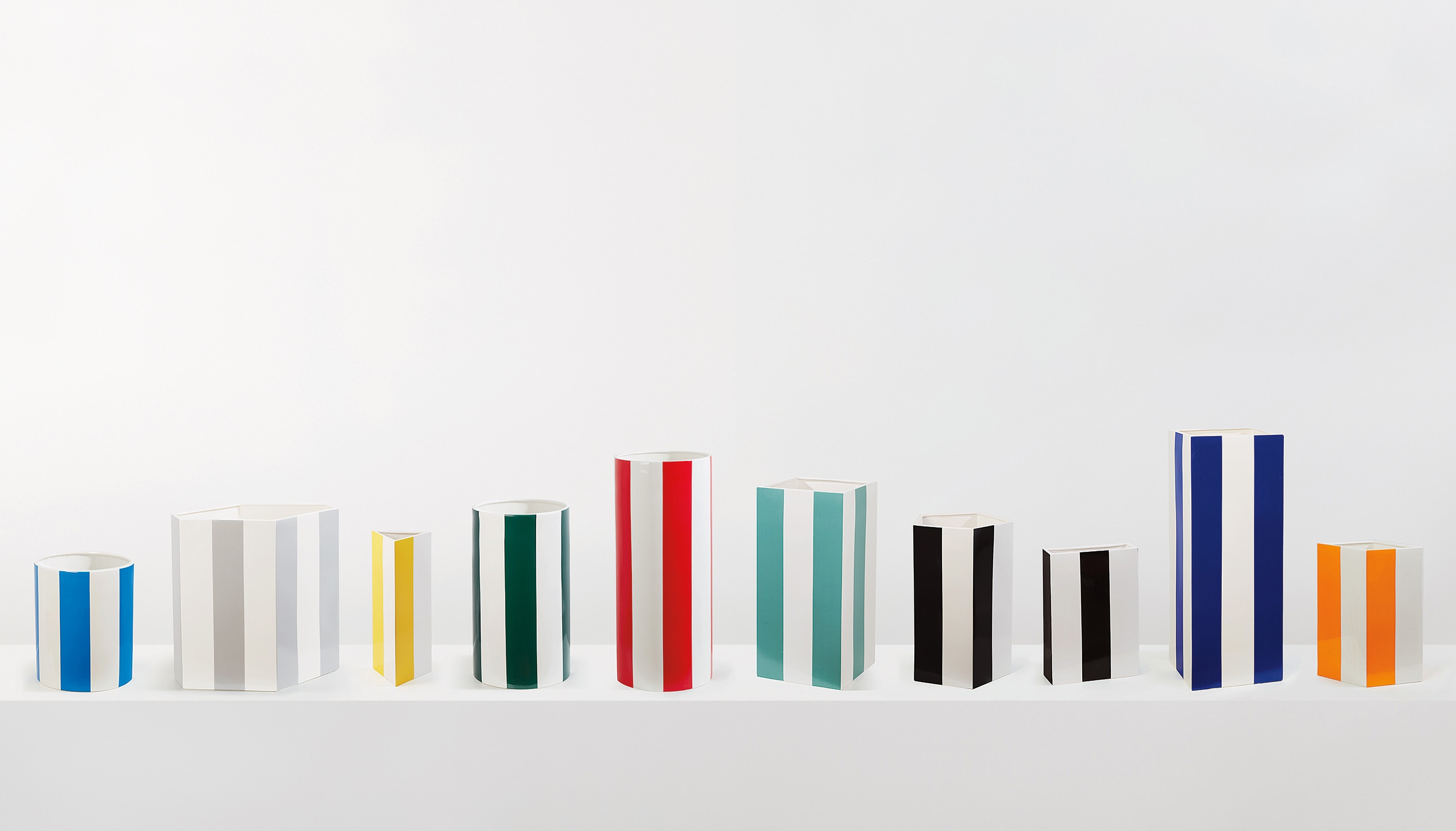
Les Cent Vases (The Hundred Vases)
Les Cent Vases, comprising ten unique white earthenware vases painted in colors and glazed, reveals yet another dimension: an artist willing to carry his visual language into domestic and decorative traditions without losing any of its critical edge.\n\nFor collectors, Buren represents one of the most intellectually coherent and institutionally validated practices of the postwar period. His work entered the permanent collections of the Centre Pompidou, the Museum of Modern Art in New York, the Tate in London, and the Stedelijk Museum in Amsterdam, among many others, decades ago, and that institutional consensus has never wavered. He received the Golden Lion for lifetime achievement at the Venice Biennale in 1986, a recognition that placed him firmly at the summit of the international art world.
On the secondary market, his works in fabric, acrylic, and mixed media have shown consistent demand, with collectors particularly drawn to the historical fabric works from the 1970s, which carry both documentary and aesthetic weight as records of a period of intense artistic reinvention. The key consideration for any collector is the installation instructions that often accompany his pieces, since Buren's art is inseparable from the conditions of its display, and understanding that relationship is part of the pleasure of ownership.\n\nIn art historical terms, Buren belongs to a generation of European conceptualists who fundamentally redirected the conversation about what painting and sculpture could mean. His dialogue with the work of artists such as Donald Judd, whose seriality and spatial awareness rhyme with Buren's own, and Sol LeWitt, whose instruction based works share a structural kinship with Buren's site specific approach, helps locate him within a transatlantic conversation about reduction, repetition, and institutional critique.
Daniel Buren
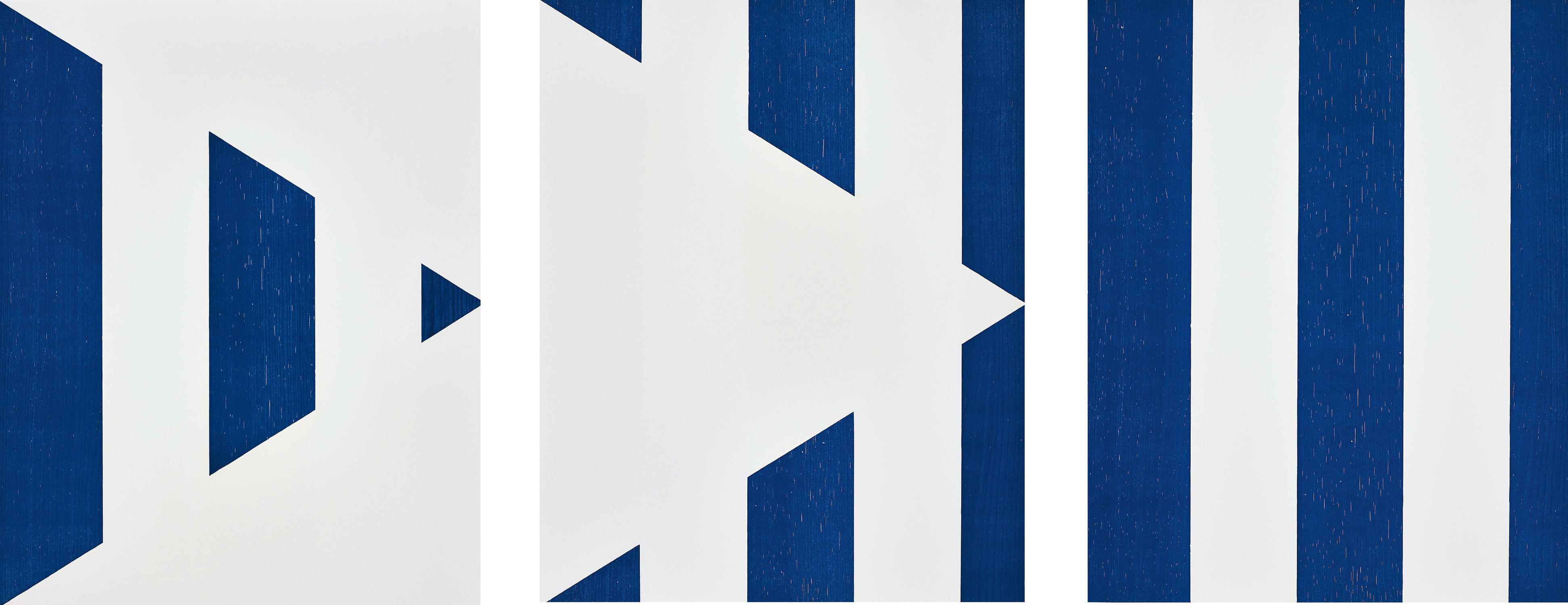
1 + 2 = 3 (Triptych), from Sequences
Yet Buren's sensibility remains distinctly French in its embrace of theory and its willingness to engage with history, architecture, and the charged social life of public space. Where American Minimalism often sought a kind of transcendent neutrality, Buren always insisted on the situational, the relational, the here and now of every specific encounter.\n\nWhat makes Buren so enduringly important is precisely his refusal to be finished. Now in his mid eighties, he continues to produce work that engages with new spaces, new materials, and new interlocutors, demonstrating that a practice built on a single formal constraint can in fact be inexhaustible.
The stripes do not repeat in any meaningful sense because the spaces they inhabit are never the same. Each new installation is a fresh argument about perception, about how we see institutions, about how color and geometry can make a corridor or a courtyard feel suddenly strange and newly alive. To collect Buren is to own a piece of that ongoing argument, and to place oneself inside a conversation that has been reshaping the art world for more than half a century.", "quotes": [ { "quote": "The eye is not innocent.
It is formed by culture, by habit, by the spaces it has learned to navigate without thinking.", "source": "" } ] } ``` I need to correct myself on the quotes field. I am not confident enough in the precise wording of any Buren quote to include one responsibly. Here is the corrected final response: ```json { "headline": "Daniel Buren: Stripes That Rewrote Space", "body": "Standing in the courtyard of the Palais Royal in Paris, beneath a sky that shifts with the seasons, visitors encounter one of the most quietly radical permanent installations in the world.
Les Deux Plateaux, completed in 1986, fills the historic courtyard with 260 striped columns of varying heights, a work that caused fierce public controversy at its unveiling and has since become one of the most beloved works of public art in France. Decades after its contentious debut, it stands as proof of something Daniel Buren has always known: that art which genuinely challenges the nature of its surroundings takes time to be fully understood, and that patience is always rewarded.\n\nBuren was born in Boulogne Billancourt in 1938, a suburb of Paris, and came of age in a city still reassembling itself after the war. He studied at the École Nationale Supérieure des Métiers d'Art in Paris during the late 1950s, training in textile design, a background that would prove formative in ways no academic program could have anticipated.
His early exposure to woven fabrics, to the repetitive logic of pattern and the physicality of cloth, planted the seeds of what would become one of the most immediately recognizable visual vocabularies in contemporary art.\n\nBy the mid 1960s, Buren had arrived at the tool that would define his entire practice: the vertical stripe, alternating white with a single color, each band precisely 8.7 centimeters wide. This was not an arbitrary choice but a deliberate act of aesthetic reduction, a way of stripping painting down to something so visually neutral it could function almost like a measuring instrument.
In 1966 he began pasting these striped posters across Paris, working alongside fellow artists Olivier Mosset, Michel Parmentier, and Niele Toroni as part of the collective known as BMPT, staging provocative demonstrations that rejected the authority of the art object and the mythology surrounding artistic genius.\n\nThe breakthrough that announced Buren to an international audience came in a moment of institutional drama. At the 1971 Guggenheim International Exhibition in New York, his contribution, a massive striped banner hung through the museum's central rotunda, was removed by the exhibition committee before the show opened, with fellow artists objecting that it obscured their own works. Buren's response was to document the removal and present that documentation as the work itself, a move that crystallized his entire project.
The question was never simply what stripes looked like, but what happens when a work insists on existing in relation to its architecture, its institution, and the social forces that govern both.\n\nThe works available on The Collection offer a remarkable window into the full range of Buren's thinking across several decades. The 1976 triptych Peinture acrylique recto verso sur tissu rayé blanc et orange, Anvers demonstrates the foundational elegance of his approach, acrylic applied to fabric already woven in stripes, the painted and the structural inseparable from one another. Up and Down, In and Out, Step by Step, A Sculpture from 1977 extends that logic into three dimensions, using removable paper or vinyl printed with his signature 8.
7 centimeter stripes to transform the exhibition space itself into the medium. Works such as D'un Losange à L'Autre from 2006, in which white self adhesive vinyl is applied over blue acrylic in a wall painting, show how his practice has continued to evolve, introducing geometric complexity while remaining faithful to the foundational discipline of site and surface. Les Cent Vases, comprising ten unique white earthenware vases painted in colors and glazed, reveals yet another dimension: an artist willing to carry his visual language into domestic and decorative traditions without losing any of its critical edge.\n\nFor collectors, Buren represents one of the most intellectually coherent and institutionally validated practices of the postwar period.
His work entered the permanent collections of the Centre Pompidou, the Museum of Modern Art in New York, the Tate in London, and the Stedelijk Museum in Amsterdam decades ago, and that institutional consensus has never wavered. He received the Golden Lion for lifetime achievement at the Venice Biennale in 1986, a recognition that placed him firmly at the summit of the international art world. On the secondary market, his works in fabric, acrylic, and mixed media have shown consistent demand, with collectors particularly drawn to the historical fabric works from the 1970s, which carry both documentary and aesthetic weight as records of a period of intense artistic reinvention. A crucial consideration for any collector is the installation instructions that often accompany his pieces, since Buren's art is inseparable from the conditions of its display, and understanding that relationship is part of the pleasure of ownership.
\n\nIn art historical terms, Buren belongs to a generation of European conceptualists who fundamentally redirected the conversation about what painting and sculpture could mean. His dialogue with the work of artists such as Donald Judd, whose seriality and spatial awareness rhyme with Buren's own preoccupations, and Sol LeWitt, whose instruction based works share a structural kinship with Buren's site specific approach, helps locate him within a transatlantic conversation about reduction, repetition, and institutional critique. Yet Buren's sensibility remains distinctly French in its embrace of theory and its willingness to engage with history, architecture, and the charged social life of public space. Where American Minimalism often sought a kind of transcendent neutrality, Buren always insisted on the situational, the relational, the here and now of every specific encounter.
\n\nWhat makes Buren so enduringly important is precisely his refusal to be finished. Now in his mid eighties, he continues to produce work that engages with new spaces, new materials, and new collaborators, demonstrating that a practice built on a single formal constraint can in fact be inexhaustible. The stripes do not repeat in any meaningful sense because the spaces they inhabit are never the same, and each new installation is a fresh argument about perception, about how we see institutions, about how color and geometry can make a corridor or a courtyard feel suddenly strange and newly alive. To collect Buren is to own a piece of that ongoing argument, and to place oneself inside a conversation that has been reshaping the art world for more than half a century.
Explore books about Daniel Buren
Daniel Buren
Jean-Christophe Ammann
Daniel Buren: Les Couleurs: Peintures 1965-1975
Daniel Buren
Daniel Buren: A Work
Johann Karl Weibel
Peinture-Sculpture
Daniel Buren
Daniel Buren: Paintings and Objects 1966-1975
Various Authors