Claude Lalanne, 1925 - 2019
Claude Lalanne, Where Nature Becomes Pure Magic
Artist Spotlight · The Collection Editorial
In the spring of 2023, Christie's Paris offered a remarkable grouping of works by Claude Lalanne that drew spirited bidding from collectors across Europe, Asia, and the Americas. The sale confirmed what devoted admirers have long understood: that Lalanne's bronze creatures, flowering furniture, and silverwork services occupy a singular position in the art market, beloved equally by those who collect fine art and those who believe the most beautiful objects are the ones you live alongside every day. Her work does not belong to one world or another. It belongs to all of them at once.
Claude Lalanne, 1925 - 2019
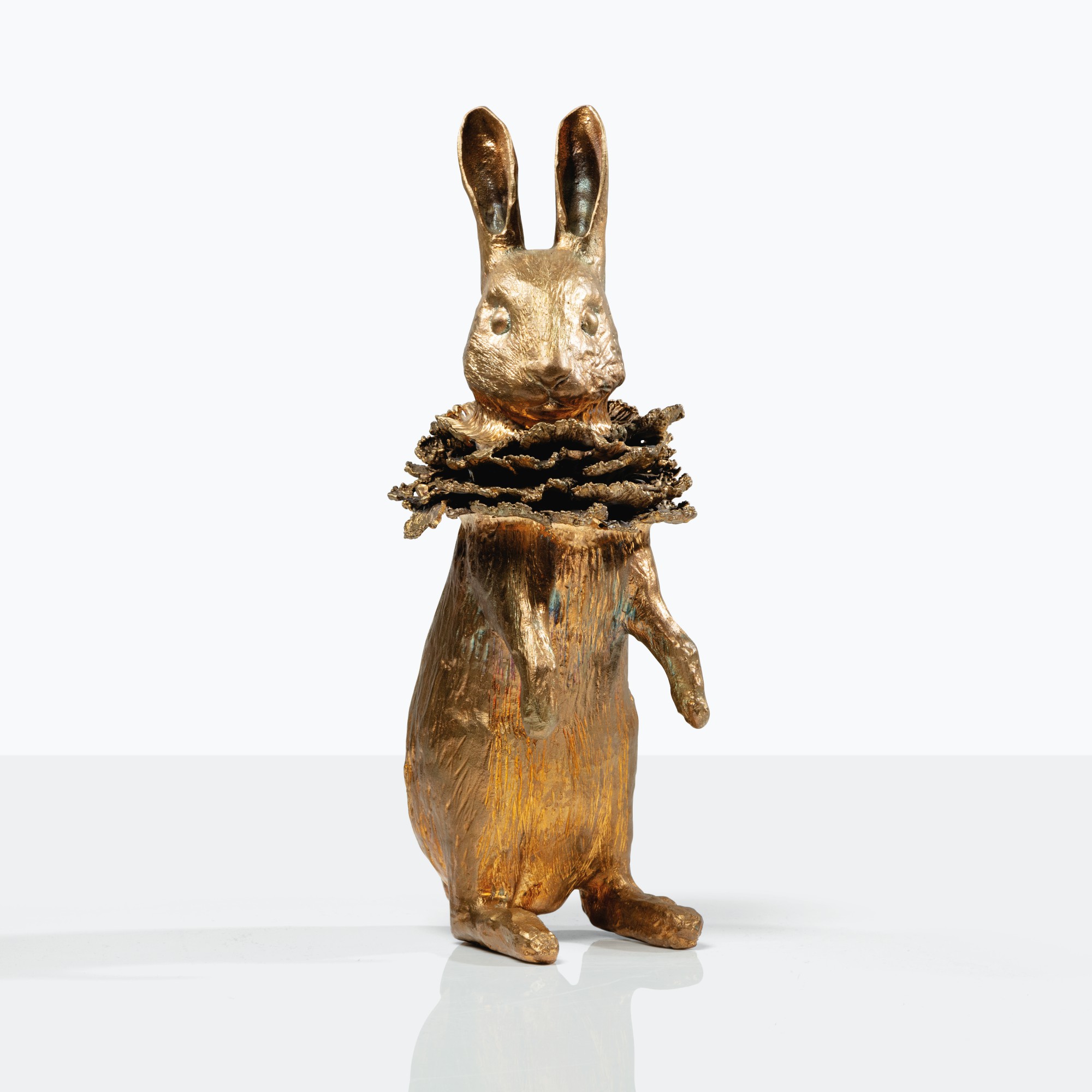
Petit lapin debout à collerette
Claude Lalanne was born in Paris in 1925, and the city shaped her sensibility in ways that were both formal and deeply personal. She trained at the École des Beaux Arts and the École des Arts Décoratifs, absorbing the French tradition of craft and ornament while remaining restlessly curious about what lay beyond its polished conventions. Paris in the postwar years was electrically alive with new ideas, and Lalanne moved through its studios, galleries, and salons with an openness that would prove formative. It was in this milieu that she met François Xavier Lalanne, the sculptor who would become her husband and lifelong creative companion.
Together they formed one of the most celebrated partnerships in the history of modern decorative art, exhibiting jointly as Les Lalanne while each maintained a fiercely individual vision. Claude's artistic development unfolded with organic patience, much like the natural forms she would spend a lifetime translating into metal. Her earliest serious work drew on direct observation of plants, animals, and the human body, and she developed an extraordinary technical method that became her signature: electroplating living plants and organic forms in copper to create casts of uncanny fidelity. A leaf, a branch, a tangle of roots would emerge from her studio transformed into something eternal, retaining every vein and imperfection of the original.
Claude Lalanne, 1925 - 2019
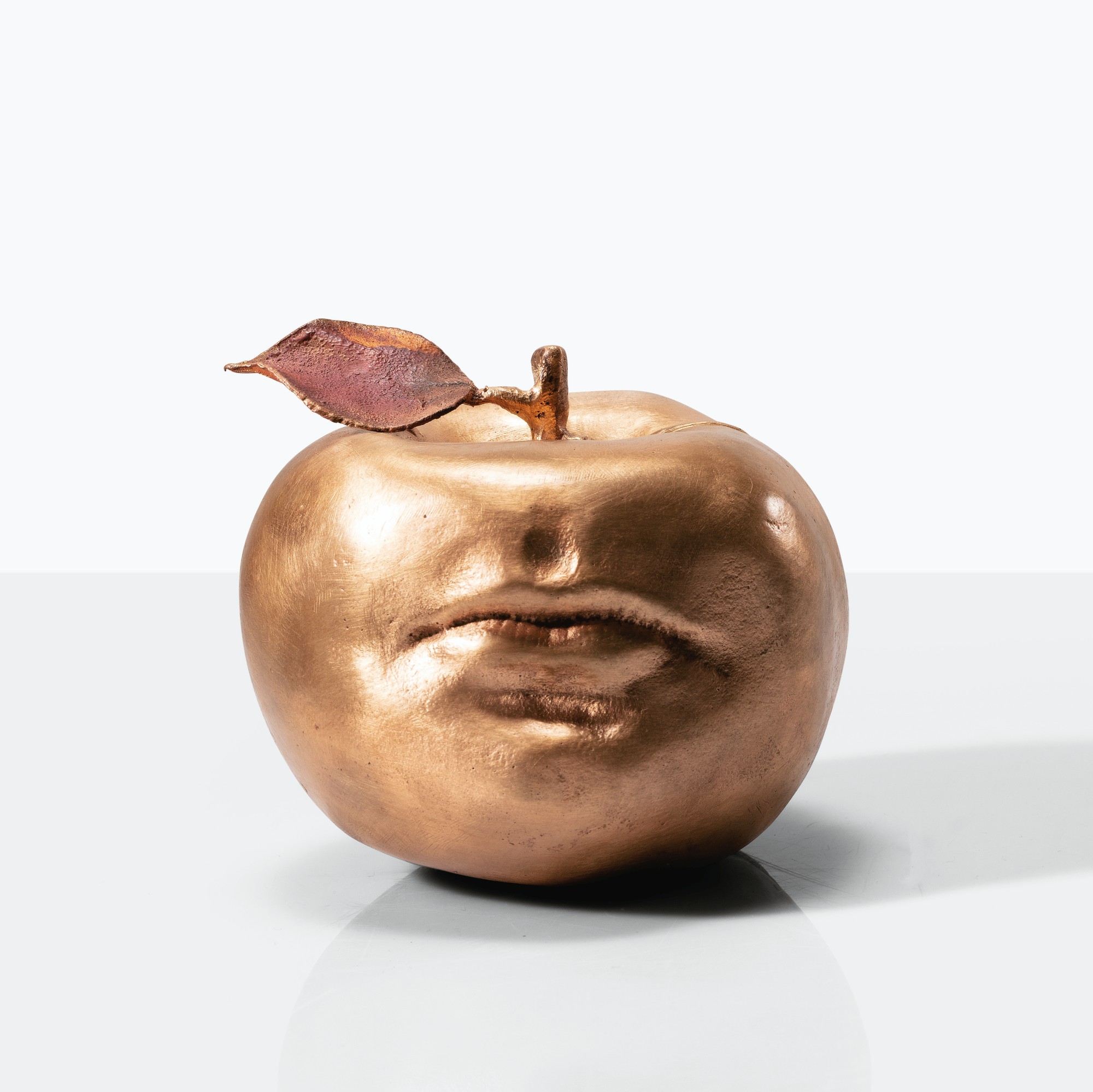
Pomme bouche
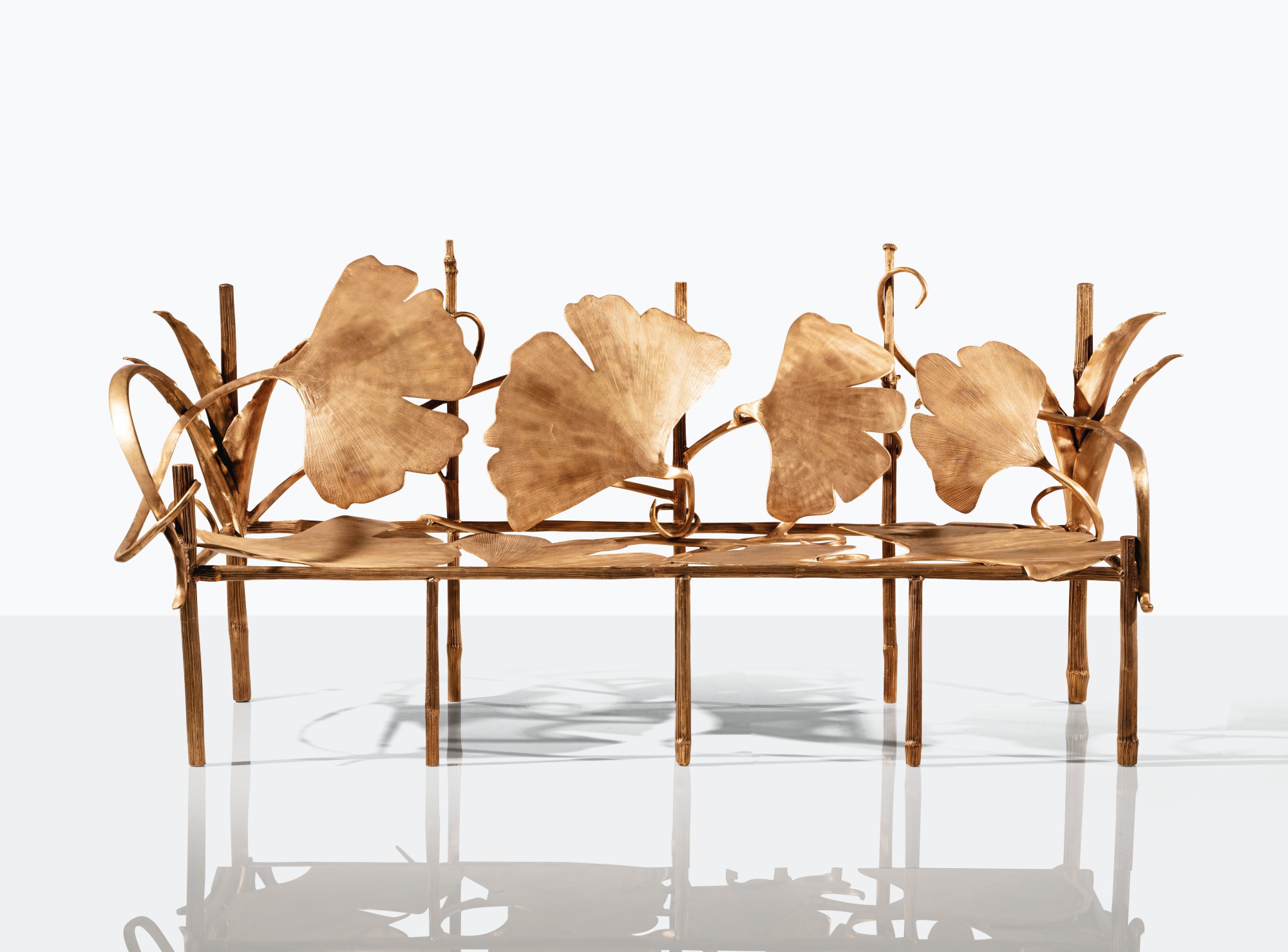
This process gave her work a quality that no purely hand modeled sculpture could achieve, a kind of collaboration with nature itself in which the artist guided and selected but never fully controlled the outcome. By the late 1960s she had developed the vocabulary that would define her for the next five decades. The works that collectors prize most are those in which function and fantasy are so thoroughly intertwined that the distinction dissolves. The Banquette Les Berces Adossées, in gilt patinated bronze, is at once seating and sculpture, a piece of furniture that seems to have grown rather than been made.
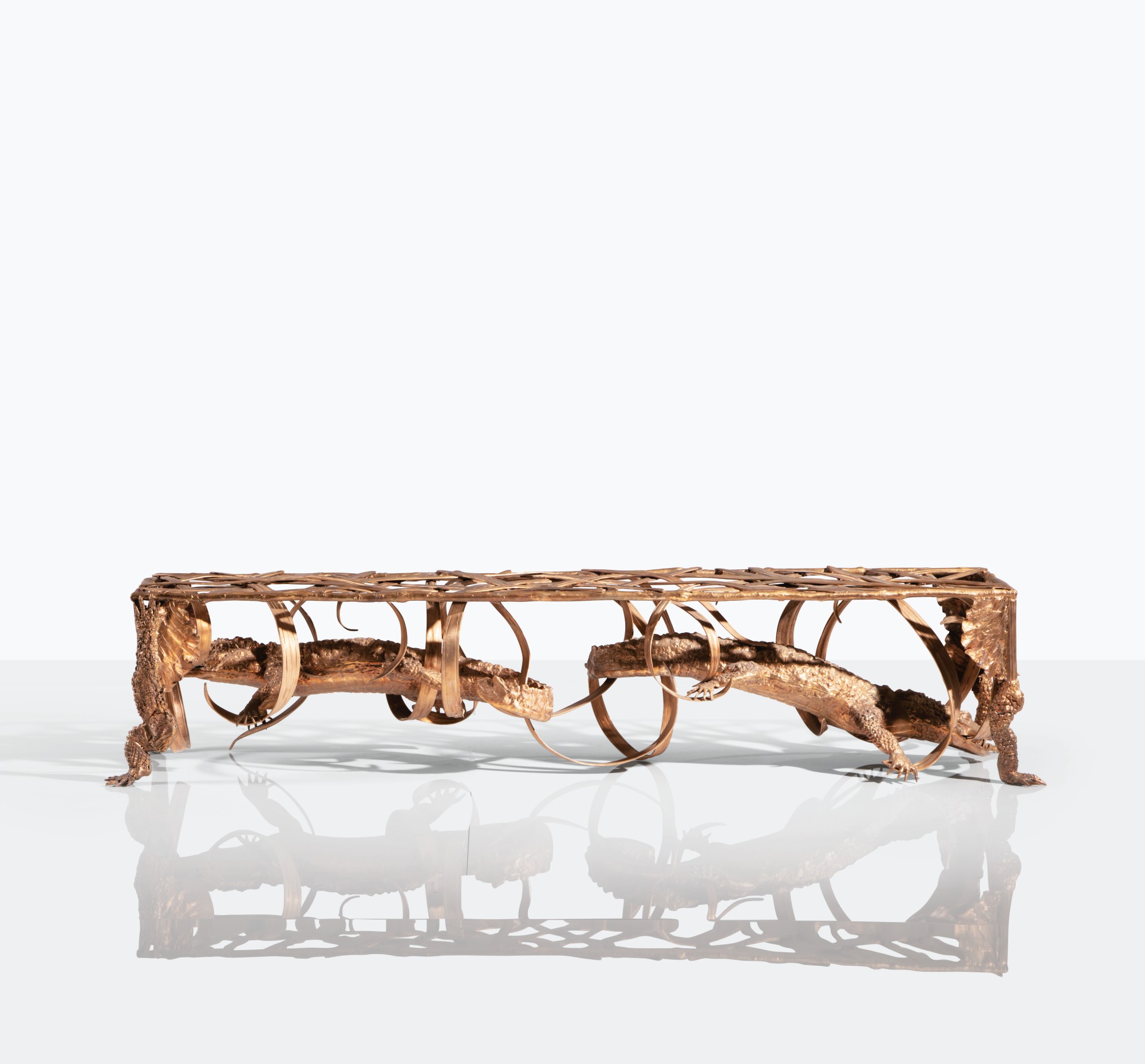
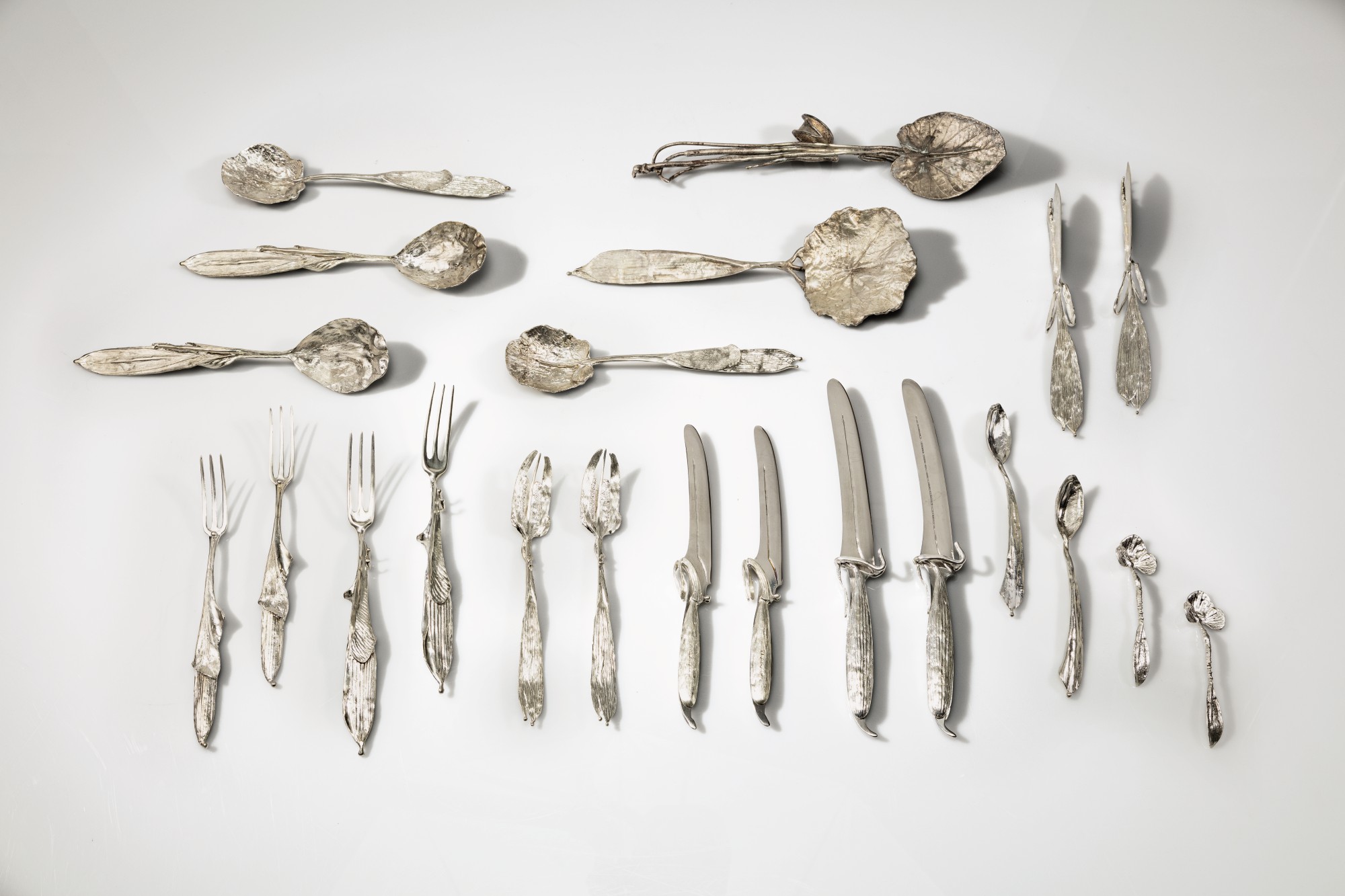
The Banc Crocodiles offers a similar enchantment, its reptilian forms curling beneath a surface just plausible enough to invite you to sit. Pomme Bouche, one of her most celebrated and sought after objects, merges the human mouth with the form of an apple in gilt patinated bronze and galvanised copper, a quietly surrealist image that rewards long looking. Her silverware services, including the magnificent Service Phagocytes and the refined Service Sven, extend this vision to the dining table, transforming the ritual of a meal into an encounter with something genuinely strange and beautiful. The Guéridon Osiris and the Rampe Structure Végétale reveal how fully her ambition extended into architectural and interior space, with the latter, a unique piece in gilt patinated bronze and painted steel, bringing the energy of a climbing plant into the language of structure itself.
Claude Lalanne, 1925 - 2019
Banc Crocodiles
Within art history, Claude Lalanne occupies a position that is genuinely her own, though her work resonates with several important currents. The Surrealist movement, with its appetite for unexpected juxtapositions and its trust in the unconscious logic of the imagination, provided one important frame. Salvador Dalí's furniture objects and Meret Oppenheim's fur teacup belong to the same broad family of ideas, objects that unsettle comfortable categories. The Art Brut tradition, with its celebration of untrained instinct and raw material truth, offers another lens, though Lalanne's technical accomplishment was anything but naive.
Collectors who admire her work often find similar pleasures in the work of Line Vautrin, whose bronze and resin objects carry the same quality of accumulated enchantment, or in the furniture sculptures of Diego Giacometti, whose animal legged tables and chairs share Lalanne's conviction that useful objects deserve the full ambition of art. François Xavier Lalanne himself, working in an adjacent but distinct register, rounds out the natural comparison. The market for Lalanne's work has grown steadily and with genuine conviction rather than speculative froth. Major auction houses including Christie's, Sotheby's, and Artcurial have handled her pieces with consistent enthusiasm, and private sales through leading galleries have placed her work in significant collections on both sides of the Atlantic.
Claude Lalanne, 1925 - 2019
Service Sven
What draws collectors is not merely rarity, though her unique and small edition works are genuinely scarce. It is the quality of lived experience that her objects promise. A Lalanne piece changes a room. It asks questions of the people who inhabit that room and answers them in ways that vary with the light, the season, the mood of the observer.
For collectors who believe that art should be present in daily life rather than sealed behind glass, her work represents something close to an ideal. Claude Lalanne continued working with remarkable energy and invention until her death in 2019 at the age of ninety three, and the full arc of her achievement has only grown clearer in the years since. She demonstrated, across more than six decades of practice, that the boundary between fine art and decorative art is a bureaucratic convenience rather than a creative truth. She made objects of genuine surrealist imagination that you could also sit on, eat from, and walk past every morning on your way to breakfast.
She treated nature not as a subject to be depicted but as a collaborator to be listened to. That combination of intellectual seriousness and sensory generosity is rare in any era. In her own, it was extraordinary.
Explore books about Claude Lalanne, 1925 - 2019
Claude Lalanne
Alastair Macaulay
Claude and François-Xavier Lalanne
Emmanuel Macaulay-Lalanne
The Lalanne Phenomenon
Pierre Restany
Claude Lalanne: Catalogue Raisonné
Cheska Leigh-Pemberton
Surrealism and Design: Claude Lalanne
Museum of Modern Art