Claude Cahun
Claude Cahun: The Mirror Breaks Free
Artist Spotlight · The Collection Editorial
“Shuffle the cards. Masculine? Feminine? It depends on the situation. Neuter is the only gender that always suits me.”
Aveux non avenus, 1930
In 2022, the Jeu de Paume in Paris mounted a landmark survey of Claude Cahun's work that drew queues around the block and reignited a global conversation about identity, photography, and the radical possibilities of self portraiture. That exhibition, which traveled to wider European audiences and generated fervent critical attention, confirmed what a generation of curators and collectors had long understood: Cahun is not a footnote to Surrealism but one of its most visionary and daring protagonists. To encounter her photographs in person is to feel the ground shift slightly beneath you, as if the image itself is asking whether you truly know yourself. Claude Cahun was born Lucy Renée Mathilde Schwob in Nantes, France, in 1894, into a prominent Jewish intellectual family.
Claude Cahun
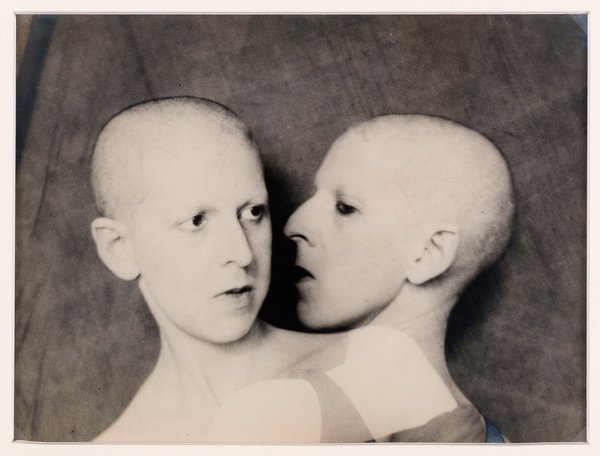
Que me veux-tu?, 1928
Her uncle, Marcel Schwob, was a celebrated symbolist writer, and the literary atmosphere of her upbringing gave her an early appetite for transformation and narrative. She adopted the gender neutral name Claude Cahun as a young artist, a gesture that was far more than a pseudonym. It was a declaration of philosophical intent, a refusal to be fixed by the categories that the early twentieth century demanded. She studied at the Sorbonne and later at Oxford, moving through circles of writers and thinkers who were beginning to crack open the rigid structures of bourgeois European culture.
Her partnership with the artist and designer Marcel Moore, born Suzanne Malherbe, was the great creative and personal alliance of her life. The two women, who became stepsisters after their parents married and remained lifelong companions, collaborated so intimately on Cahun's photographic work that it is often impossible and perhaps unnecessary to fully separate their contributions. Moore frequently operated the camera or constructed the elaborate props and costumes that populate Cahun's images. Together they built a private world of signs and disguises in their Jersey home and later in their Paris studio, a world that was both deeply personal and strikingly prescient about the performative nature of gender and identity.
Claude Cahun
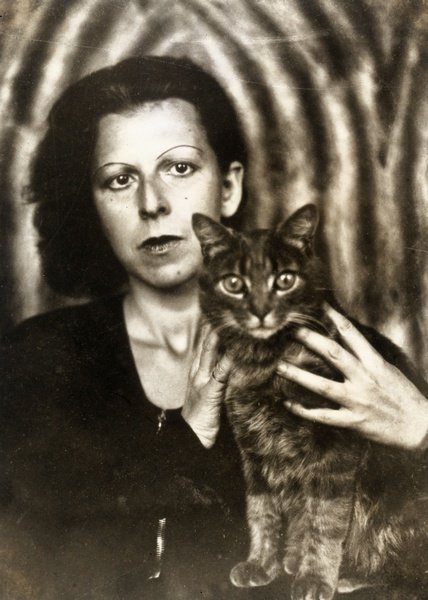
Lucie au Kid, 1930
Cahun's artistic development moved across photography, writing, and object making with restless intelligence. Her 1930 publication Aveux non avenus, a fragmented autobiographical text illustrated with photomontages she created with Moore, is one of the most singular art books of the twentieth century. It anticipates the strategies of later feminist and queer theory with an almost uncanny clarity. By the mid 1930s she had become embedded within the Parisian Surrealist circle, exhibiting in the landmark 1936 International Surrealist Exhibition in London alongside André Breton, Salvador Dalí, and Man Ray.
“Under this mask, another mask. I will never finish removing all these faces.”
Aveux non avenus, 1930
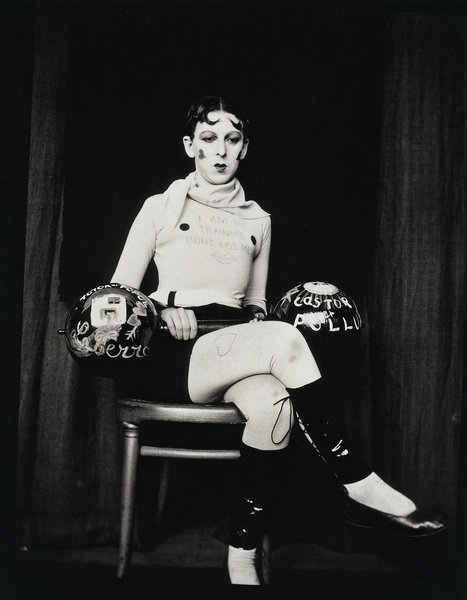
Yet Cahun always maintained a critical distance from the movement's more programmatic aspects, and her work never subordinated the personal to the ideological. The self portraits that form the core of her legacy are among the most psychologically complex images in the history of the medium. Works such as Que me veux tu from 1928 present the artist in a state of deliberate doubling, her face multiplied and mirrored in a composition that refuses to resolve into a single stable identity. Autoportrait from 1927 is equally unsettling and equally beautiful, the artist shaved, direct, and confrontational in a way that would not become common visual language for another half century.
Claude Cahun
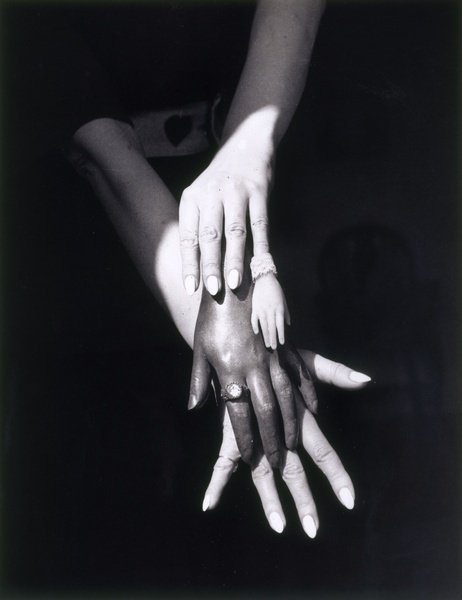
Sans titre, 1936
Sans titre from 1936 and the Poupée series from the same year show her expanding into object and assemblage, weaving together found materials, hair, and paint into forms that feel alive with suppressed narrative. Her Object of 1936, combining wood, paint, a tennis ball, and found materials, stands as a remarkable bridge between her photographic practice and the broader Surrealist object tradition championed by figures like Meret Oppenheim. For collectors, Cahun's work represents one of the most compelling opportunities in early twentieth century photography. Her prints, predominantly gelatin silver works made in intimate scales, carry an immediacy and psychological weight that photographs many times their size cannot match.
The rarity of her work on the market, combined with its growing institutional significance, has made each appearance at auction a genuine event. Her photographs have been acquired by major institutions including the San Francisco Museum of Modern Art, the Art Institute of Chicago, and the Pompidou Centre in Paris, lending institutional legitimacy to a market that continues to mature. Collectors drawn to the intersection of Surrealism, feminist art history, and photographic modernism find in Cahun a figure who satisfies all three interests simultaneously and with extraordinary depth. Cahun's place in art history is best understood in relation to a constellation of artists who similarly used the body, the camera, and the constructed self as primary materials.
Claude Cahun
Autoportrait, 1927
The parallels with Cindy Sherman are frequently and rightly drawn, though Cahun preceded Sherman's Untitled Film Stills by half a century. Her work also resonates powerfully with that of Hannah Höch in its collage sensibilities and political edge, and with Frida Kahlo in its unflinching autobiographical intensity. Among her Surrealist contemporaries, Meret Oppenheim and Dora Maar shared something of her determination to exceed the roles the movement's male leadership had scripted for women. Cahun simply did so with a quieter, more sustained radicalism.
What makes Cahun so alive to us now is precisely the quality that made her difficult to categorize in her own time. She did not fit. She was too playful for pure politics, too rigorous for mere aesthetics, too personal for theory, and too theoretical for memoir. That refusal to be contained is exactly what contemporary culture has come to cherish.
Her life story carries its own extraordinary weight: during the German Occupation of Jersey during the Second World War, she and Moore conducted a covert resistance campaign, distributing anti Nazi leaflets and propaganda, for which they were arrested in 1944 and sentenced to death. The liberation of the island spared their lives. The courage embedded in that chapter only deepens our reading of images that were always, in essence, acts of defiance. To collect Claude Cahun is to hold a piece of that defiance, and to understand that art at its most vital has always insisted on the right to be exactly, irreducibly, beautifully itself.
Explore books about Claude Cahun
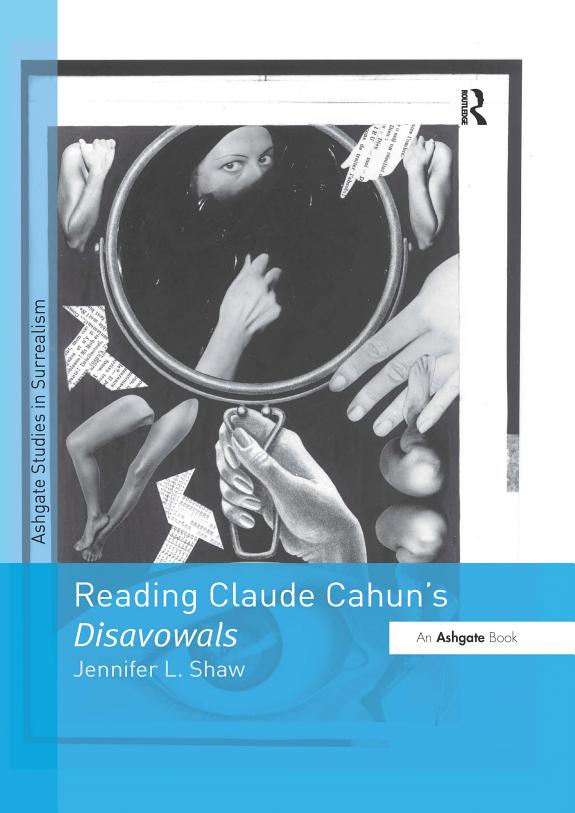
Claude Cahun: A Sensual Politics of Photography
Tirza True Latimer
Claude Cahun: The Complete Lesbian Body
Whitney Chadwick
Cahun and Moore: Histories, Theories, Practices
Whitney Chadwick and Isabelle de Courtivron
Claude Cahun: The Exile of the Marvelous
Michèle C. Cone
The Writings of Claude Cahun
Cahun, Claude and François Leperlier
Claude Cahun: Aveux Non Avenus
Cahun, Claude