Claire Tabouret
Claire Tabouret Paints the World Anew
Artist Spotlight · The Collection Editorial
“I am interested in the moment just before transformation, when everything is still possible.”
Claire Tabouret
In recent seasons, Claire Tabouret has emerged as one of the most compelling voices in contemporary figurative painting, earning a place in the permanent collections of major institutions and commanding growing enthusiasm among discerning collectors on both sides of the Atlantic. Her 2023 solo exhibition at Perrotin in New York drew significant critical attention, reinforcing what those who have followed her career for years already knew: Tabouret is not simply a painter of figures but a painter of feeling, of memory held just beneath the surface of the skin. At a moment when figurative painting has reclaimed its central place in contemporary art discourse, her work feels not like a trend but like a reckoning. Tabouret was born in 1981 in Pertuis, a small town in the south of France, and her early years in Provence shaped the atmospheric, color saturated quality that would later define her canvases.
Claire Tabouret
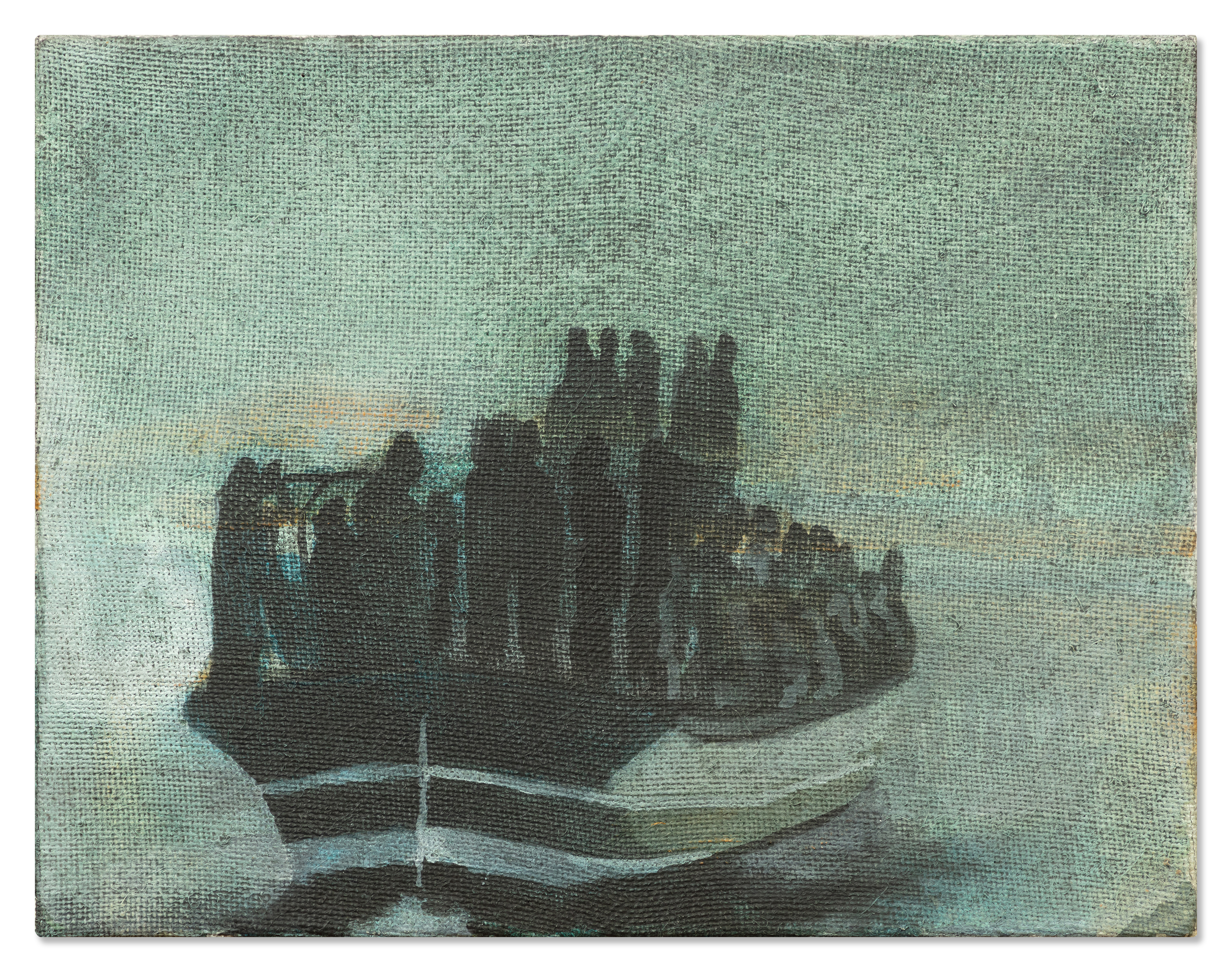
La traversée, 2011
She studied at the École Nationale Supérieure des Beaux Arts in Paris, where she developed a rigorous foundation in painting while beginning to explore the psychological terrain that would become her signature territory. After completing her studies, she relocated to Los Angeles, a move that proved transformative. The light of Southern California, so different from the cool diffusion of northern Europe, seeped into her palette and loosened something in her practice, pushing her toward the luminous, almost spectral washes of color for which she is now celebrated. Tabouret's artistic development has followed an arc of increasing emotional intensity and formal confidence.
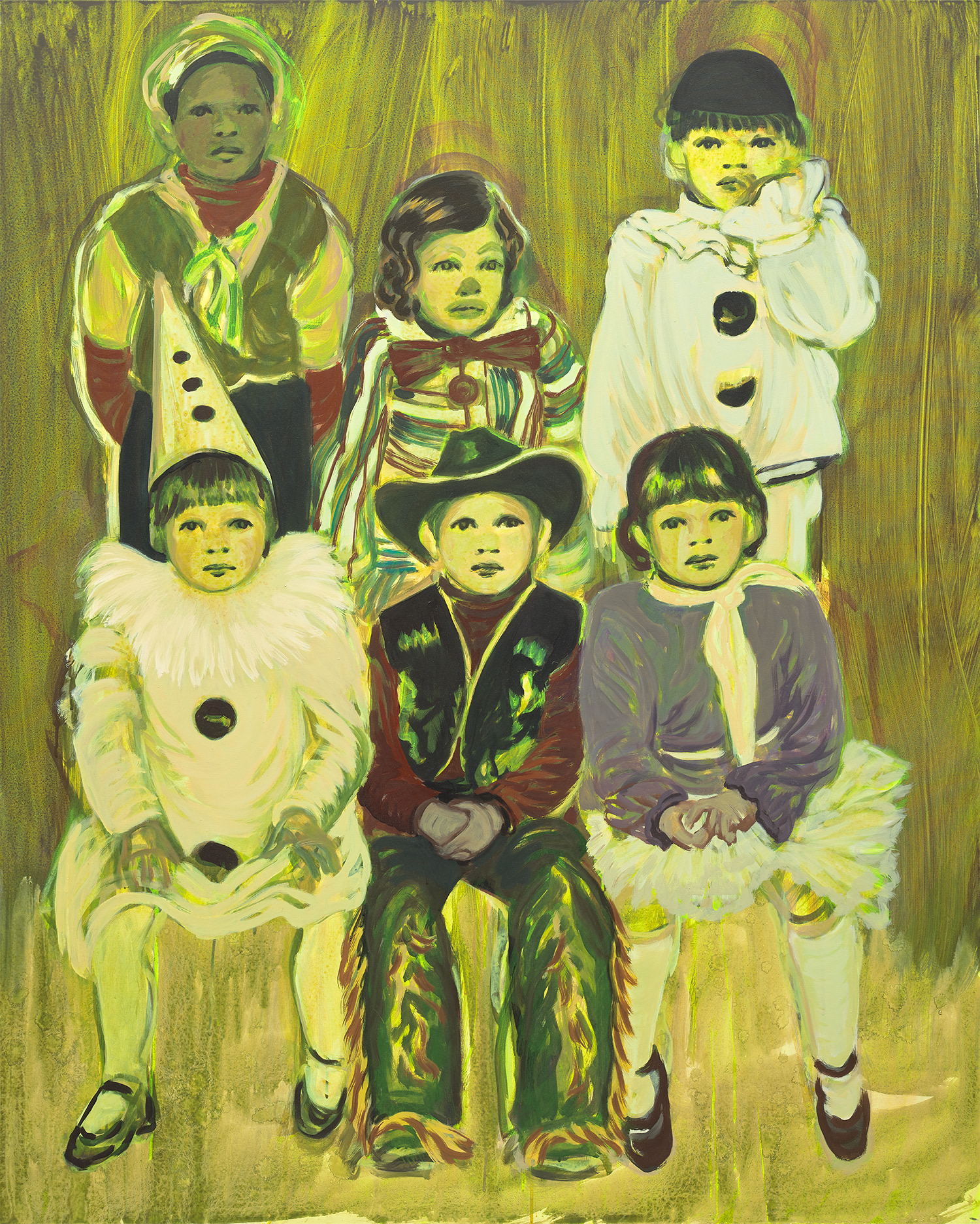
Her early works, including the quietly haunting "La traversée" from 2011, already demonstrated her interest in collective experience and the anonymity of the group, figures moving together through ambiguous space as if caught between worlds. Over the following years, she refined and deepened this approach, moving through explorations of girlhood, ritual, and transformation. Works like "L'Attente" from 2015 and "Le Carnaval (Les Cotillons)" from the same year reveal a painter fully in command of her means, using acrylic in thin, layered veils that accumulate into something almost hallucinatory. The occasional incorporation of fabric and feathers into her surfaces adds a tactile dimension that pulls the viewer closer, as if the painting itself is reaching out.
Claire Tabouret
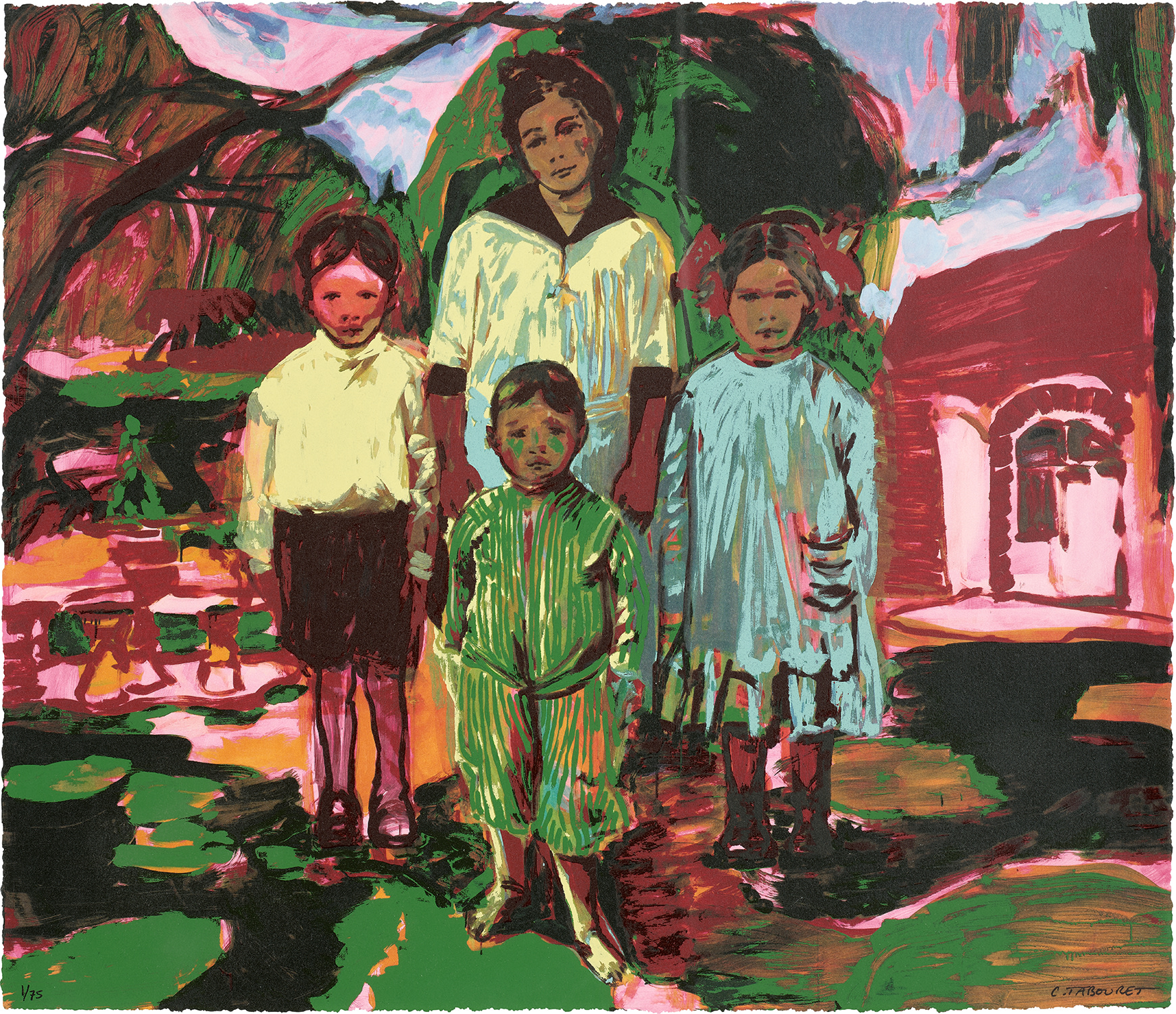
The Siblings
Among her most discussed works are those depicting groups of children and young women, figures whose faces are often obscured or masked, their identities dissolved into the collective. "The Soccer Team" from 2019 is a particularly powerful example: a group of young players rendered in Tabouret's characteristic washes of blue and green, their individuality subsumed into shared experience, their gaze directed outward with an intensity that is simultaneously confrontational and vulnerable. "Portrait with Feathers" from 2016, executed in acrylic and feathers on paper, demonstrates her ability to work at an intimate scale with no loss of emotional force. These are paintings that ask questions about who we are when we are seen, and who we become when we are not.
For collectors, Tabouret's work occupies an unusually compelling position in the current market. Her paintings have entered the holdings of major private collections across the United States and Europe, and her prints, including editions such as "The Siblings," a lithograph with screenprint on Somerset paper, and "Girlfriends (Stripes)," a digital pigment print on Hahnemühle paper, offer a thoughtful point of entry for those beginning to engage with her practice. The 2025 signed offset print "Self Portrait Under the Moonlight" marks a continued investment in the print medium as a serious vehicle for her ideas rather than a secondary output. Collectors drawn to her work often speak of a quality that is difficult to name but impossible to ignore: the sense that her figures are on the verge of something, that the painting has captured a moment of becoming rather than a moment of being.
Claire Tabouret
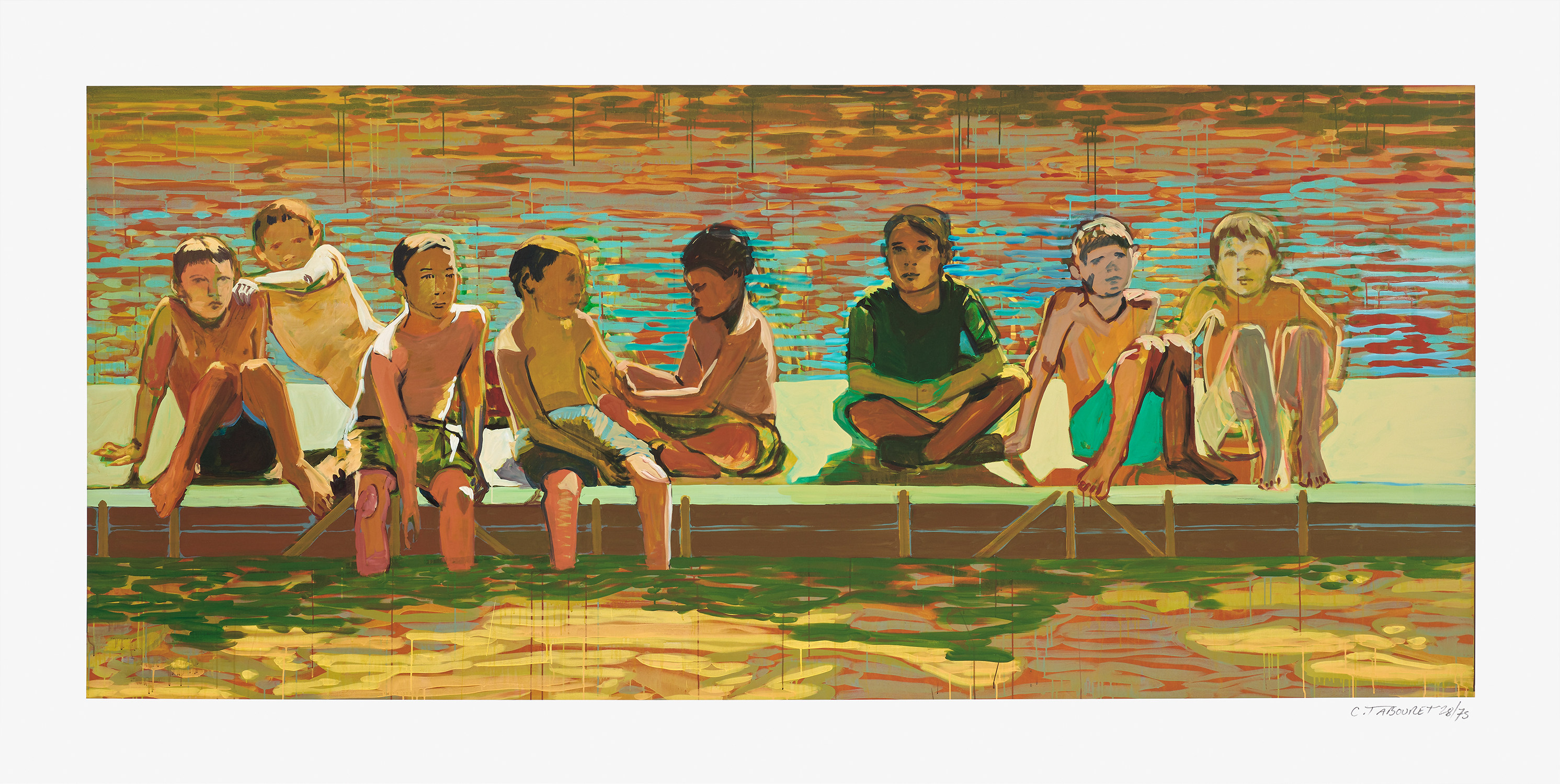
The Dock
Tabouret's work sits naturally within a broader conversation about the renewed vitality of figurative painting in the twenty first century. Her practice shares certain affinities with artists such as Cecily Brown in its layered, gestural approach to the figure, and with Marlene Dumas in its willingness to use paint as a vehicle for psychological excavation. There is also something in her work that recalls the dreamlike figuration of Paula Rego, particularly in the way children and groups of women are rendered as both innocent and charged with hidden meaning. Yet Tabouret's voice is distinctly her own, shaped by her particular geography, her movement between France and California, and her sustained attention to the way memory distorts and beautifies in equal measure.
What makes Tabouret matter today, beyond the considerable pleasures of her individual paintings, is the consistency and seriousness of her inquiry. At a time when the art world can reward novelty over depth, she has chosen to remain committed to a set of questions that do not resolve easily: What does it mean to be seen? How does the group both protect and erase the individual? Where does childhood end and the knowledge of the world begin?
Claire Tabouret
L’Attente, 2015
Her canvases do not answer these questions so much as hold them open, returning the viewer to a space of genuine uncertainty that feels, in the best possible sense, like art doing its most essential work. For those who collect her, and for those encountering her practice for the first time, the experience is one of recognition, as if she has painted something you always knew but could never quite put into words.