Christian Boltanski

Christian Boltanski: A Light That Endures
Artist Spotlight · The Collection Editorial
“A good work of art can never be read in one way. My work is full of contradictions. An artwork is open.”
Christian Boltanski, artist statement
In the winter of 2010, visitors to the Grand Palais in Paris encountered something they would never fully recover from. Christian Boltanski had filled the vast iron and glass nave with thousands of secondhand garments arranged across the floor, presided over by a mechanical claw that periodically descended to seize a fistful of clothing before releasing it back onto the pile. The installation, titled Personnes, was part of the Monumenta series, and it stopped Paris in its tracks. Critics reached for words like sublime and devastating.
Christian Boltanski
Monument
Ordinary visitors simply stood still. It was the clearest possible demonstration of what Boltanski had spent four decades perfecting: the art of making the invisible visible, of giving form to grief and wonder simultaneously. Christian Boltanski was born in Paris in 1944, just weeks after the Liberation, to a family whose biography was already freighted with the defining trauma of the twentieth century. His father, a Jewish doctor, had hidden beneath the floorboards of the family home during the German occupation, and the silence and secrecy of that period cast long shadows over Boltanski's childhood.
He was largely self taught as an artist, having left formal schooling early, and this outsider relationship to institutional knowledge gave his practice an urgency and a directness that would become its hallmark. He grew up in Saint Germain des Prés, surrounded by postwar Paris's intellectual ferment, absorbing its questions about history, identity, and what it meant to survive. Boltanski came to international attention in the late 1960s and early 1970s, a period when he was exploring film, painting, and theatrical gesture with equal restlessness. He staged fictional autobiographies, sent elaborate packages and letters to galleries and institutions, and began working with photography not as a documentary medium but as an instrument of uncertainty.
Christian Boltanski
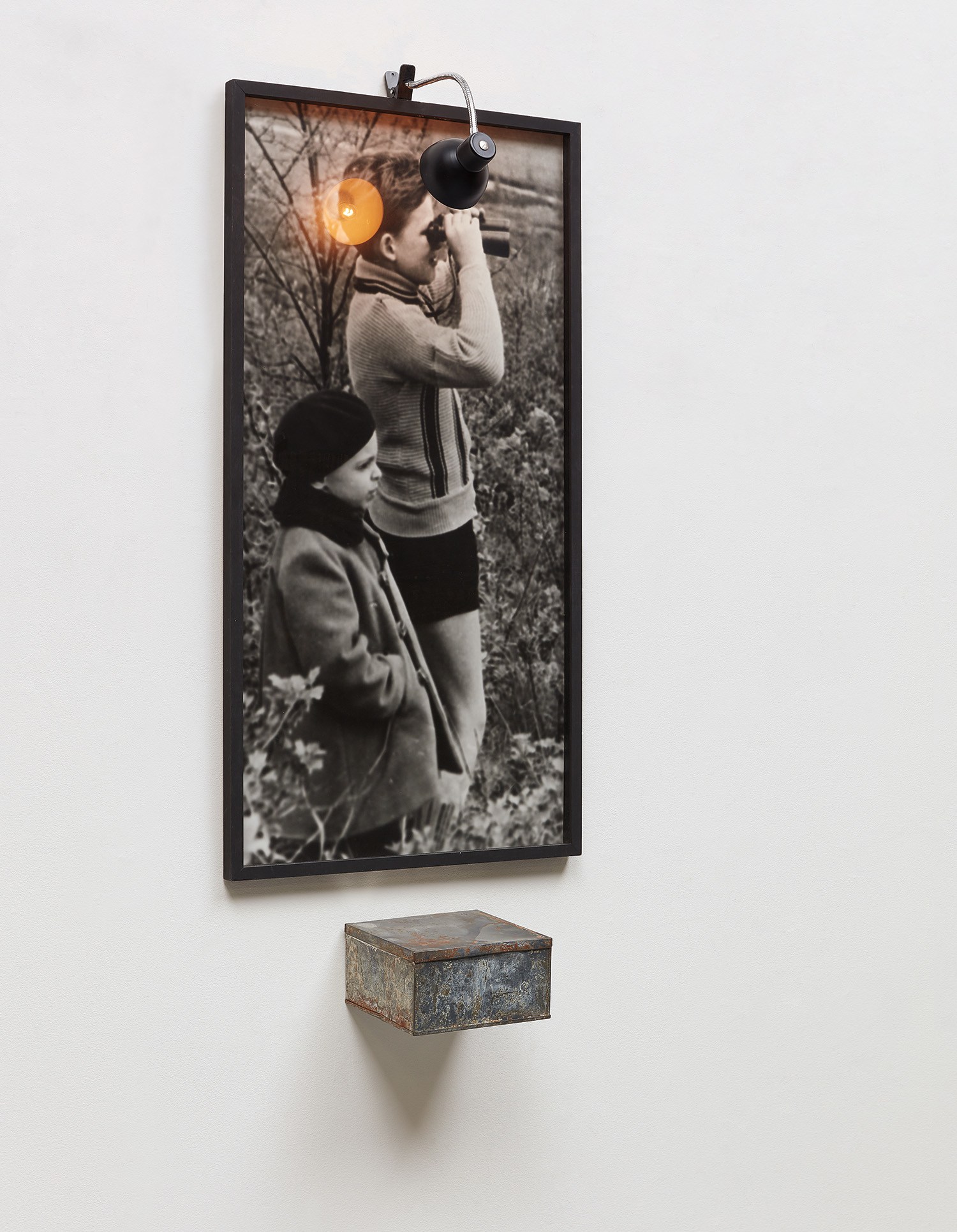
Portrait of Two Boys with Binoculars
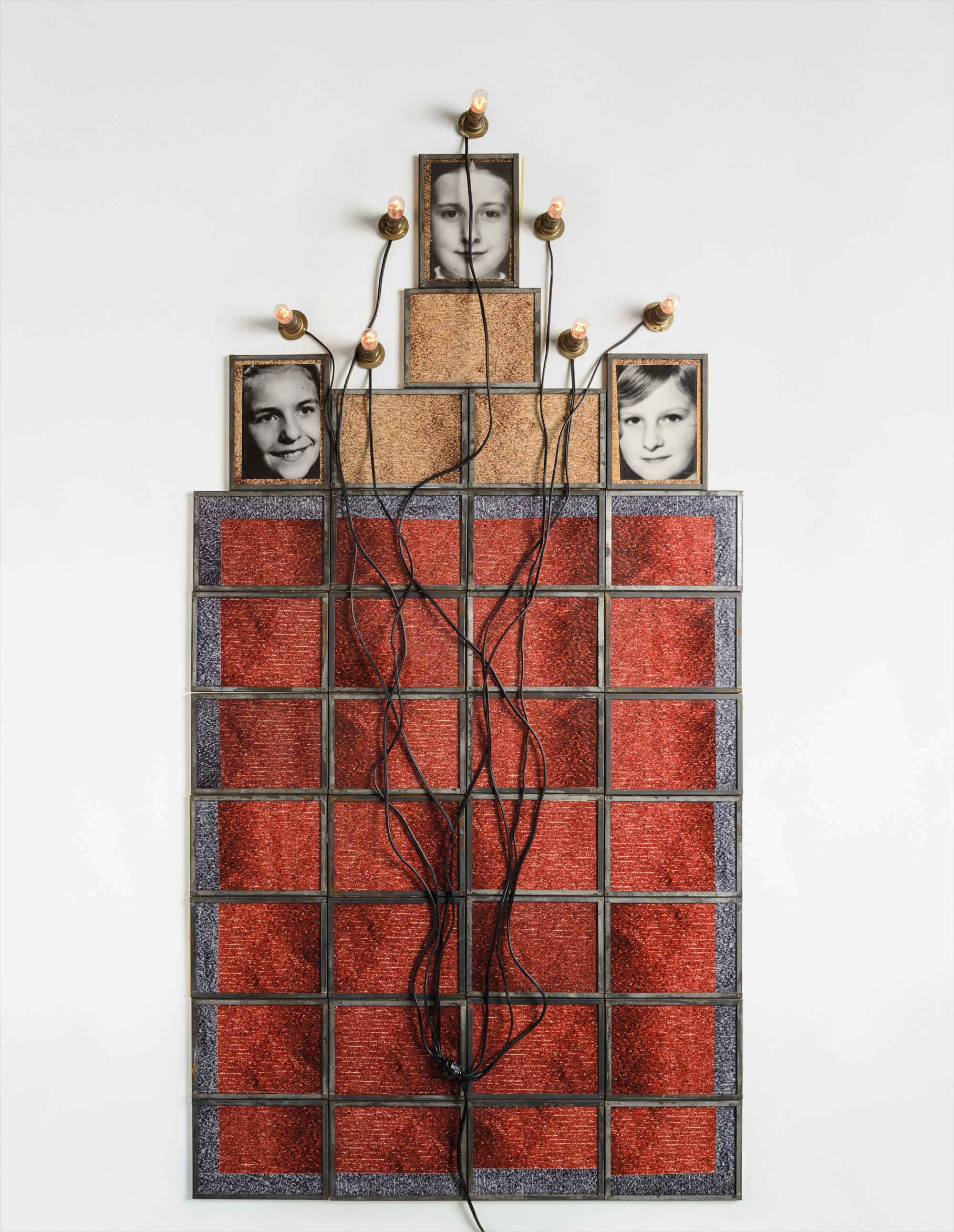
His early focus on childhood photographs, many of them blurred or poorly reproduced, introduced one of his most enduring themes: the instability of memory and the way images promise presence while delivering absence. By the late 1970s and into the 1980s, his Monuments series had begun to take shape, assembling found photographs of children behind grids of bare light bulbs, transforming domestic snapshots into something between a shrine and an indictment. The works from this period, many of them involving gelatin silver prints, tin biscuit boxes, electric lamps, and salvaged clothing, became the visual language that defined Boltanski's mature practice. The biscuit tins, often stacked into towering arrangements or deployed as reliquary containers, carried the weight of the everyday transformed into the sacred.
“I try to show that life is short and that we should always remember those who have disappeared.”
Christian Boltanski, interview
The lights that illuminate his photographs flicker with a dual meaning he described himself: they suggest both the interrogation lamp and the votive candle, the secular and the spiritual held in a single gesture. His 1989 work La Fête du Pourim, which combines photographs, lamps, and clothing fixed to a wooden panel, exemplifies this quality of concentrated emotional intelligence. It draws on Jewish commemorative tradition while remaining universally legible as an act of mourning and celebration held together without resolution. Works such as Reliquaire, with its gelatin silver prints, steel mesh boxes, and dozens of small tins enclosing fabric, distill this approach to its essence, objects arranged with the care of liturgy.
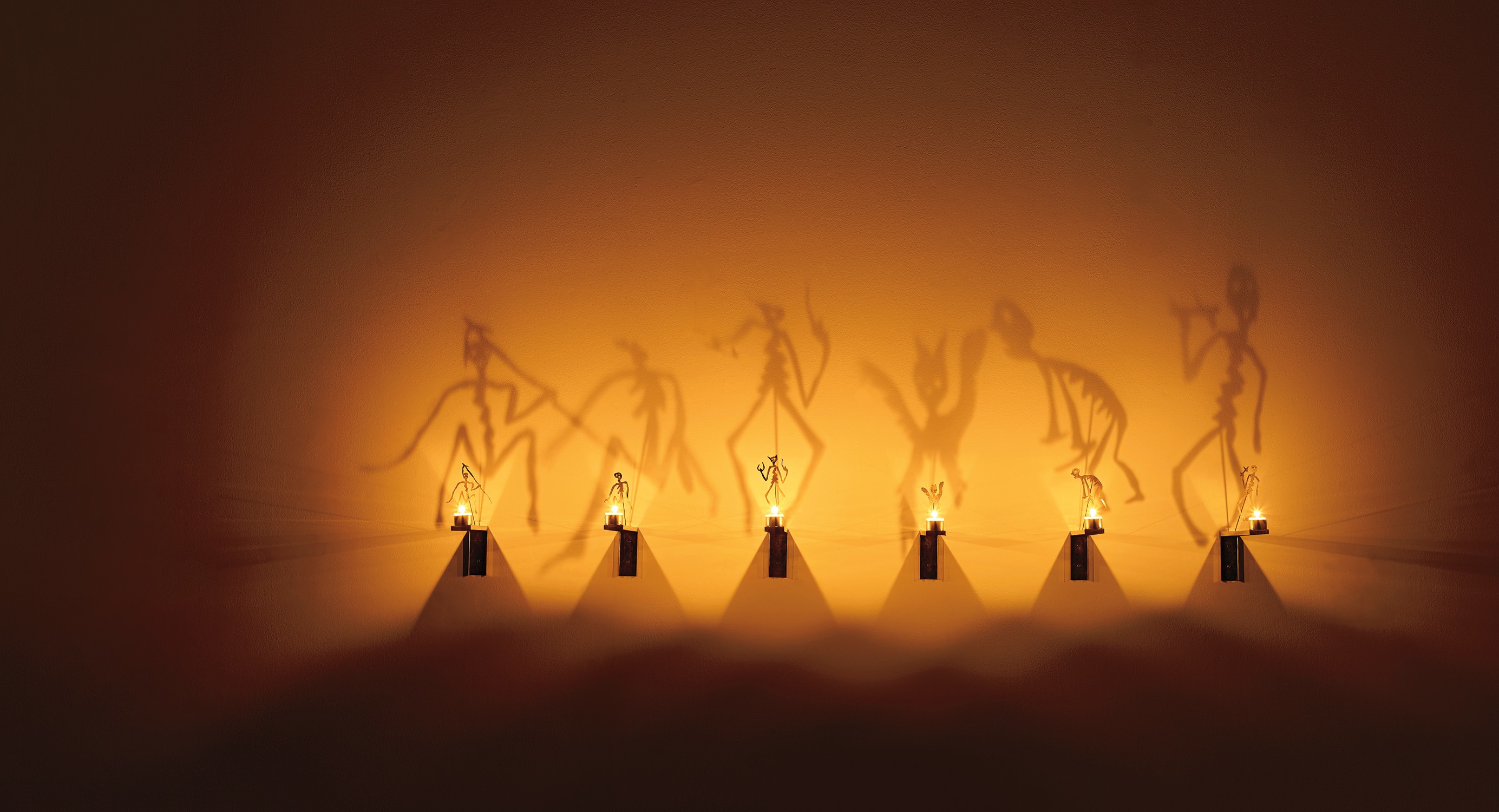
Christian Boltanski
Shadows from the Lessons of Darkness
Boltanski's Gymnasium Chases, a limited edition artist's book enclosed in a metal case, offers collectors an intimate entry point into his practice, demonstrating how he extended his vocabulary into multiples without ever reducing its emotional charge. His titled installations such as Shadows from the Lessons of Darkness continued this investigation of light as both threat and consolation, a duality that gives his work its particular psychological richness. Across all of it runs a conviction that art is not a statement but an open field, populated by the experiences and memories of those who encounter it. He was one of the most articulate artists of his generation about what he was doing and why, and his reflections on the relationship between the work and the viewer form an essential part of understanding his practice.
For collectors, Boltanski represents one of the most coherent and intellectually substantial bodies of work to emerge from late twentieth century European art. His pieces hold their value not only on the auction market but in the context of any serious collection, offering a depth of resonance that grows rather than diminishes with time. Works on paper, photographs, and mixed media installations at accessible scales have long attracted thoughtful collectors who understand that the power of a Boltanski piece is not diminished by its modest physical footprint. His multiples and limited editions, made with the same intentionality as his large installations, are particularly worth seeking out for collectors building with care.
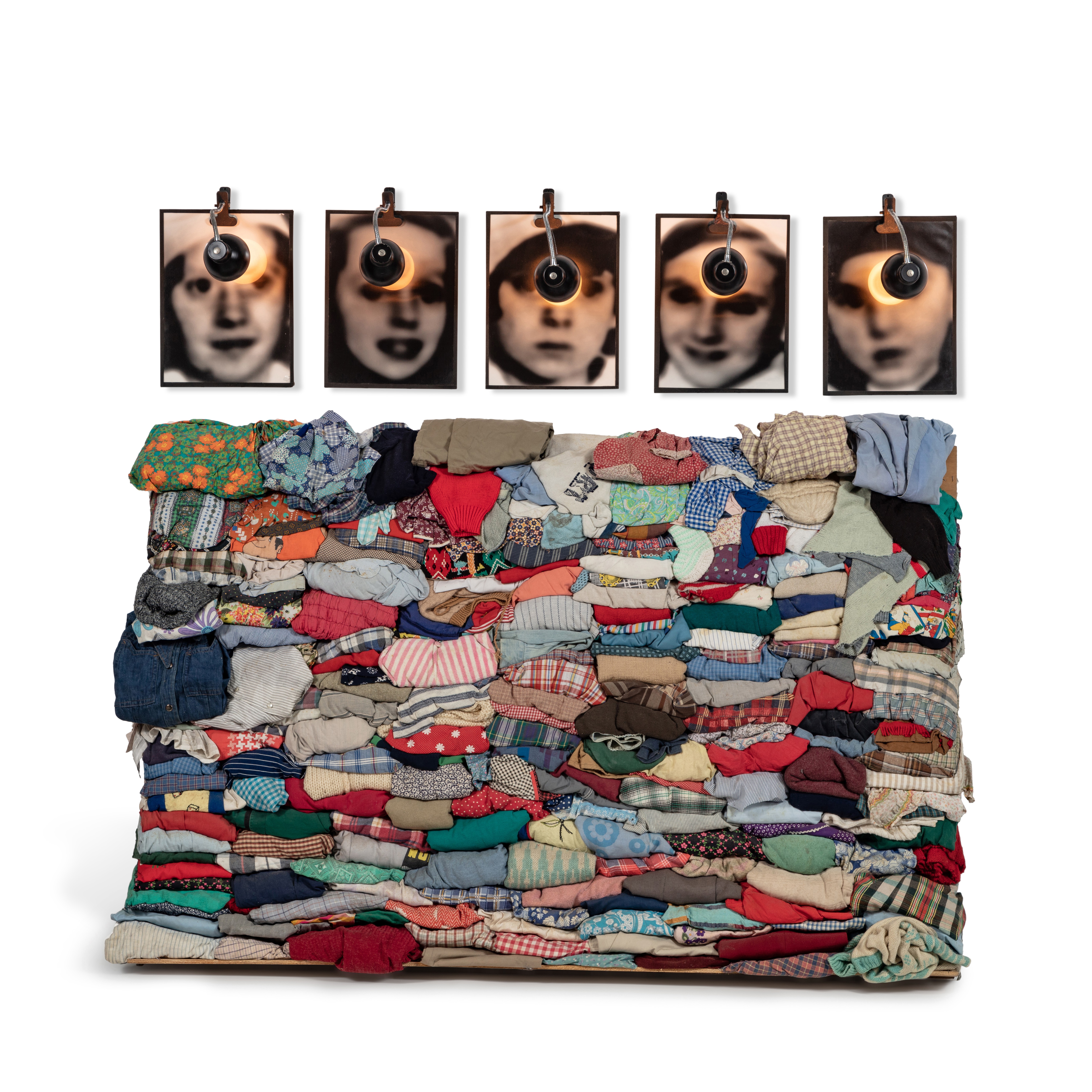
Christian Boltanski
La Fête du Pourim, 1989
Major institutions including the Centre Pompidou, the Art Institute of Chicago, and the Museum of Modern Art hold significant works, lending further context and gravitas to any private holding. Boltanski belongs to a generation of artists who transformed the relationship between contemporary art and historical trauma, and he is best understood alongside figures such as Anselm Kiefer, whose monumental canvases carry similar burdens of European memory, and Sophie Calle, whose investigations of intimacy and documentation share his interest in the archive as both evidence and elegy. He was also a profound influence on younger artists working with installation and photography, and his thinking about the collective and the anonymous shaped a broad range of practices that followed. His participation in the Venice Biennale in 2011, where he represented France with the project Chance, confirmed his standing as one of the indispensable figures of international contemporary art in the final decades of his life.
Christian Boltanski died in Paris in July 2021, leaving behind a practice of extraordinary density and humanity. The years since his death have seen continued institutional attention to his work, with collections and estates reassessing holdings and curators returning to his installations with fresh eyes. What endures is the quality of presence his work creates, the sense of standing in a space that holds more than it shows. He described himself not as a storyteller but as someone who creates conditions for memory, and that generosity of approach, the invitation to bring your own grief and wonder to the encounter, is precisely what makes his work inexhaustible.
To own a Boltanski is to hold a question that never stops asking itself.
Explore books about Christian Boltanski