Chris Ofili
Chris Ofili: Where Everything Sacred Glitters
Artist Spotlight · The Collection Editorial
“I want the paintings to have a sense of spirituality, but also to be rooted in the physical world.”
Chris Ofili, Interview Magazine
When the Tate Britain mounted its landmark survey of Chris Ofili's work in 2010, audiences encountered something that felt at once ancient and thrillingly contemporary: vast canvases alive with phosphorescent paint, maps of the African continent rendered in collage, surfaces studded with glitter and map pins, and the now legendary elephant dung supports that elevate each painting off the gallery wall like a devotional object on an altar. That exhibition crystallized what devoted collectors and curators had understood for years. Ofili is not simply a painter. He is a mythmaker, a synthesist, a figure of genuine rarity who has spent three decades building one of the most distinctive and spiritually charged bodies of work in contemporary art.
Chris Ofili
Chris Ofili
Ofili was born in Manchester in 1968 to Nigerian parents, and that dual inheritance has never been incidental to his work. It is the very engine of it. He studied at the Chelsea School of Art and then at the Royal College of Art in London, graduating in 1993 and entering a British art scene crackling with the energy of the Young British Artists generation. A formative British Council scholarship took him to Zimbabwe in 1992, and the experience was revelatory.
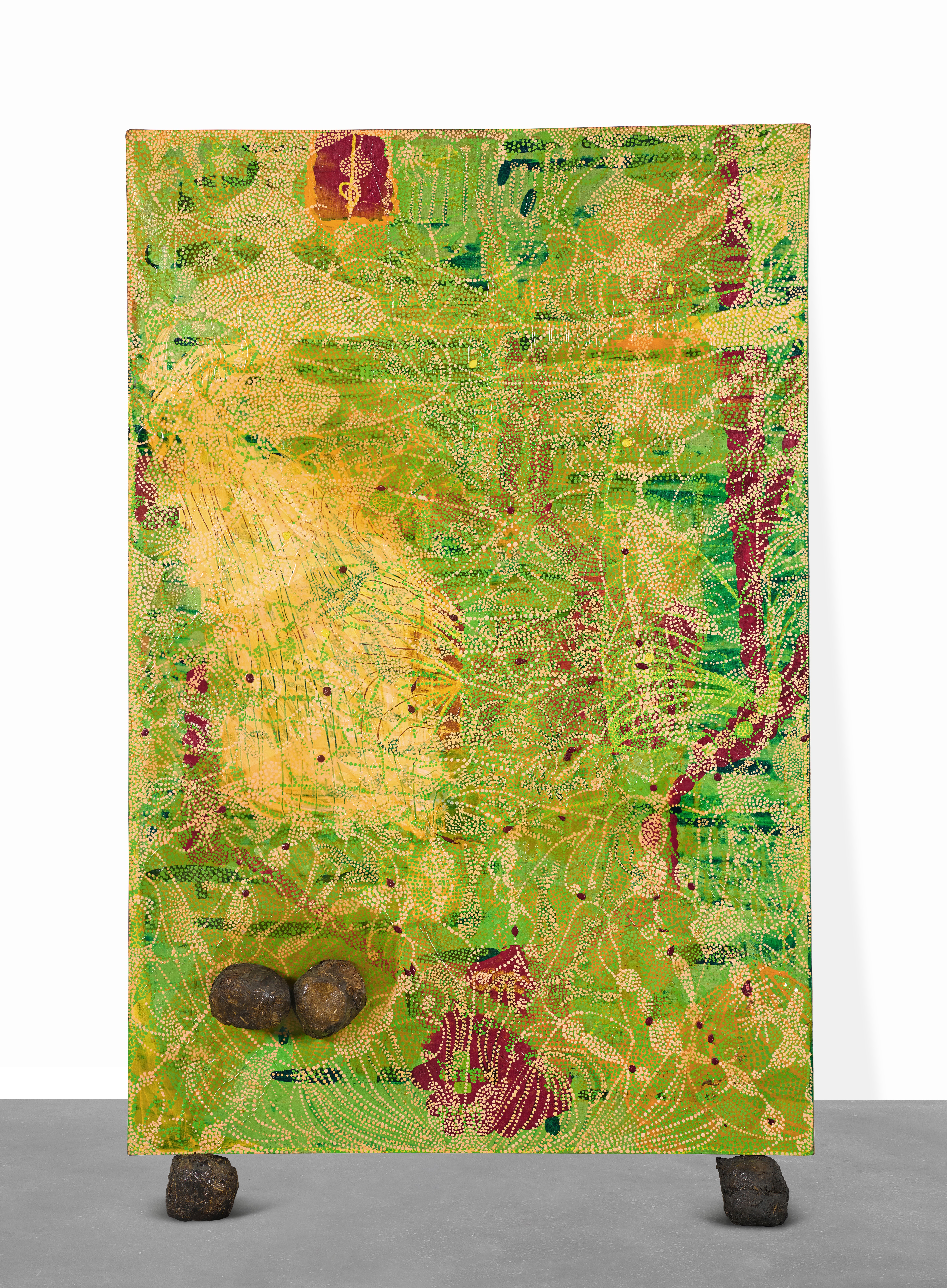
Encountering cave paintings and the rhythms of African visual culture reshaped his understanding of what paint on a surface could do, what it could carry, what it could mean. He returned to London not simply with new imagery but with a new cosmology. The elephant dung, which Ofili began incorporating into his paintings after that Zimbabwe trip, is perhaps the most discussed element of his practice, and also the most misunderstood. It arrives at the canvas not as provocation for its own sake but as a material freighted with genuine symbolism: in many African cultures the elephant is sacred, its dung a symbol of regeneration and abundance.
Chris Ofili
Untitled
Ofili uses it structurally, as a support for the canvas, and decoratively, mounted onto the painted surface in circular forms that resemble full moons or anatomical details depending on the surrounding imagery. Combined with glitter, resin, paper collage, and layers of oil and acrylic, these paintings have a density and a shimmer that rewards sustained looking. They are paintings you move toward slowly and then cannot leave. His breakthrough years in the mid to late 1990s produced some of the most celebrated works of his generation.
“Trinidad has given me a new relationship with colour and with light. It changed everything about how I see.”
Chris Ofili, The Guardian
He won the Turner Prize in 1998, one of the youngest recipients of that honour at the time, and the award brought sustained international attention. Works from this period such as Rara and Mala, dating to 1994, already display the full vocabulary: the acrylic and oil layering, the resin, the elephant dung on canvas, the two characteristic dung supports below. The Naked Spirit of Captain Shit and the Legend of the Black Stars, completed in 2000, channels hip hop iconography and blaxploitation cinema through a compositional intelligence rooted in European portraiture and African cosmology. These are paintings that hold all of these references without strain, synthesizing them into something that feels genuinely new.
Chris Ofili
Rara & Mala, 1994
The controversy surrounding The Holy Virgin Mary, shown at the Brooklyn Museum of Art in 1999 as part of the Sensation exhibition, brought Ofili to audiences far beyond the art world. The then Mayor of New York, Rudy Giuliani, threatened to withdraw the museum's funding over the work, which depicted a Black Madonna surrounded by imagery drawn from African and Western traditions, her breast formed from elephant dung and the background populated with collaged forms from adult magazines. The public confrontation was fierce, but it also illuminated something essential about Ofili's project. He was asking serious questions about the nature of the sacred, about whose bodies are considered holy, and about the hierarchies embedded in Western religious iconography.
Those questions have not dated. In 2005 Ofili relocated to Trinidad, a move that was not a retreat but an expansion. The light, the colour, the mythology of the Caribbean island entered his work in ways that are still reverberating. His Afro Lunar Lovers series and the paintings that followed show a palette that became lusher, more nocturnal, suffused with deep blues and greens that feel simultaneously oceanic and celestial.
Chris Ofili
The Agony in the Garden
Blue Night Rider One, completed in 2006 and worked in oil, acrylic and coal on canvas, is among the most commanding paintings of this period. The coal gives the dark grounds a mineral depth, a geological quality, as though these images are being excavated from the earth rather than constructed upon a surface. Black Milky Way, from 2007, extends this nocturnal grandeur into something approaching the cosmic. For collectors, Ofili represents a singular opportunity.
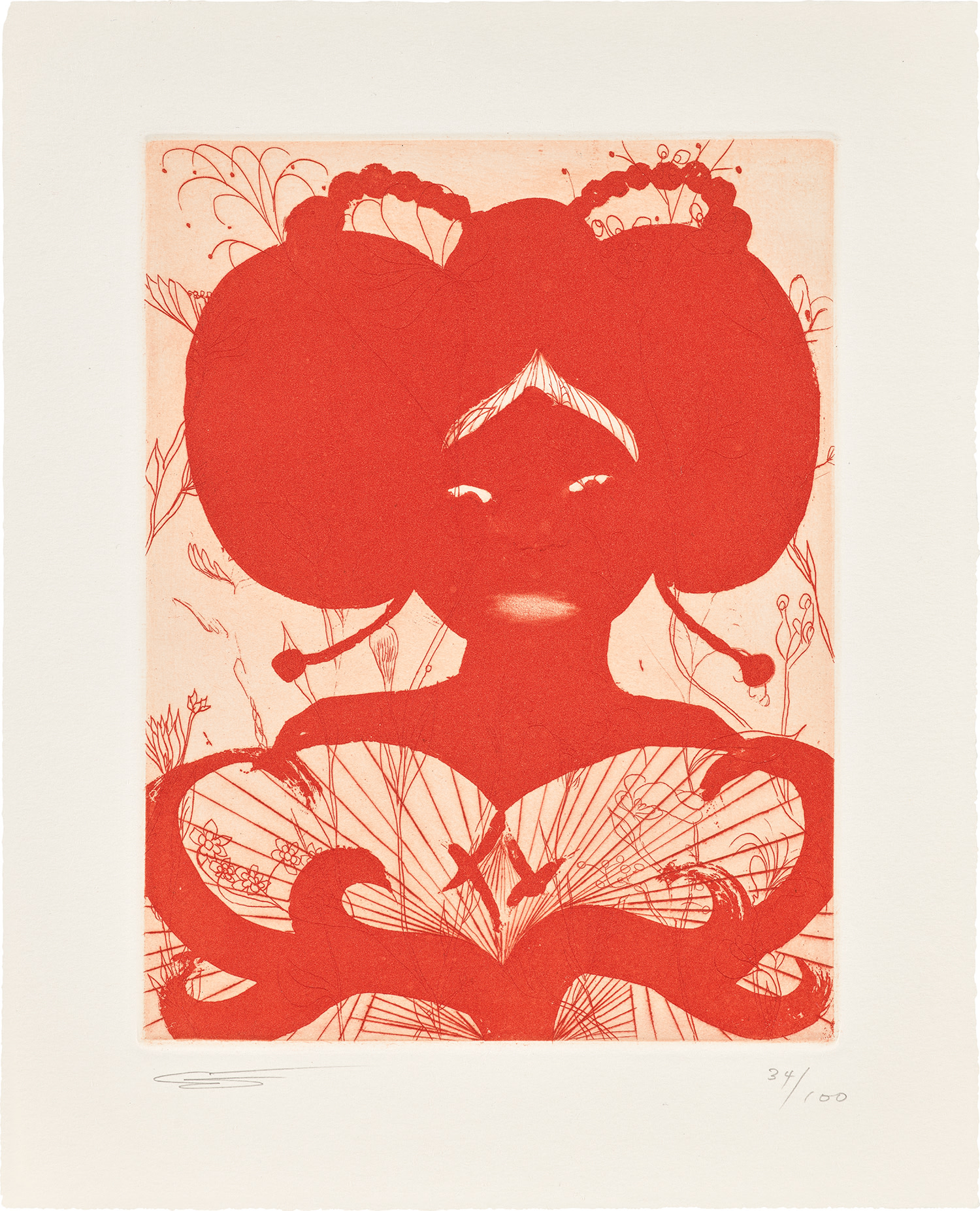
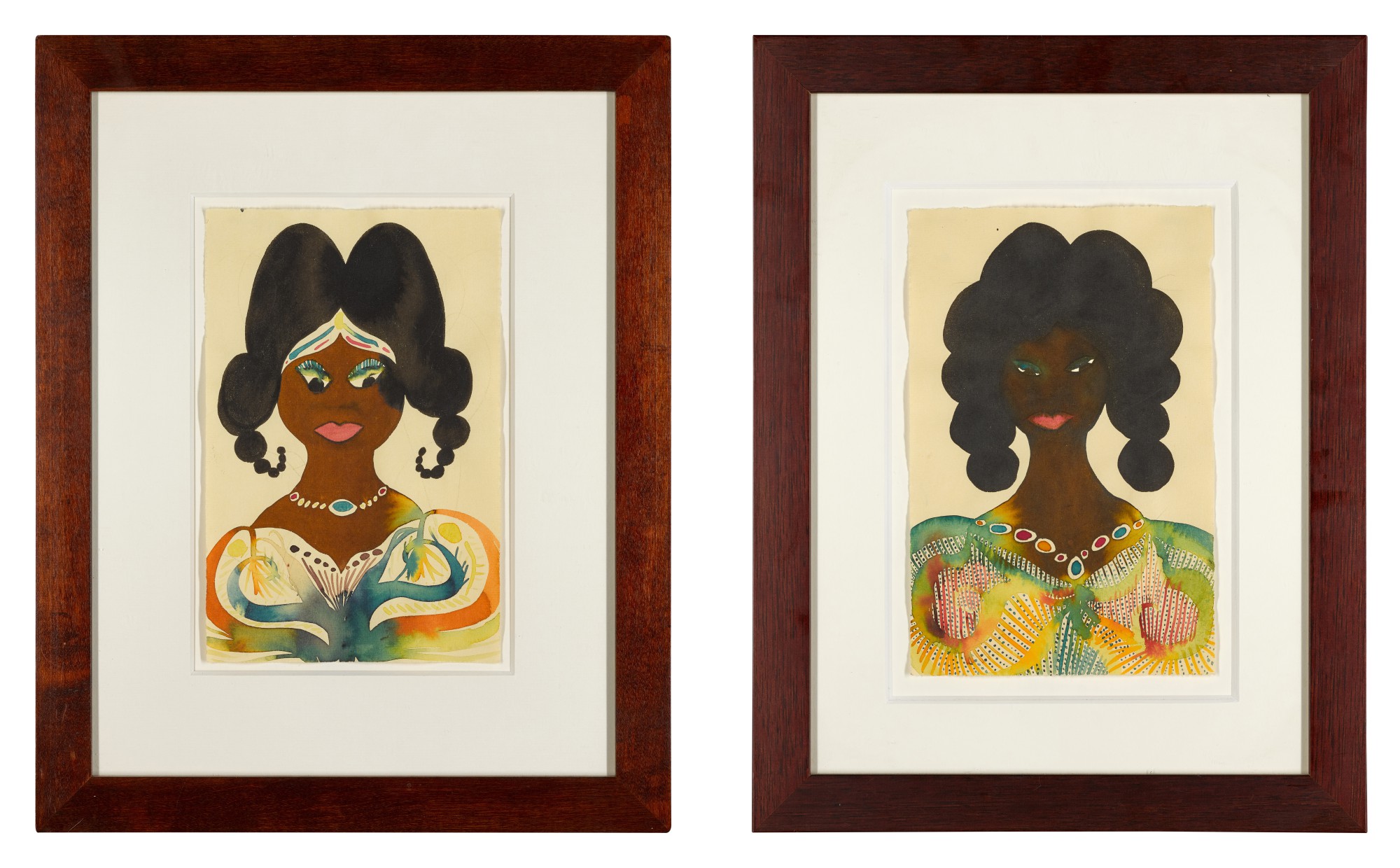
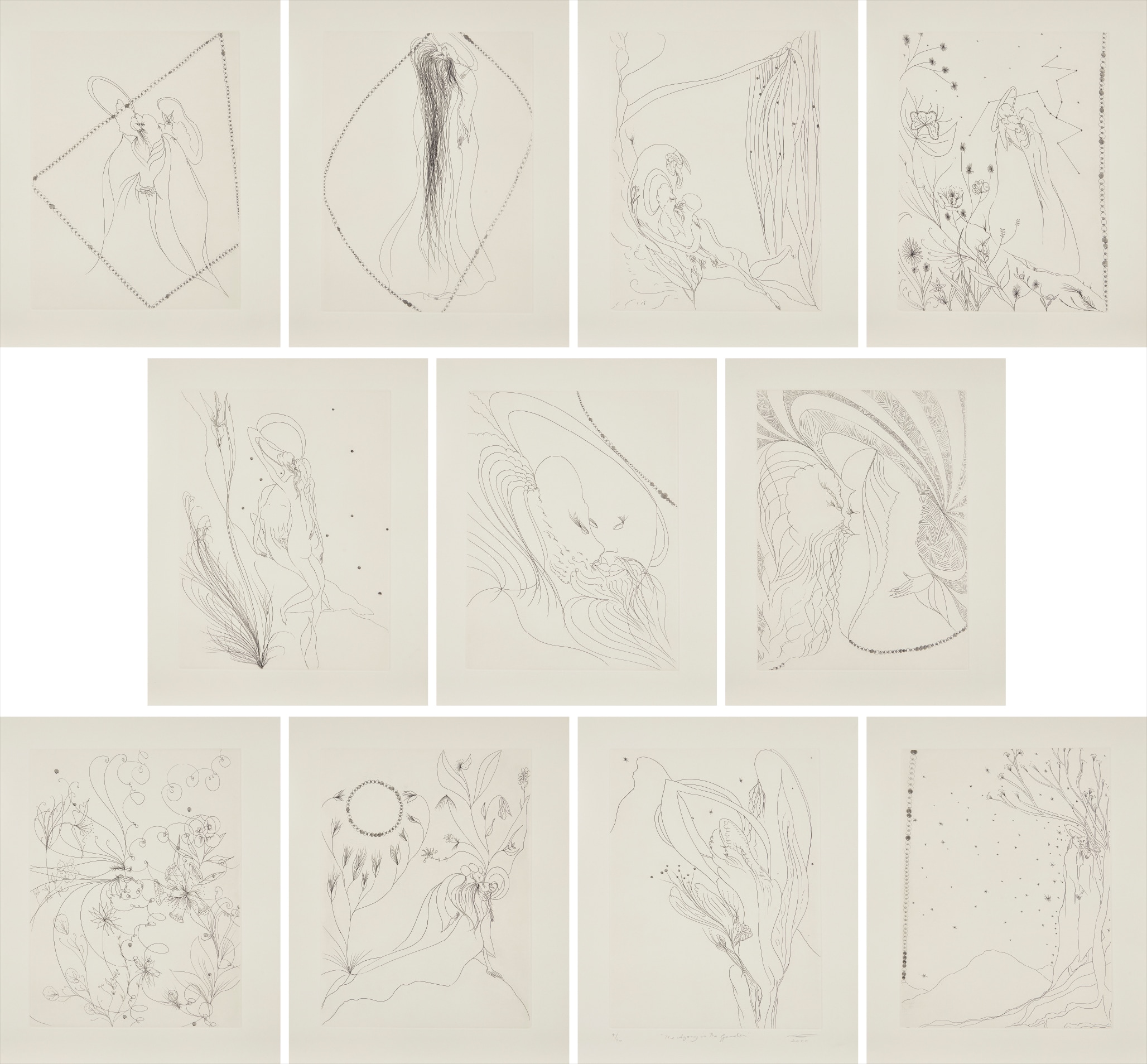
His works across media, including the etchings and aquatints produced in partnership with specialist print studios, offer genuine entry points into a practice that has commanded serious institutional attention for three decades. The complete set of The Agony in the Garden, eleven etchings and aquatints on Somerset paper with title page and justification, is a work of profound technical and conceptual ambition, demonstrating that Ofili's intelligence translates across every medium he touches. His watercolours are tender and direct in ways that surprise those familiar only with the large paintings. The leather and suede collages, such as Pramnian Odyssey I worked with gold leaf on panel, reveal a craftsman's intimacy with materials.
Collectors who have built holdings across Ofili's media report the consistent experience of artworks that deepen with time, that reveal new details, new resonances, new formal relationships across years of looking. Ofili occupies a distinctive position in the broader landscape of contemporary painting precisely because his influences are so genuinely wide. His work invites comparison with Kerry James Marshall in its reclamation of Black figuration for the grand tradition of painting, with Kara Walker in its excavation of cultural mythology and iconography, and with the decorative intensity of artists such as Yinka Shonibare. But Ofili is finally his own category.
His paintings are held by the Tate, MoMA, the Studio Museum in Harlem, and major private collections on several continents. They appear in the art historical literature with the confidence of works that have already proved their importance. What makes Ofili matter now, and what will ensure he matters in fifty years, is the seriousness of his ambitions combined with an absolute commitment to sensory pleasure. He wants his paintings to be beautiful.
He wants them to be complex. He wants them to honour multiple traditions without being owned by any single one. In an art world that sometimes prizes conceptual distance over emotional engagement, Ofili insists on both, and he delivers both with a consistency that is, in the truest sense of the word, extraordinary. To live with an Ofili is to live with a painting that is always asking something of you, and always giving something back.
Explore books about Chris Ofili