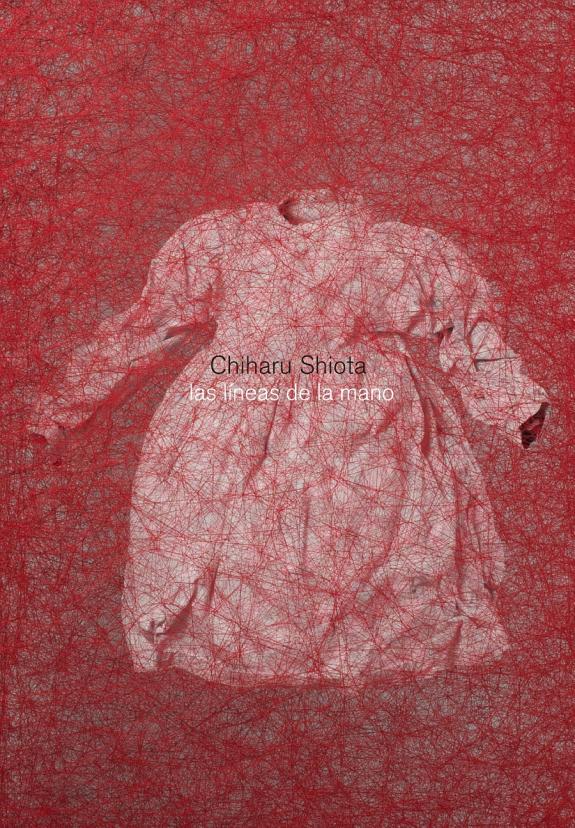
Chiharu Shiota
Chiharu Shiota Weaves the World Together
Artist Spotlight · The Collection Editorial
“I want to feel the existence of life and death, memory and the present moment, in the space itself.”
Chiharu Shiota, interview with the Mori Art Museum
In the spring of 2015, the eyes of the international art world turned to the Japanese Pavilion at the Venice Biennale, where Chiharu Shiota had filled the entire space with an ocean of red thread suspending thousands of keys from the ceiling. The installation, titled The Key in the Hand, was one of the most discussed works of that edition of the Biennale, drawing visitors who stood in silence beneath its canopy of crimson, reaching upward toward objects that seemed to carry the weight of every door ever opened, every threshold ever crossed. It announced to a global audience what devoted collectors and museum curators had long understood: Shiota is among the most powerful and original voices in contemporary art, an artist whose work bypasses intellectual argument and speaks directly to the body, to memory, to the quiet terror and beauty of being alive. Shiota was born in Kishiwada, Osaka, in 1972, and her early life in Japan gave her a sensibility shaped by both intimacy and dislocation.
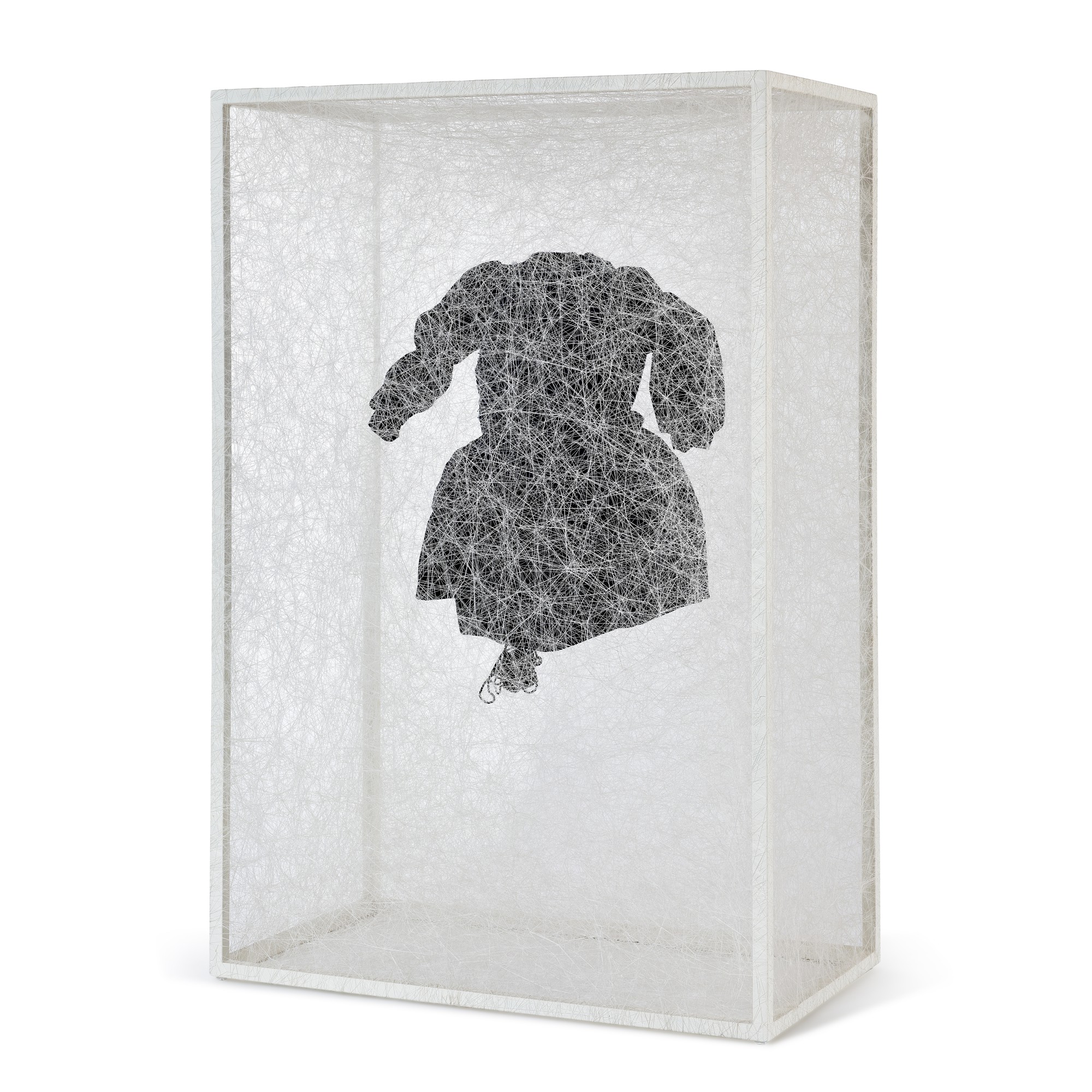
Chiharu Shiota
生存的狀態(童裝裙), 2013
She studied painting at Kyoto Seika University before making the decisive move to Germany, where she studied under Marina Abramovic at the Hochschule für Bildende Künste Braunschweig and later at the Universität der Künste Berlin. The encounter with Abramovic was formative, deepening Shiota's understanding of the body as a site of artistic investigation, though she would ultimately find her own language far removed from direct performance. Germany became her home base, and Berlin, with its particular history of rupture and reconstruction, proved a city whose atmosphere was inseparable from the ideas she was beginning to develop. The emergence of her signature thread installations did not happen overnight but evolved through years of searching experimentation.
In her early performances, she covered her own body in mud, immersed herself in water, and pressed herself against architectural surfaces, searching for the point where the self dissolves into its surroundings. Thread arrived as the material that could make this dissolution visible at scale. Beginning in earnest in the late 1990s and accelerating through the 2000s, she began constructing environments in which black or red thread spread across rooms like a nervous system made manifest, incorporating objects gathered for their resonance rather than their beauty. Old shoes, worn dresses, burned pianos, vintage keys, boats, suitcases: each object entered her installations trailing its own invisible history, which the thread seemed to make suddenly, achingly visible.
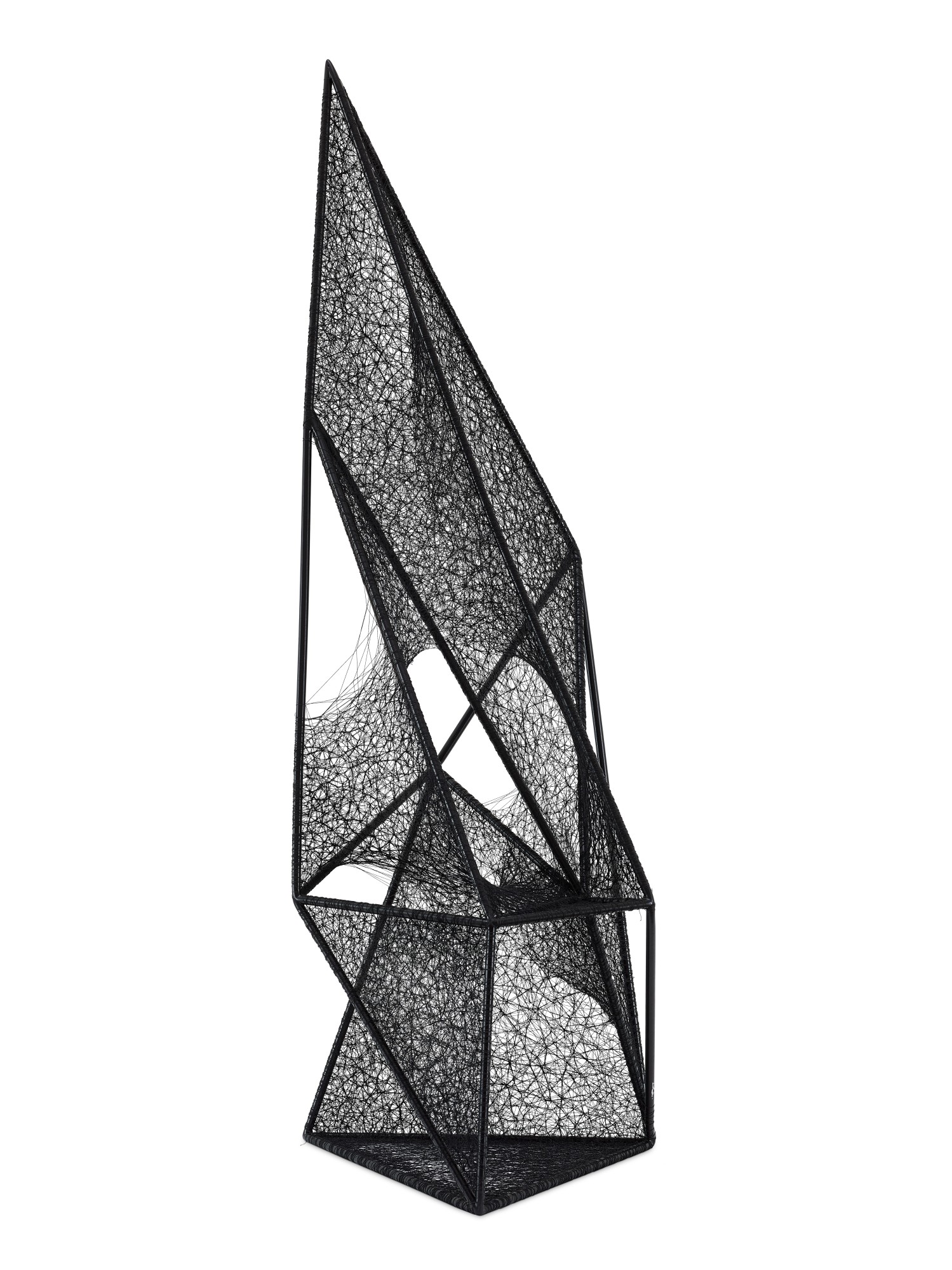
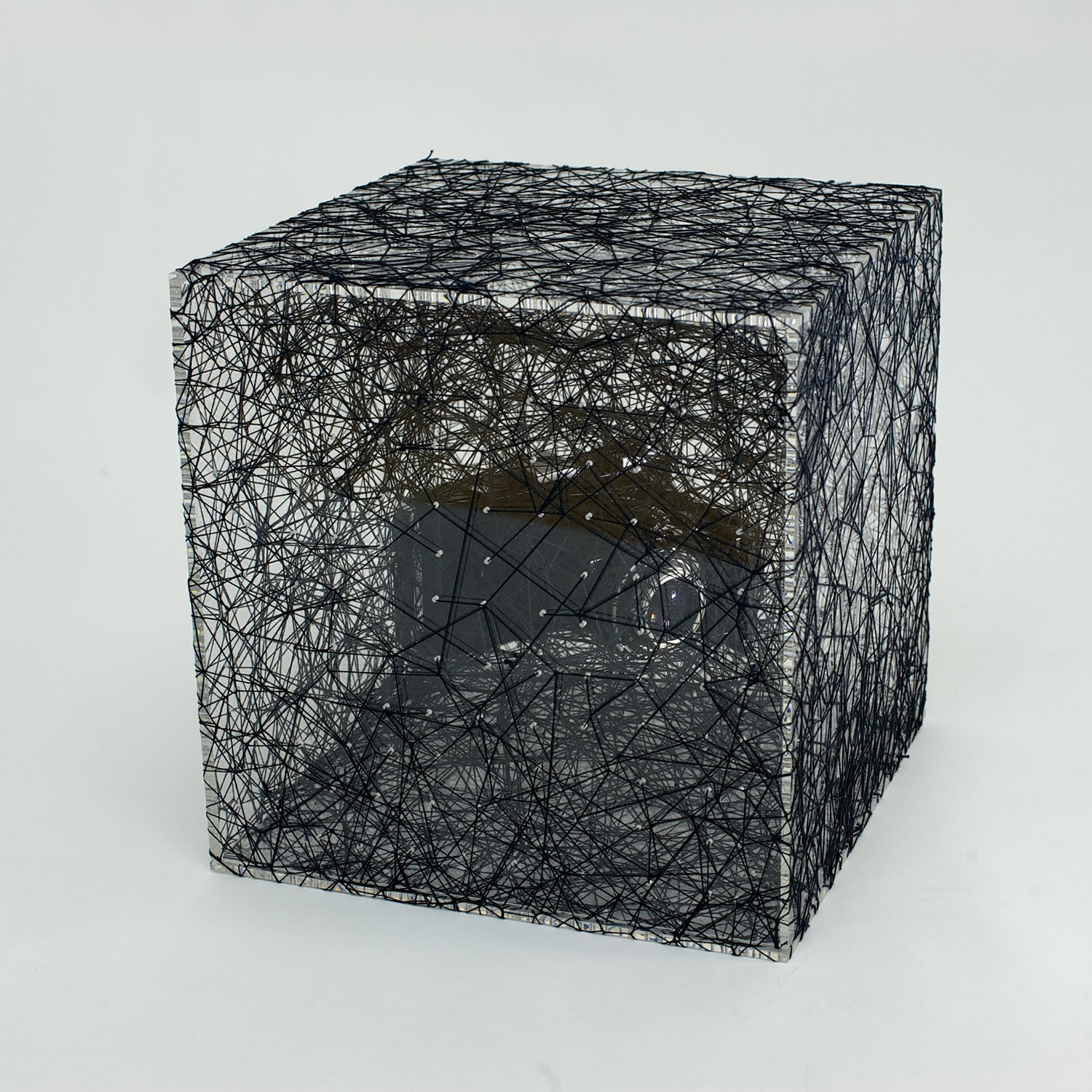
Chiharu Shiota
生存的狀態(水晶), 2019
The works grouped under her long running series State of Being represent perhaps the most coherent and collectible expression of her vision. These are typically smaller scale works housed within acrylic vitrines, in which a single found object, a camera, a puppet house, a child's dress, a pistol, a kimono, becomes entangled within a dense web of black thread. The effect is one of simultaneous preservation and transformation: the object is held, protected, and at the same time overtaken, as though memory itself were a physical substance that accumulates around the things we cannot let go. State of Being (Camera) from 2012 encases a vintage camera in thread so dense the apparatus becomes almost geological, a fossil of looking.
“The thread is like a nerve, or a vein. It connects everything.”
Chiharu Shiota
State of Being (Keys) from 2016 and State of Being (Ship) from 2020 extend this logic across different registers of longing, travel, and departure. These works reward sustained attention, and collectors who live with them report that they change character depending on the light, the season, and the mood of the viewer. On the secondary market and in institutional acquisitions, Shiota's work has attracted sustained and growing interest. Major museums including the National Art Center in Tokyo, the Mori Art Museum, and institutions across Europe and Australia have acquired her installations and object works.
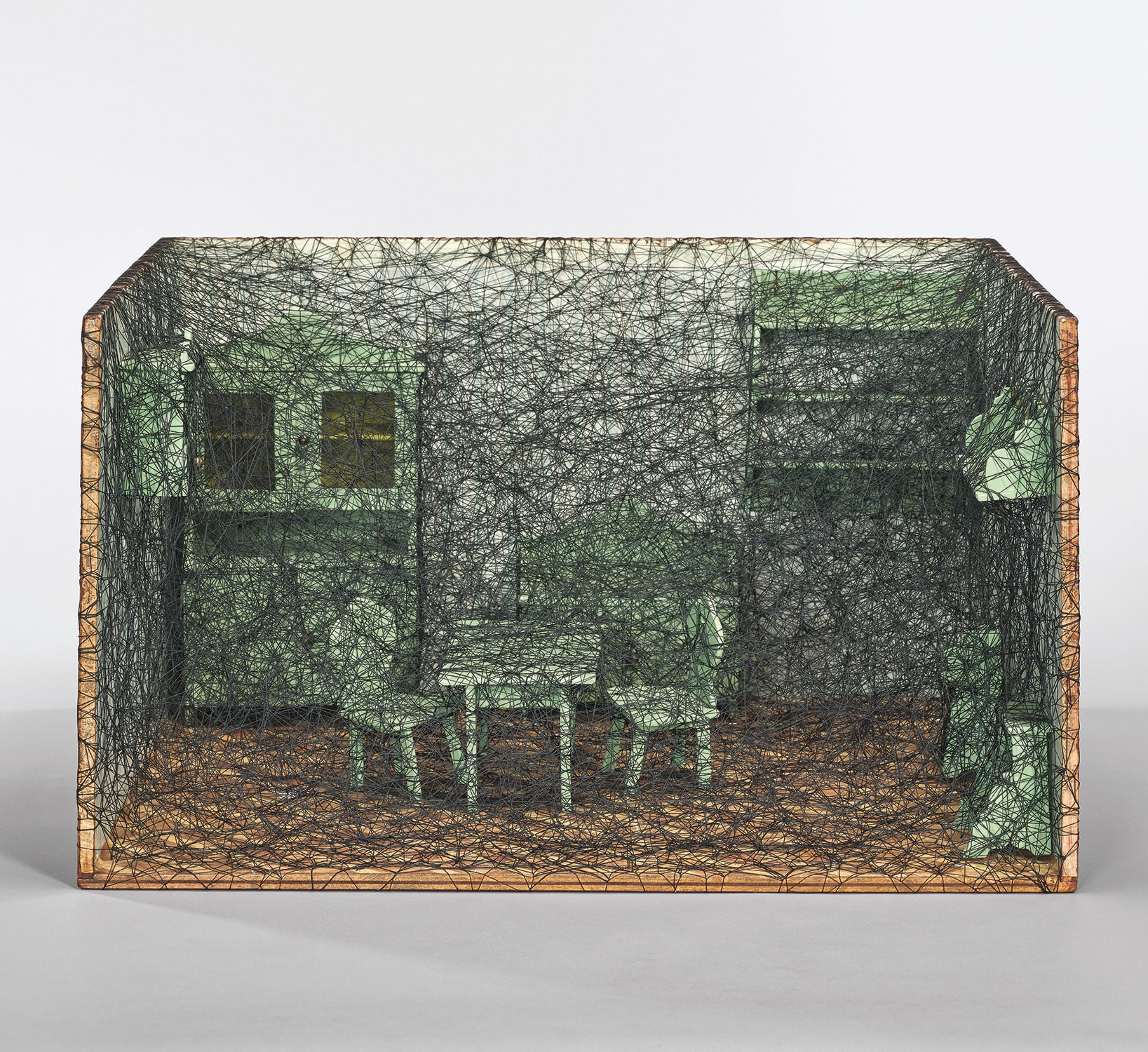
Chiharu Shiota
State of Being (Puppet House), 2013
Her large scale installations present logistical challenges that make them the domain of major institutions, but the State of Being works offer serious private collectors a genuine opportunity to own something that carries the full emotional charge of her practice in a scale suited to living with. What distinguishes her most sought after pieces is their specificity: the choice of object matters enormously, and works that incorporate objects with strong psychological or cultural resonance, keys, weapons, garments worn by children, tend to generate the deepest responses and the strongest collector loyalty. Within the broader landscape of contemporary art, Shiota occupies a singular position that rewards thinking about in relation to several traditions. Her interest in the physical residue of lived experience connects her to Arte Povera artists such as Christian Boltanski, whose use of accumulated personal objects to address absence and memory offers a useful parallel.
Her emphasis on installation as immersive environment aligns her with figures like Ann Hamilton and Kiki Smith, both of whom use material accumulation to evoke embodied experience. Her Japanese heritage and her sustained engagement with German culture also place her within a transnational conversation about cultural memory and displacement that has produced some of the most significant art of the last three decades. She is an artist who belongs to no single tradition but has synthesized several into something unmistakably her own. What makes Shiota matter today, and what will secure her place in the longer history of contemporary art, is the combination of formal originality and genuine emotional necessity in her work.
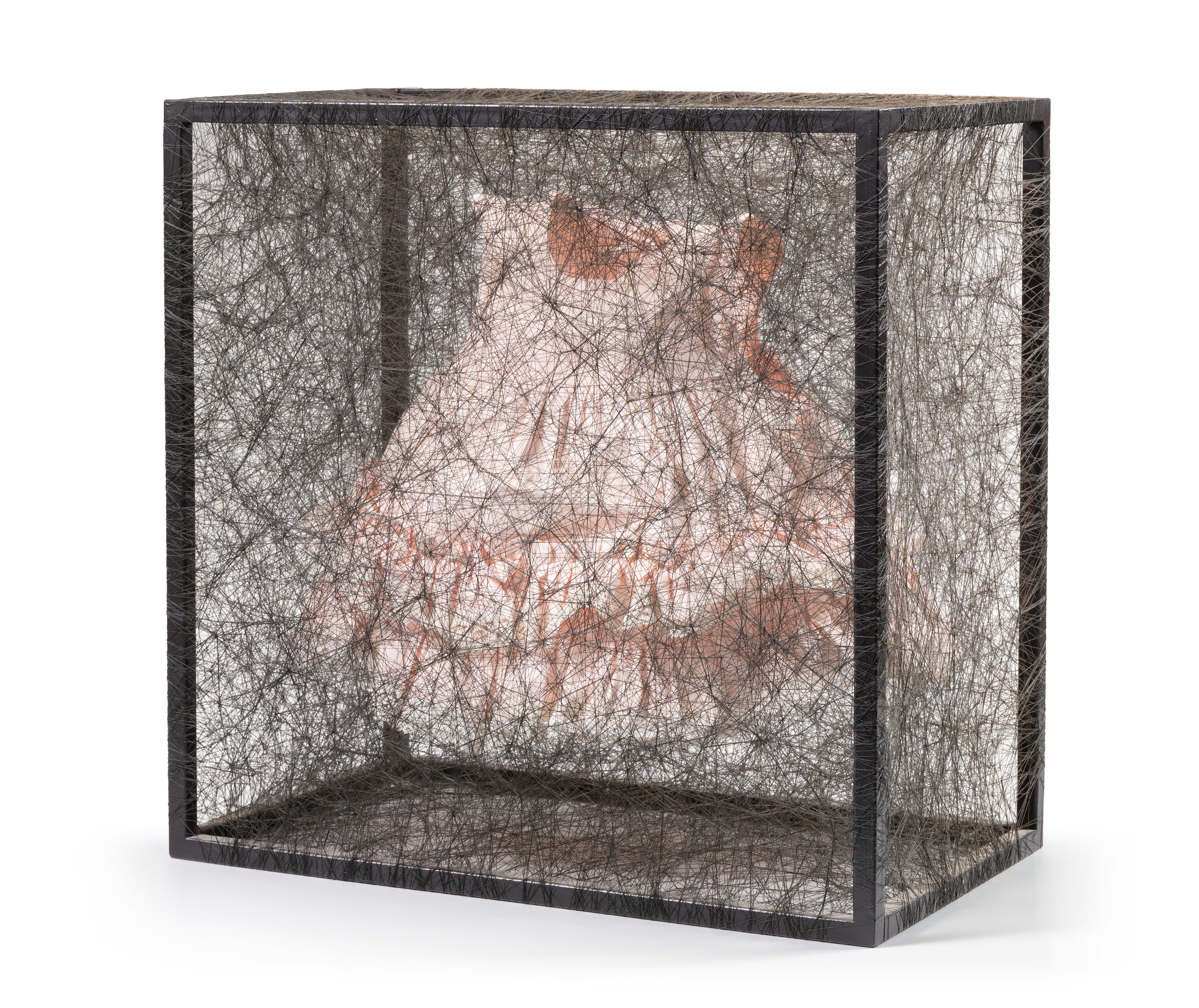
Chiharu Shiota
State of Being (children’s dress), 2011
At a moment when much ambitious art feels required to explain itself through text and context, her installations and object works communicate with an immediacy that is rare. Visitors weep in front of her large scale pieces without always being able to say why, and collectors describe a similar experience of recognition when living with her smaller works, a sense that something previously inexpressible has been given form. Her ongoing production, her continued institutional recognition, and the growing depth of collector engagement with her practice all point in the same direction. Chiharu Shiota is not an artist on the way to significance.
She is an artist whose significance is becoming clearer with each passing year.
Explore books about Chiharu Shiota