Cheong Soo Pieng
Cheong Soo Pieng, Where Two Worlds Meet
Artist Spotlight · The Collection Editorial
Stand before one of Cheong Soo Pieng's elongated Sarawak women, their bodies rendered in that extraordinary signature geometry, and you understand immediately why museums and collectors across Asia have spent decades pursuing his work with such devotion. In recent years, major retrospectives and institutional acquisitions across Singapore, Hong Kong, and beyond have reaffirmed his position not merely as a local hero but as one of the defining voices of twentieth century Asian modernism. The National Gallery Singapore, which holds a significant collection of his work, has done much to ensure that new generations encounter his paintings on the terms they deserve: as ambitious, formally rigorous, and deeply felt contributions to world art. His reputation, once concentrated among Southeast Asian collectors, has expanded considerably, drawing serious attention from international institutions and private collections alike.
Cheong Soo Pieng
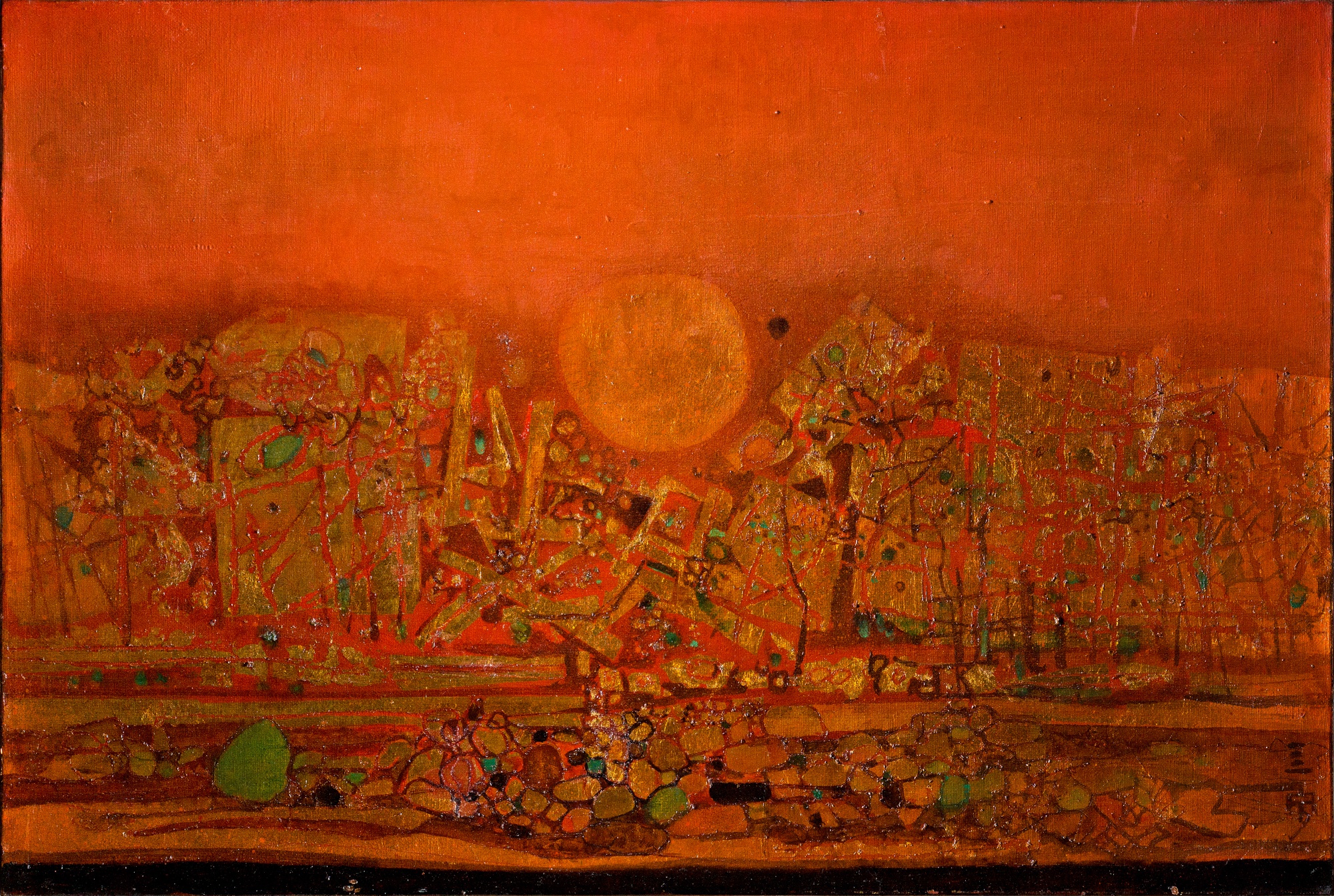
Red sunrise 紅色日出, 1975
Cheong Soo Pieng was born in Xiamen, in China's Fujian province, in 1917. He trained at the Xinhua Art Academy in Shanghai and later at the Xiamen Academy of Art, absorbing the classical foundations of Chinese ink painting while also encountering the European modernist currents that had begun to filter into China's cosmopolitan art schools during the 1930s. This dual formation, rooted equally in the brushwork traditions of the East and the compositional freedoms of the West, would prove to be the generative tension of his entire career. He arrived in Singapore in 1947, a city then in the process of becoming something new, and he became part of that becoming in the most direct and lasting way.
In Singapore, Cheong joined the Nanyang Academy of Fine Arts as a teacher, a role he would hold for decades and through which he shaped generations of Singaporean artists. He was a founding member of what became known as the Nanyang style, a movement that sought to forge a distinctly Southeast Asian visual language by fusing Chinese ink techniques with the light, colour, and subject matter of the tropical world. In 1952, he joined fellow artists Liu Kang, Chen Wen Hsi, and Chen Chong Swee on a landmark journey to Bali and Java in Indonesia. That trip was transformative.
Cheong Soo Pieng
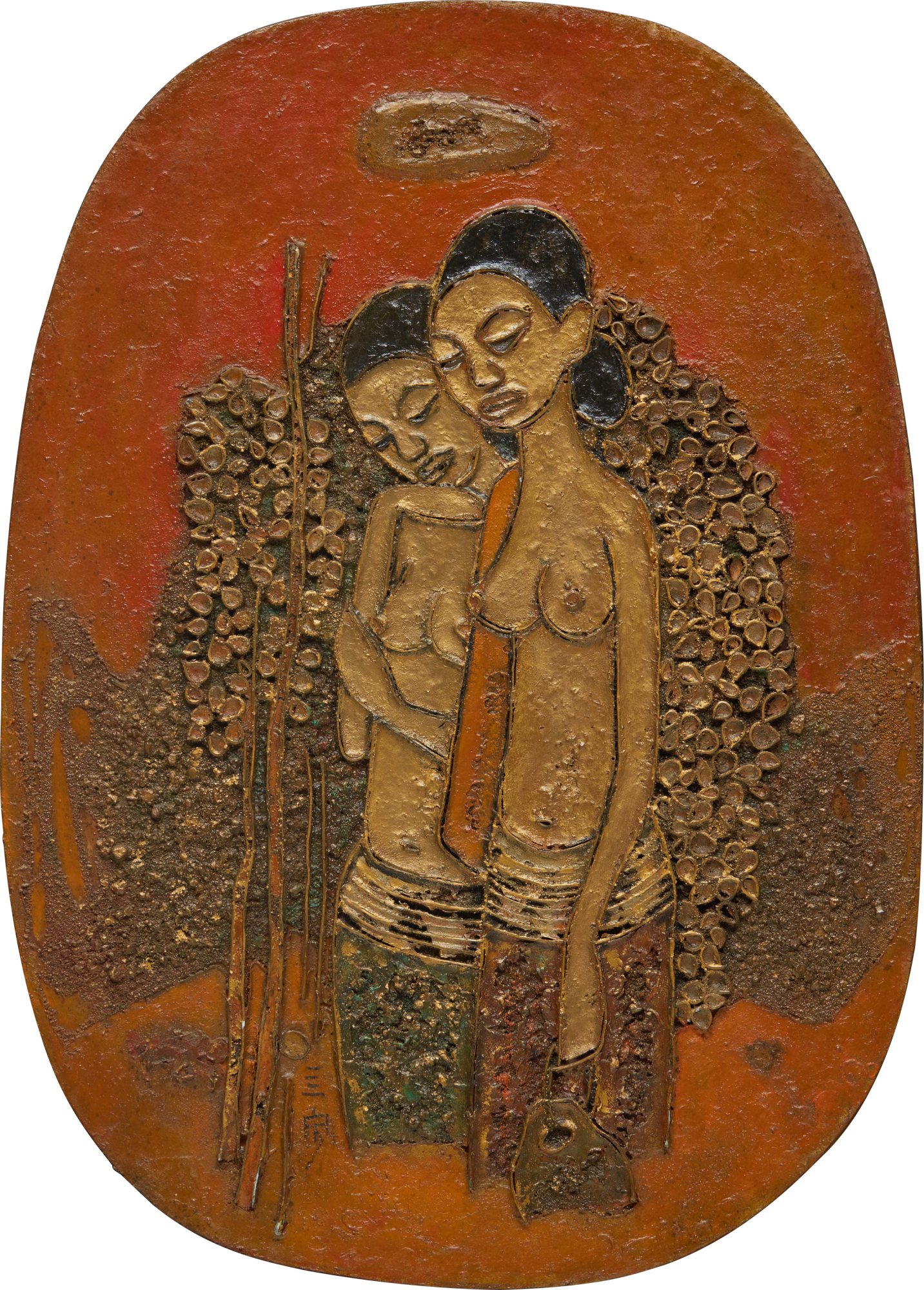
Sarawak girls 砂拉越少女, 1972
The luminous landscapes, the ceremonial dress, the bodies moving through equatorial light: all of it entered his visual vocabulary and stayed there for the rest of his life. What distinguishes Cheong from his contemporaries is the sheer originality of his formal language. Where other painters of his generation synthesised East and West in ways that remained legible as either Chinese or European in their dominant mode, Cheong arrived at something genuinely new. His figures, particularly the indigenous women of Borneo and Bali that recur throughout his work, are elongated and stylised in a manner that recalls both the vertical rhythms of Chinese scroll painting and the flattened planes of Modigliani or the Cubists.
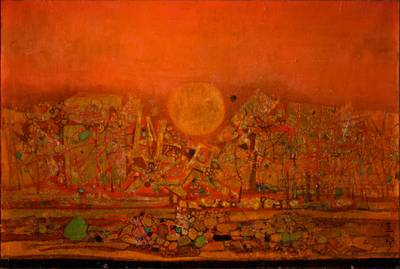
Yet the result belongs to neither tradition exclusively. Works such as Sarawak Girls from 1972 and Seated Ladies from 1955 demonstrate this synthesis with particular clarity, the figures inhabiting a pictorial space that feels simultaneously ancient and strikingly modern. His palette, too, is his own: warm ochres and deep greens, sudden bursts of vermillion, and in later works the extraordinary luminosity achieved through his use of gold foil alongside oil paint. Among the most celebrated works available to collectors today, Red Sunrise from 1975 stands as a testament to his late mastery.
Cheong Soo Pieng
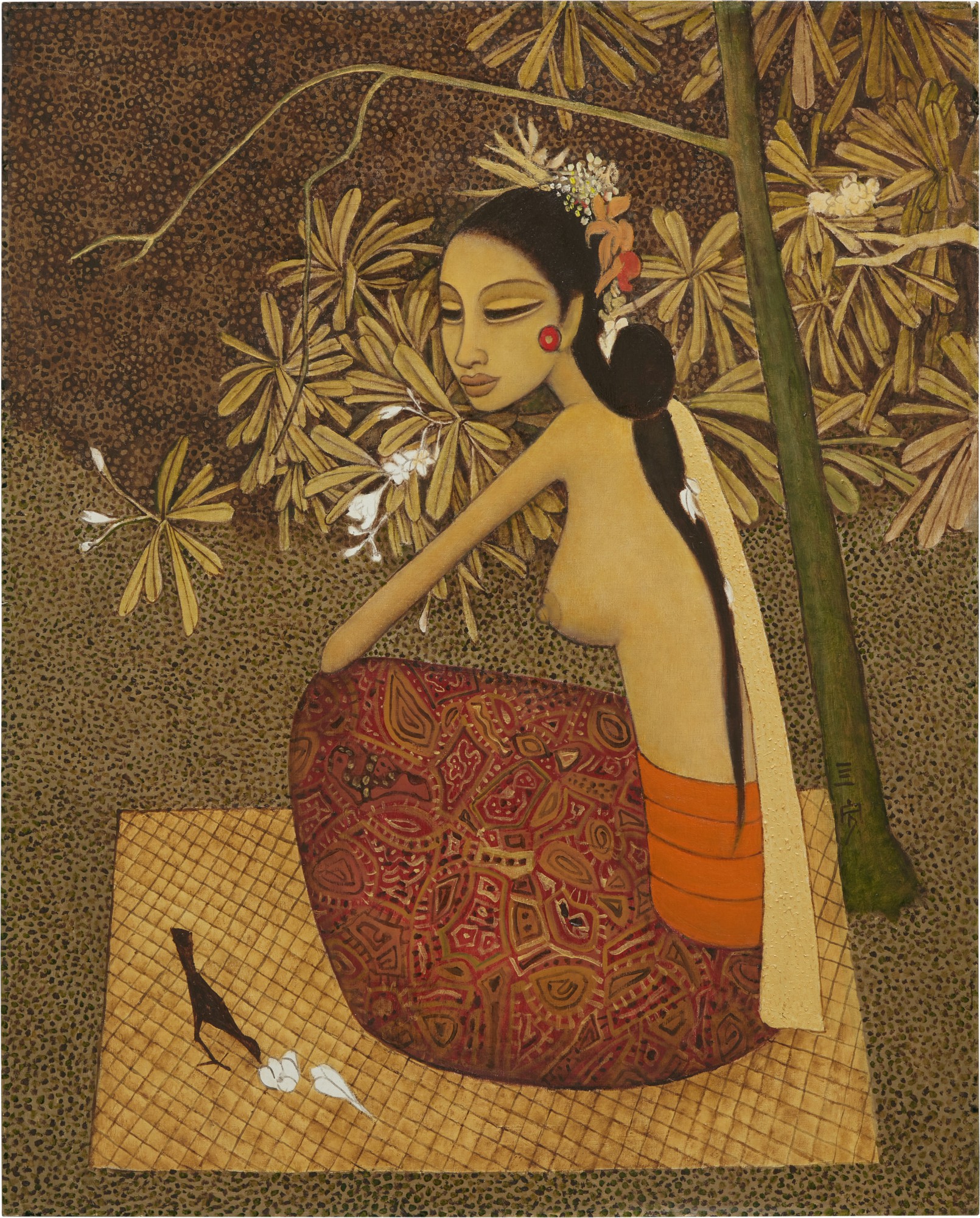
Bali Girl 峇里女子, 1978
Executed in oil and gold foil on canvas, it captures the atmospheric intensity that characterised his mature output, the landscape dissolved into planes of colour and light that carry emotional weight far beyond mere description. Bali Girl from 1978 and Brother and Sister from 1976 show his sustained commitment to figuration even as his handling of paint became looser and more gestural with age. By the Lotus Pond, completed in 1980 just three years before his death, is among his most lyrical works, the traditional subject matter of Chinese painting reimagined through a tropical lens with a tenderness that feels entirely personal. These late oils, with their integration of gold foil and richly worked surfaces, are particularly sought after by collectors who understand how technically adventurous Cheong remained until the very end.
In the auction market, Cheong's work has achieved consistently strong results at the major Asian sale rooms, particularly at Christie's and Sotheby's Hong Kong and Singapore, where his paintings attract competitive bidding from collectors across the region and increasingly from Europe and North America. Works on paper, including his ink and colour compositions such as Two Seated Ladies by the River and Ploughing, offer collectors a more accessible point of entry into his practice while demonstrating the same quality of thought and hand that animates his large canvases. Collectors new to his work are advised to pay close attention to provenance and to the condition of the surface, particularly on the mixed media works where the integration of different materials can be complex. The most sought after pieces tend to be the figurative compositions from the 1950s through the late 1970s, works that unite formal invention with the warmth and specificity of observed life in Southeast Asia.
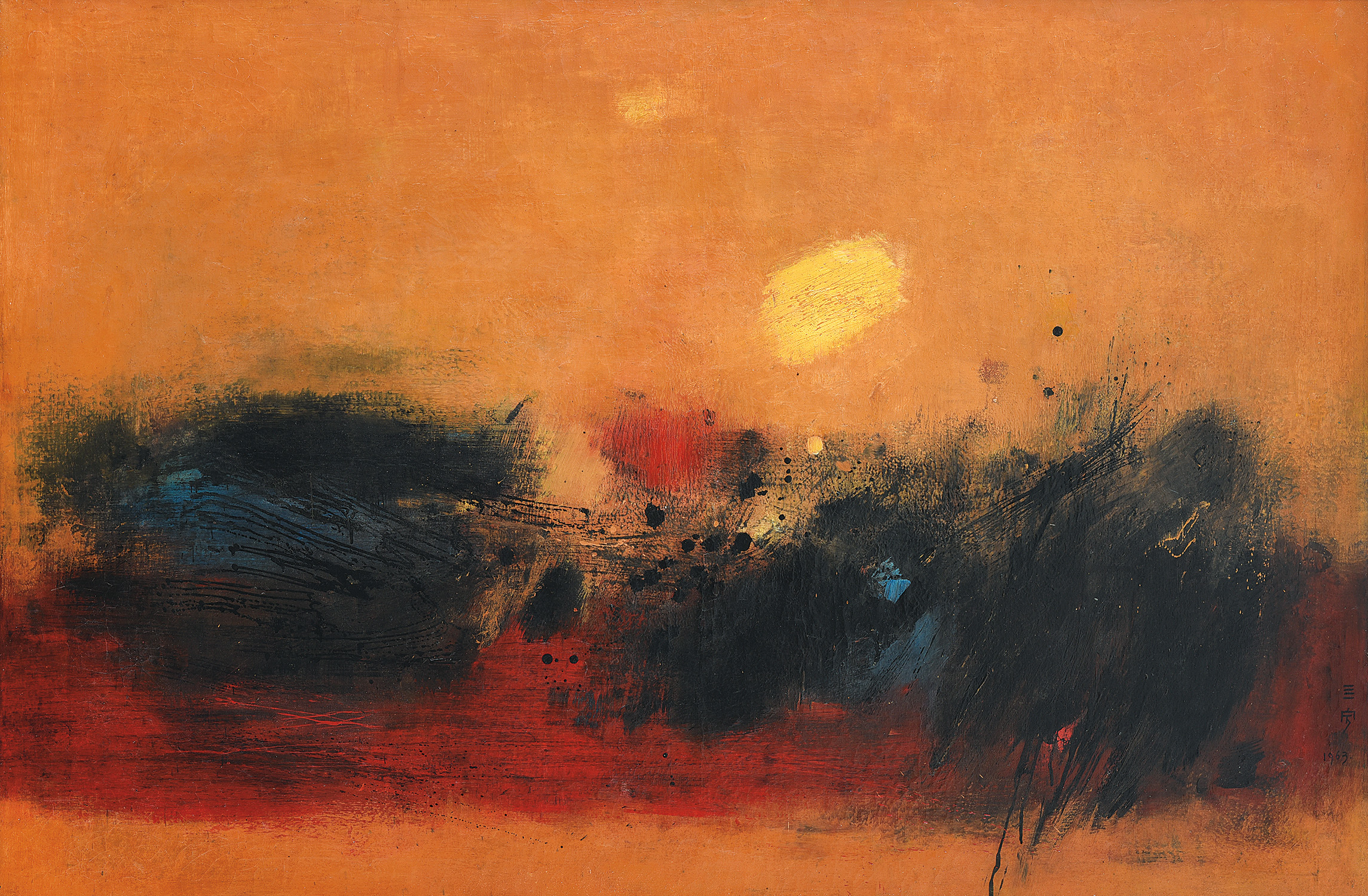
Cheong Soo Pieng
Nature’s Expression, 1963
To place Cheong Soo Pieng within the broader sweep of art history is to understand just how rare his achievement was. His synthesis anticipates concerns that became central to postcolonial discourse decades later: the question of how an artist shaped by multiple cultural inheritances might forge a visual language that honours all of them without being reduced to any single one. Collectors drawn to the work of artists such as Georgette Chen, who shared his formation within the Nanyang circle, or to the figurative modernism of Affandi in Indonesia, will find in Cheong a figure of comparable importance and perhaps greater formal ambition. On a global scale, his negotiation of Eastern and Western traditions places him in productive dialogue with artists like Zao Wou Ki or Sanyu, whose work in Paris attracted significant institutional attention and whose market positions have grown substantially in recent decades.
Cheong Soo Pieng died in Singapore in 1983, leaving behind a body of work that feels more vital with each passing year. His legacy is felt not only in the collections of major institutions but in the practice of every Southeast Asian artist who has dared to ask what a truly regional modernism might look like. He answered that question with extraordinary confidence and beauty, and the paintings he left behind continue to reward that confidence with interest. For collectors with an eye on art history and a taste for genuine formal invention, his work represents one of the great opportunities of this moment: a master whose importance is fully understood in Asia and whose recognition in the wider world is, quite rightly, still growing.
Explore books about Cheong Soo Pieng
Cheong Soo Pieng: A Retrospective
National Museum Board, Singapore
Cheong Soo Pieng: The Nanyang Period
Kwok Kian Chow
Modern Art in Singapore: Pioneering Works from the 1950s-1970s
T.K. Sabapathy
Southeast Asian Modernism: Art in the Wake of Independence
John Clark