Brice Marden
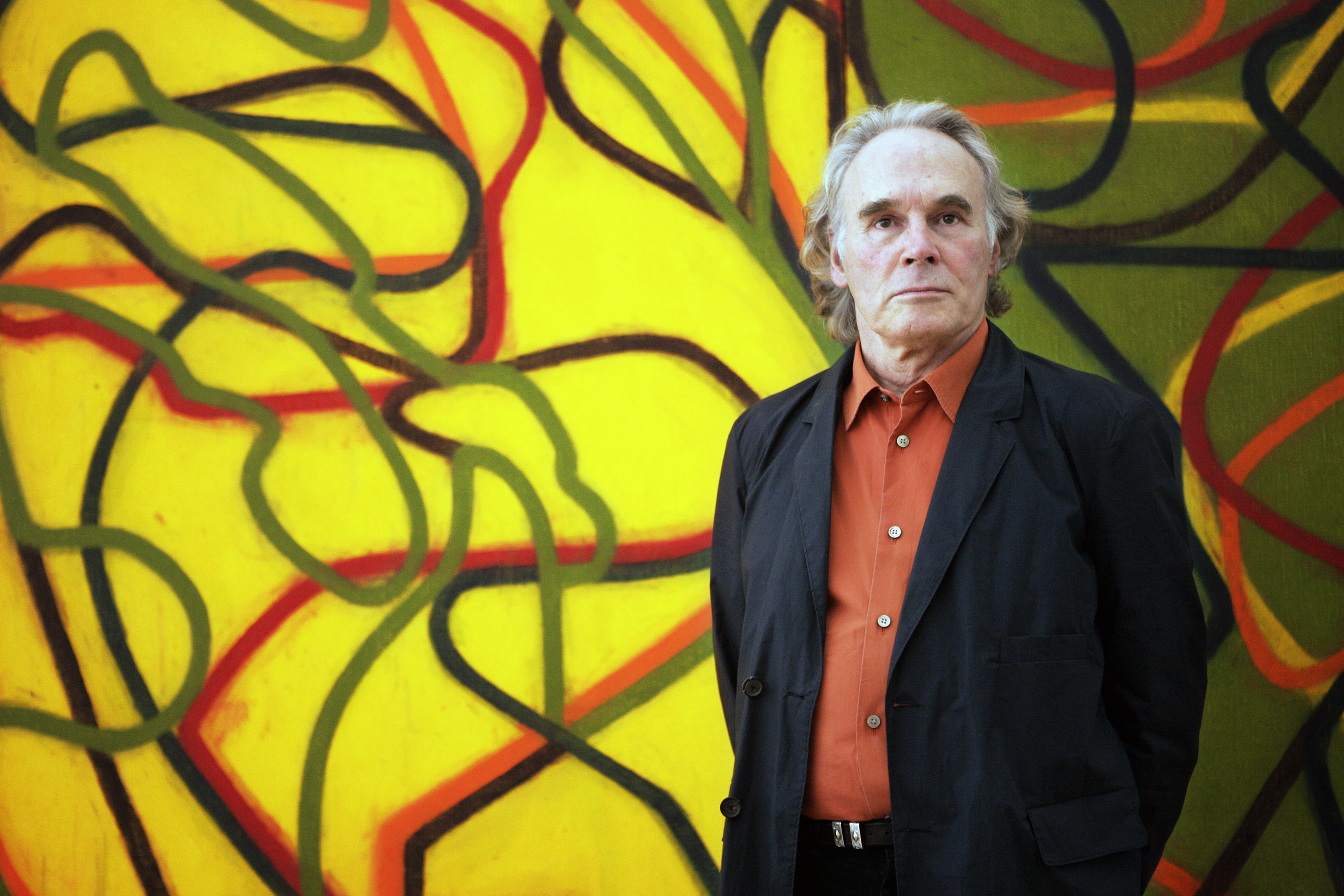
Brice Marden, Master of Luminous Silence
Artist Spotlight · The Collection Editorial
“I want the painting to be an object but I also want it to be an experience.”
Brice Marden, interview with Pat Steir, 1973
When the Museum of Modern Art mounted its landmark retrospective of Brice Marden in 2006, filling its galleries with decades of work that ranged from hushed monochromatic panels to the looping, calligraphic tangles of his mature period, the art world paused to take full measure of one of the most quietly consequential painters America had ever produced. The show made clear what serious collectors had long understood: that Marden operated in a register entirely his own, somewhere between discipline and feeling, between the seen and the sensed. His passing in 2023 at the age of eighty four marked the close of a singular chapter in postwar painting, and the years since have only deepened appreciation for the body of work he left behind. Brice Marden was born in 1938 in Bronxville, New York, and came of age artistically at a moment when Abstract Expressionism still cast a long shadow over American painting.
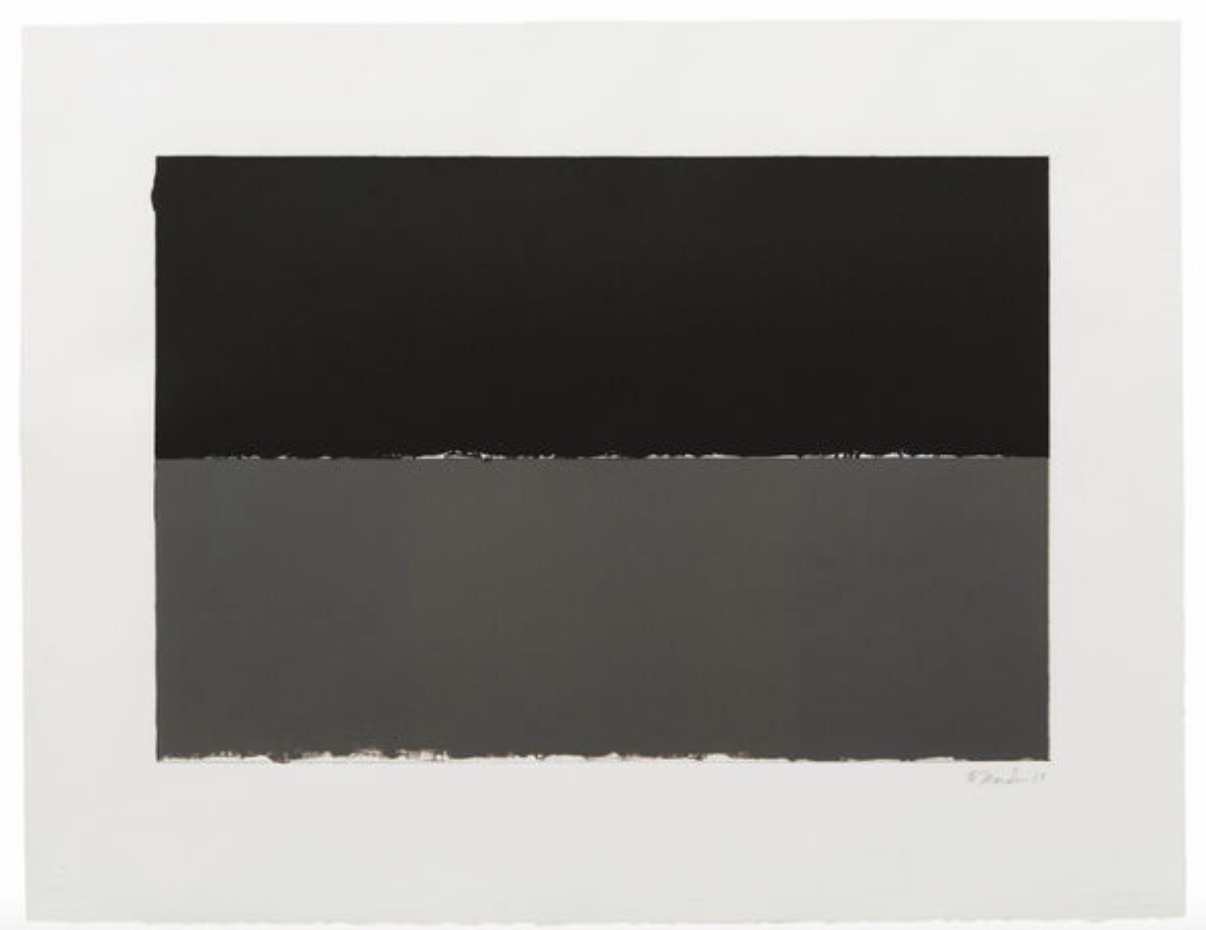
Brice Marden
Gulf, 1969
He studied at Florida Southern College before transferring to Boston University, and it was during his graduate studies at the Yale School of Art and Architecture in the early 1960s that his sensibility truly began to take shape. Yale in those years was a crucible of serious thinking about color and form, and Marden absorbed those lessons with an unusual depth of purpose. His early exposure to the work of Jasper Johns, for whom he worked as a studio assistant in the mid 1960s, proved formative, instilling in him a reverence for the physical surface of the canvas as a site of meaning in itself. Marden emerged onto the New York scene in the late 1960s with a body of work that was immediately distinctive.
His early paintings employed a mixture of oil and beeswax applied to canvas or linen, resulting in surfaces of extraordinary tactile richness that seemed to absorb light rather than reflect it. These were paintings of muted, complex color, often organized as single panels or multi panel arrangements of rectangular fields. Works from this period, including the iconic Point from 1969, demonstrate his ability to charge a seemingly simple format with an almost unbearable density of attention. The beeswax gave the surfaces a warm, slightly translucent quality, as though the color existed just beneath a skin of material, breathing quietly.
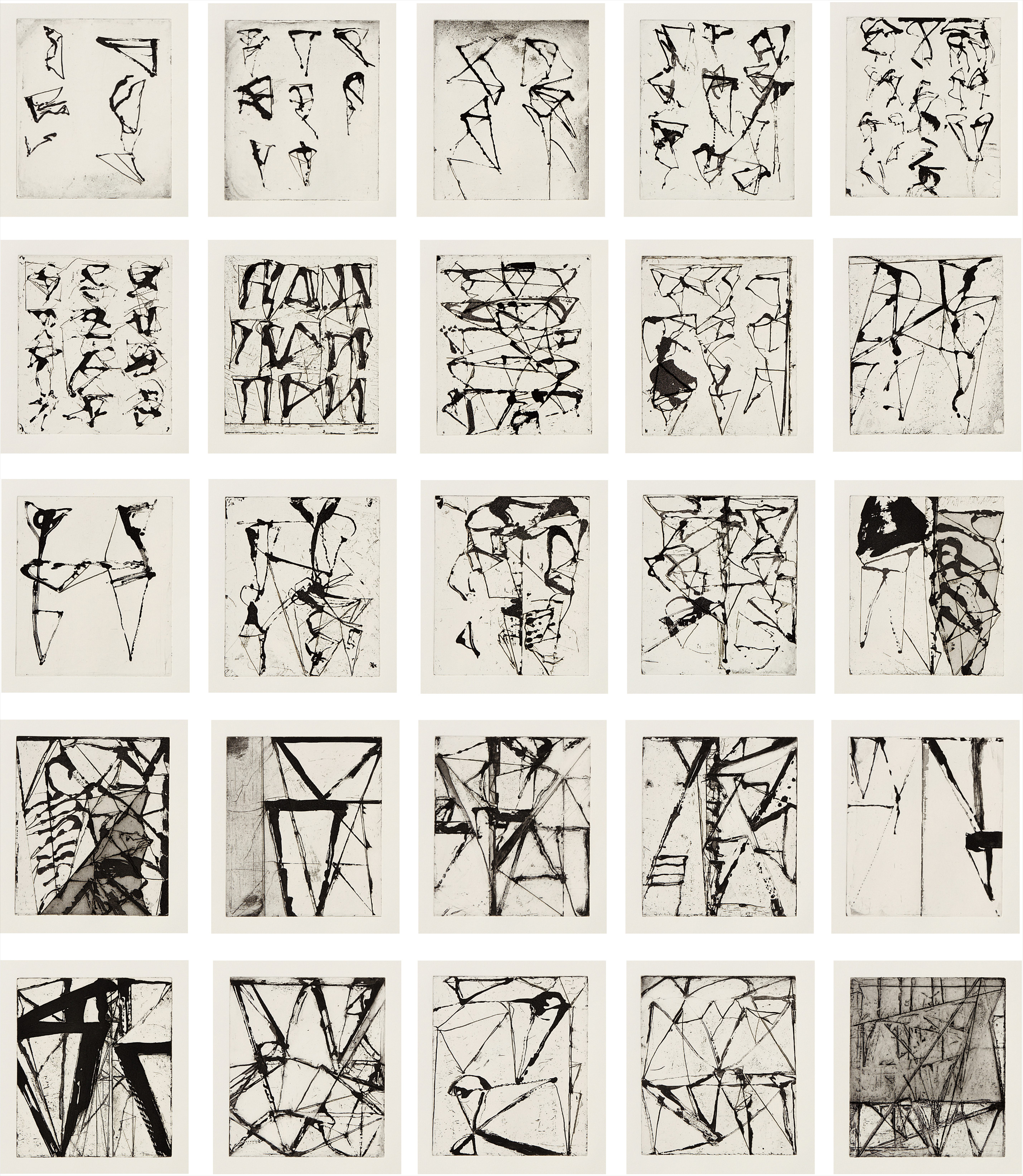
Brice Marden
Etchings to Rexroth
Through the 1970s and into the 1980s, Marden refined and extended this monochromatic language, producing works of increasing formal rigor that nonetheless never felt cold or academic. His palette during this period favored the muted and the earthy: grays, ochres, dusty greens, and smoky blues that seemed drawn from landscape and memory rather than from theory. The Grove Group, a series completed in the mid 1970s inspired by the olive groves of the Greek island of Hydra where he spent time each year, demonstrated how deeply his work was rooted in the experience of specific places and light conditions. Then, in the late 1980s, something shifted.
“Color is the medium through which I feel I can most directly express what I want to say.”
Brice Marden
Inspired by a deepening engagement with East Asian philosophy, poetry, and particularly the calligraphic traditions he encountered in Chinese and Japanese writing, Marden began to allow line to move freely across his canvases for the first time. The result was one of the great transformations in late twentieth century painting. The Cold Mountain series, begun in the late 1980s and named for the Tang Dynasty poet Han Shan, announced this new phase with extraordinary force. Here the contained planes of his earlier work gave way to looping, interweaving lines rendered in oil, hovering over grounds of layered color that retained all the atmospheric richness of his previous paintings.
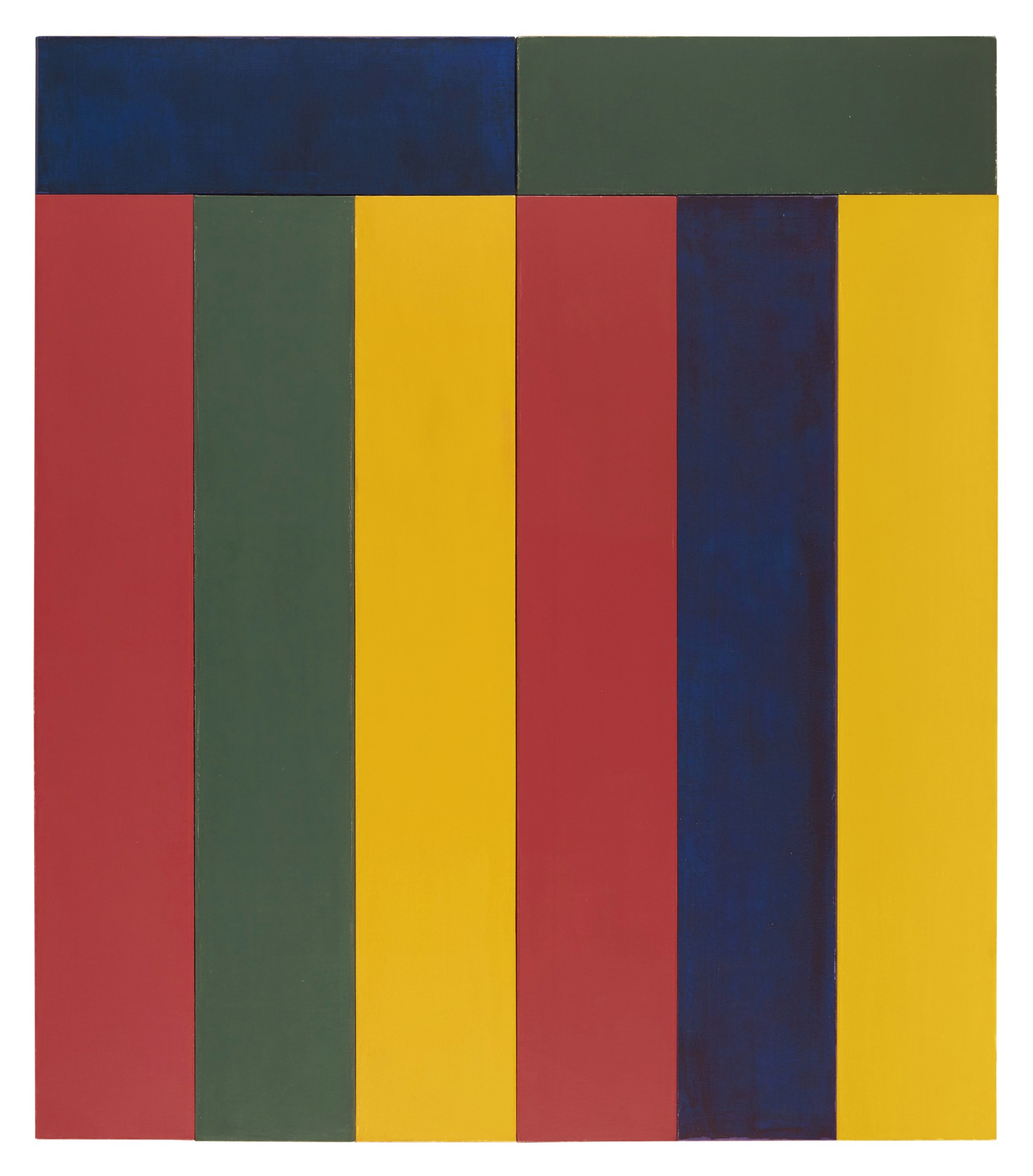
Brice Marden
Elements IV
The works felt simultaneously ancient and urgently contemporary, as though Marden had discovered a way to make the Western painted surface pulse with the energy of a brushstroke tradition thousands of years old. Later series, including the Suzhou paintings named for the classical gardens of that Chinese city, continued this dialogue between Eastern and Western visual thinking, expanding his chromatic range and achieving a luminosity that astonished even longtime admirers. Works like Elements IV, rendered in eight parts in oil on canvas, show a painter fully in command of a language that was entirely his own invention. For collectors, Marden's work offers one of the most compelling propositions in the postwar and contemporary market.
His output across painting, printmaking, and works on paper is substantial but never diluted: every work, from the major canvases held by institutions including MoMA, the Guggenheim, and the San Francisco Museum of Modern Art, to the intimate etchings and lithographs produced in careful collaboration with master printers, reflects the same exacting sensibility. His prints, including the celebrated Etchings to Rexroth, a complete set of twenty five etchings with aquatint inspired by Kenneth Rexroth's translations of classical Chinese poetry, are among the most prized multiples in the postwar canon. Gulf, the 1969 lithograph, has remained a touchstone for collectors drawn to his early period, while the Suzhou prints demonstrate the full richness of his later visual language. Works on paper offer an accessible entry point into a practice whose major canvases now command prices in the millions at auction at houses including Christie's and Sotheby's.
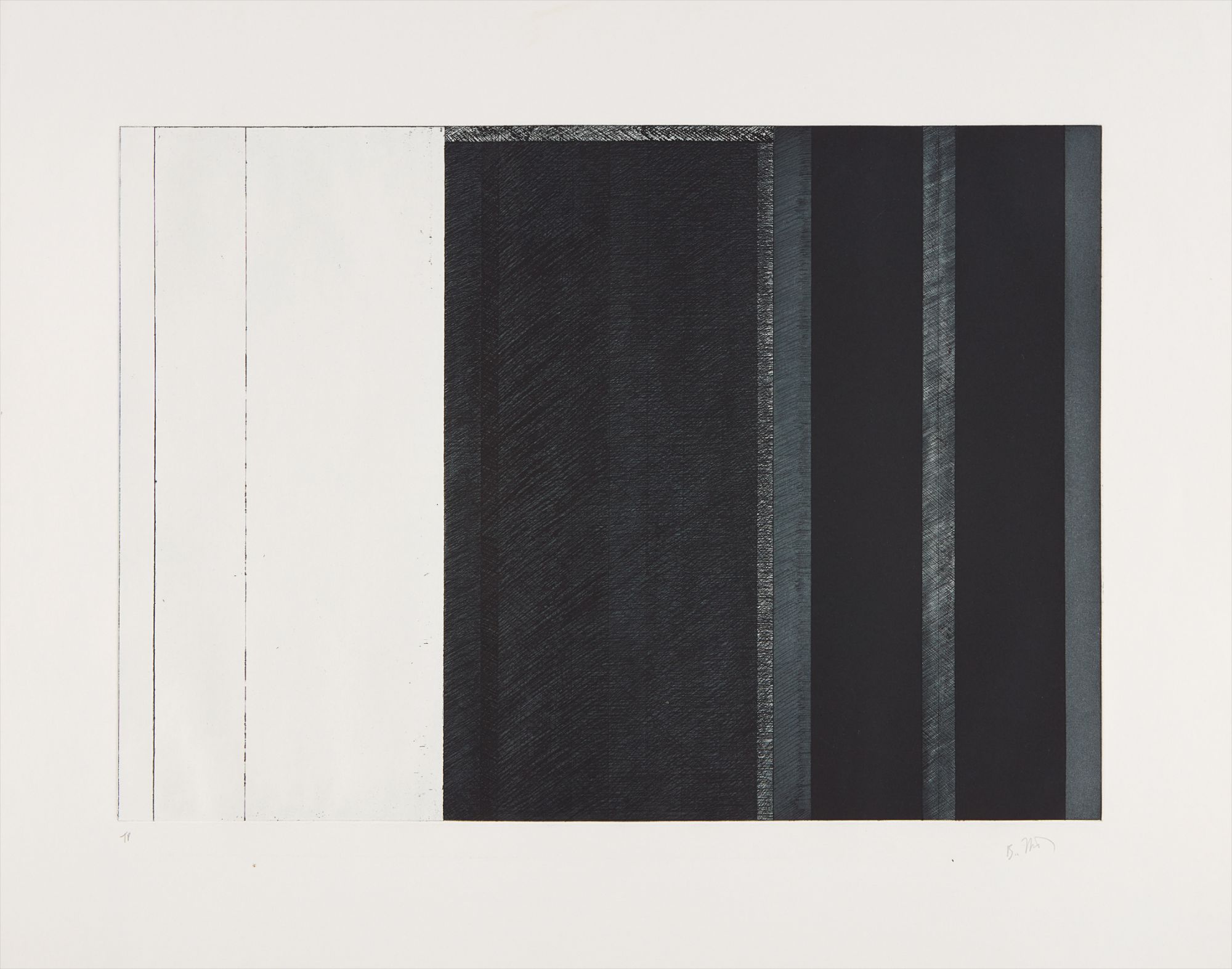
Brice Marden
1976-77
Within art history, Marden occupies a position that is both central and singular. He is often discussed in relation to minimalism, and the formal economy of his early panels invites that comparison, but he always resisted the label, insisting on the emotional and even spiritual charge his paintings were meant to carry. He is better understood alongside painters like Robert Ryman, whose dedication to the material reality of painting he shared, and Agnes Martin, whose work similarly explored the territory between abstraction and inner experience. The influence of Mark Rothko's commitment to color as an emotionally transformative force is also legible in Marden's work, though the quality of attention he demands is distinctly his own.
Later artists working with gestural abstraction and process, from Christopher Wool to Cecily Brown, have acknowledged his example. What endures in Brice Marden's work is something that resists easy description but is immediately felt in front of the paintings themselves: a quality of sustained, unhurried attention that feels almost radical in its insistence. He made paintings that ask you to slow down, to look again, to let the surface teach you how to see it. In an era of information saturation, that invitation feels more valuable than ever.
The collectors and institutions who have committed to his work are custodians of some of the most serious painting the twentieth century produced, and the conversation around that work shows every sign of deepening as more time passes.
Explore books about Brice Marden
Brice Marden: Paintings and Drawings
Diane Waldman
Brice Marden: Cold Mountain
Robert Storr

Brice Marden: A Retrospective
Paul Schimmel

Brice Marden: Work of the 1990s
Various
Brice Marden: Paintings 1985-1995
Klaus Kertess
Brice Marden: Etchings
Ruth Fine

Brice Marden: Drawings
Robert Storr