Bob Thompson
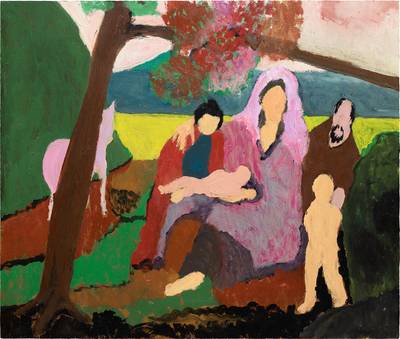
Bob Thompson: Color, Myth, and Pure Brilliance
Artist Spotlight · The Collection Editorial
In 2005, the Studio Museum in Harlem mounted a landmark exhibition that reintroduced Bob Thompson to a new generation of collectors and scholars, positioning him as one of the most singular and urgently relevant painters to have emerged from postwar American art. That moment of institutional reckoning has only deepened in the years since. Today, Thompson's canvases appear in major museum collections including the Whitney Museum of American Art, the Smithsonian American Art Museum, and the Museum of Modern Art, and his work continues to draw serious attention from collectors who recognize in his vivid, allegorical paintings something that feels simultaneously ancient and radically alive. The art world has spent decades catching up to what Thompson understood intuitively: that figuration and abstraction are not opposites but partners in an ongoing conversation about what it means to be human.
Bob Thompson
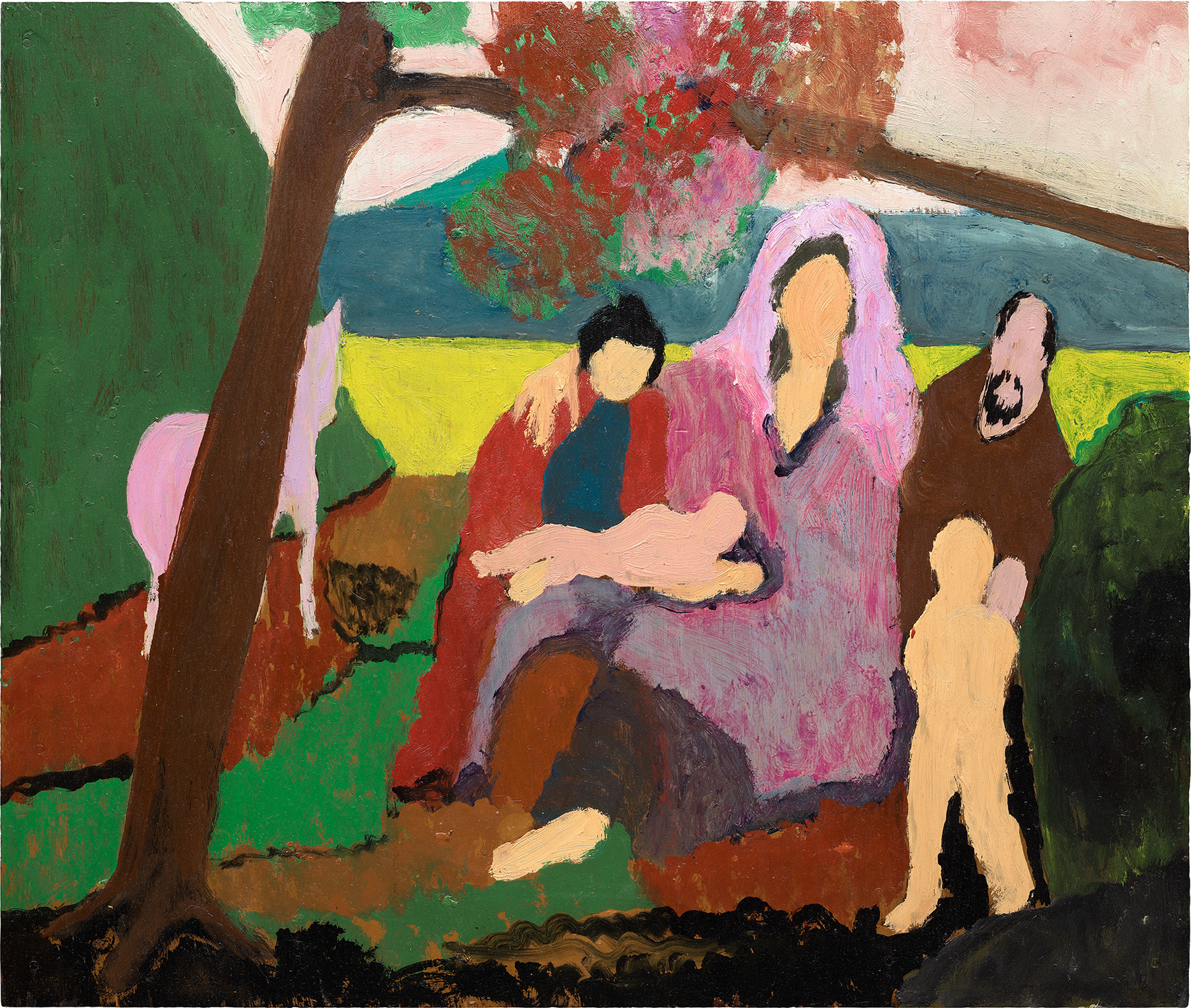
The Family, 1961
Bob Thompson was born on June 26, 1937, in Louisville, Kentucky, into a middle class African American family that encouraged his early interest in art. A defining tragedy arrived when Thompson was a teenager: he witnessed a car accident that took the lives of his father and a close friend, an event that seems to have left its mark on the urgent, almost feverish quality of his later work. He enrolled at the University of Louisville before transferring to the School of the Boston Museum of Fine Arts, and it was in Boston that his visual education truly began to accelerate. He encountered reproductions and then originals of European Old Master painting, and something clicked into place that would shape everything he made for the rest of his life.
Thompson moved to New York City around 1958 and immersed himself in the Cedar Tavern scene, that storied downtown world where painters, poets, and jazz musicians traded ideas and challenged one another across long evenings. He befriended figures including Red Grooms and Alice Neel, and he absorbed the lessons of Abstract Expressionism without ever being consumed by them. Where his contemporaries were moving toward pure abstraction, Thompson moved in the opposite direction, or rather he moved sideways, finding a third path that used the emotional intensity and chromatic freedom of Abstract Expressionism as a vehicle for deeply human, narrative imagery drawn from myth, scripture, and art history. The defining characteristic of Thompson's mature work is the way he takes a compositional framework from Goya, Poussin, or Delacroix and floods it with color so saturated and so personal that the source becomes both visible and completely transformed.
Bob Thompson
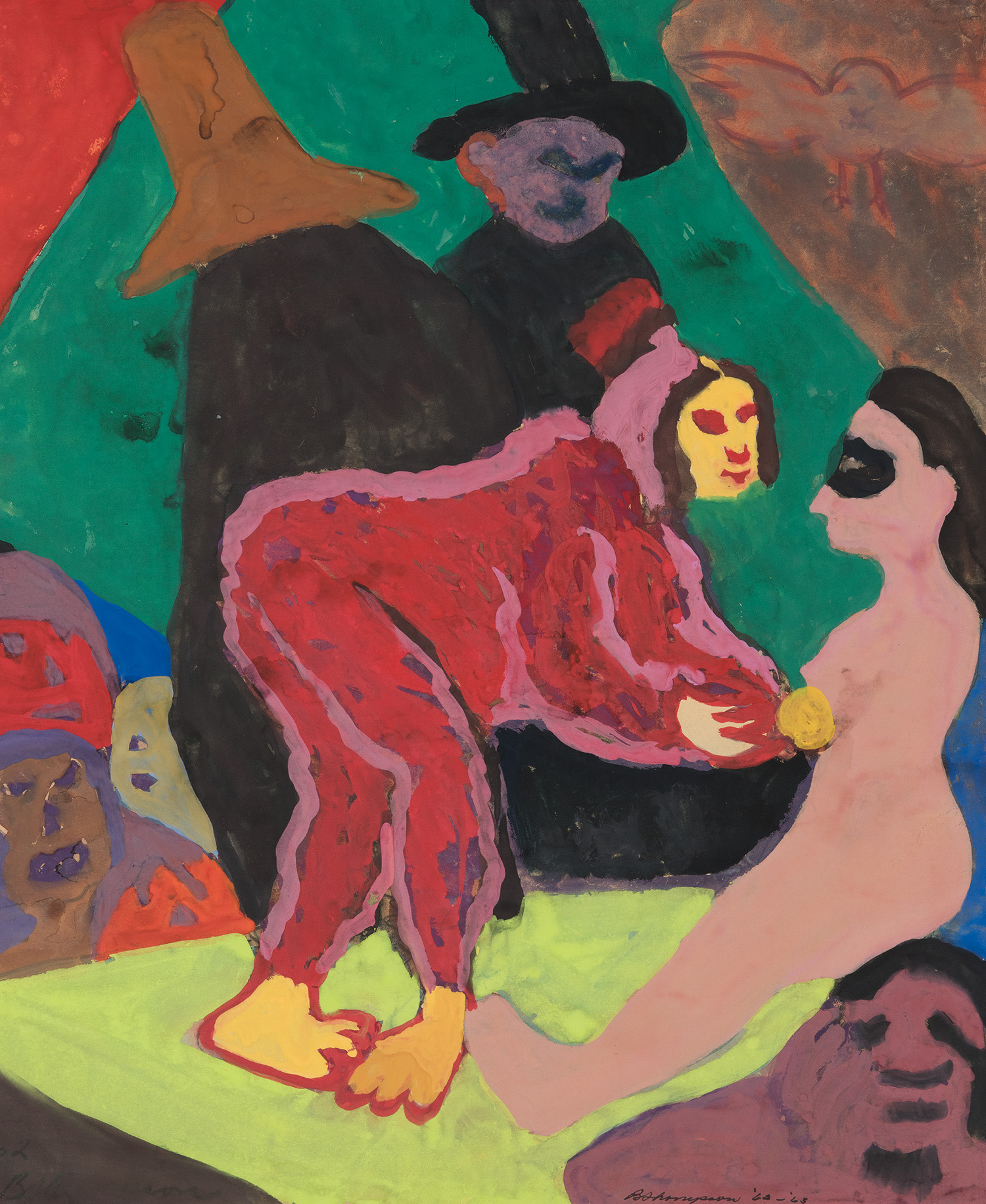
The Beg, 1962
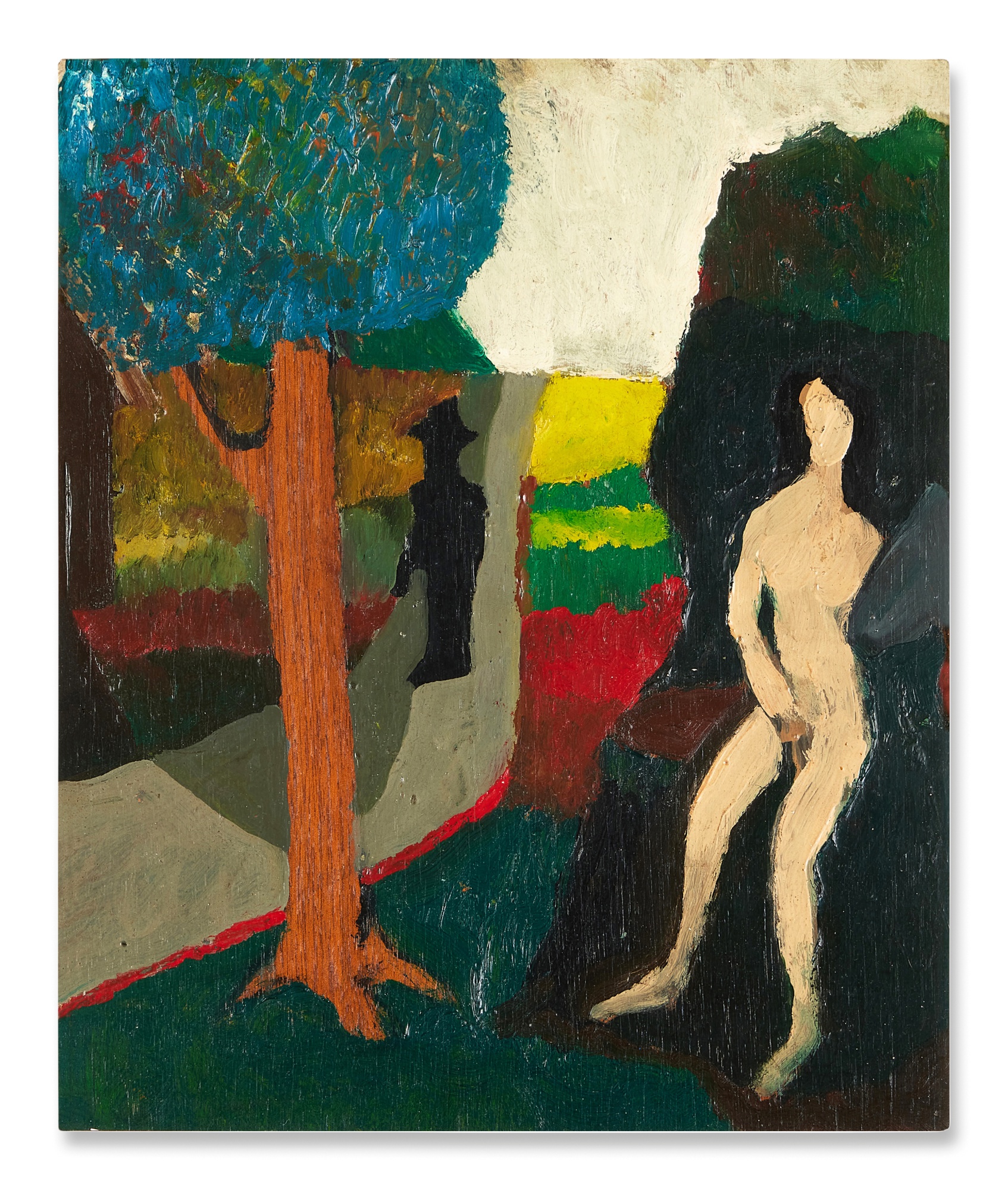
His figures are flattened to near silhouettes, rendered in bold blocks of cobalt, crimson, forest green, and burnt orange, yet they retain an unmistakable psychological presence. This was a radical act. By appropriating the visual grammar of the Western canon and repainting it in his own chromatic language, Thompson was doing something that later generations of artists would make explicit: he was claiming that tradition as his own, interrogating it, and making it yield new meaning. Works like The Traveler from 1960 and The Family from 1961 demonstrate how completely he had synthesized these influences into a voice that belonged to no one but himself.
Among the works available on The Collection, The Family from 1961 stands as a particularly compelling entry point into Thompson's world. Executed in oil on panel, it encapsulates his gift for arranging figures in shallow pictorial space while charging the scene with a warmth and tension that feels genuinely mythological. The Beg from 1962 and Adam and Eve from 1964, both executed in gouache on paper, reveal the intimacy and spontaneity of his works on paper, which are no less fully realized than his larger canvases. Thompson moved between media with remarkable fluency, and his drawings and works on paper offer collectors an opportunity to study his compositional thinking up close, to see the intelligence at work beneath the bravura color.
Bob Thompson
The Traveler, 1960
From a collecting perspective, Thompson represents one of the genuinely significant undervalued narratives in twentieth century American art, though that is changing with increasing speed. His auction results have climbed steadily as institutional scholarship and curatorial attention have grown. Works on paper, including gouaches and drawings, have historically offered more accessible entry points while carrying the full force of his artistic vision. Collectors drawn to figures such as Henry Ossawa Tanner, Romare Bearden, and Jay DeFeo will find in Thompson a painter who bridges multiple conversations at once: the transatlantic dialogue between American and European modernism, the history of Black artists engaging with and transforming canonical Western imagery, and the broader postwar story of figuration reasserting itself against the dominance of pure abstraction.
Thompson spent time in Europe, living in Rome and Ibiza during the early 1960s on a John Hay Whitney Foundation Fellowship, and this immersion in European painting only deepened his engagement with the Old Masters he had studied in reproduction. He was not a tourist in that tradition but a genuine participant, someone who understood Goya's blacks and Poussin's classical geometry on their own terms before making them his own. Artists who share something of his spirit include Francis Bacon in his confrontational figuration, Jean Michel Basquiat in his reclamation of art historical symbols, and Peter Saul in his unruly chromatic intensity, though Thompson arrived at his distinctive position entirely independently and on his own terms. Bob Thompson died in Rome in 1966 at the age of twenty eight, leaving behind a body of work that rewards every additional hour one spends with it.
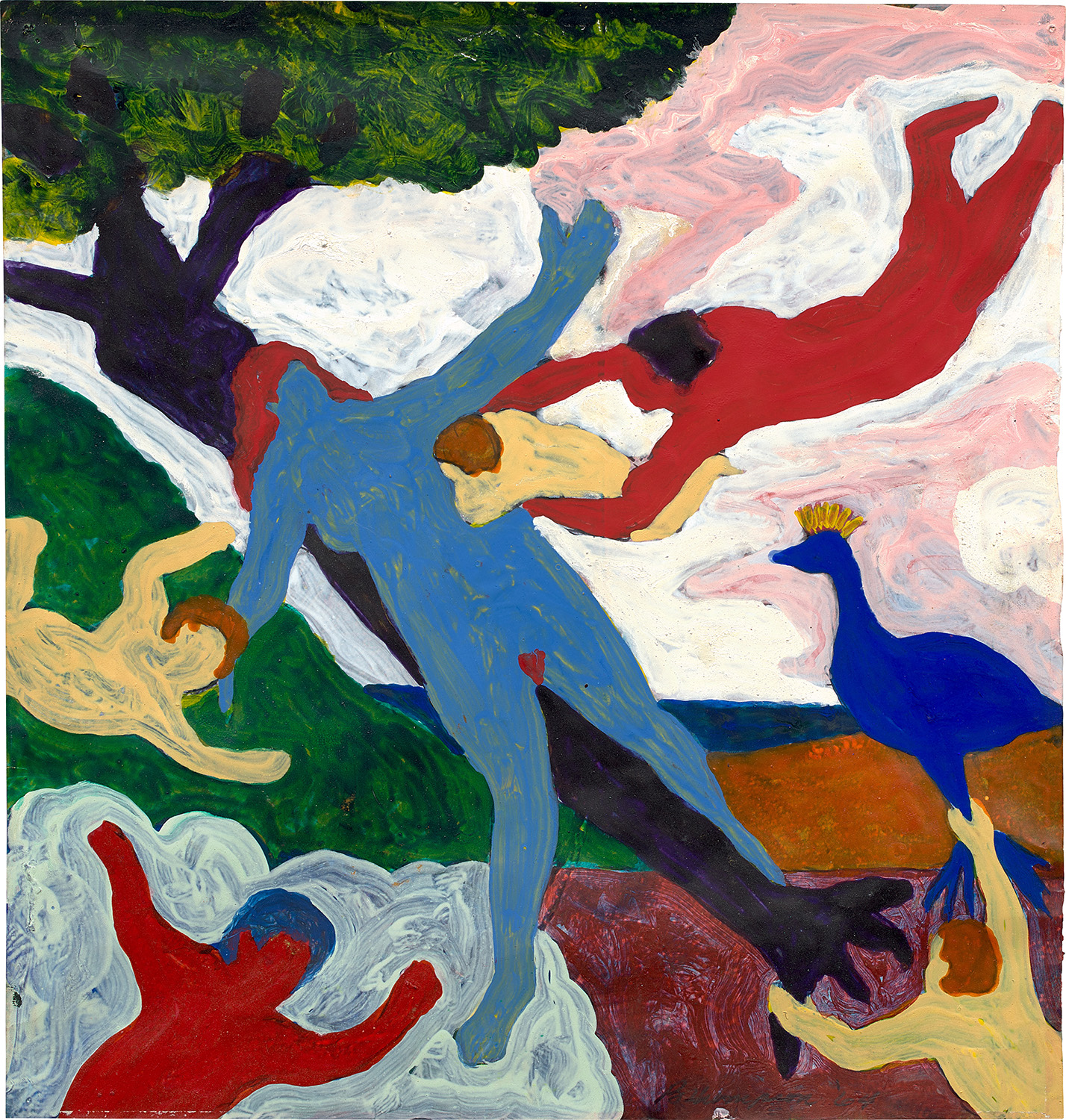
Bob Thompson
Nativity Scene, 1964
The brevity of his career makes the prolific output he achieved all the more remarkable: hundreds of paintings and works on paper produced across roughly a decade of mature practice. What endures is not simply the beauty of individual canvases but the coherence of a vision, a painter who understood that the great myths of Western culture were also his myths to interpret, inhabit, and transform. Collecting Thompson is an act of recognition, an acknowledgment that this voice, so distinct and so fully formed, deserves the sustained attention it is finally, and deservedly, receiving.