Bernd and Hilla Becher
Beauty Found in Industrial Monuments
Artist Spotlight · The Collection Editorial
“We try to present the buildings as objectively as possible, free from any aesthetic or ideological interpretation.”
Bernd and Hilla Becher, interview
Few photographic bodies of work have aged with the quiet authority of Bernd and Hilla Becher's. In 2022, a landmark retrospective at the Fundació Antoni Tàpies in Barcelona brought fresh eyes to their vast archive of industrial images, reminding a new generation just how radical it once was to point a camera at a water tower and call it art. Their gelatin silver prints continue to command serious attention at auction, with major works appearing regularly at Christie's and Sotheby's, drawing both institutional buyers and private collectors who understand that this is photography operating at the highest level of conceptual ambition. Bernd Becher was born in Siegen, Germany in 1931, a city whose own industrial heritage it sits at the heart of a steel and mining region would prove quietly prophetic.
Bernd and Hilla Becher
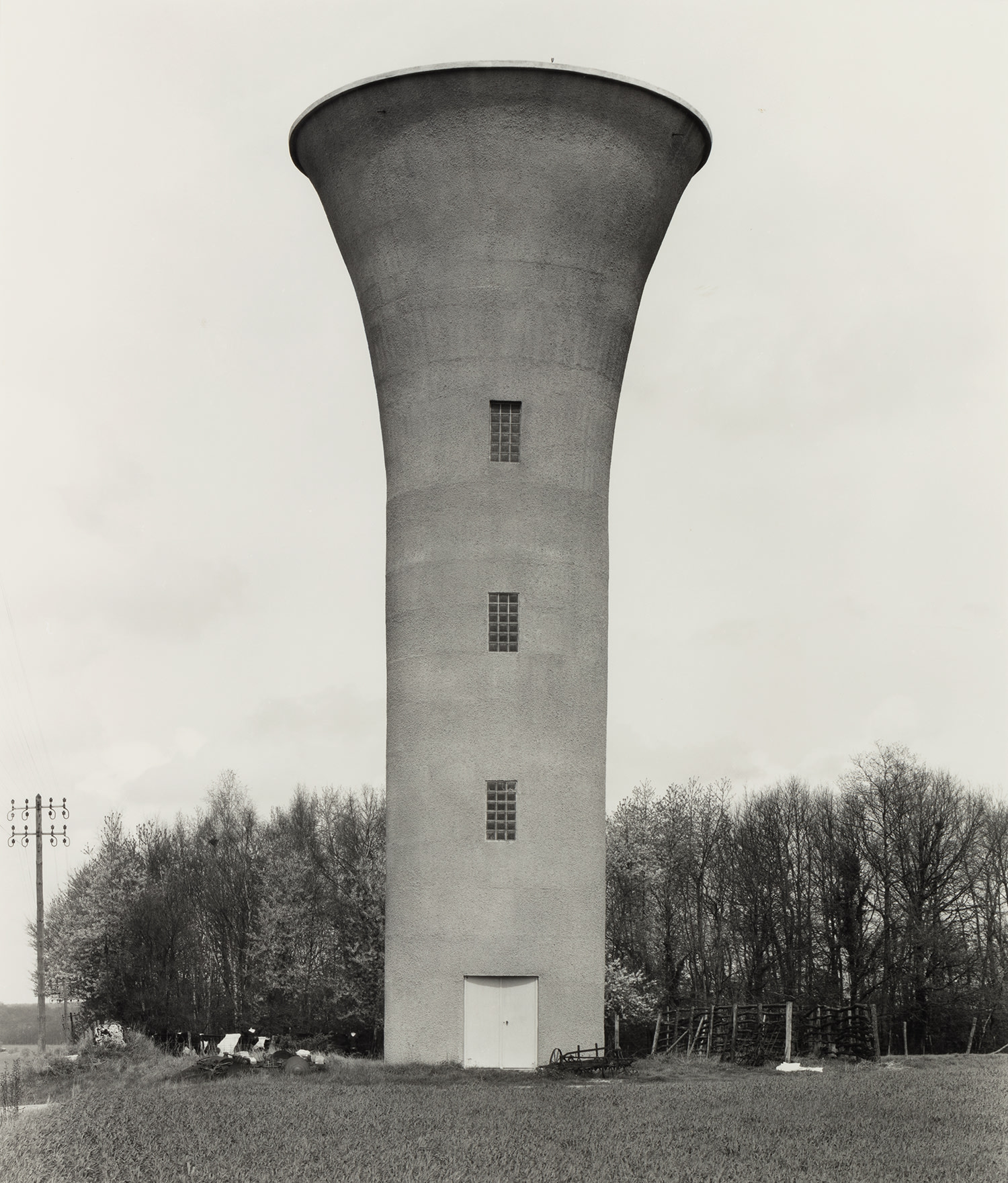
Water Tower, Maisoncelles, Seine-et-Marne, France
He studied painting and typography at the Stuttgart Academy before turning decisively toward photography. Hilla Wobeser, born in Potsdam in 1934, trained in photography in Düsseldorf and brought a rigorous technical foundation to the partnership. The two met at the Kunstakademie Düsseldorf in the late 1950s and began working together almost immediately, their sensibilities so perfectly matched that the question of individual authorship became, for them, beside the point. Their collaboration was also a marriage, and the sustained intimacy of that bond gave their decades of shared fieldwork a quality that transcends mere methodology.
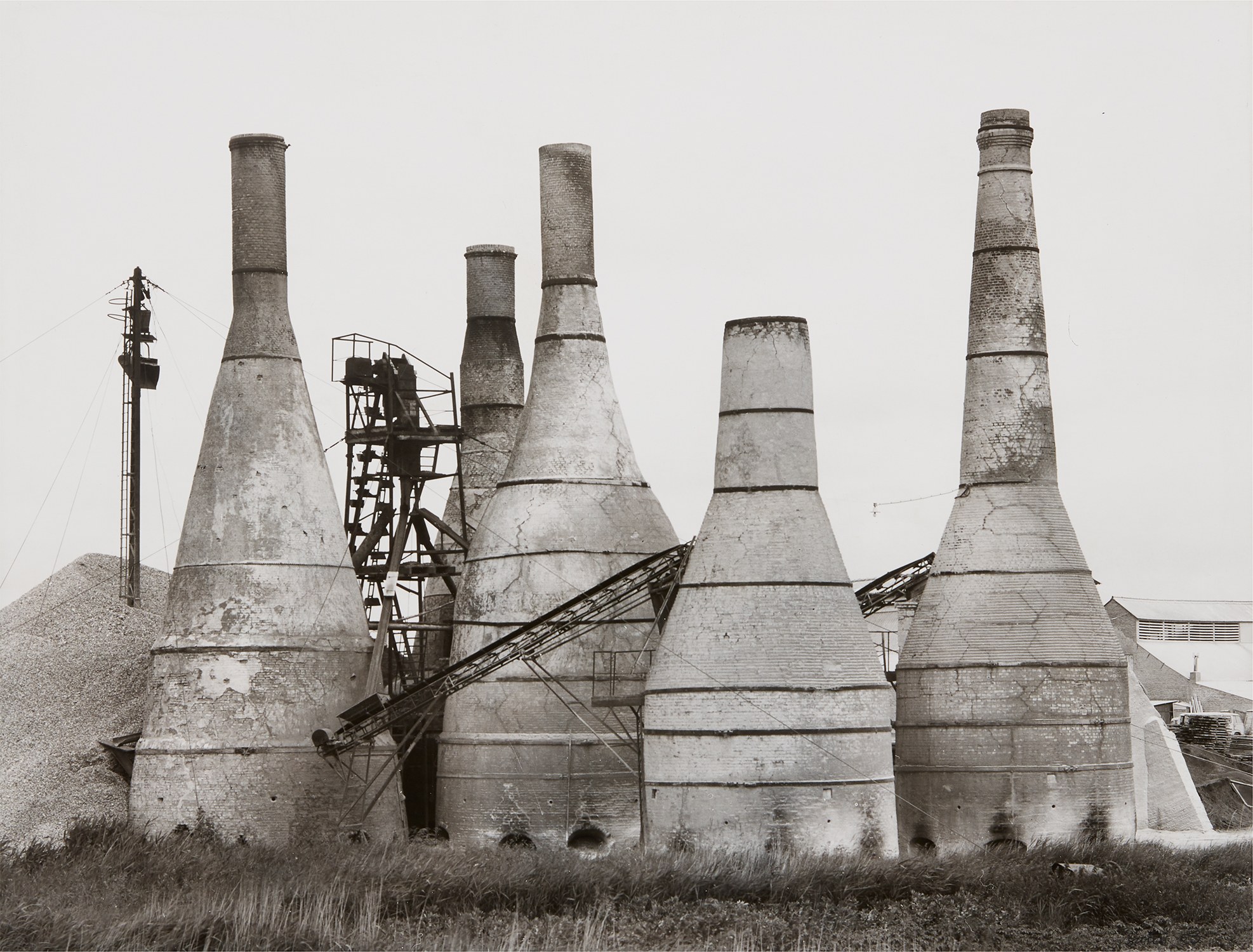
Their artistic project took shape against the backdrop of postwar West Germany, a country in the process of simultaneously rebuilding and reckoning with its industrial past. The Bechers recognised that the great functional structures of the 19th and early 20th centuries were disappearing with troubling speed, absorbed into redevelopment or simply left to decay. Beginning in the late 1950s and intensifying through the 1960s and 1970s, they set out on an extraordinary programme of documentation, travelling across the Ruhr Valley, the industrial towns of England and Belgium, the American Midwest, and the coalfields of France. They photographed water towers, blast furnaces, coal bunkers, winding towers, lime kilns, and grain elevators with a consistency of approach that was itself the artistic statement.
Bernd and Hilla Becher
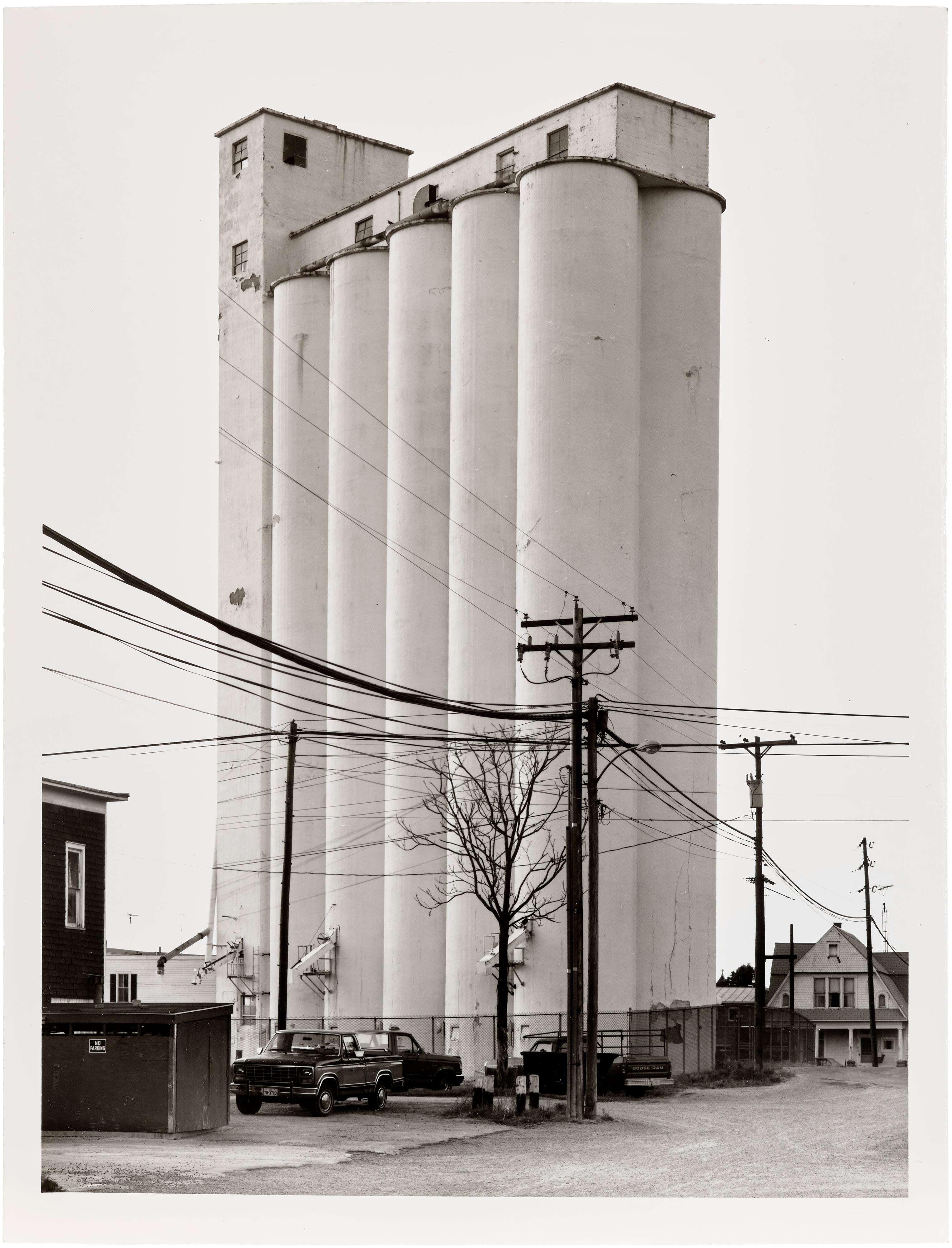
Grain Elevators, Sycamore, Ohio, USA
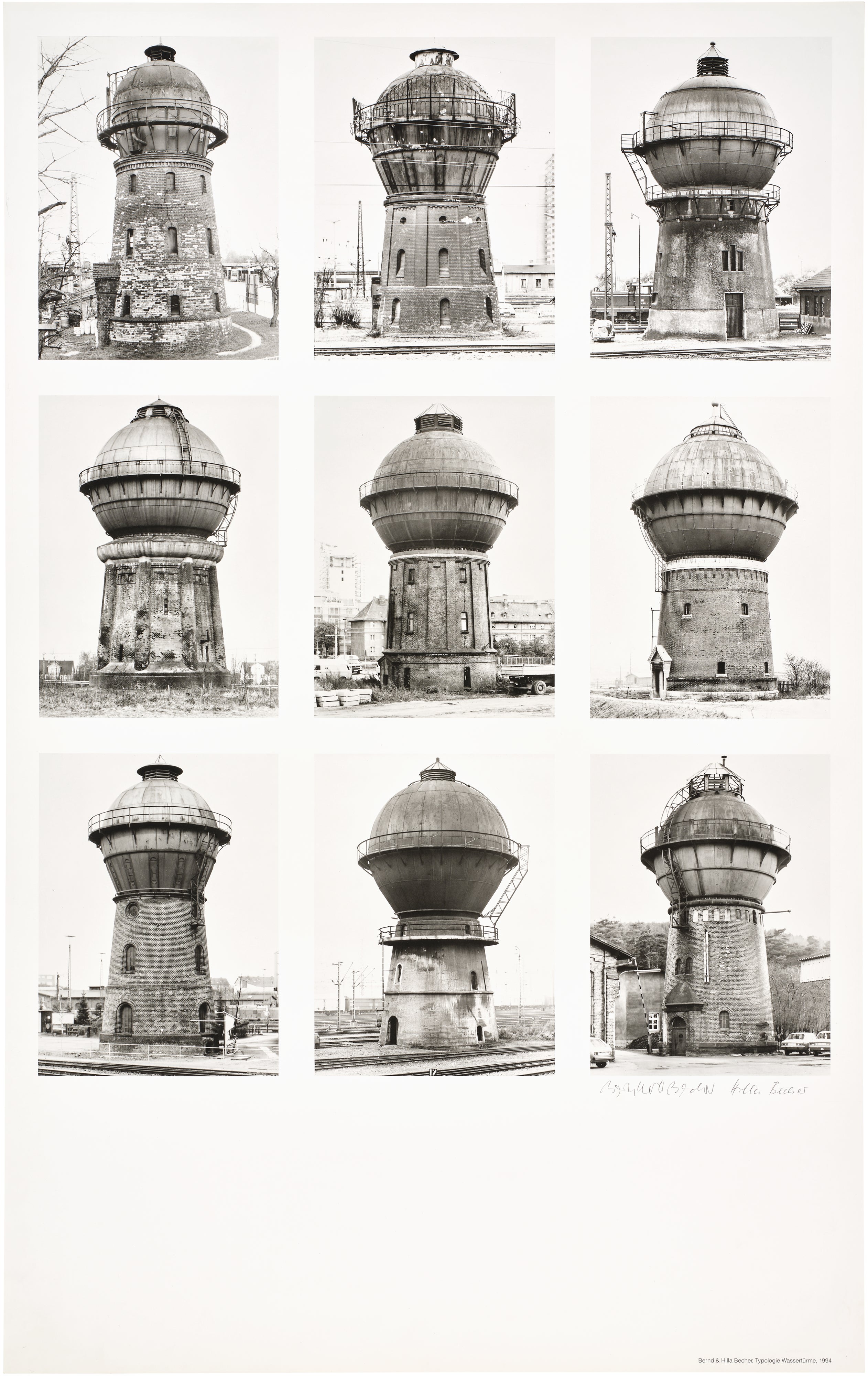
Every image was made under overcast skies, from a level angle, with a large format camera, producing prints of crystalline clarity and near total tonal neutrality. What elevated their work from documentation to art was the typological method. Rather than presenting individual structures as singular subjects, the Bechers grouped photographs of similar industrial forms into grids, typically nine or fifteen prints arranged so that the eye could move across them, noting similarities and registering differences with a pleasure that is essentially sculptural. A grid of water towers becomes a study in vernacular engineering ingenuity, each solution to the same functional problem subtly distinct in profile, proportion, and material.
The Bechers called these groupings typologies, borrowing a term from architecture and archaeology and applying it to a body of work that was, among other things, a profound meditation on anonymity and collective human making. The structures they photographed had no named architects. They were built by industrial necessity, and the Bechers treated them with the same seriousness one might give to a cathedral. Among the most celebrated examples of their practice are the water tower series, which spans structures photographed across Germany, France, Belgium, and beyond.
Bernd and Hilla Becher
Lime Kilns, Harlingen, Netherlands
Works such as Water Tower, Oberhausen/Ruhr, Germany and Water Tower, Herve/Liège, Belgium demonstrate how the same subject, approached with identical photographic discipline, yields entirely different formal results. Their photographs of grain elevators in the American Midwest, including Grain Elevators, Sycamore, Ohio, USA, carry a particular poignancy, capturing structures that were already becoming anachronistic at the moment of photography. The multi part work Chemische Fabrik Wesseling Bei Köln from 1998 shows how their vision expanded over time to encompass larger, more complex industrial complexes, with the grid format allowing the viewer to absorb both the totality and the detail of an entire facility. From a collecting perspective, the Bechers occupy a position of remarkable stability and prestige.
Their work sits firmly within the Blue Chip tier of the photography market, with institutional holdings at MoMA in New York, Tate in London, the Museum Folkwang in Essen, and the Centre Pompidou in Paris lending their prints a museum validated authority that collectors find deeply reassuring. Print quality matters enormously when acquiring their work: the finest examples are gelatin silver prints with full margins, ideally from early printings, and works on Baryta paper carry particular desirability among knowledgeable buyers. Multi part and grid works command the strongest prices, as they most fully embody the typological logic that defines the practice. The original grey folders that accompanied certain publications, seen with works such as the Grain Elevators, Sycamore, Ohio edition, are details that signal provenance and completeness.
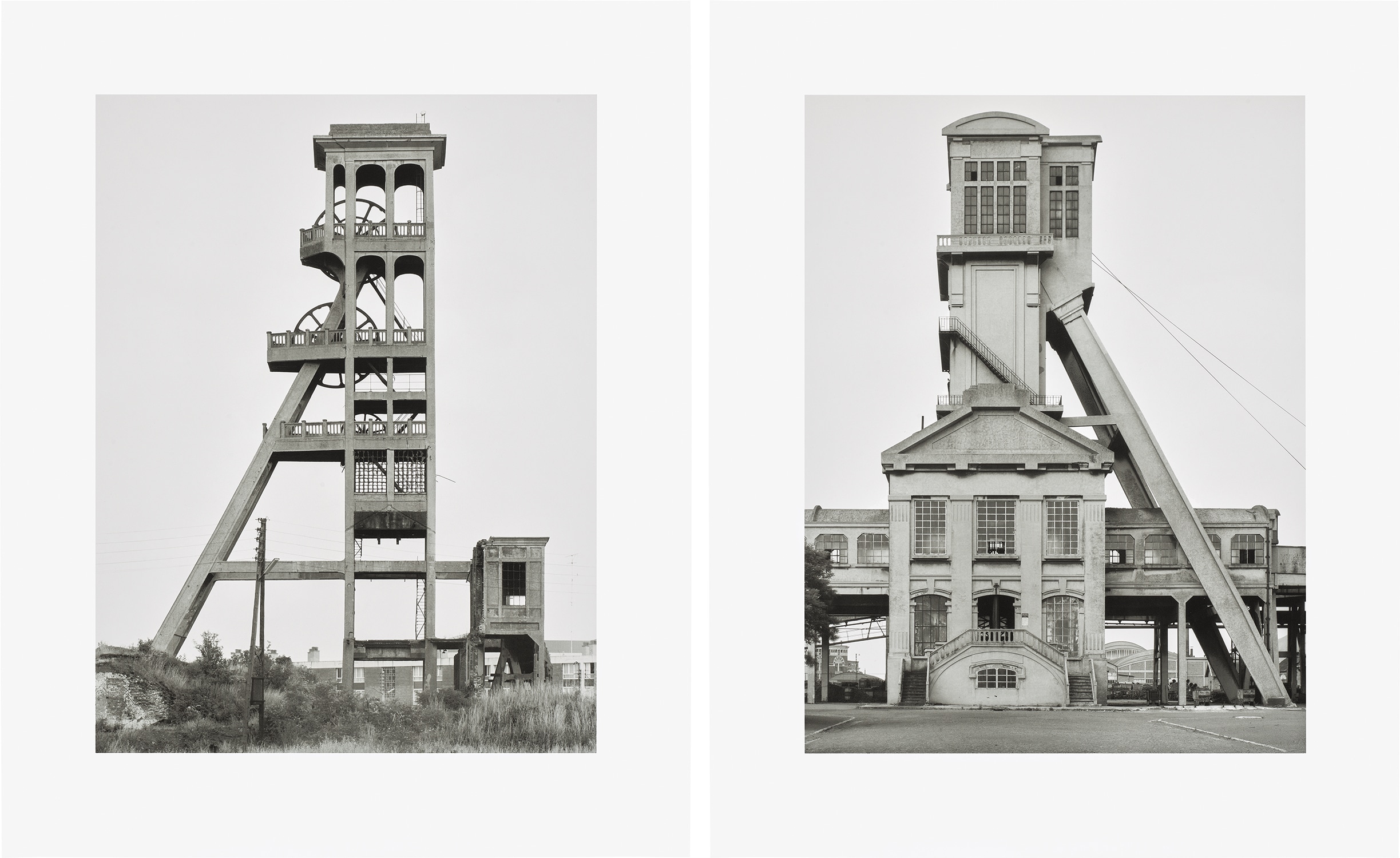
Bernd and Hilla Becher
Zwei Fördertürme (Two Pithead Frames)
To understand the Bechers is to understand the Düsseldorf School they helped create. From the mid 1970s onward, Bernd Becher taught at the Kunstakademie Düsseldorf, where his students included Andreas Gursky, Thomas Struth, Candida Höfer, Thomas Ruff, and Axel Hütte, a cohort that would go on to transform the scale and ambition of art photography in the 1980s and 1990s. The Bechers gave this generation something invaluable: a method, a seriousness, and a conviction that photography could hold its own in the company of painting and sculpture. Their relationship to conceptual art more broadly connects them to contemporaries such as Ed Ruscha, whose photographic books of the 1960s share a deadpan systematic quality, and to the Minimalist sculptors who were, in the same period, exploring seriality and industrial form.
Hilla Becher continued working and supporting the legacy of their archive following Bernd's death in 2007, ensuring that their life's work remained accessible and properly contextualised. She passed away in 2015, leaving behind one of the most coherent and consequential bodies of work in the history of photography. What makes the Bechers matter today, perhaps more than ever, is the way their project speaks to a contemporary anxiety about disappearance, about what industrial modernity built and what it has left behind. Their photographs are monuments to human ingenuity that no longer serve their original purpose, preserved in silver and paper with a tenderness that the word document barely begins to describe.
To live with a Becher print is to keep faith with the world that made it.
Explore books about Bernd and Hilla Becher
Bernd and Hilla Becher: Life and Work
Gunter Metken
Industrial Structures
Bernd Becher, Hilla Becher

Anonymous Sculptures: A Typology of Technical Constructions
Bernd Becher, Hilla Becher
Bernd and Hilla Becher: Photographs 1957-2011
Bernd Becher, Hilla Becher
Typologies: Nine Contemporary Photographers
Ed. Martha Colburn
Framework: Building and the New Museum
Klaus Honnef