Barry Flanagan RA
Barry Flanagan: The Hare Leaps Forever
Artist Spotlight · The Collection Editorial
“The hare is a very old symbol. It has a lot of resonance for people across many cultures.”
Barry Flanagan, interview
There is a moment, standing before a Barry Flanagan bronze, when the weight of the metal seems to dissolve entirely. The hare mid leap, ears pinned back, limbs flung outward in pure kinetic joy, appears to have been caught in flight rather than cast from a mould. It is a trick of extraordinary sculptural intelligence, and it is the reason Flanagan's work continues to command devoted attention from collectors, curators, and audiences worldwide. Major institutions from Tate Britain to the Museum of Fine Arts in Boston hold his pieces, and the secondary market has sustained robust enthusiasm for his bronzes across decades, with significant works regularly appearing at Christie's, Sotheby's, and Phillips to considerable results.
Barry Flanagan RA
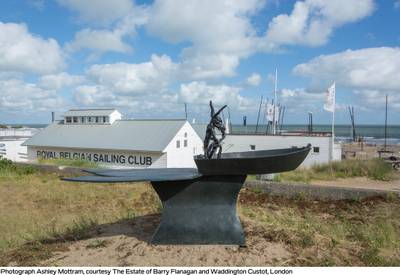
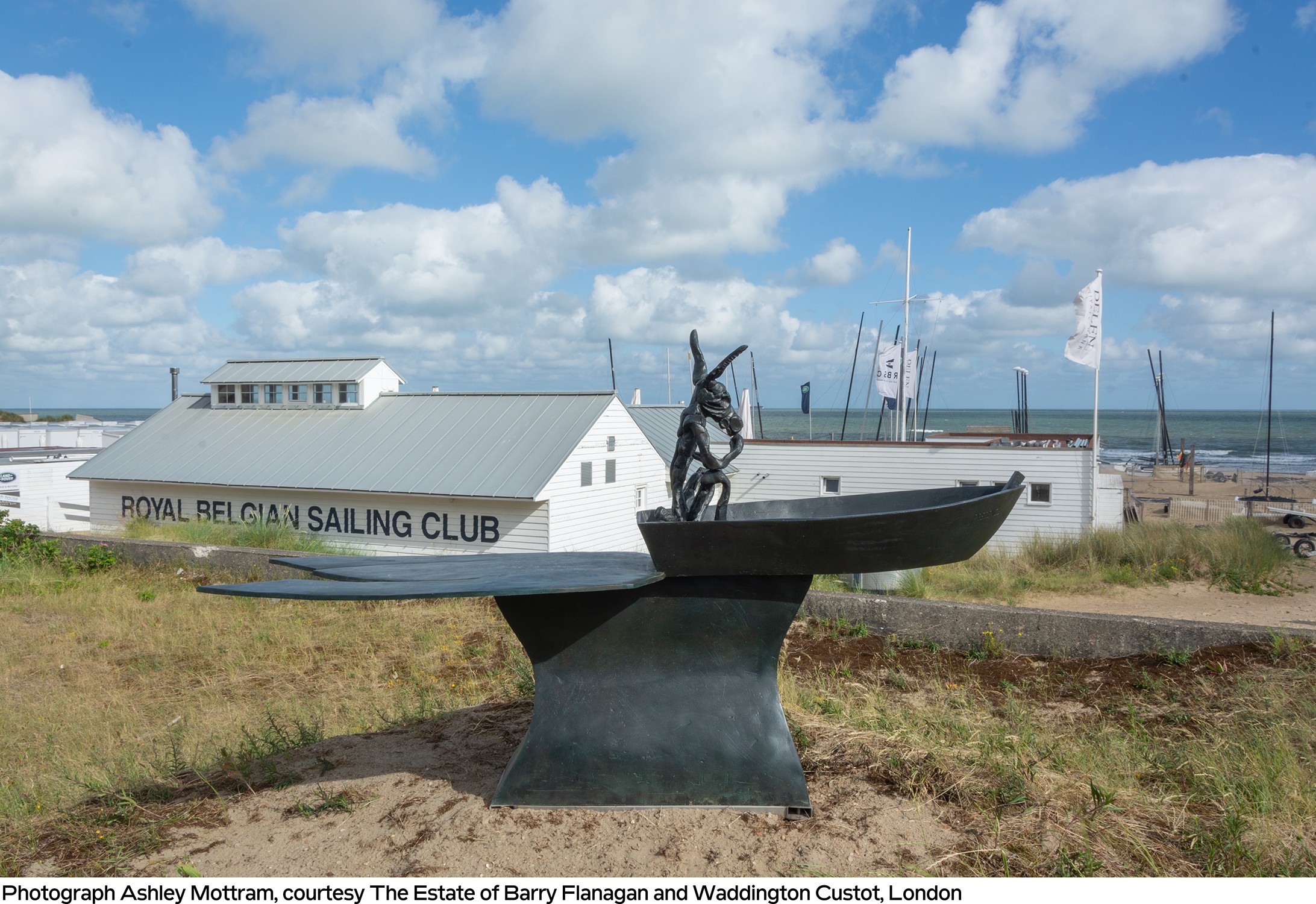
Sculler, 1998
Barry Flanagan was born in Prestatyn, North Wales, in 1941, and the Celtic landscape of his origins was never entirely absent from his imagination. He studied at Birmingham College of Arts and Crafts before moving to London to attend St Martin's School of Art, where he arrived in the early 1960s and found himself inside one of the most electrically charged moments in British sculpture. St Martin's under Anthony Caro was a crucible of formal ambition and conceptual restlessness, and Flanagan absorbed its energies while quietly plotting a very different course. Where many of his peers pursued geometric abstraction and industrial materials, he was drawn instinctively toward the organic, the provisional, and the playful.
His earliest mature work, made through the late 1960s, was deliberately anti monumental. He worked with sand, hessian, rope, and cloth, creating soft sculptures and floor based arrangements that questioned every assumption about what sculpture was supposed to be. These pieces, shown at the Rowan Gallery in London and included in landmark group exhibitions of the period, placed Flanagan firmly within the international conversation around Arte Povera and process based art. He was a peer to artists such as Richard Long and Gilbert and George, fellow travellers in the British avant garde who were each, in their own fashion, dismantling the sculptural object.
Barry Flanagan RA
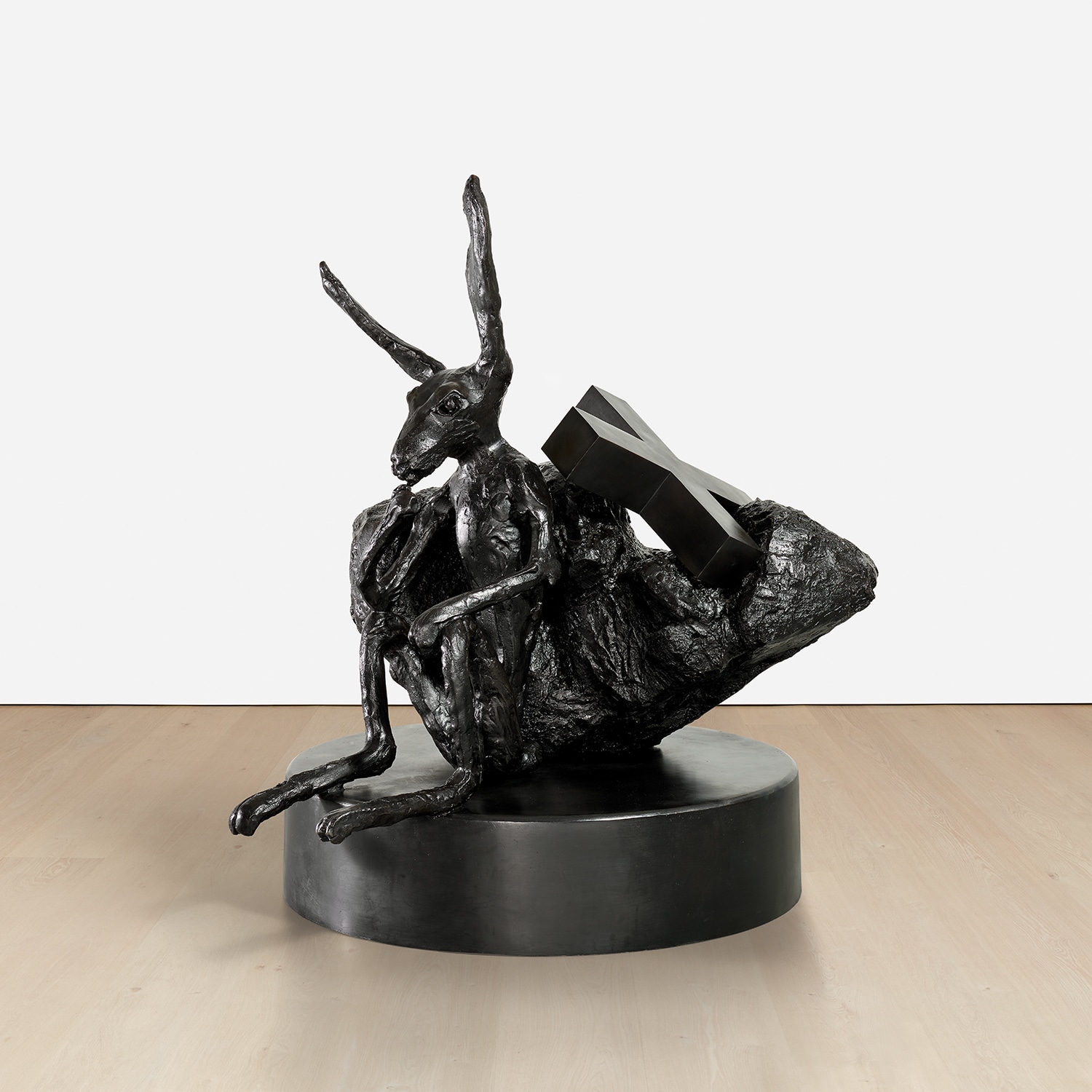
Thinker @ Rock Cross, 1997
Yet Flanagan's sensibility was always warmer, more irreverent, and ultimately more interested in delight than in critique. The turn toward bronze in the late 1970s was neither a retreat nor a capitulation to convention. It was, in retrospect, one of the most inspired pivots in late twentieth century British art. Flanagan had begun carving in stone, and from stone he moved toward casting, finding in the ancient medium a paradoxical freedom.
Bronze could hold movement. It could be made to seem weightless. And with the arrival of the hare as his central motif, somewhere around 1979 and 1980, everything accelerated. The hare was not chosen arbitrarily.
Barry Flanagan RA
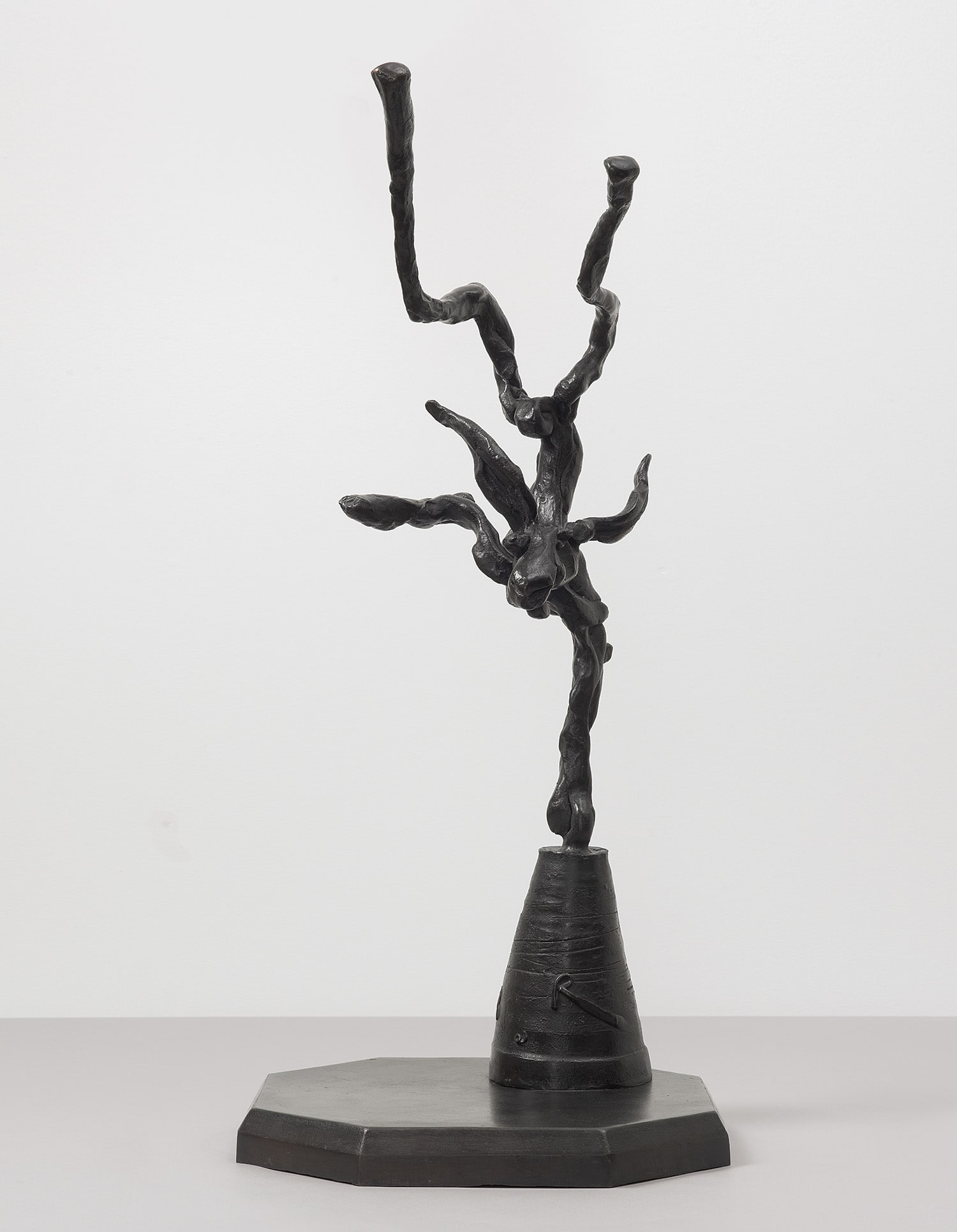
Handstand in Aid of Millennial Blessings, 1999
Rich in folklore across Celtic, Asian, and classical traditions, associated with the moon and with trickster energy, it gave Flanagan a figure that was simultaneously archetypal and infinitely flexible. He could make it meditate, box, drum, balance, leap, and think, and each pose carried a different philosophical freight without ever becoming laboured. Among the works available through The Collection, the range of Flanagan's imagination is vividly apparent. Leaping Hare on Crescent and Bell from 1983 is among the earliest and most cosmologically resonant of his bronze hares, the crescent moon beneath its feet connecting the animal to its mythological roots while the composition achieves a balletic equipoise that still astonishes.
Thinker at Rock Cross from 1997 places the hare in direct dialogue with Rodin, a gesture that is simultaneously homage and gentle comedy, the creature's borrowed pose both reverent and completely absurd in the best possible sense. Handstand in Aid of Millennial Blessings, created in 1999, shows Flanagan at his most exuberant, the inverted hare a kind of secular blessing, a figure of pure celebratory energy on the cusp of a new century. The Unicorn from 1982, rendered in gilded bronze on a unique Portland stone base, demonstrates that his mythological imagination extended well beyond a single species, and the gilding gives the work a heraldic gravity that sits in productive tension with his characteristic wit. Horse on Anvil from 2001 is among his later masterworks, the animal poised on the blacksmith's tool in a composition that speaks of transformation, craft, and the ancient relationship between maker and material.
Barry Flanagan RA
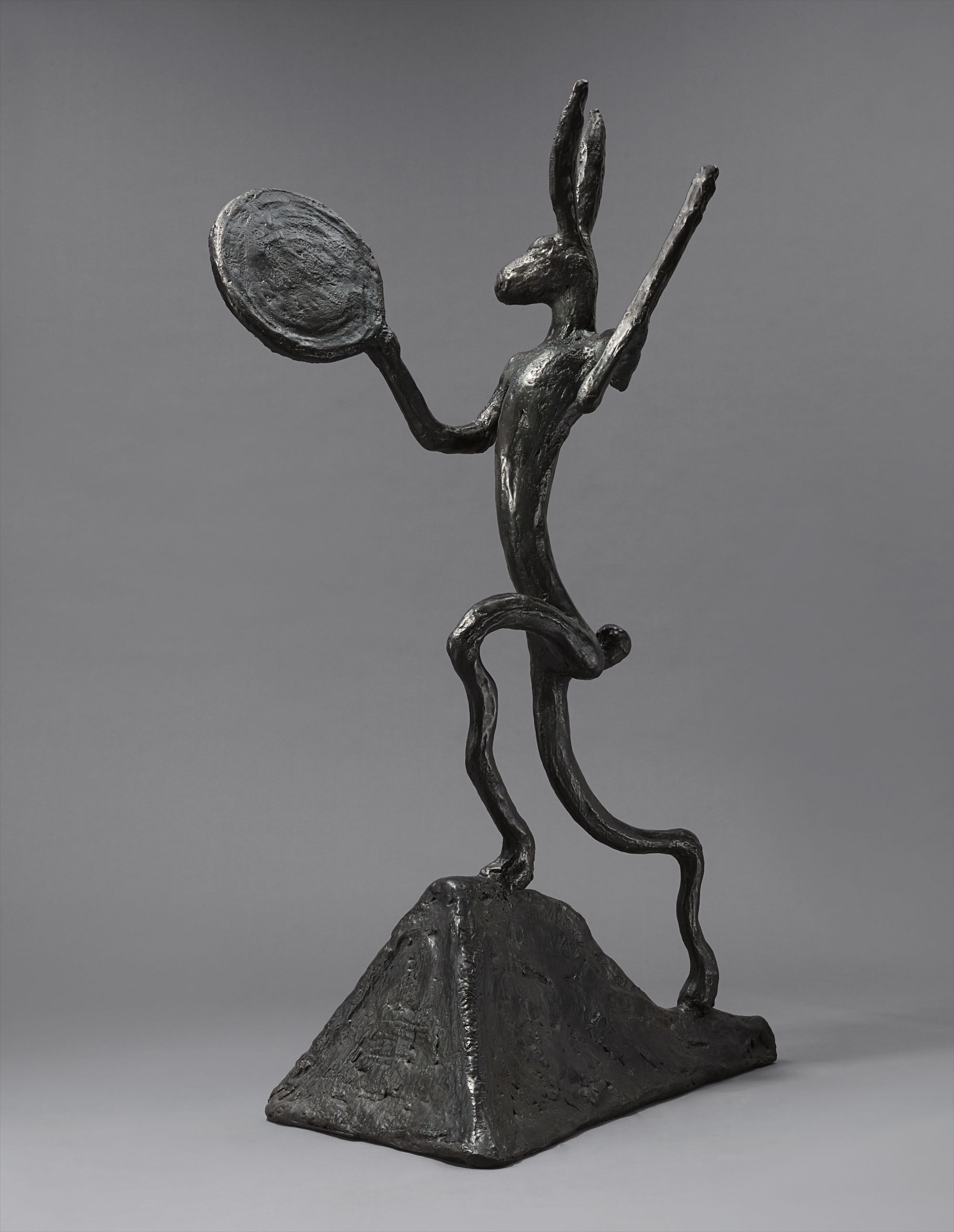
Left Handed Drummer
For collectors, Flanagan's bronzes occupy a particularly appealing position in the market. They were typically produced in small, carefully documented editions, and the provenance trails are generally clear and well maintained by his estate. The works reward close attention to patination: Flanagan worked with his foundries to achieve surfaces that ranged from warm golden browns to deep blacks and greens, and the quality of a patina is often a reliable indicator of a prime casting. Left Handed Drummer, with its dark brown and black patina, is a fine example of this craft dimension in his practice.
Collectors drawn to the intersection of sculptural rigour and humanistic warmth, those who also admire artists such as Elisabeth Frink with her own deeply felt animal bronzes, or the witty formal intelligence of William Turnbull, tend to find in Flanagan a natural and deeply satisfying complement. Flanagan was elected a Royal Academician and exhibited at venues including the Venice Biennale, where he represented Britain in 1982, a moment that consolidated his international standing and introduced his hares to a global audience that responded with immediate affection. His work entered major collections in Europe, North America, and Japan, and he spent significant periods living and working in Ibiza, where the Mediterranean light and the island's ancient character fed his ongoing interest in myth and natural energy. He died in Dublin in 2009, leaving behind a body of work that had managed the rare feat of being simultaneously beloved and critically serious.
What Barry Flanagan ultimately gave us is a vision of sculpture as a site of joy without superficiality. His hares are not decorative objects; they are philosophical propositions about aliveness, about the relationship between the human and the animal, about the capacity of bronze, the most ancient of sculptural materials, to hold a moment of pure levity forever. To own a Flanagan is to live with that proposition daily, to have a conversation partner in your home or garden that is always, somehow, mid leap. That is an extraordinary gift from any artist, and it is why his work continues to matter with such undiminished warmth and force.
Explore books about Barry Flanagan RA
Barry Flanagan
Michael Shepherd
Barry Flanagan: Sculpture 1965-1982
Various authors

Barry Flanagan: New Sculptures
Various authors
Barry Flanagan RA: A Sculpture Retrospective
Lisa Jardine
Barry Flanagan: The Divine Comedy
Various authors