Barkley L. Hendricks

Barkley Hendricks: The Portrait Master Who Saw Everything
Artist Spotlight · The Collection Editorial
“These paintings have to do with people. I want you to deal with their humanity.”
Barkley L. Hendricks, "Birth of the Cool" catalogue, 2008
There are moments in art history when, in retrospect, it becomes clear that one artist was working at a frequency the rest of the world had not yet tuned into. For Barkley L. Hendricks, that moment arrived fully formed in 2008, when the first major retrospective of his work, titled "Birth of the Cool," opened at the Nasher Museum of Art at Duke University before traveling to institutions across the country including the Santa Monica Museum of Art and the Studio Museum in Harlem. Audiences and critics encountered something extraordinary: decades of monumental, life sized portraits of Black men and women rendered with an elegance and psychological authority that felt simultaneously historical and urgently contemporary.
Barkley L. Hendricks
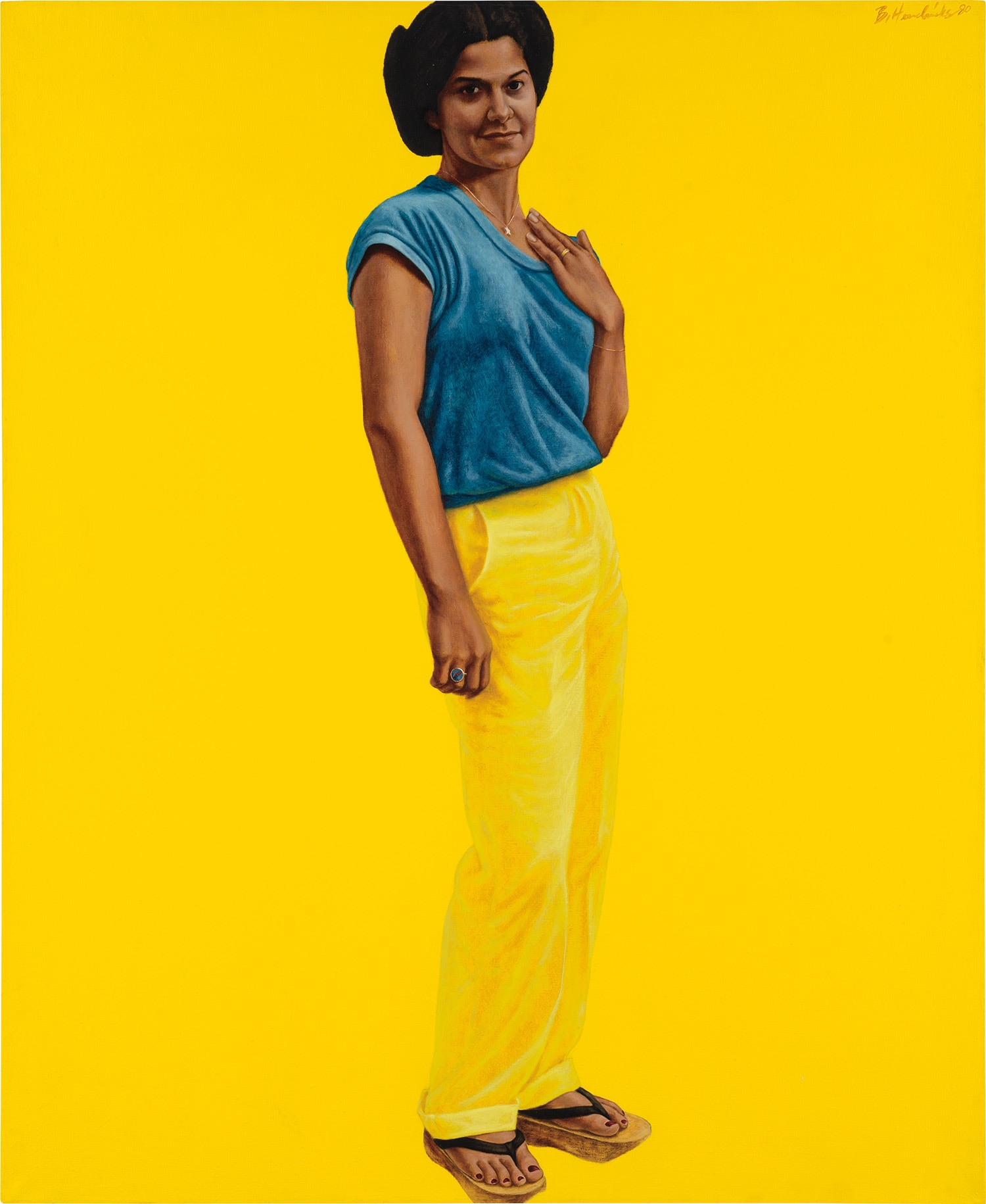
Selina/Star, 1980
The art world, catching up at last, exhaled in recognition. Barkley Lewis Hendricks was born in Philadelphia in 1945 and grew up in North Philadelphia at a time when the city was a crucible of jazz, civil rights energy, and street style so refined it could stop traffic. He showed prodigious talent early, enrolling at the Pennsylvania Academy of the Fine Arts while still a teenager, where he would go on to earn his certificate in 1967. He then pursued his Master of Fine Arts at Yale University, graduating in 1972, entering one of the most intellectually rigorous programs in American art education at a moment when the boundaries of painting were being furiously debated.
Hendricks absorbed all of it without losing sight of what he wanted to say and who he wanted to paint. The formation Hendricks received at the Pennsylvania Academy gave him something invaluable: a deep and unsentimental knowledge of the Old Masters. He studied the compositional strategies of Velázquez, the luminous flesh tones of Titian, the formal gravity of Hans Holbein. He looked hard at the portrait tradition of European painting and understood its mechanisms completely, which meant he could do something radical with them.
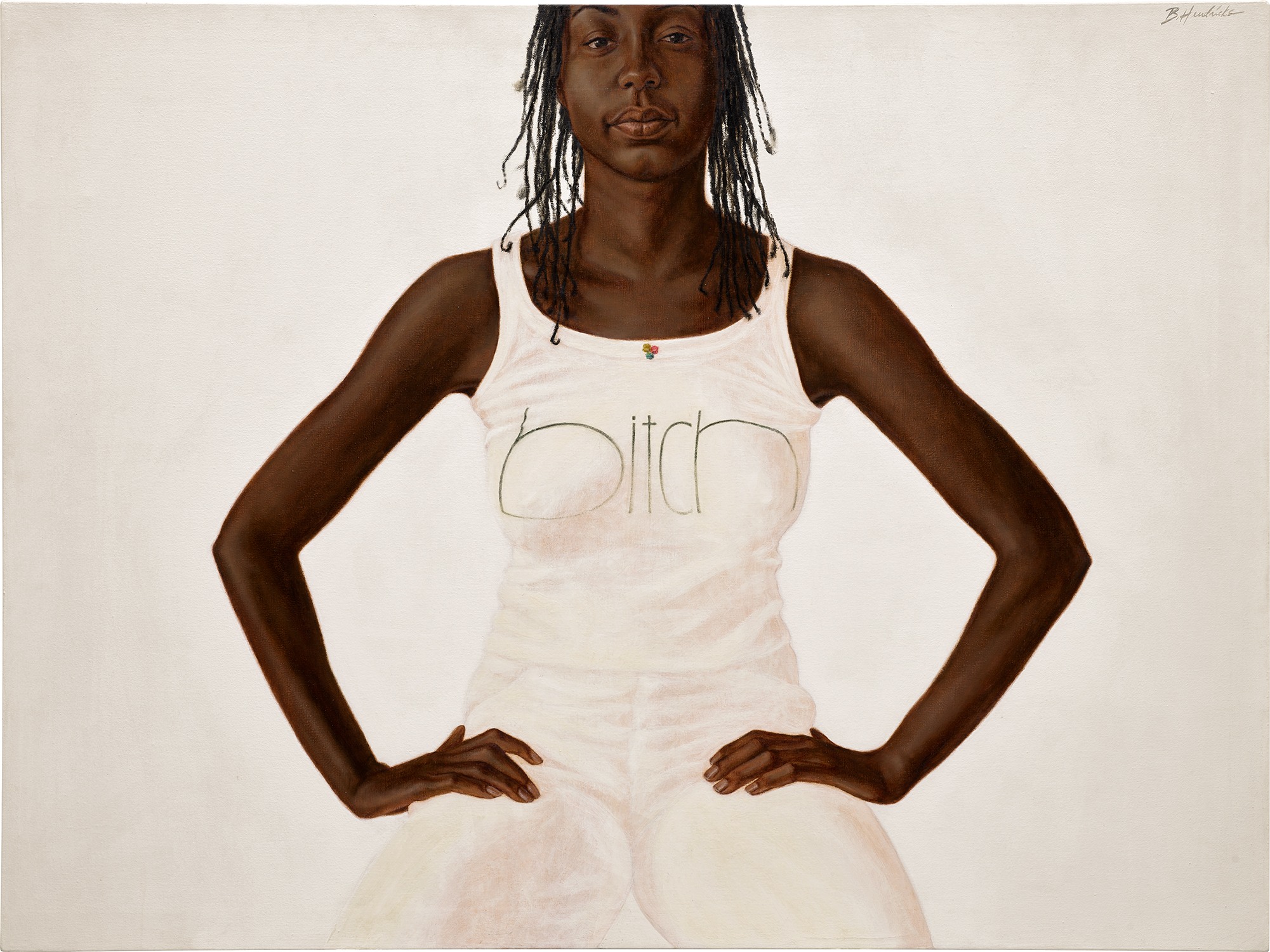
Barkley L. Hendricks
Vendetta, 1977
At the same time, he was an avid and sophisticated photographer, and the influence of the photographic frame, of the freeze and the pose, runs through his canvases as a second visual language. The combination produced a style that was unlike anything else being made in America at the time. Hendricks spent most of his teaching career at Connecticut College in New London, where he joined the faculty in 1972 and remained for decades. The subjects he painted were friends, acquaintances, strangers encountered on the street, people from his neighborhoods in Philadelphia and New London, individuals whose style and bearing commanded his attention.
“I paint people who I feel have a certain presence, a certain style, a certain je ne sais quoi.”
Barkley L. Hendricks, interview
He asked them to stand before him and he gave them the full treatment: large canvases, often at life scale, rendered with a technical precision that honored the tradition while the backgrounds, often flat fields of white, gold, or other pure color, stripped away any narrative context and insisted the viewer look at nothing except the person standing there. The message was quiet and absolute. These people matter. Look at them.

Barkley L. Hendricks
Untitled, 1978
Among the works available on The Collection, "Vendetta" from 1977, executed in oil, acrylic, and Magna on canvas, exemplifies his mature approach during one of his most productive periods. The title carries a knowing edge, a word that implies stories untold, while the figure commands the picture plane with complete self possession. "Selina/Star" from 1980, in oil and acrylic on linen, demonstrates his gift for capturing the specific poetry of an individual's presence, the way a particular person stands or holds themselves as a form of autobiography. His waterworks, including the untitled 1978 piece on paper, reveal a more intimate register of his practice, looser and exploratory, offering collectors a window into his thinking outside the large scale oils.
For collectors, the significance of Hendricks is difficult to overstate, and the market has responded accordingly over the past decade and a half. His major paintings are held in important institutional collections including the National Portrait Gallery in Washington, D.C., the Nasher Museum, and the Studio Museum in Harlem.
Works that reach the secondary market attract serious competition among both private collectors and institutional buyers who recognize that his paintings occupy a genuinely irreplaceable position in the narrative of American art. His prices rose substantially following the "Birth of the Cool" retrospective and have continued to strengthen as cultural conversations about representation, identity, and the history of portraiture have placed him at the very center of the discussion. Collectors who came to him early understood something essential: that beauty and political force are not in opposition, and that Hendricks proved it on canvas after canvas. To understand Hendricks fully, it helps to place him in a constellation of artists working in the second half of the twentieth century who were reassessing what figurative painting could carry and for whom.
Alice Neel, his older contemporary, shared his commitment to painting the people around her with unsparing attention and warmth. Kerry James Marshall, who came after Hendricks and has acknowledged the weight of his example, continues the project of centering Black figures in the most exalted conventions of Western painting. Jordan Casteel, among the generation that has emerged in the twenty first century, carries a related spirit of direct and loving witness. Hendricks stands upstream from all of them, having arrived at his convictions when doing so required more courage and more clarity.
Barkley Hendricks passed away in April 2017, but the ongoing relevance of his work feels less like legacy and more like presence. The Pennsylvania Academy of the Fine Arts, his first great school, organized retrospective attention to his contributions. The Studio Museum in Harlem, a vital institution for the recognition of artists of African descent, has championed his reputation consistently. What he created across four decades of painting is a visual argument for the inherent dignity, style, and complexity of Black life in America, made with tools borrowed from the grandest tradition in Western art and wielded with a confidence that never faltered.
To own a work by Hendricks is to own a piece of that argument, rendered in paint, at full human scale, looking back at you without apology.
Explore books about Barkley L. Hendricks