Angelo Mangiarotti
Angelo Mangiarotti, Where Structure Becomes Poetry
Artist Spotlight · The Collection Editorial
There is a particular kind of genius that refuses to separate beauty from logic, that insists the way a thing is held together is as important as what it looks like. Angelo Mangiarotti belonged to that rare category. Born in Milan in 1921, he spent nine decades proving that the joint, the load, the grain of stone and the behavior of metal were not merely engineering concerns but the very vocabulary of art. Today, as collectors and institutions across Europe and the United States revisit the great Italian modernists with fresh urgency, Mangiarotti's work stands out with quiet, commanding authority.
Angelo Mangiarotti
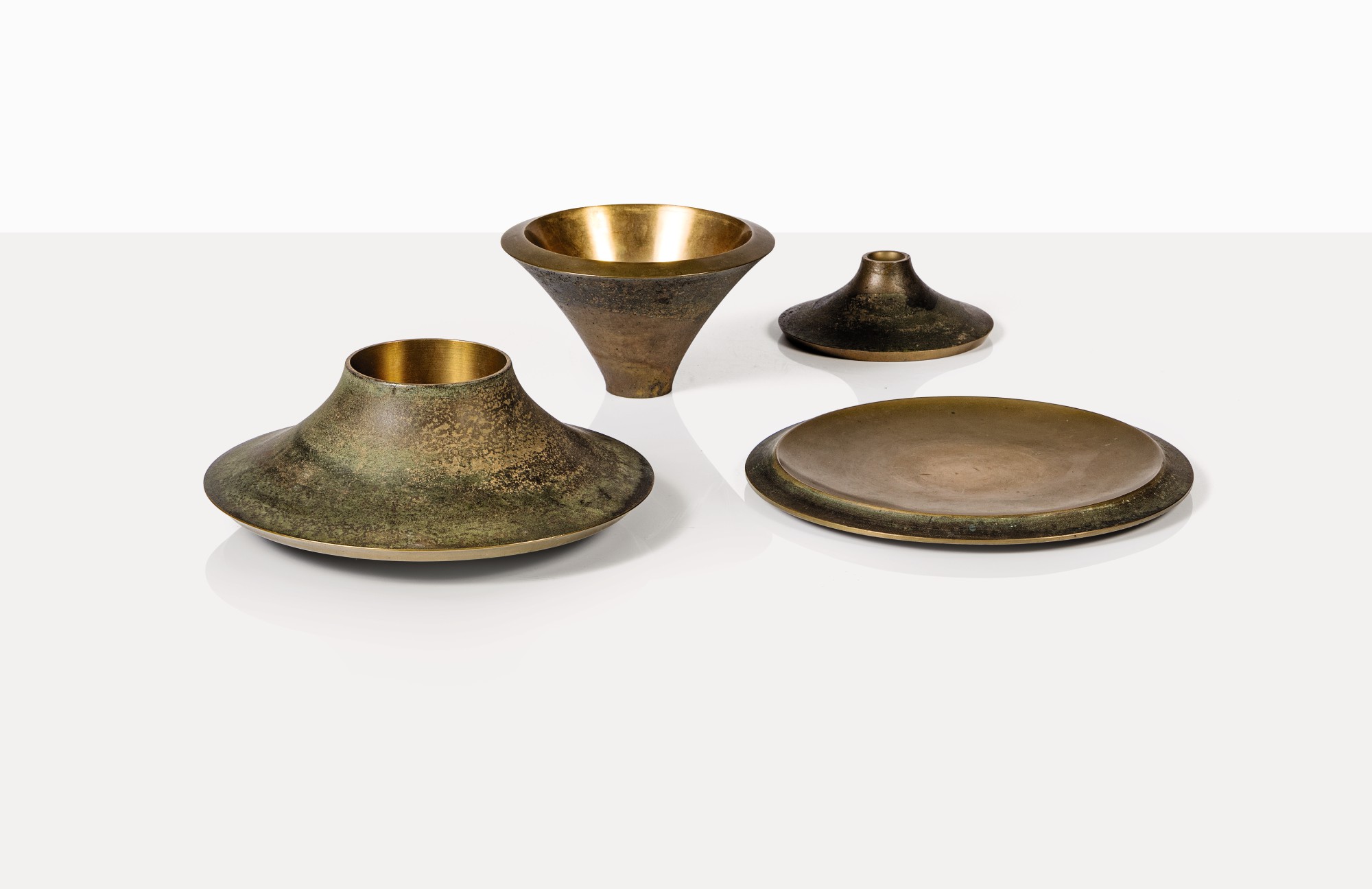
Trois vases et une coupe
His furniture, vessels, and architectural projects feel not like relics of the twentieth century but like proposals for how things ought always to have been made. Mangiarotti came of age in a Milan that was electric with postwar ambition. He studied at the Politecnico di Milano, graduating in 1948 into a city rebuilding itself and hungry for a new visual language. His education was rigorous and technically demanding, and it gave him a deep respect for the properties of materials that would define his entire career.
In 1953 and 1954 he traveled to the United States, where he worked in the offices of Frank Lloyd Wright in Taliesin and came into contact with Walter Gropius and Konrad Wachsmann at the Illinois Institute of Technology. These encounters with American functionalism and the Bauhaus tradition did not dilute his Italian sensibility so much as sharpen it, giving him a framework through which to channel his instinct for elemental, gravity driven form. Returning to Italy, Mangiarotti established his own practice in Milan and quickly became associated with the most searching conversations in Italian design. He collaborated with Bruno Morassutti in the late 1950s, producing buildings and structures that demonstrated his signature preoccupation with prefabrication, exposed joinery, and the honest expression of how weight is transferred through a form.
Angelo Mangiarotti
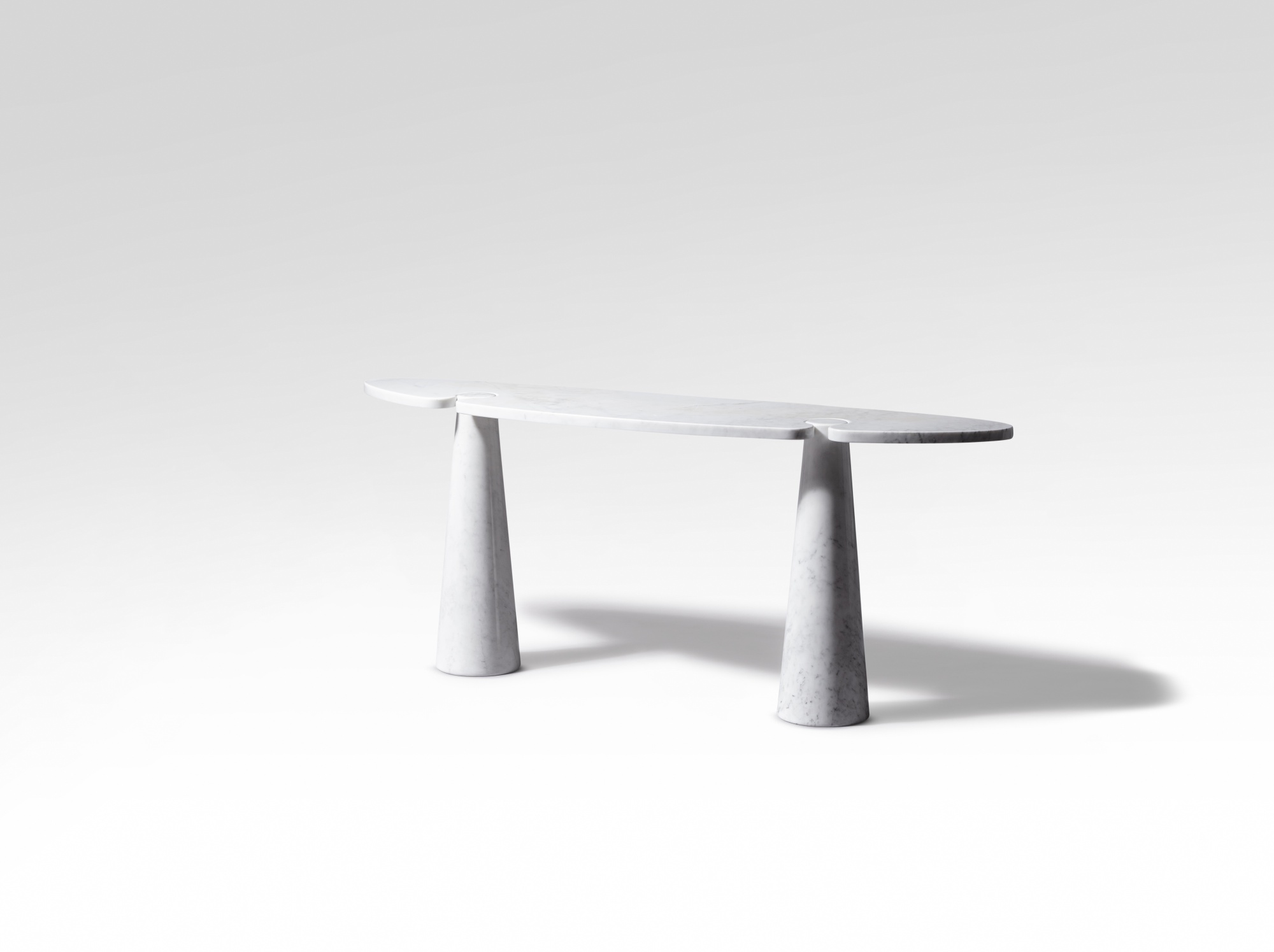
Console Eros
His industrial buildings and railway station projects from this period are studies in structural poetry: forms that do exactly what they must do and nothing more, yet arrive at an elegance that purely aesthetic solutions rarely achieve. He was never interested in decoration for its own sake. Every curve, every taper, every chamfered edge had a reason rooted in physics and material behavior. It is in his object making, however, that Mangiarotti perhaps achieved his most intimate and lasting expressions.
His work in marble, particularly Carrara marble, is where structure and sensuality meet most vividly. The Console Eros, executed in Carrara marble, is one of the most celebrated examples of his approach: a piece in which the table top appears to rest on its base through a logic of balance and compression rather than conventional joinery, as if gravity itself has been persuaded to cooperate. There are no bolts, no adhesives doing visible work. The forms lean into one another, locked by their own weight, a solution as ancient as the stone arch and as modern as anything in twentieth century design.
It is this quality, the sense that the object has found the only possible way it could exist, that gives Mangiarotti's work its peculiar emotional power. The Trois vases et une coupe, cast in bronze, demonstrates a similarly meditative approach: organic volumes that feel discovered rather than designed, each form a study in how material wants to settle and hold. For collectors, Mangiarotti's work occupies a fascinating position at the intersection of design history and fine art. His pieces have been held by major museum collections including the Museum of Modern Art in New York and important Italian public institutions, and they appear regularly at auction at houses including Christie's and Phillips, where his marble works in particular have attracted serious international attention.
What draws sophisticated collectors is precisely the quality that can be hardest to articulate: these objects do not simply sit in a room. They reorganize it. They make the space around them feel more considered. A Mangiarotti marble table or vessel brings with it a kind of philosophical seriousness, a reminder that the designed object, at its highest level, is an argument about how the world should be.
Collectors who come to his work often find themselves unable to stop at one piece, drawn deeper into the logic of a practice that rewards sustained attention. Understanding Mangiarotti's place in art history requires situating him within a remarkable generation of Italian designers and architects who together made Italy the center of global design culture in the postwar decades. His peers and contemporaries included Gio Ponti, whose decorative brilliance offered a counterpoint to Mangiarotti's structural austerity, and Marco Zanuso, who shared his interest in industrial process and new materials. Further afield, his structural preoccupations resonate with the work of Jean Prouvé in France, who similarly made the logic of construction the subject of his art.
Among sculptors, there are affinities with the work of Constantin Brancusi in the reduction of form to essential volumes, and with Isamu Noguchi in the sensitive handling of stone as a living material. Mangiarotti is the figure who holds these worlds together: architect, designer, and sculptor at once, refusing the boundaries between disciplines with the same confidence with which he refused unnecessary ornament. In 1994, the Associazione per il Disegno Industriale honored Mangiarotti with the Compasso d'Oro for lifetime achievement, Italy's most prestigious design award and one of the most respected in the world. It was a recognition not just of specific objects but of an entire way of thinking about making.
He continued working until late in his life, and when he died in 2012 at the age of ninety, the tributes that came from architects, designers, and collectors around the world reflected the breadth of his influence. The legacy he left is not simply a body of beautiful objects, though it is certainly that. It is a method: a way of asking, before anything else, how does this thing want to stand up. In answering that question with extraordinary patience and imagination across six decades, Angelo Mangiarotti made work that is not simply of its time but permanently, generously alive.
Explore books about Angelo Mangiarotti